
Protein Engineering Methods and Applications 04 19 22052021

- Slides: 15
Protein Engineering: Methods and Applications ﻅ. ﻕ 04: 19 22/05/2021 1
1. Introduction. Protein engineering is the design of new enzymes or proteins with new or desirable functions. It is based on the use of recombinant DNA technology to change amino acid sequences. ﻅ. ﻕ 04: 19 22/05/2021 2
2. Protein engineering methods 2. 1. The most classical method in protein engineering is the so-called “rational design” approach which involves “site-directed mutagenesis” of proteins. 2. 2. Evolutionary methods that mutagenesis and selection involve random 2. 3. Localized or region-specific random mutagenesis is another technique which is a combination of rational and random approaches of protein engineering. ﻅ. ﻕ 04: 19 22/05/2021 3
2. 4. Peptidomimetics. It involves mimicking or blocking the activity of enzymes or natural peptides upon design and synthesis of peptide analogs that are metabolically stable. Peptidomimetics is an important approach for bioorganic and medical chemistry. It includes a variety of synthesis methods such as the use of a common intermediate, solid phase synthesis and combinatorial approaches. ﻅ. ﻕ 04: 19 22/05/2021 4
2. 5. (mostly new) Artificial DNA Synthesis. ﻅ. ﻕ 04: 19 22/05/2021 5
6 04: 19 22/05/2021 ﻕ. ﻅ
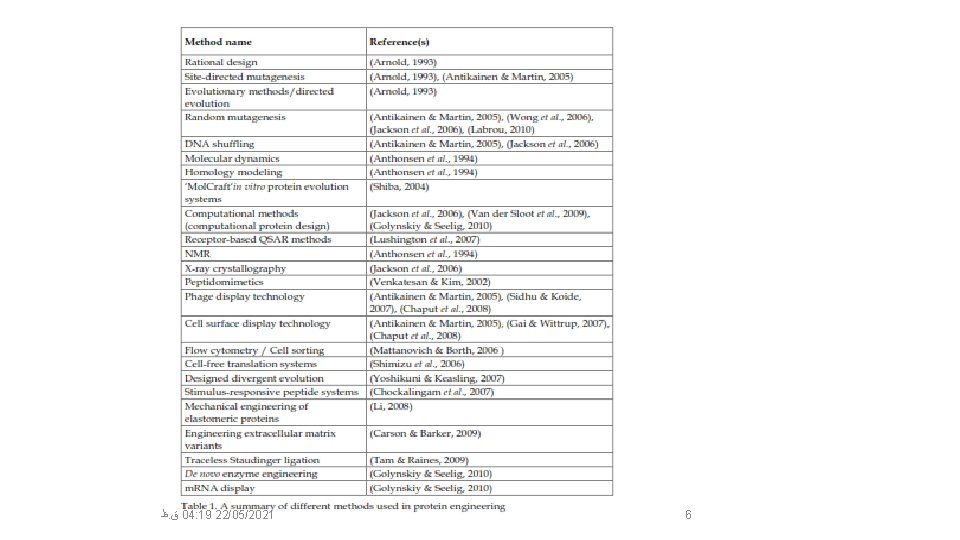
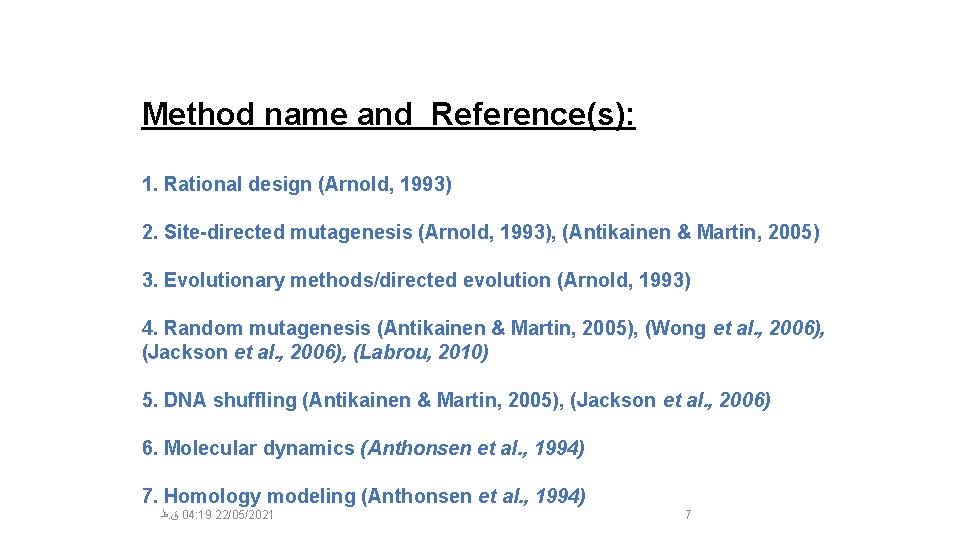
Method name and Reference(s): 1. Rational design (Arnold, 1993) 2. Site-directed mutagenesis (Arnold, 1993), (Antikainen & Martin, 2005) 3. Evolutionary methods/directed evolution (Arnold, 1993) 4. Random mutagenesis (Antikainen & Martin, 2005), (Wong et al. , 2006), (Jackson et al. , 2006), (Labrou, 2010) 5. DNA shuffling (Antikainen & Martin, 2005), (Jackson et al. , 2006) 6. Molecular dynamics (Anthonsen et al. , 1994) 7. Homology modeling (Anthonsen et al. , 1994) ﻅ. ﻕ 04: 19 22/05/2021 7
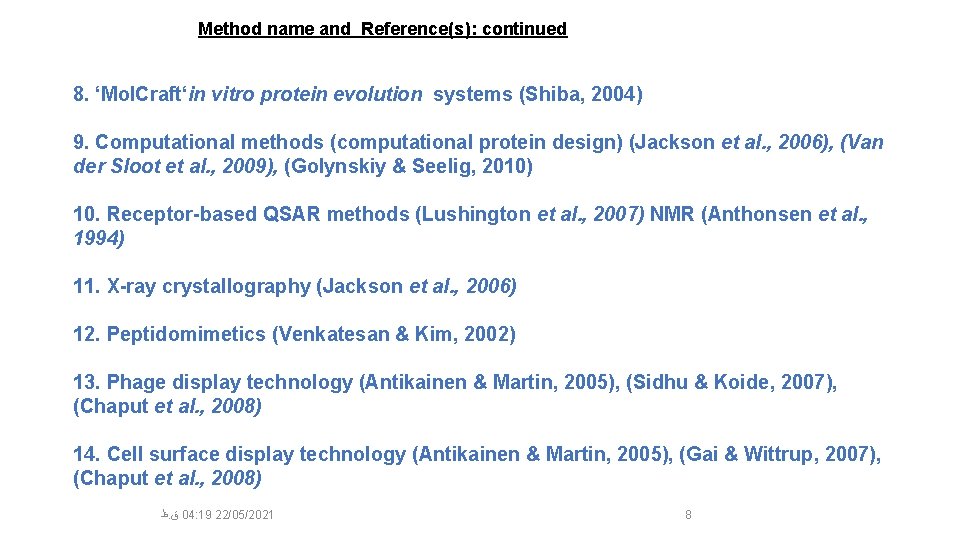
Method name and Reference(s): continued 8. ‘Mol. Craft‘in vitro protein evolution systems (Shiba, 2004) 9. Computational methods (computational protein design) (Jackson et al. , 2006), (Van der Sloot et al. , 2009), (Golynskiy & Seelig, 2010) 10. Receptor-based QSAR methods (Lushington et al. , 2007) NMR (Anthonsen et al. , 1994) 11. X-ray crystallography (Jackson et al. , 2006) 12. Peptidomimetics (Venkatesan & Kim, 2002) 13. Phage display technology (Antikainen & Martin, 2005), (Sidhu & Koide, 2007), (Chaput et al. , 2008) 14. Cell surface display technology (Antikainen & Martin, 2005), (Gai & Wittrup, 2007), (Chaput et al. , 2008) ﻅ. ﻕ 04: 19 22/05/2021 8
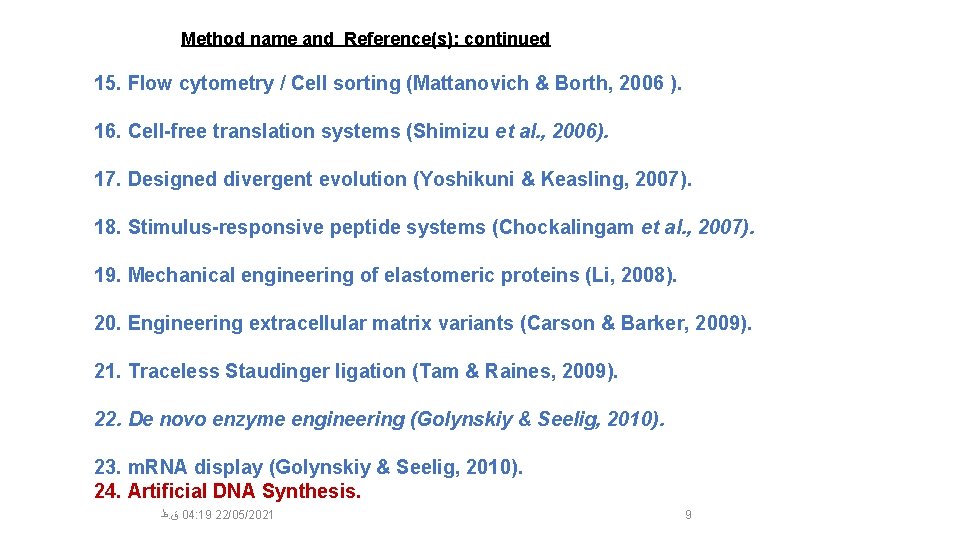
Method name and Reference(s): continued 15. Flow cytometry / Cell sorting (Mattanovich & Borth, 2006 ). 16. Cell-free translation systems (Shimizu et al. , 2006). 17. Designed divergent evolution (Yoshikuni & Keasling, 2007). 18. Stimulus-responsive peptide systems (Chockalingam et al. , 2007). 19. Mechanical engineering of elastomeric proteins (Li, 2008). 20. Engineering extracellular matrix variants (Carson & Barker, 2009). 21. Traceless Staudinger ligation (Tam & Raines, 2009). 22. De novo enzyme engineering (Golynskiy & Seelig, 2010). 23. m. RNA display (Golynskiy & Seelig, 2010). 24. Artificial DNA Synthesis. ﻅ. ﻕ 04: 19 22/05/2021 9
3. Protein engineering applications ﻅ. ﻕ 04: 19 22/05/2021 10
11 04: 19 22/05/2021 ﻕ. ﻅ
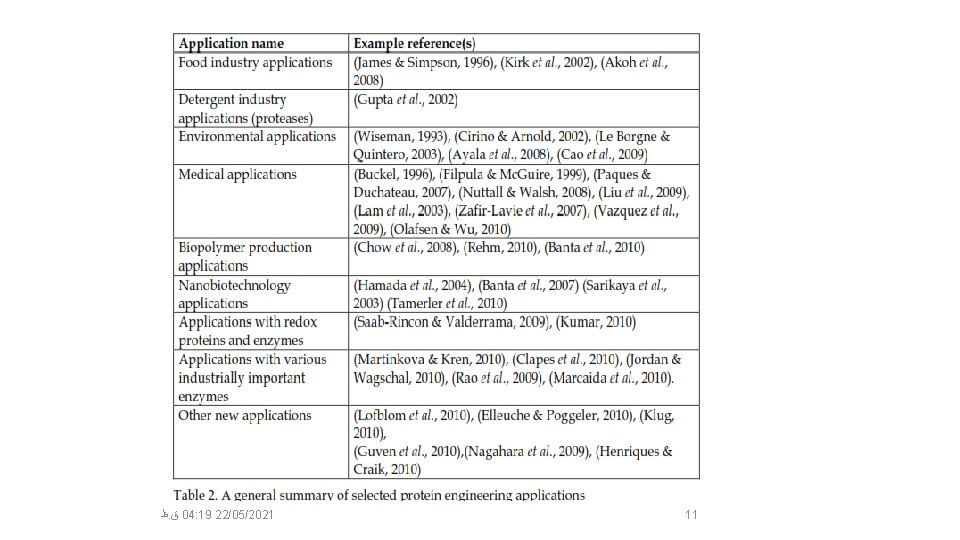
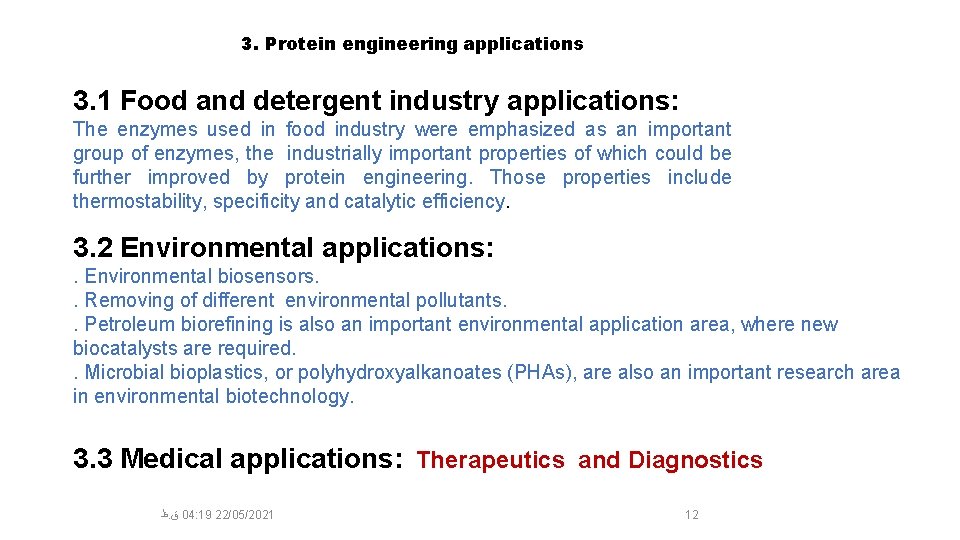
3. Protein engineering applications 3. 1 Food and detergent industry applications: The enzymes used in food industry were emphasized as an important group of enzymes, the industrially important properties of which could be further improved by protein engineering. Those properties include thermostability, specificity and catalytic efficiency. 3. 2 Environmental applications: . Environmental biosensors. . Removing of different environmental pollutants. . Petroleum biorefining is also an important environmental application area, where new biocatalysts are required. . Microbial bioplastics, or polyhydroxyalkanoates (PHAs), are also an important research area in environmental biotechnology. 3. 3 Medical applications: Therapeutics and Diagnostics ﻅ. ﻕ 04: 19 22/05/2021 12
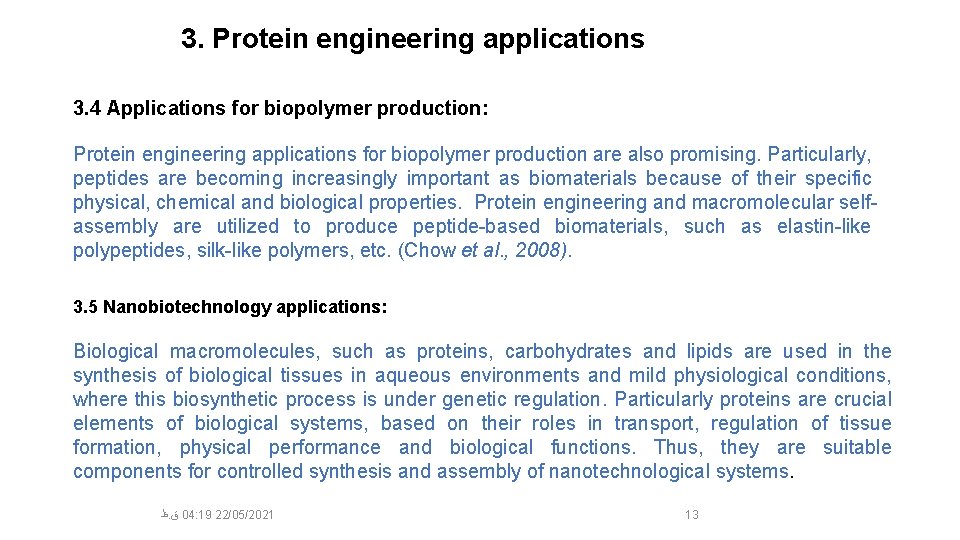
3. Protein engineering applications 3. 4 Applications for biopolymer production: Protein engineering applications for biopolymer production are also promising. Particularly, peptides are becoming increasingly important as biomaterials because of their specific physical, chemical and biological properties. Protein engineering and macromolecular selfassembly are utilized to produce peptide-based biomaterials, such as elastin-like polypeptides, silk-like polymers, etc. (Chow et al. , 2008). 3. 5 Nanobiotechnology applications: Biological macromolecules, such as proteins, carbohydrates and lipids are used in the synthesis of biological tissues in aqueous environments and mild physiological conditions, where this biosynthetic process is under genetic regulation. Particularly proteins are crucial elements of biological systems, based on their roles in transport, regulation of tissue formation, physical performance and biological functions. Thus, they are suitable components for controlled synthesis and assembly of nanotechnological systems. ﻅ. ﻕ 04: 19 22/05/2021 13
3. Protein engineering applications 3. 6 Applications with redox proteins and enzymes: Improvement of redox proteins and enzymes by protein engineering is also an important application field. Such proteins and enzymes can be modified to be used in nanodevices for biosensing, as well as for nanobiotechnology applications (Gilardi & Fantuzzi, 2001). The electrochemistry of redox proteins particularly draws attention for applications in biofuel cells, chemical synthesis and biosensors. 3. 7 Applications with various industrially important enzymes: These include nitrilases (Martinkova & Kren, 2010), aldolases (Clapes et al. , 2010), microbial beta-D-xylosidases (Jordan & Wagschal, 2010) etc ﻅ. ﻕ 04: 19 22/05/2021 14
3. Protein engineering applications 3. 8 Other new applications Recently, novel types of proteins have been developed, using combinatorial protein engineering techniques. These binding proteins of non-Ig origin are called “affibody binding proteins”. With their high affinity, these proteins have been used in many different applications such as diagnostics, bioseparation, functional inhibition, viral targeting, and in vivo tumor imaging or therapy (Nygren, 2008). More recently, comprehensive reviews on engineered affinity proteins (Gronwall & Stahl, 2009), and affibody molecules (Lofblom et al. , 2010) were published, where their therapeutic, diagnostic and biotechnological applications were discussed in detail. ﻅ. ﻕ 04: 19 22/05/2021 15