
Protein databases Henrik Nielsen Background Nucleotide databases Gen
Protein databases Henrik Nielsen
Background- Nucleotide databases Gen. Bank, http: //www. ncbi. nlm. nih. gov/Genbank/ National Center for Biotechnology Information (NCBI), National Library of Medicine (NLM), National Institutes of Health (NIH), USA. EMBL, http: //www. ebi. ac. uk/embl/ European Bioinformatics Institute (EBI), England (Established in 1980 by the European Molecular Biology Laboratory, Heidelberg, Tyskland) DDBJ, http: //www. ddbj. nig. ac. jp/ National Institue of Genetics, Japan Together they form International Nucleotide Sequence Database Collaboration, http: //www. insdc. org/
Protein databases Swiss-Prot, http: //www. expasy. org/sprot/ Established in 1986 in Swizerland Ex. PASy (Expert Protein Analysis System) Swiss Institute of Bioinformatics (SIB) and European Bioinformatics Institute (EBI) PIR, http: //pir. georgetown. edu/ Established in 1984 National Biomedical Research Foundation, Georgetown University, USA In 2002 merged into: Uni. Prot, http: //www. uniprot. org/ A collaboration between SIB, EBI and Georgetown University.

Uni. Prot Knowledgebase (Uni. Prot. KB) Uni. Prot Reference Clusters (Uni. Ref) Uni. Prot Archive (Uni. Parc) Uni. Prot Knowledgebase Release 2011_02 (08 -Feb-11) consists of: Uni. Prot. KB/Swiss-Prot: Annotated manually (curated) 525, 207 entries Uni. Prot. KB/Tr. EMBL: Computer annotated 13, 499, 622 entries
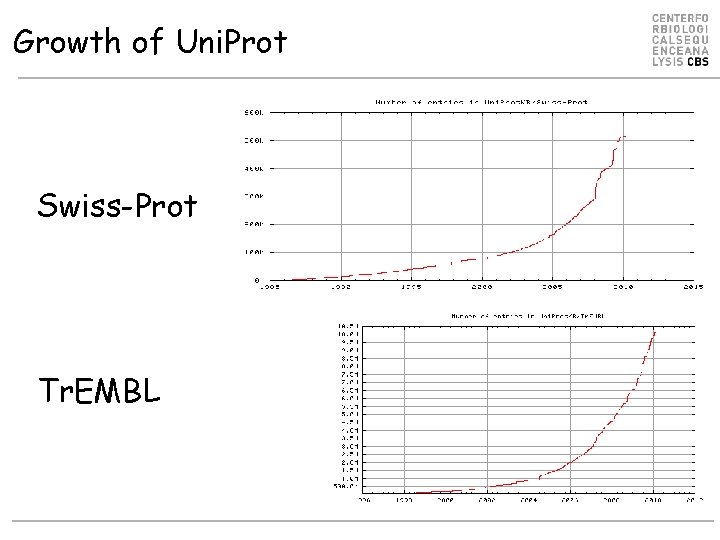
Growth of Uni. Prot Swiss-Prot Tr. EMBL
Content of Uni. Prot Knowledgebase • Amino acid sequences • Functional and structural annotations – – – Function / activity Secondary structure Subcellular location Mutations, phenotypes Post-translational modifications • Origin – organism: Species, subspecies; classification – tissue • References • Cross references
Amino acid sequences From where do you get amino acid sequences? • Translation of nucleotide sequences (Gen. Bank/EMBL/DDBJ) • Amino acids sequencing: Edman degradation • Mass spectrometry • 3 D-structures
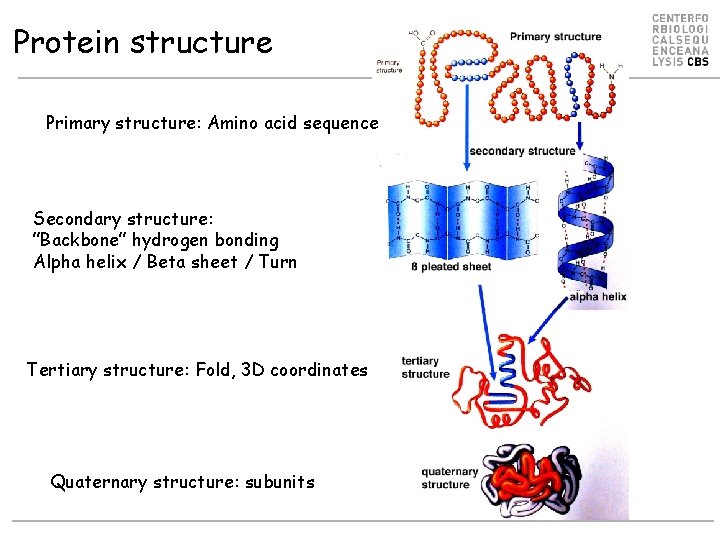
Protein structure Primary structure: Amino acid sequence Secondary structure: ”Backbone” hydrogen bonding Alpha helix / Beta sheet / Turn Tertiary structure: Fold, 3 D coordinates Quaternary structure: subunits

Subcellular location An animal cell:
Post-translational modifications • Cleavage of signal peptide, transit peptide or pro-peptide • Phosphorylation • Glycosylation • Lipid anchors • Disulfide bond • Prosthetic groups (e. g. metal ions)
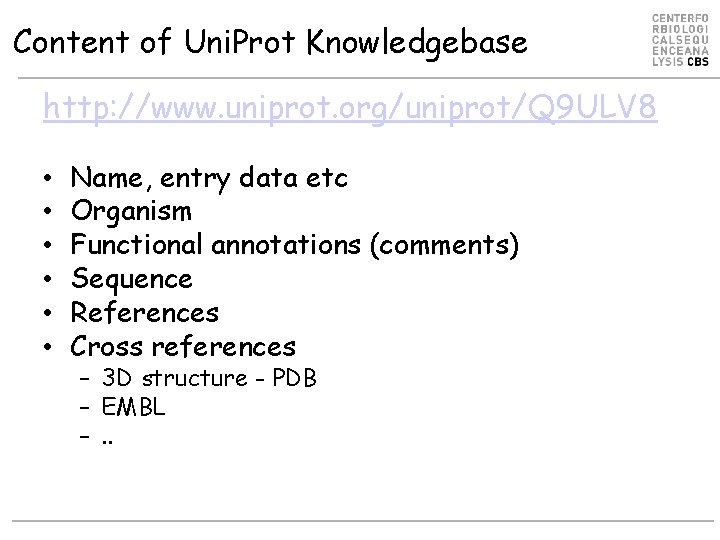
Content of Uni. Prot Knowledgebase http: //www. uniprot. org/uniprot/Q 9 ULV 8 • • • Name, entry data etc Organism Functional annotations (comments) Sequence References Cross references – 3 D structure - PDB – EMBL –. .
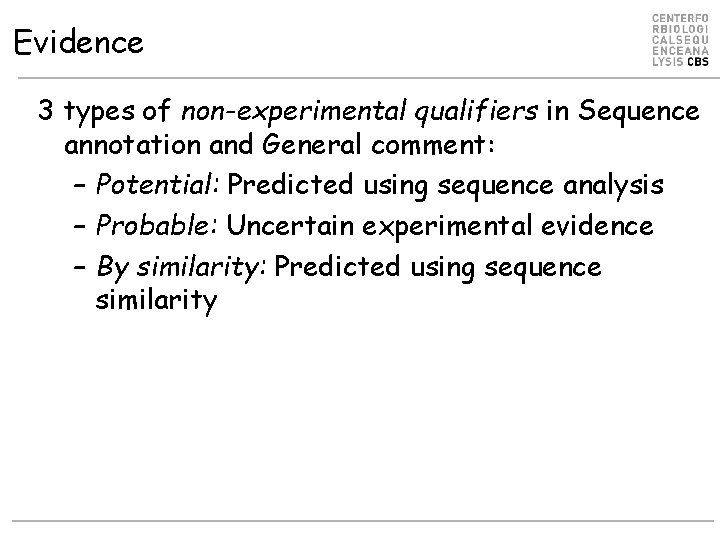
Evidence 3 types of non-experimental qualifiers in Sequence annotation and General comment: – Potential: Predicted using sequence analysis – Probable: Uncertain experimental evidence – By similarity: Predicted using sequence similarity
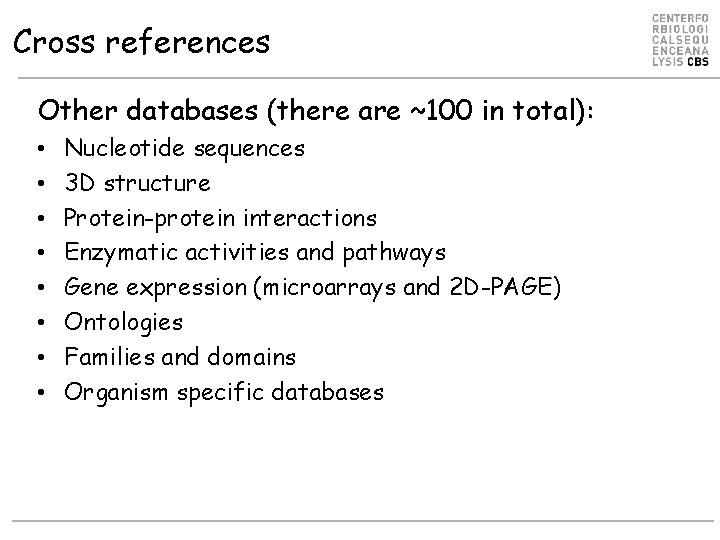
Cross references Other databases (there are ~100 in total): • • Nucleotide sequences 3 D structure Protein-protein interactions Enzymatic activities and pathways Gene expression (microarrays and 2 D-PAGE) Ontologies Families and domains Organism specific databases
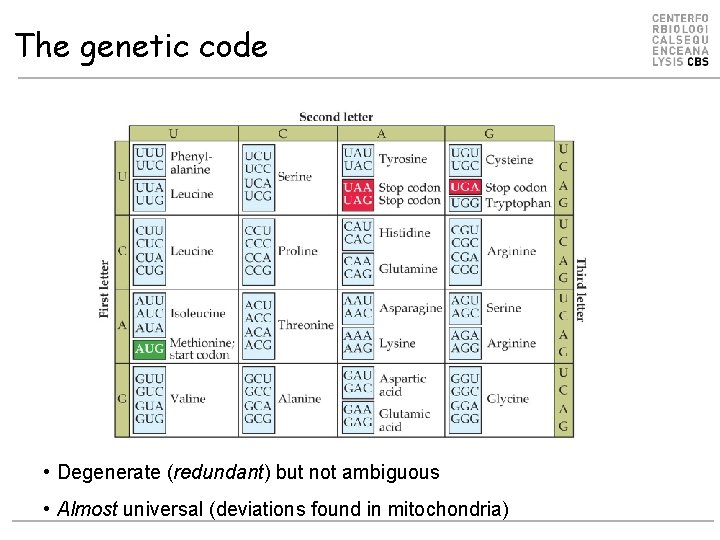
The genetic code • Degenerate (redundant) but not ambiguous • Almost universal (deviations found in mitochondria)
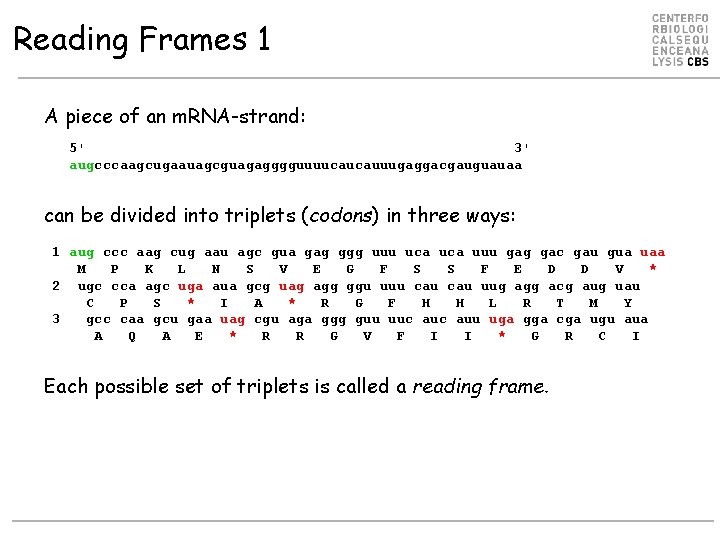
Reading Frames 1 A piece of an m. RNA-strand: 5' 3' augcccaagcugaauagcguagagggguuuucaucauuugaggacgauguauaa can be divided into triplets (codons) in three ways: 1 aug ccc aag cug aau agc gua gag ggg uuu uca uuu gag gac gau gua uaa M P K L N S V E G F S S F E D D V * 2 ugc cca agc uga aua gcg uag agg ggu uuu cau uug agg acg aug uau C P S * I A * R G F H H L R T M Y 3 gcc caa gcu gaa uag cgu aga ggg guu uuc auu uga gga cga ugu aua A Q A E * R R G V F I I * G R C I Each possible set of triplets is called a reading frame.
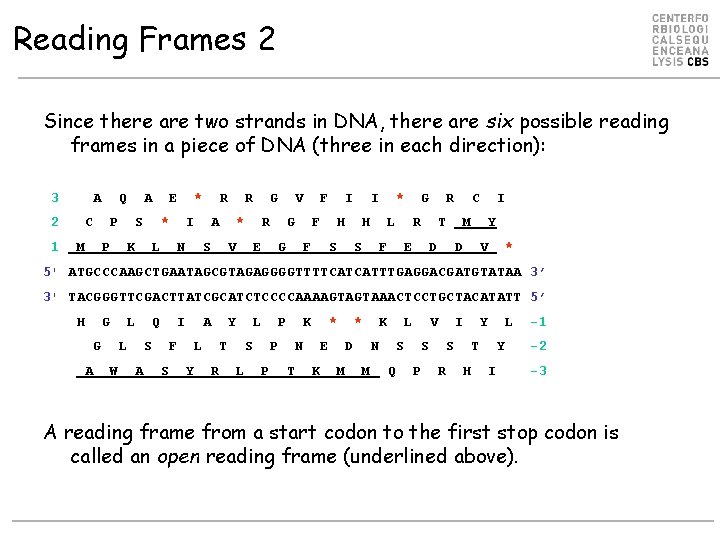
Reading Frames 2 Since there are two strands in DNA, there are six possible reading frames in a piece of DNA (three in each direction): 3 A 2 1 Q C A P M E P S * K * L I R N A R S * G V R V E G F I G F F I H S * H S L F G R E R T D C M D I Y V * 5' ATGCCCAAGCTGAATAGCGTAGAGGGGTTTTCATCATTTGAGGACGATGTATAA 3’ 3' TACGGGTTCGACTTATCGCATCTCCCCAAAAGTAGTAAACTCCTGCTACATATT 5’ H G G A L L W Q S A I F S A L Y Y T R L S L P P P K N T * E K * D M K N M L S Q V S P I S R Y T H L Y I -1 -2 -3 A reading frame from a start codon to the first stop codon is called an open reading frame (underlined above).
- Slides: 16