
Protein and Amino Acid Metabolism Protein metabolism during
Protein and Amino Acid Metabolism
Protein metabolism during exercise typically ignored, why should we care? l Estimated amimo acids contribute 5 -15% of energy during prolonged exercise l Because energy demands are so high during exercise, a small percentage is still substantial l Amino acids essential to integrity of skeletal muscle, their use for energy is of concern
Skeletal Muscle l~ 40 % of body weight l Second largest source of stored energy (fat is first) – Glycogen – Amino acids
l Skeletal muscle is composed of three sources of amino acids – Free amino acid pool – Contractile protein – Non-contractile protein
Free Amino Acid Pool l Free amino acids can come from plasma or muscle l Muscle due to it’s mass contains ~75% of the total body free AA l Still, free AA thought to contribute only ~1% of metabolically active AA
Non-contractile Protein l Tyrosine and phenylalanine used as indicators of non-contractile protein degradation l Magnitude of appearance proportional to intensity and duration l Animal studies have demonstrated up to 25% degradation during prolonged exercise
Contractile Protein l 3 -methyl histidine (3 -MH) most common indicator of metabolism l 3 -MH excretion reduced during exercise and elevated afterward l Indicates contractile protein spared during exercise, but not after
l This biphasic response depends on type of exercise and intensity or duration l Following light intensity endurance exercise 3 -MH is not elevated during recovery – Elevated following hi-intensity or prolonged light intensity though l In animals, 3 -MH elevated after eccentric exercise
A brief note l The liver can contribute significant amounts of amino acids to the total body pool l Some of the 3 -MH degradation is believed to come from this source l In studies using biopsies, it appears as though 3 -MH degradation is suppressed during exercise
Amino Acid Metabolism in Muscle l Six amino acids can be metabolized by muscle – Alanine – Aspartate – Glutamate – BCAA
BCAA? ? l Branched Chain Amino Acids l Isoleucine l Leucine l Valine l Important sources of Krebs intermediates under certain conditions
Transamination l First step in BCAA metabolism l Donation of NH 3 to form glutamate + BCOA l BCOA can then form Acetyl-Co. A or Succinyl-Co. A – BCOA can also leave and go to liver
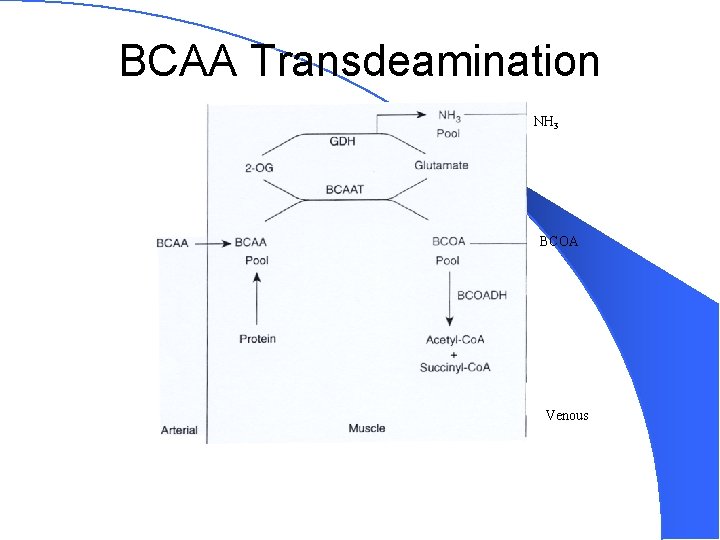
BCAA Transdeamination NH 3 BCOA Venous
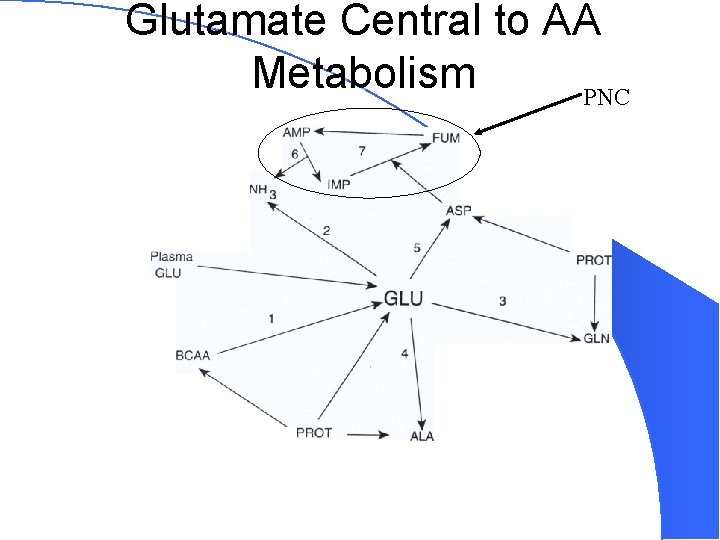
Glutamate Central to AA Metabolism PNC
Amino Acid Oxidation During Exercise l Skeletal muscle can utilize Ala, Asp, Glu and the BCAA l Ala released from muscle consistently for gluconeogenesis l Asp donates NH 3 for reamination of IMP to AMP + fumarate (TCA)
l ~4 % BCOADH active in muscle at rest l Liver BCOADH completely active regardless l At rest – BCAA deaminated >> BCOA in muscle and sent to the liver for oxidation
AA as Energy Source in Skeletal Muscle l Oxidation of BCAA yield between 32 -43 ATP – Comparable to complete oxidation of glucose l AA contribute uup to 18 % energy during prolonged exercise l BCOADH shown to increase activity up to 66 % in rodents Sk muscle
Measuring AA Flux from Muscle l At rest net efflux of AA from leg muscle – Muscle releasing AA l During exercise net uptake – Prolonged exercise results in release from liver (BCAA)
Evidence l Mclean et al. - no net accumulation of AA in blood or muscle – Indicates sk. Mc uptake and oxidation l Rennie et al. – during exercise significant drop in efflux of BCOA – BCAA being oxidized in muscle
More Evidence l Henderson et al. – 13 C leucine – Oxidation to 13 CO 2 – Showed oxidation proportional to metabolic rate – Dependent upon intensity and duration
What’s all this mean? ? l During exercise amino acids will be oxidized l Rate of oxidation depends on intensity and duration of the activity l Long duration, intense activities will result in high rates of AA oxidation – Marathon, bike race, triathlon
Remember AMP Deamination? l AMP >> IMP + NH 3 l Purposes – ATP/ADP ratio – Prevention of adenine nucleotide loss – Production of ammonia to buffer H+ – Regulation of carbohydrate metabolism l PFK and IMP activation of PHOS
Ammonia as a buffer? ? l NH 3 can accept a proton l NH 3 + H+ NH 4+ l Probably not physiologically significant
Purine Nucleotide Cycle l Reaminates l Asp IMP to AMP + GTP Fumarate + NH 3 l NH 3 can be used to reaminate IMP l Fumarate can be used in the Kreb’s cycle
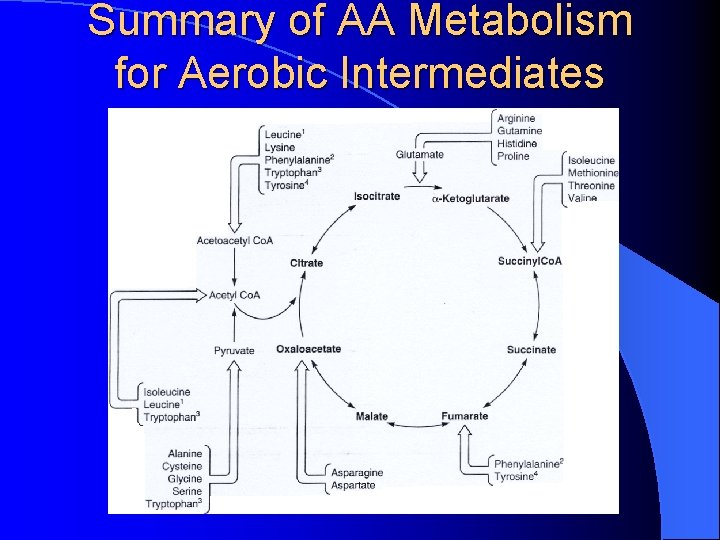
Summary of AA Metabolism for Aerobic Intermediates

Infuence of Carbohydrates l Depletion of glycogen prior to exercise results in elevated plasma NH 3 levels l Plasma NH 3 levels lower during prolonged exercise when subjects consume CHO
l If glycogen is depleted using prior exercise and diet, plasma BCAA are elevated l During the subsequent exercise bout, plasma BCAA significantly reduced l Indicates BCAA muscle is taking up and oxidizding
Influence of FFA l Infusion of FFA during leg exercise at 80 % workmax l Arterial concentration of several AA acids reduced relative to control l Net release of NH 3 ~ half of control
Ketones l Infusion of ketones has consistently been shown to reduce leucine oxidation l No data on NH 3 or other amino acids
Influence of Amino Acids l When AA are infused or ingested plasma AA will rise l BCAA will be preferentially taken up by muscle and pass by the liver l AA l Is oxidation will increase this good or bad? ? ?
- Slides: 31