
Protection Type Current Transformer Modeling With Air Gaps
- Slides: 1
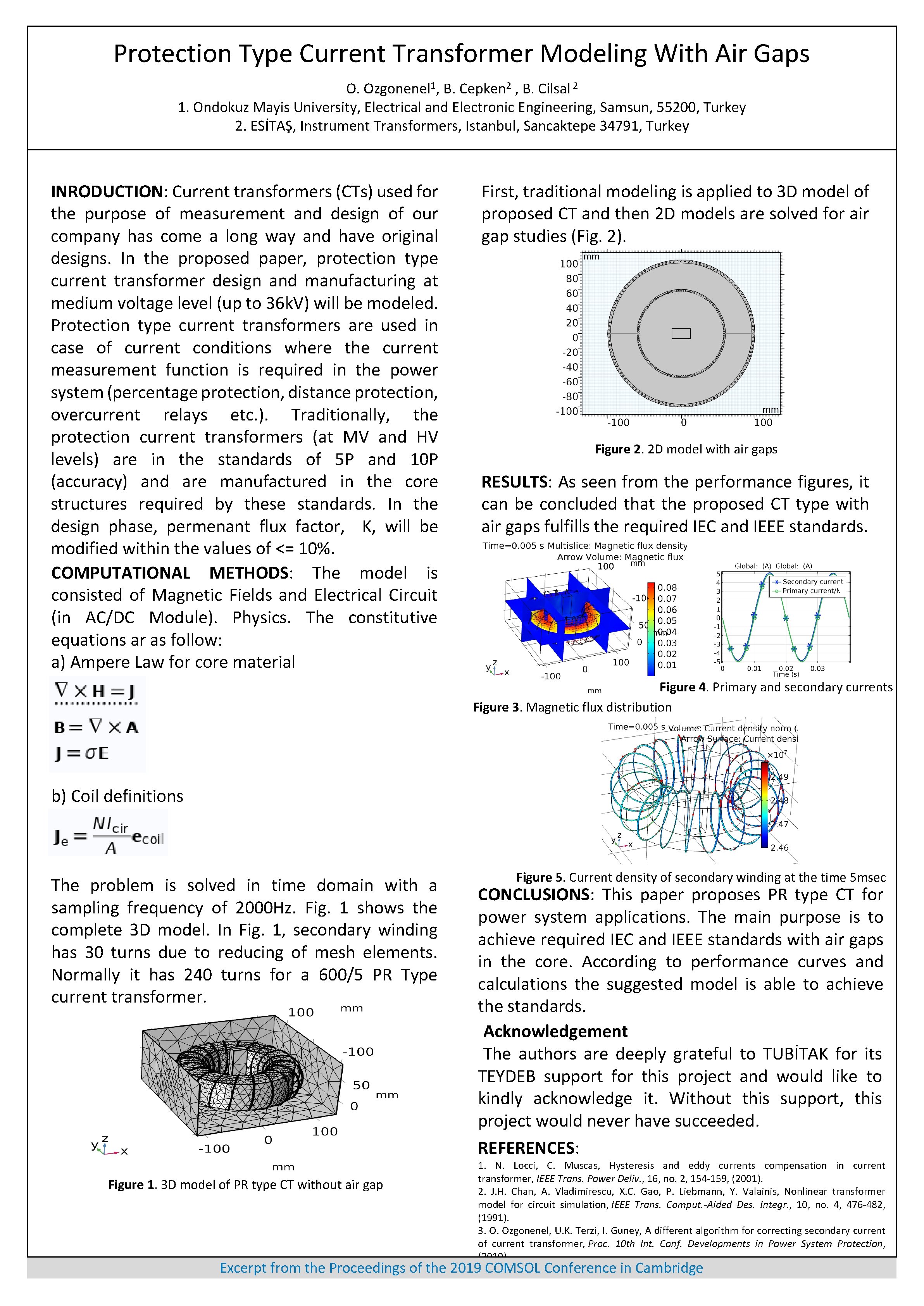
Protection Type Current Transformer Modeling With Air Gaps O. Ozgonenel 1, B. Cepken 2 , B. Cilsal 2 1. Ondokuz Mayis University, Electrical and Electronic Engineering, Samsun, 55200, Turkey 2. ESİTAŞ, Instrument Transformers, Istanbul, Sancaktepe 34791, Turkey INRODUCTION: Current transformers (CTs) used for the purpose of measurement and design of our company has come a long way and have original designs. In the proposed paper, protection type current transformer design and manufacturing at medium voltage level (up to 36 k. V) will be modeled. Protection type current transformers are used in case of current conditions where the current measurement function is required in the power system (percentage protection, distance protection, overcurrent relays etc. ). Traditionally, the protection current transformers (at MV and HV levels) are in the standards of 5 P and 10 P (accuracy) and are manufactured in the core structures required by these standards. In the design phase, permenant flux factor, K, will be modified within the values of <= 10%. COMPUTATIONAL METHODS: The model is consisted of Magnetic Fields and Electrical Circuit (in AC/DC Module). Physics. The constitutive equations ar as follow: a) Ampere Law for core material First, traditional modeling is applied to 3 D model of proposed CT and then 2 D models are solved for air gap studies (Fig. 2). Figure 2. 2 D model with air gaps RESULTS: As seen from the performance figures, it can be concluded that the proposed CT type with air gaps fulfills the required IEC and IEEE standards. Figure 4. Primary and secondary currents Figure 3. Magnetic flux distribution b) Coil definitions The problem is solved in time domain with a sampling frequency of 2000 Hz. Fig. 1 shows the complete 3 D model. In Fig. 1, secondary winding has 30 turns due to reducing of mesh elements. Normally it has 240 turns for a 600/5 PR Type current transformer. Figure 1. 3 D model of PR type CT without air gap Figure 5. Current density of secondary winding at the time 5 msec CONCLUSIONS: This paper proposes PR type CT for power system applications. The main purpose is to achieve required IEC and IEEE standards with air gaps in the core. According to performance curves and calculations the suggested model is able to achieve the standards. Acknowledgement The authors are deeply grateful to TUBİTAK for its TEYDEB support for this project and would like to kindly acknowledge it. Without this support, this project would never have succeeded. REFERENCES: 1. N. Locci, C. Muscas, Hysteresis and eddy currents compensation in current transformer, IEEE Trans. Power Deliv. , 16, no. 2, 154 -159, (2001). 2. J. H. Chan, A. Vladimirescu, X. C. Gao, P. Liebmann, Y. Valainis, Nonlinear transformer model for circuit simulation, IEEE Trans. Comput. -Aided Des. Integr. , 10, no. 4, 476 -482, (1991). 3. O. Ozgonenel, U. K. Terzi, I. Guney, A different algorithm for correcting secondary current of current transformer, Proc. 10 th Int. Conf. Developments in Power System Protection, (2010). Excerpt from the Proceedings of the 2019 COMSOL Conference in Cambridge