
Protection amino groups A great many protective groups
![5 - Mono protection of small diamines [H 2 N(CH 2)n. NH 2, [n=](https://slidetodoc.com/presentation_image_h2/551519557b4ecb73b5d511cd7f988166/image-4.jpg "5 - Mono protection of small diamines [H 2 N(CH 2)n. NH 2, [n=")
- Slides: 19
Protection amino groups A great many protective groups have been developed for the amino group, including 1 - carbamates (-NCO 2 R), used for the protection of amino acids in peptide and protein syntheses. Carbamates are formed from an amine with a wide variety of reagents, the chloroformate being the most common. n-Alkyl carbamates are cleaved by acid-catalyzed hydrolysis. 2 -amides (-NCOR), used more widely in syntheses of alkaloids and for the protection of the nitrogen bases adenine, cytosine, and guanine in nucleotide syntheses. amides are formed from the acid chloride. N-alkylamides are cleaved by acidic or basic hydrolysis at reflux and by ammonolysis conditions that cleave peptide bonds. 1
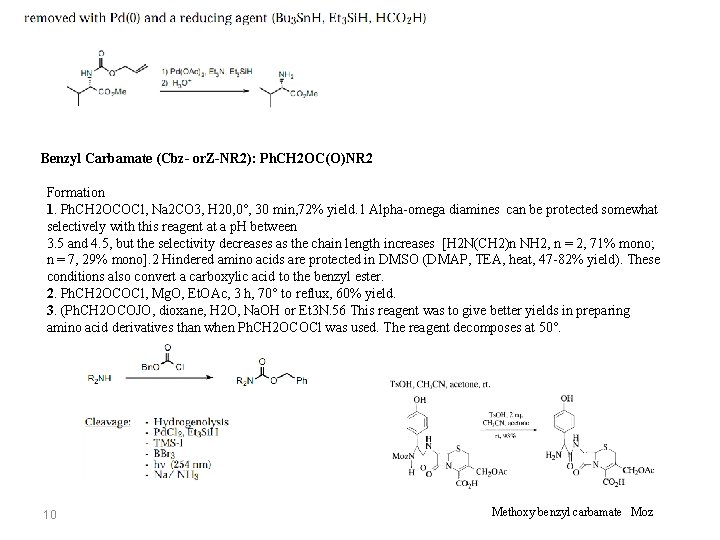
CARBAMATES Carbamates can be used as protective groups for amino acids to minimize racemization in peptide synthesis. Many carbamates have been used as protective groups. The most useful compounds (not necessarily the simplest structures) are a) t-butyl (BOC), readily cleaved by acidic hydrolysis; b) benzyl (Cbz or Z), cleaved by catalytic hydrogenolysis, c) 2, 4 -dichlorobenzyl, stable to the acid-catalyzed hydrolysis of benzyl and t-butyl carbamates; d) 2 -(biphenylyl)isopropyl, cleaved more easily than t-butyl carbamate by dilute acetic acid. E) 9 -fluorenylmethyl, cleaved by α-elimination with base. f) isonicotinyl, cleaved by reduction with zinc in acetic acid. g) 1 -adamantyl, readily cleaved by trifluoroacetic acid. h) and allyl, readily cleaved by Pd-catalyzed isomerization. 2
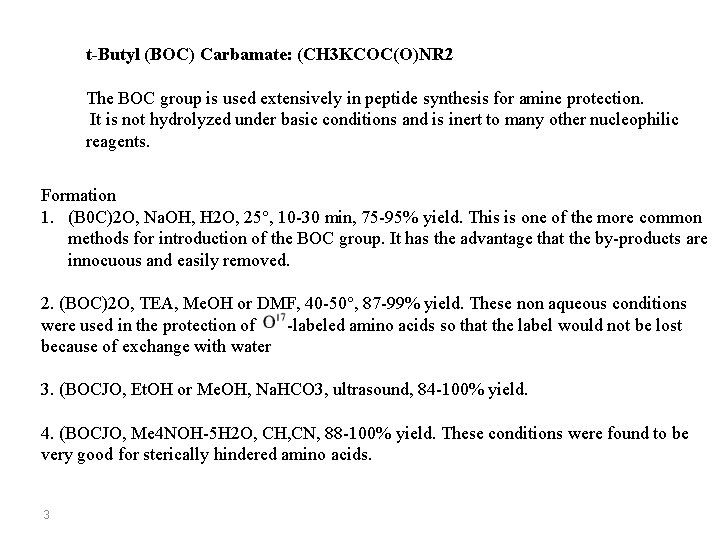
t-Butyl (BOC) Carbamate: (CH 3 KCOC(O)NR 2 The BOC group is used extensively in peptide synthesis for amine protection. It is not hydrolyzed under basic conditions and is inert to many other nucleophilic reagents. Formation 1. (B 0 C)2 O, Na. OH, H 2 O, 25°, 10 -30 min, 75 -95% yield. This is one of the more common methods for introduction of the BOC group. It has the advantage that the by-products are innocuous and easily removed. 2. (BOC)2 O, TEA, Me. OH or DMF, 40 -50°, 87 -99% yield. These non aqueous conditions were used in the protection of -labeled amino acids so that the label would not be lost because of exchange with water 3. (BOCJO, Et. OH or Me. OH, Na. HCO 3, ultrasound, 84 -100% yield. 4. (BOCJO, Me 4 NOH-5 H 2 O, CH, CN, 88 -100% yield. These conditions were found to be very good for sterically hindered amino acids. 3
5 - Mono protection of small diamines [H 2 N(CH 2)n. NH 2, [n= 2 -6] is achieved by reacting an excess of the amine with (BOC)2 O in dioxane (75 -90% yield). 4
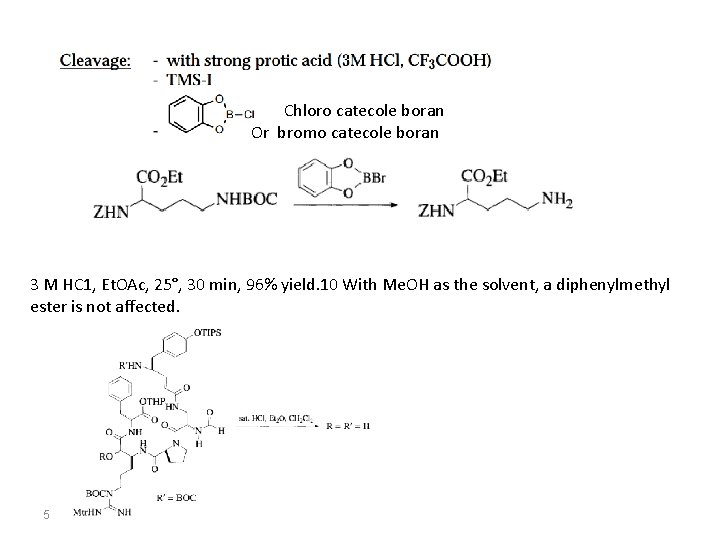
Chloro catecole boran Or bromo catecole boran 3 M HC 1, Et. OAc, 25°, 30 min, 96% yield. 10 With Me. OH as the solvent, a diphenylmethyl ester is not affected. 5
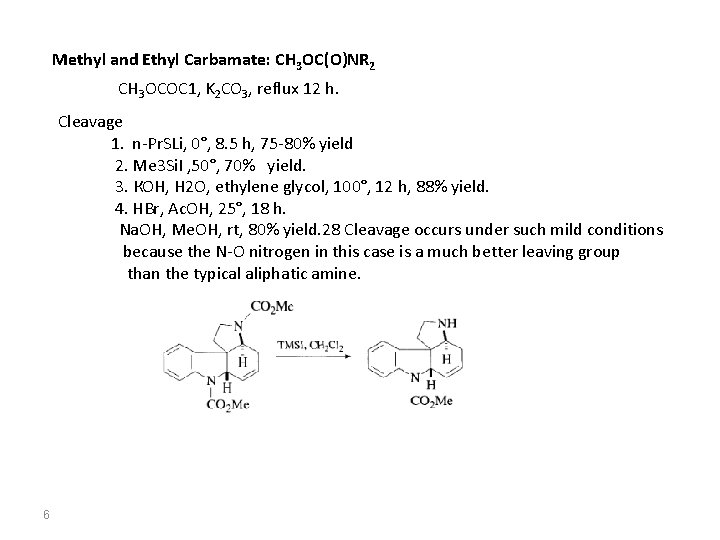
Methyl and Ethyl Carbamate: CH 3 OC(O)NR 2 CH 3 OCOC 1, K 2 CO 3, reflux 12 h. Cleavage 1. n-Pr. SLi, 0°, 8. 5 h, 75 -80% yield 2. Me 3 Si. I , 50°, 70% yield. 3. КОН, Н 2 О, ethylene glycol, 100°, 12 h, 88% yield. 4. HBr, Ac. OH, 25°, 18 h. Na. OH, Me. OH, rt, 80% yield. 28 Cleavage occurs under such mild conditions because the N-O nitrogen in this case is a much better leaving group than the typical aliphatic amine. 6
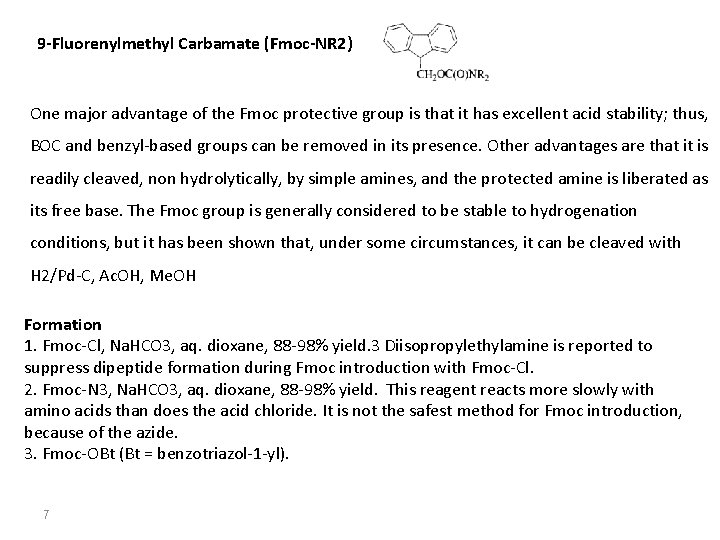
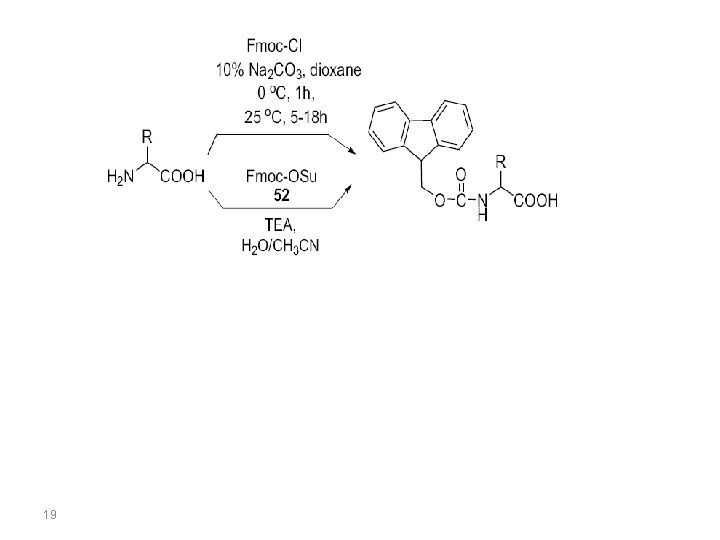
9 -Fluorenylmethyl Carbamate (Fmoc-NR 2) One major advantage of the Fmoc protective group is that it has excellent acid stability; thus, BOC and benzyl-based groups can be removed in its presence. Other advantages are that it is readily cleaved, non hydrolytically, by simple amines, and the protected amine is liberated as its free base. The Fmoc group is generally considered to be stable to hydrogenation conditions, but it has been shown that, under some circumstances, it can be cleaved with H 2/Pd-C, Ac. OH, Me. OH Formation 1. Fmoc-Cl, Na. HCO 3, aq. dioxane, 88 -98% yield. 3 Diisopropylethylamine is reported to suppress dipeptide formation during Fmoc introduction with Fmoc-Cl. 2. Fmoc-N 3, Na. HCO 3, aq. dioxane, 88 -98% yield. This reagent reacts more slowly with amino acids than does the acid chloride. It is not the safest method for Fmoc introduction, because of the azide. 3. Fmoc-OBt (Bt = benzotriazol-1 -yl). 7
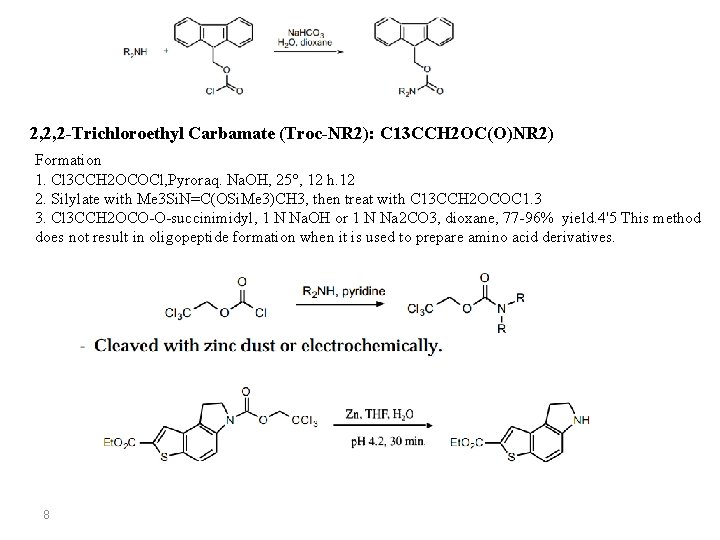
2, 2, 2 -Trichloroethyl Carbamate (Troc-NR 2): C 13 CCH 2 OC(O)NR 2) Formation 1. Cl 3 CCH 2 OCOCl, Pyroraq. Na. OH, 25°, 12 h. 12 2. Silylate with Me 3 Si. N=C(OSi. Me 3)CH 3, then treat with C 13 CCH 2 OCOC 1. 3 3. Cl 3 CCH 2 OCO-O-succinimidyl, 1 N Na. OH or 1 N Na 2 CO 3, dioxane, 77 -96% yield. 4'5 This method does not result in oligopeptide formation when it is used to prepare amino acid derivatives. 8
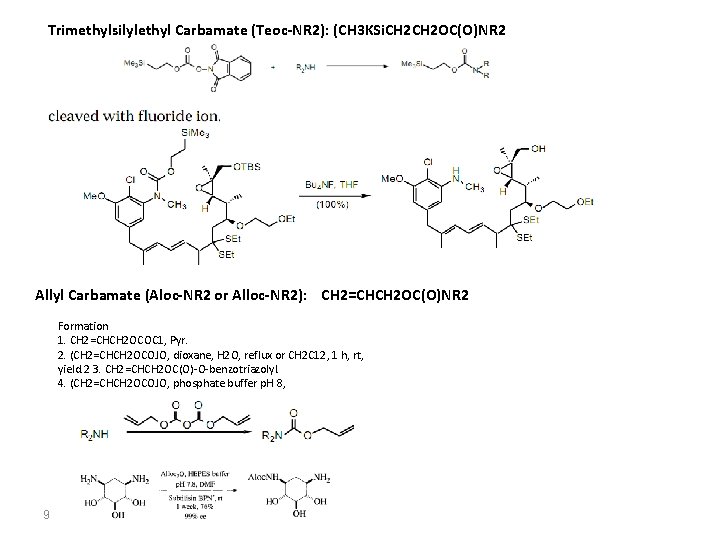
Trimethylsilylethyl Carbamate (Teoc-NR 2): (CH 3 KSi. CH 2 OC(O)NR 2 Allyl Carbamate (Aloc-NR 2 or Alloc-NR 2): CH 2=CHCH 2 OC(O)NR 2 Formation 1. CH 2=CHCH 2 OCOC 1, Pyr. 2. (CH 2=CHCH 2 OCOJO, dioxane, H 2 O, reflux or CH 2 C 12, 1 h, rt, yield. 2 3. CH 2=CHCH 2 OC(O)-O-benzotriazolyl. 4. (CH 2=CHCH 2 OCOJO, phosphate buffer p. H 8, 9
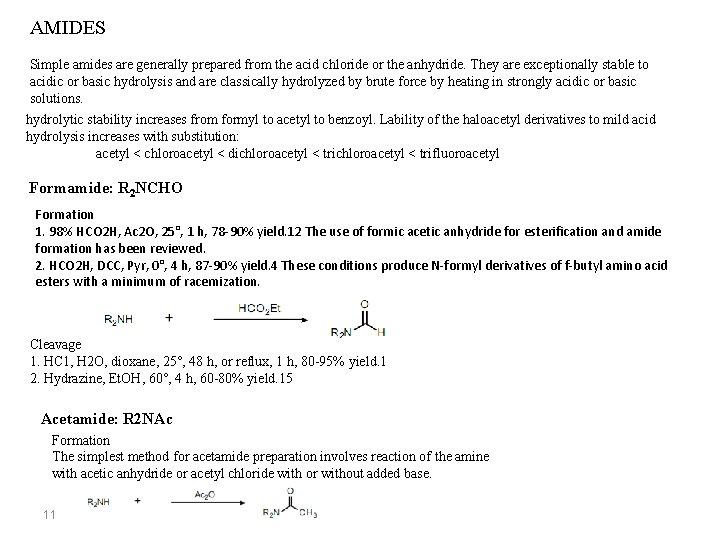
Benzyl Carbamate (Cbz- or. Z-NR 2): Ph. CH 2 OC(O)NR 2 Formation 1. Ph. CH 2 OCOCl, Na 2 CO 3, H 20, 0°, 30 min, 72% yield. 1 Alpha-omega diamines can be protected somewhat selectively with this reagent at a p. H between 3. 5 and 4. 5, but the selectivity decreases as the chain length increases [H 2 N(CH 2)n NH 2, n = 2, 71% mono; n = 7, 29% mono]. 2 Hindered amino acids are protected in DMSO (DMAP, TEA, heat, 47 -82% yield). These conditions also convert a carboxylic acid to the benzyl ester. 2. Ph. CH 2 OCOCl, Mg. O, Et. OAc, 3 h, 70° to reflux, 60% yield. 3. (Ph. CH 2 OCOJO, dioxane, H 2 O, Na. OH or Et 3 N. 56 This reagent was to give better yields in preparing amino acid derivatives than when Ph. CH 2 OCOCl was used. The reagent decomposes at 50°. 10 Methoxy benzyl carbamate Moz
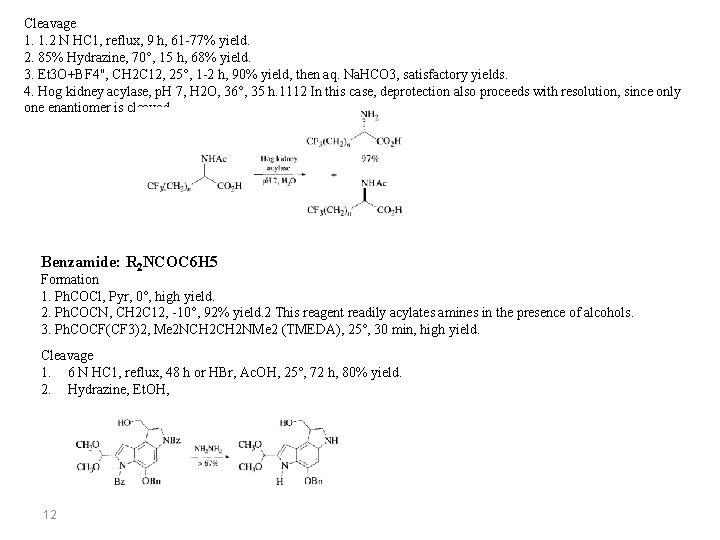
AMIDES Simple amides are generally prepared from the acid chloride or the anhydride. They are exceptionally stable to acidic or basic hydrolysis and are classically hydrolyzed by brute force by heating in strongly acidic or basic solutions. hydrolytic stability increases from formyl to acetyl to benzoyl. Lability of the haloacetyl derivatives to mild acid hydrolysis increases with substitution: acetyl < chloroacetyl < dichloroacetyl < trifluoroacetyl Formamide: R 2 NCHO Formation 1. 98% HCO 2 H, Ac 2 O, 25°, 1 h, 78 -90% yield. 12 The use of formic acetic anhydride for esterification and amide formation has been reviewed. 2. HCO 2 H, DCC, Pyr, 0°, 4 h, 87 -90% yield. 4 These conditions produce N-formyl derivatives of f-butyl amino acid esters with a minimum of racemization. Cleavage 1. HC 1, H 2 O, dioxane, 25°, 48 h, or reflux, 1 h, 80 -95% yield. 1 2. Hydrazine, Et. OH, 60°, 4 h, 60 -80% yield. 15 Acetamide: R 2 NAc Formation The simplest method for acetamide preparation involves reaction of the amine with acetic anhydride or acetyl chloride with or without added base. 11
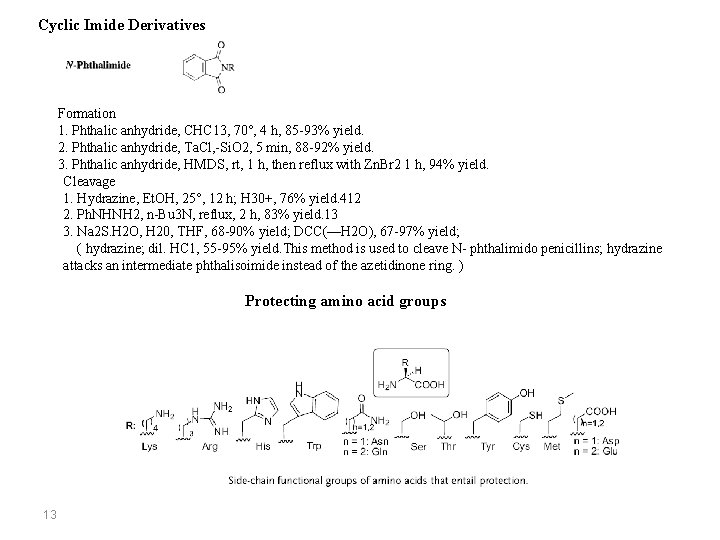
Cleavage 1. 1. 2 N HC 1, reflux, 9 h, 61 -77% yield. 2. 85% Hydrazine, 70°, 15 h, 68% yield. 3. Et 3 O+BF 4", CH 2 C 12, 25°, 1 -2 h, 90% yield, then aq. Na. HCO 3, satisfactory yields. 4. Hog kidney acylase, p. H 7, H 2 O, 36°, 35 h. 1112 In this case, deprotection also proceeds with resolution, since only one enantiomer is cleaved. Benzamide: R 2 NCOC 6 H 5 Formation 1. Ph. COCl, Pyr, 0°, high yield. 2. Ph. COCN, CH 2 C 12, -10°, 92% yield. 2 This reagent readily acylates amines in the presence of alcohols. 3. Ph. COCF(CF 3)2, Me 2 NCH 2 NMe 2 (TMEDA), 25°, 30 min, high yield. Cleavage 1. 6 N HC 1, reflux, 48 h or HBr, Ac. OH, 25°, 72 h, 80% yield. 2. Hydrazine, Et. OH, 12
Cyclic Imide Derivatives Formation 1. Phthalic anhydride, CHC 13, 70°, 4 h, 85 -93% yield. 2. Phthalic anhydride, Ta. Cl, -Si. O 2, 5 min, 88 -92% yield. 3. Phthalic anhydride, HMDS, rt, 1 h, then reflux with Zn. Br 2 1 h, 94% yield. Cleavage 1. Hydrazine, Et. OH, 25°, 12 h; H 30+, 76% yield. 412 2. Ph. NHNH 2, n-Bu 3 N, reflux, 2 h, 83% yield. 13 3. Na 2 S. H 2 O, H 20, THF, 68 -90% yield; DCC(—H 2 O), 67 -97% yield; ( hydrazine; dil. HC 1, 55 -95% yield. This method is used to cleave N- phthalimido penicillins; hydrazine attacks an intermediate phthalisoimide instead of the azetidinone ring. ) Protecting amino acid groups 13
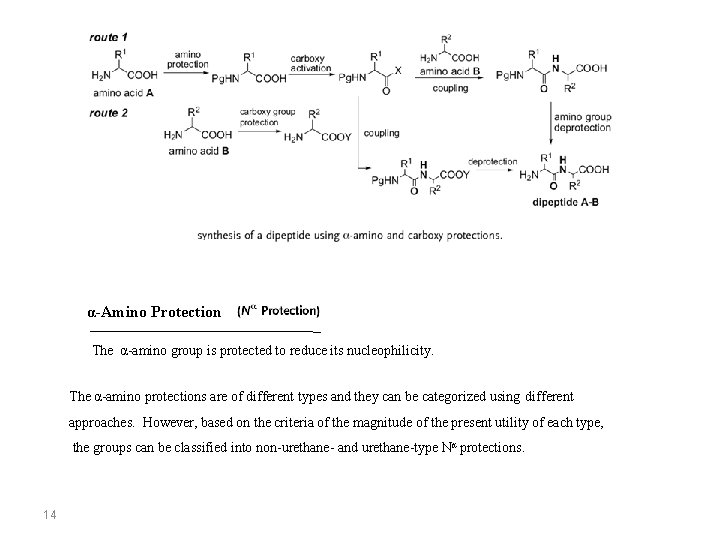
α-Amino Protection The α-amino group is protected to reduce its nucleophilicity. The α-amino protections are of different types and they can be categorized using different approaches. However, based on the criteria of the magnitude of the present utility of each type, the groups can be classified into non-urethane- and urethane-type Nα protections. 14
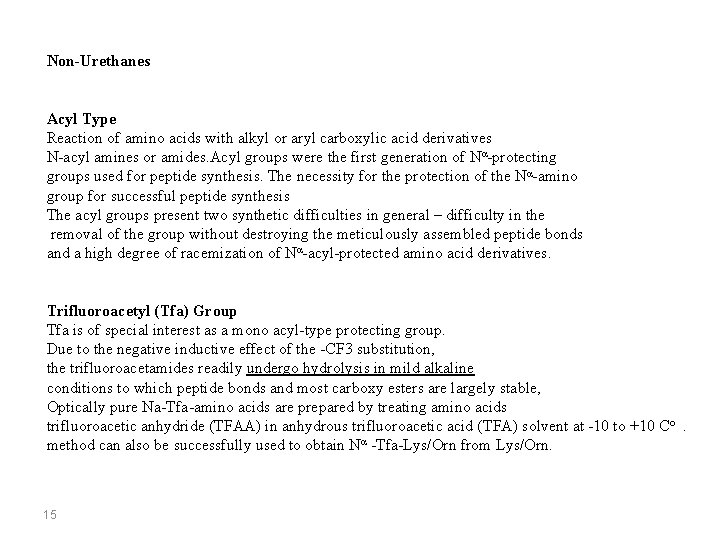
Non-Urethanes Acyl Type Reaction of amino acids with alkyl or aryl carboxylic acid derivatives N-acyl amines or amides. Acyl groups were the first generation of Nα-protecting groups used for peptide synthesis. The necessity for the protection of the Nα-amino group for successful peptide synthesis The acyl groups present two synthetic difficulties in general – difficulty in the removal of the group without destroying the meticulously assembled peptide bonds and a high degree of racemization of Nα-acyl-protected amino acid derivatives. Trifluoroacetyl (Tfa) Group Tfa is of special interest as a mono acyl-type protecting group. Due to the negative inductive effect of the -CF 3 substitution, the trifluoroacetamides readily undergo hydrolysis in mild alkaline conditions to which peptide bonds and most carboxy esters are largely stable, Optically pure Na-Tfa-amino acids are prepared by treating amino acids trifluoroacetic anhydride (TFAA) in anhydrous trifluoroacetic acid (TFA) solvent at -10 to +10 C o. method can also be successfully used to obtain Nα -Tfa-Lys/Orn from Lys/Orn. 15
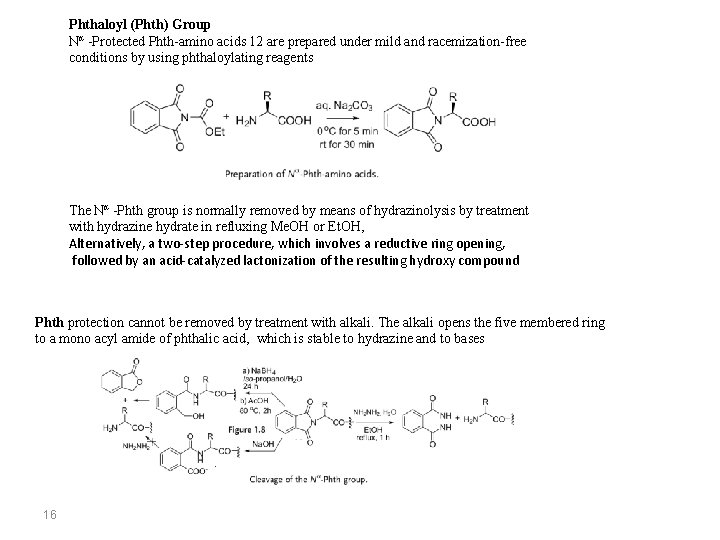
Phthaloyl (Phth) Group Nα -Protected Phth-amino acids 12 are prepared under mild and racemization-free conditions by using phthaloylating reagents The Nα -Phth group is normally removed by means of hydrazinolysis by treatment with hydrazine hydrate in refluxing Me. OH or Et. OH, Alternatively, a two-step procedure, which involves a reductive ring opening, followed by an acid-catalyzed lactonization of the resulting hydroxy compound Phth protection cannot be removed by treatment with alkali. The alkali opens the five membered ring to a mono acyl amide of phthalic acid, which is stable to hydrazine and to bases 16
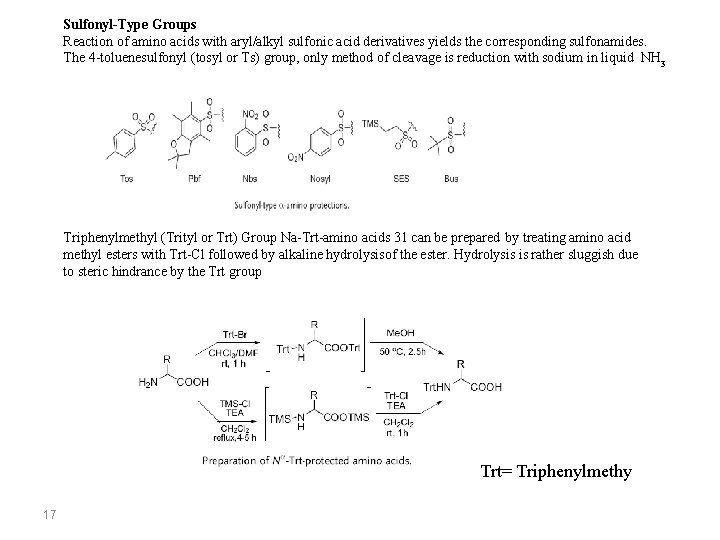
Sulfonyl-Type Groups Reaction of amino acids with aryl/alkyl sulfonic acid derivatives yields the corresponding sulfonamides. The 4 -toluenesulfonyl (tosyl or Ts) group, only method of cleavage is reduction with sodium in liquid NH 3 Triphenylmethyl (Trityl or Trt) Group Na-Trt-amino acids 31 can be prepared by treating amino acid methyl esters with Trt-Cl followed by alkaline hydrolysisof the ester. Hydrolysis is rather sluggish due to steric hindrance by the Trt group Trt= Triphenylmethy 17
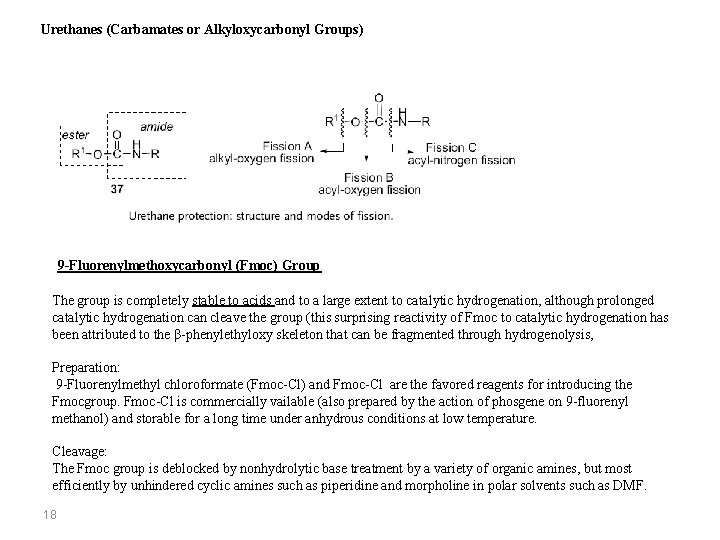
Urethanes (Carbamates or Alkyloxycarbonyl Groups) 9 -Fluorenylmethoxycarbonyl (Fmoc) Group The group is completely stable to acids and to a large extent to catalytic hydrogenation, although prolonged catalytic hydrogenation can cleave the group (this surprising reactivity of Fmoc to catalytic hydrogenation has been attributed to the β-phenylethyloxy skeleton that can be fragmented through hydrogenolysis, Preparation: 9 -Fluorenylmethyl chloroformate (Fmoc-Cl) and Fmoc-Cl are the favored reagents for introducing the Fmocgroup. Fmoc-Cl is commercially vailable (also prepared by the action of phosgene on 9 -fluorenyl methanol) and storable for a long time under anhydrous conditions at low temperature. Cleavage: The Fmoc group is deblocked by nonhydrolytic base treatment by a variety of organic amines, but most efficiently by unhindered cyclic amines such as piperidine and morpholine in polar solvents such as DMF. 18
19