
Protecting the Safety and Health of Workers Coronavirus

- Slides: 43
Protecting the Safety and Health of Workers Coronavirus Disease (COVID-19) www. lni. wa. gov/coronavirus
Agenda Historical Perspective Explanation of Terms Current State Requirements Assessment of Risk Guidance Resources Questions Tip: To see speaker notes for this presentation RIGHT -click the screen anywhere and select “Show Presenter View”
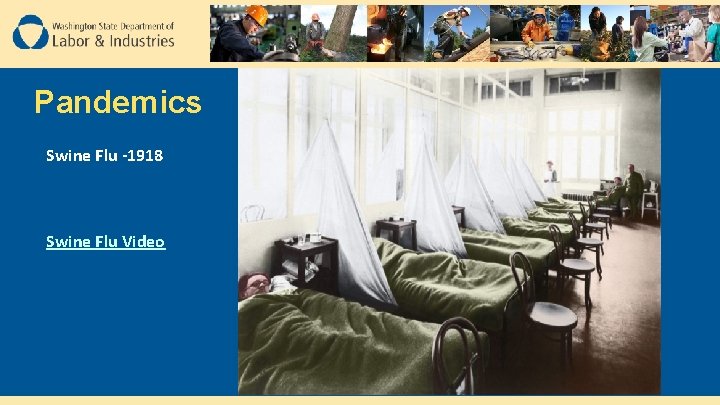
Pandemics Swine Flu -1918 Swine Flu Video
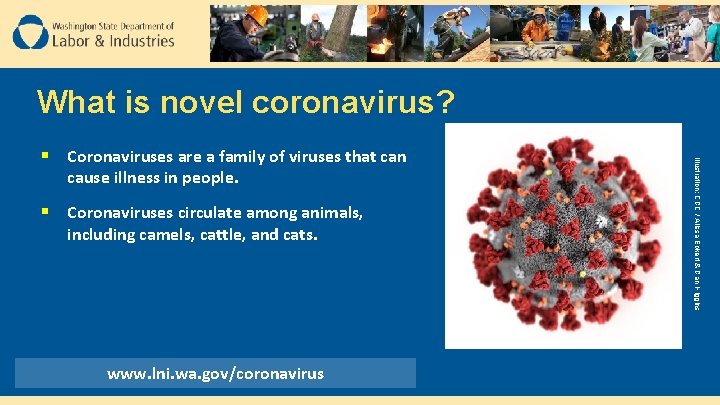
What is novel coronavirus? cause illness in people. § Coronaviruses circulate among animals, including camels, cattle, and cats. www. lni. wa. gov/coronavirus Illustration: CDC / Alissa Eckert & Dan Higgins § Coronaviruses are a family of viruses that can
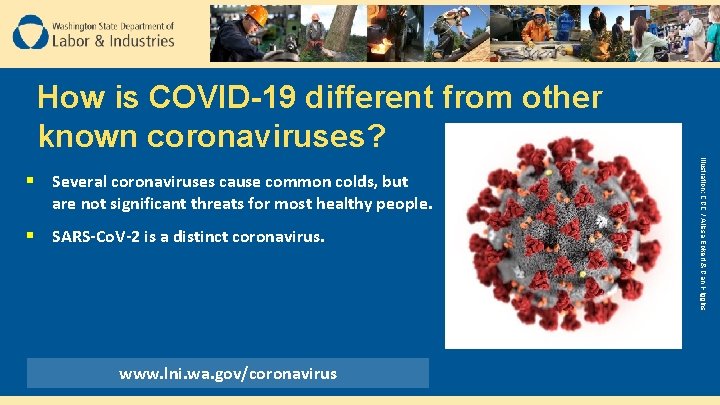
How is COVID-19 different from other known coronaviruses? are not significant threats for most healthy people. § SARS-Co. V-2 is a distinct coronavirus. www. lni. wa. gov/coronavirus Illustration: CDC / Alissa Eckert & Dan Higgins § Several coronaviruses cause common colds, but
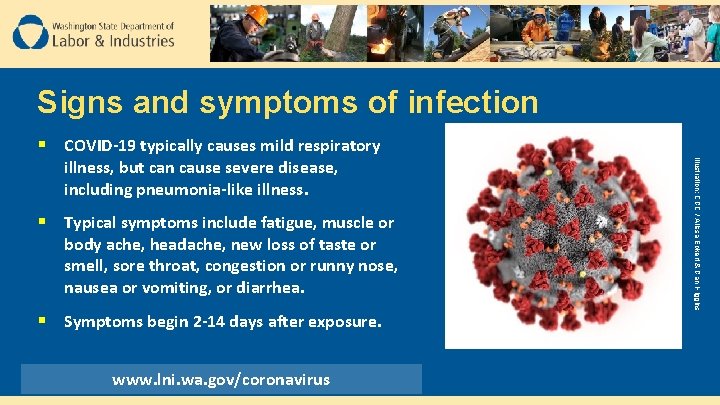
Signs and symptoms of infection § COVID-19 typically causes mild respiratory § Typical symptoms include fatigue, muscle or body ache, headache, new loss of taste or smell, sore throat, congestion or runny nose, nausea or vomiting, or diarrhea. § Symptoms begin 2 -14 days after exposure. www. lni. wa. gov/coronavirus Illustration: CDC / Alissa Eckert & Dan Higgins illness, but can cause severe disease, including pneumonia-like illness.
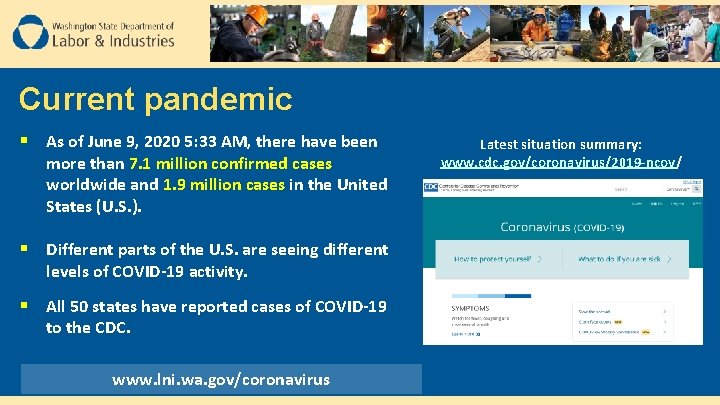
Current pandemic § As of June 9, 2020 5: 33 AM, there have been more than 7. 1 million confirmed cases worldwide and 1. 9 million cases in the United States (U. S. ). § Different parts of the U. S. are seeing different levels of COVID-19 activity. § All 50 states have reported cases of COVID-19 to the CDC. www. lni. wa. gov/coronavirus Latest situation summary: www. cdc. gov/coronavirus/2019 -ncov/
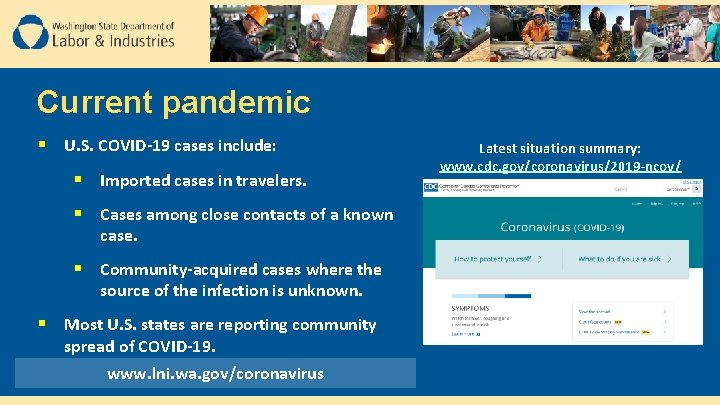
Current pandemic § U. S. COVID-19 cases include: § Imported cases in travelers. § Cases among close contacts of a known case. § Community-acquired cases where the source of the infection is unknown. § Most U. S. states are reporting community spread of COVID-19. www. lni. wa. gov/coronavirus Latest situation summary: www. cdc. gov/coronavirus/2019 -ncov/
How COVID is spread § Person-to-person spread. § Mainly through respiratory droplets from someone who is infected. People who are infected often—but not always—have symptoms of illness. § People without symptoms are able to spread virus. www. lni. wa. gov/coronavirus Latest situation summary: www. cdc. gov/coronavirus/2019 -ncov/
How COVID is spread § To spread the virus, the respiratory droplets must contact one of the mucus membranes, not just any skin surface. These include the eyes, nose, and mouth. § Wearing a mask and eye protection may help to prevent the spread. www. lni. wa. gov/coronavirus Latest situation summary: www. cdc. gov/coronavirus/2019 -ncov/
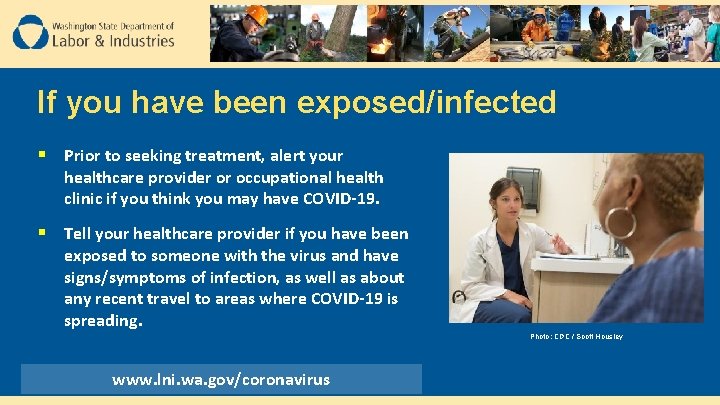
If you have been exposed/infected § Prior to seeking treatment, alert your healthcare provider or occupational health clinic if you think you may have COVID-19. § Tell your healthcare provider if you have been exposed to someone with the virus and have signs/symptoms of infection, as well as about any recent travel to areas where COVID-19 is spreading. Photo: CDC / Scott Housley www. lni. wa. gov/coronavirus
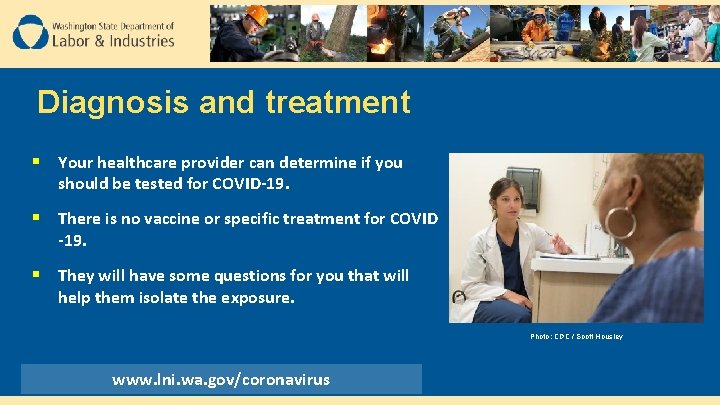
Diagnosis and treatment § Your healthcare provider can determine if you should be tested for COVID-19. § There is no vaccine or specific treatment for COVID -19. § They will have some questions for you that will help them isolate the exposure. Photo: CDC / Scott Housley www. lni. wa. gov/coronavirus
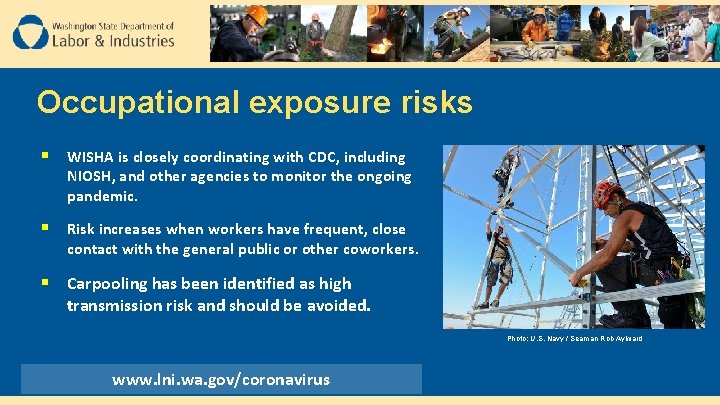
Occupational exposure risks § WISHA is closely coordinating with CDC, including NIOSH, and other agencies to monitor the ongoing pandemic. § Risk increases when workers have frequent, close contact with the general public or other coworkers. § Carpooling has been identified as high transmission risk and should be avoided. Photo: U. S. Navy / Seaman Rob Aylward www. lni. wa. gov/coronavirus
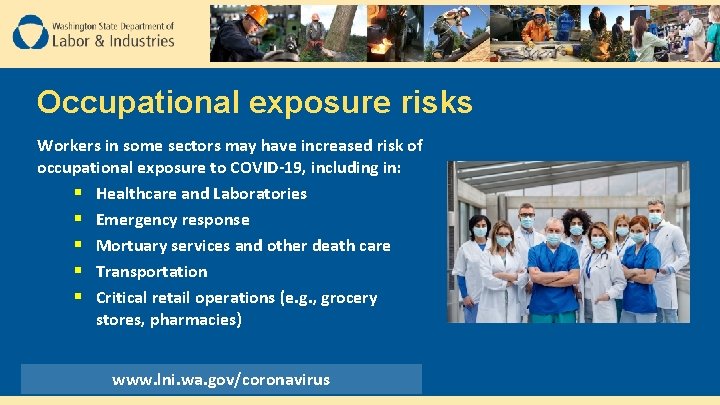
Occupational exposure risks Workers in some sectors may have increased risk of occupational exposure to COVID-19, including in: § Healthcare and Laboratories § Emergency response § Mortuary services and other death care § Transportation § Critical retail operations (e. g. , grocery stores, pharmacies) www. lni. wa. gov/coronavirus
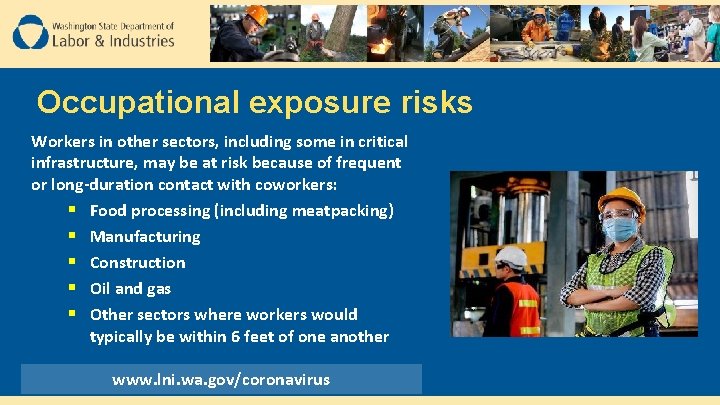
Occupational exposure risks Workers in other sectors, including some in critical infrastructure, may be at risk because of frequent or long-duration contact with coworkers: § Food processing (including meatpacking) § Manufacturing § Construction § Oil and gas § Other sectors where workers would typically be within 6 feet of one another www. lni. wa. gov/coronavirus
Existing WISHA standards protect Relevant WISHA requirements workers from exposure (Exact code depends on industry) § Follow existing WISHA standards to help protect workers from exposure to COVID-19. § Employers should also remember that the Washington Industrial Safety and Health Act requires that all workers are protected from recognized safety and health hazards. www. lni. wa. gov/coronavirus § § § § Accident Prevention Program Employee Training Personal Protective Equipment Housekeeping / Sanitation Protection from Biological Agents Temporary Housing Hazard Communication Recordkeeping (OSHA 300) You may contact DOSH Consultation for assistance
Existing WISHA standards protect workers from exposure The following requirements must be included in your overall safety and health program: § Educate workers in a language they understand about COVID-19 and how to prevent the spread. § Maintain at least 6 feet of spacing at all times, or implement effective engineering controls. § Create a cleaning schedule to make sure commonly touched surfaces, tools, and supplies are cleaned regularly and frequently. § Encourage frequent handwashing, and make sure soap and warm water are readily available. § Wear a mask. www. lni. wa. gov/coronavirus
Existing WISHA standards protect workers from exposure § Employers must require that workers who are sick or showing symptoms are not permitted to come to work. § Any workers that become sick or develop symptoms must be sent home immediately. § Establish procedures for workers to report a suspected or confirmed case of COVID-19. www. lni. wa. gov/coronavirus
Gubernatorial proclamations In addition to any WISHA requirements, the Governor’s office has mandated certain conditions that supersede existing standards. The most current information can be found here: Washington State Coronavirus Response (COVID-19) www. lni. wa. gov/coronavirus
Exposure risk – extremely high Probable or known COVID-19 source or direct human mouth, nose, eye interactions § Transporting/caring for symptomatic patients with probable or active COVID-19 within 6 feet in vehicle; or non-hospital setting or a residence with no sanitization protocols in place. § Healthcare work involving face-to-face close proximity or potential for coughing or sneezing while working with healthy or asymptomatic people. Potential for droplets of biological material or fluids to become airborne within the breathing zone of the employee. Examples include tonometry during eye exams, visual examination of the oral and nasal cavities, visual examination of the eyes, swab sampling in the mouth or nose. www. lni. wa. gov/coronavirus
Exposure risk – extremely high continued § Vehicle with more than one occupant where at least 6 foot distance is not maintained and includes job tasks requiring close together (less than 3 feet apart) work for more than 10 minutes in an hour at least once a day. www. lni. wa. gov/coronavirus
Exposure risk – high Healthy/Asymptomatic § Work in close quarters, such as a multiple occupancy permit-required confined space or inside a room with 10 or more people where at least 6 foot distance is not maintained and includes job tasks requiring sustained close together (less than 3 feet apart) work for more than 10 minutes in an hour multiple times a day. § Work cleaning and sanitization of surfaces and floor after confirmed active COVID-19 employee was present in the area. § Also includes work that cannot be delayed performing services in home of quarantined confirmed COVID-19 clients. Examples include emergency plumbing repair or in-home pet euthanasia. www. lni. wa. gov/coronavirus
Exposure risk – high continued § Healthcare work involving procedures in close proximity to healthy or asymptomatic people with potential for aerosols generated from saliva or mucous from the mouth or nose. Examples include dental work with an ultrasonic scaler, air/water syringe, or hand piece, administering medicines with a nebulizer, spirometry, deep or forced breathing exercises. § Vehicle with more than one occupant where at least 6 foot distance is not maintained and includes job tasks requiring close together (less than 3 feet apart) work for more than 10 minutes in an hour more than once a day. www. lni. wa. gov/coronavirus
Exposure risk – medium Healthy/Asymptomatic § Large crews outside where at least 6 foot distance is mostly maintained, but with job tasks that require several minutes of 6 foot distance broken several times a day. Tools are shared and sanitized between different users. § Work inside in structure/office where at least 6 foot distance is mostly maintained, but with job tasks that require sustained several minutes of 6 foot distance broken several times a day without sneeze guards or other mitigations. § Vehicle with more than one occupant but mostly maintain 6 foot distance with job tasks that require several minutes of 6 foot distance broken several times a day. www. lni. wa. gov/coronavirus
Exposure risk – low Healthy/Asymptomatic § Crews outside on large worksite where at least 6 foot distance is easily maintained fulltime and only broken intermittently in passing up to several times a day. Tools are not shared or are sanitized between different users. § Work inside in structure/office where number present allows for at least 6 foot distance to be easily maintained fulltime and only broken intermittently in passing up to several times a day. § Non-healthcare work involving personal services (such as haircuts) where there are 1 or 2 workers inside room. All clients assumed to be wearing cloth face coverings or higher level of protection. www. lni. wa. gov/coronavirus
Exposure risk – low continued § Vehicle with more than one occupant but can maintain 6 foot distance that is only broken intermittently up to several times a day. www. lni. wa. gov/coronavirus
Exposure risk – very low (Negligible) Healthy/Asymptomatic (no COVID-19 symptoms) § Employee working alone, or, all outside or 1 -9 total persons inside building/structure with outside or HVAC air, where at least 6 foot distance is always maintained. Tools are not shared or are sanitized between different users. § Worksite with controlled and low public interaction, where at least 6 foot distance always maintained and only broken in passing once or twice a day. § Vehicle operation: employees ride alone and vehicles are sanitized between different drivers. www. lni. wa. gov/coronavirus
WISHA Requirements § You must have an Accident Prevention Program § You must train your employees on the goals of Coronavirus prevention practices § You must provide housekeeping § You must provide adequate handwashing § You must enforce social distancing www. lni. wa. gov/coronavirus
Five Basic Elements § Employers must provide basic workplace hazard education about coronavirus and how to prevent transmission in the language best understood by the employee; § Employers must ensure social distancing practices for employees and to control customer flow; § Employees must wear masks or facial coverings unless working alone. Employers must provide at no cost appropriate facial coverings, respiratory protection and PPE § Ensure frequent and adequate employee handwashing and surface sanitation; § Ensure sick employees stay home or go home if ill; www. lni. wa. gov/coronavirus
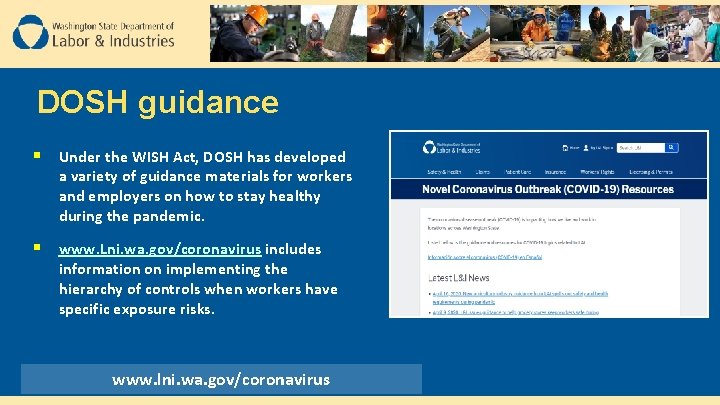
DOSH guidance § Under the WISH Act, DOSH has developed a variety of guidance materials for workers and employers on how to stay healthy during the pandemic. § www. Lni. wa. gov/coronavirus includes information on implementing the hierarchy of controls when workers have specific exposure risks. www. lni. wa. gov/coronavirus
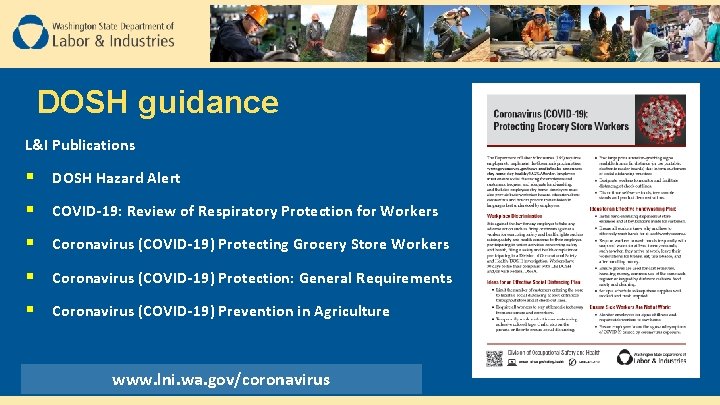
DOSH guidance L&I Publications § DOSH Hazard Alert § COVID-19: Review of Respiratory Protection for Workers § Coronavirus (COVID-19) Protecting Grocery Store Workers § Coronavirus (COVID-19) Protection: General Requirements § Coronavirus (COVID-19) Prevention in Agriculture www. lni. wa. gov/coronavirus
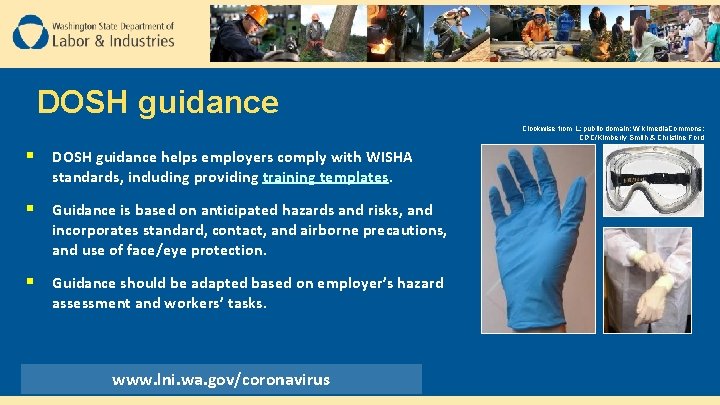
DOSH guidance Clockwise from L: public domain; Wikimedia. Commons; CDC/Kimberly Smith & Christine Ford § DOSH guidance helps employers comply with WISHA standards, including providing training templates. § Guidance is based on anticipated hazards and risks, and incorporates standard, contact, and airborne precautions, and use of face/eye protection. § Guidance should be adapted based on employer’s hazard assessment and workers’ tasks. www. lni. wa. gov/coronavirus
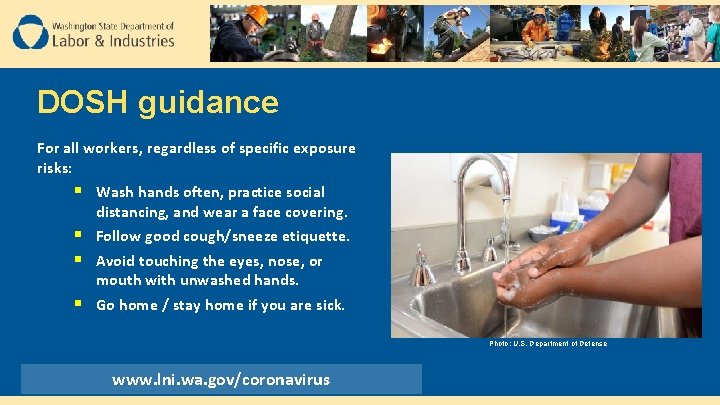
DOSH guidance For all workers, regardless of specific exposure risks: § Wash hands often, practice social distancing, and wear a face covering. § Follow good cough/sneeze etiquette. § Avoid touching the eyes, nose, or mouth with unwashed hands. § Go home / stay home if you are sick. Photo: U. S. Department of Defense www. lni. wa. gov/coronavirus
DOSH guidance § Employers should implement protocols for regularly cleaning and disinfecting high-touch surfaces in the work environment. § Wipe down surfaces such as door push bars, shopping carts, points of sale, chairs in waiting areas, and other areas that customers, visitors, or workers frequently touch. § Follow manufacturer’s instructions for use of all EPA-approved cleaning and disinfection products. § CDC provides detailed guidance for environmental cleaning and disinfection. www. lni. wa. gov/coronavirus
DOSH guidance § Train all workers about their risk of occupational exposure to COVID-19 as well as on § what to do if they have traveled to high-risk areas or been exposed to possible cases. For workers at particular risk of exposure (e. g. , in healthcare, others), discuss: § Sources of exposure to the virus and hazards associated with that exposure. § Appropriate ways to prevent or reduce the likelihood of exposure, including use of engineering and administrative controls, safe work practices, and PPE. § Some WISHA standards (e. g. , BBP, PPE) require worker training. www. lni. wa. gov/coronavirus
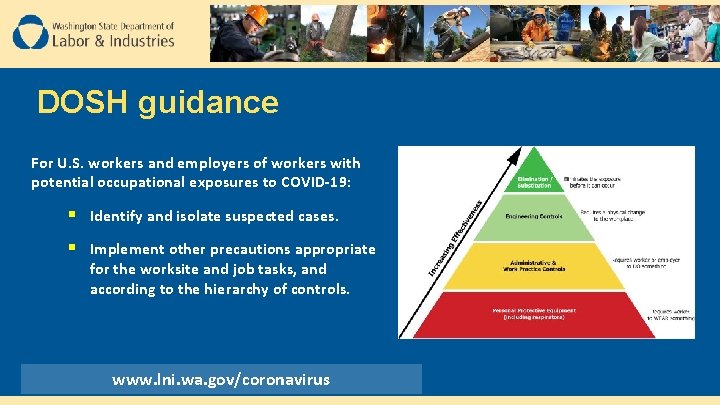
DOSH guidance For U. S. workers and employers of workers with potential occupational exposures to COVID-19: § Identify and isolate suspected cases. § Implement other precautions appropriate for the worksite and job tasks, and according to the hierarchy of controls. www. lni. wa. gov/coronavirus
DOSH guidance What should standard precautions consist of in workplaces where workers may be exposed to COVID-19? § Engineering controls, such as isolation rooms and other physical barriers, can limit most workers’ exposures. § Administrative controls and safe work practices include measures such as limiting access to patient care areas, effective sharps management, and worker training. § PPE may include gloves, gowns, goggles or face shields, and N 95 or better respirators. www. lni. wa. gov/coronavirus
Worker Rights All employees have the right to: § Raise a safety or health concern with their employer or DOSH, request personal protective equipment, or report a work-related injury or illness, including COVID-19. § Receive information and training on job hazards in their workplace. Complaints or concerns may be reported to DOSH at 1 -800 -423 -7233 or online: Submit a safety complaint or concern www. lni. wa. gov/coronavirus
Whistleblower Protections under the WISH Act § Employers cannot retaliate (fire, lay off, demote, etc. ) against employees for engaging in activity protected under the WISH Act. § Protected activity includes: § Requesting or wearing personal protective equipment § Reporting a work-related injury or illness, including COVID-19, to an employer or DOSH § Reporting an unsafe condition or requesting guidance from an employer or DOSH www. lni. wa. gov/coronavirus
Work Refusals under the WISH Act Under the WISH Act, employees have the right to refuse to perform an assigned task if they: § Have a reasonable concern of serious injury or death arising from a hazardous condition at the workplace; and § Refuse in good faith to expose themselves to the hazardous condition; and § Have no reasonable alternative; and § Have insufficient time, due to the urgency of the situation, to eliminate the danger through resort to regular statutory enforcement channels (i. e. , contacting DOSH); and § Sought correction from their employer, but were unable to resolve a dangerous condition. www. lni. wa. gov/coronavirus
For continual updates Visit OSHA’s website to sign up to receive OSHA information: § Quick Takes biweekly newsletter § Tip of the Day § www. osha. gov/contactus Follow OSHA on social media § Twitter: @OSHA_DOL § Facebook: Follow the Department of Labor page www. lni. wa. gov/coronavirus
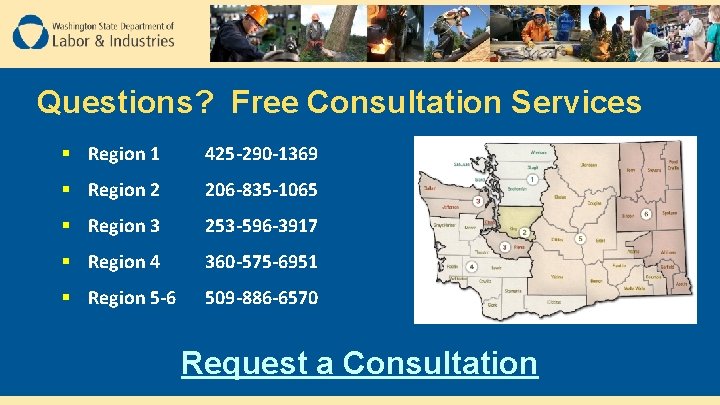
Questions? Free Consultation Services § Region 1 425 -290 -1369 § Region 2 206 -835 -1065 § Region 3 253 -596 -3917 § Region 4 360 -575 -6951 § Region 5 -6 509 -886 -6570 Request a Consultation
Additional Resources https: //www. doh. wa. gov/Emergencies/Coronavirus https: //www. lni. wa. gov/agency/outreach/novel-coronavirus-outbreak-covid-19 resources https: //www. cdc. gov/coronavirus/2019 -n. Co. V/index. html https: //www. osha. gov/SLTC/covid-19/ https: //www. cdc. gov/coronavirus/2019 -ncov/symptoms-testing/symptoms. html