
Protecting Patient Privacy Information Security HIPAA Compliance INTRODUCTION
- Slides: 19
Protecting Patient Privacy & Information Security HIPAA Compliance
INTRODUCTION Ø As an employee, student, agency or volunteer of Mc. Alester Regional Health Center, you may see and hear confidential patient health information. Ø We are committed to protecting the privacy of patients and the security of the health information they entrust to us. Under both State and Federal law patients have a right to the privacy and security of their health information. Ø A Federal law, the Health Insurance Portability and Accountability Act Privacy Rule (HIPAA) became effective April 14 th, 2003, and establishes the requirements for use and disclosure of patient information. Ø The HIPAA Security rule became effective on April 21, 2005, and defines the information security requirements for access to patient information. Ø In this presentation, we will explain the HIPAA Privacy Rule, the HIPAA Security Rule, and Mc. Alester Regional Health Center’s privacy and security practices.
WHAT IS HIPAA? Ø HIPAA = The Health Insurance Portability and Accountability Act… A Federal Law Created in 1996 • Protects health information from unauthorized access & misuse • Puts safeguards in place for health information collected, maintained, used or transmitted It is everyone’s responsibility to secure and protect patient health information.
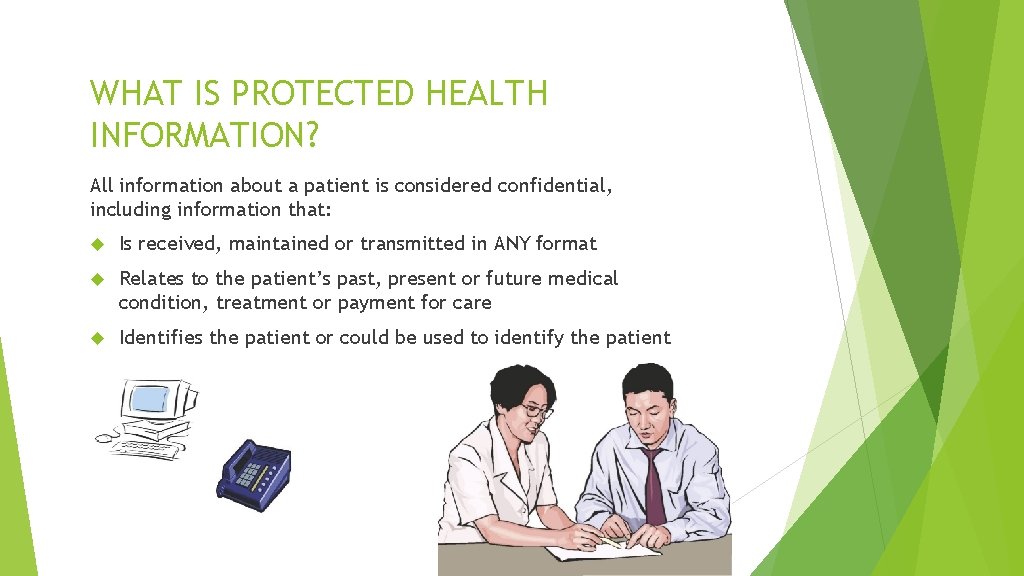
WHAT IS PROTECTED HEALTH INFORMATION? All information about a patient is considered confidential, including information that: Is received, maintained or transmitted in ANY format Relates to the patient’s past, present or future medical condition, treatment or payment for care Identifies the patient or could be used to identify the patient
HOW CAN CONFIDENTIAL HEALTH INFORMATION BE SHARED? To protect a patient’s privacy, confidential health information should be limited to the minimum necessary and only be accessible or shared with those who “need to know” in order to care for the patient or do their job. Use: The sharing of confidential health information within the organization Disclosure: The sharing of confidential health information with others outside the organization
PRIVACY SAFEGUARDS Shred all paper containing confidential information or place in closed receptacles When faxing, verify the fax number before sending Close doors or privacy curtains and lower your voice when having discussions of confidential health information Do not leave medical records unattended or in open areas Keep confidential health information you hear or see to yourself Before looking at patient information ask yourself “Do I need to know this to do my job? ” and if not, don’t look at anything Respect the privacy rights of employees who come here for care by affording their information the utmost confidentiality it deserves
SECURITY SAFEGUARDS Some examples of security safeguards include: Do not use or attempt to use another staff member’s user ID and password to gain access to e. PHI Never leave a workstation signed on/unattended with access to e. PHI Writing down or posting passwords on equipment for login purposes is not permitted Properly dispose of e. PHI on CDs, DVDs, or thumb drives Prevent theft of equipment housing e. PHI Never disable or remove virus detection software It is your responsibility to be aware of these safeguards and follow them in everyday practices.
WHAT DO YOU NEED ACCESS TO? All employees and anyone needing access to any systems at Mc. Alester Regional Health Center will be required to complete a system access form and a Confidentiality Form Directors or supervisors will be responsible for identifying, approving and communicating the systems to which staff need access to Access is dependent on position and job responsibilities Contact the IT Help Desk with any questions, issues or concerns about system access
PASSWORD MANAGEMENT You are responsible for the management of all your passwords used to access e. PHI. The sharing of user accounts and/or passwords is prohibited on Mc. Alester Regional Health Center computer systems and could result in disciplinary actions. Some best practices for password selection include: Select a password that cannot be easily guessed Passwords must include a combination of numbers and letters (upper and lower case) some systems may allow or require special characters Passwords must be at least 6 characters in length Passwords must be changed at least every 180 days Be sure your passwords meet the requirements outlined above!
WORKSTATION USE AND SECURITY In order to access e. PHI, you will need to log into a workstation. Workstation use and security measures are crucial to the security and access to e. PHI. Workstation use and security practices include: Never leave a workstation logged in and unattended; when not in use log out of applications and log off the workstation Where applicable lock the workstation or use a password protected screen saver Workstations must be positioned in a manner to secure e. PHI; if positioning may be a challenge in an areas a privacy screen may be required Unauthorized staff, visitors or patients are not allowed to touch any workstation for any reason You are responsible for securing our workstations and protecting our e. PHI.
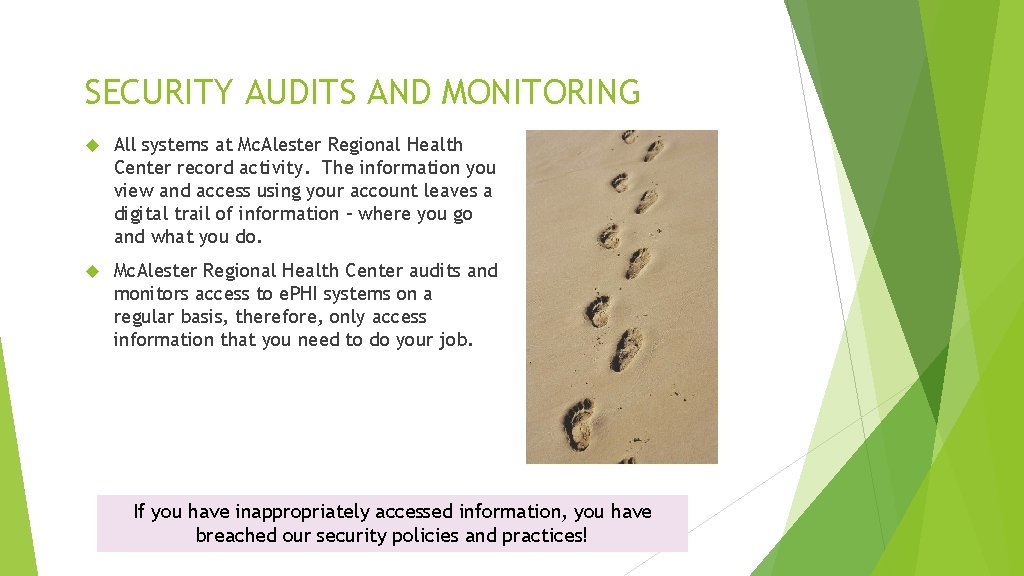
SECURITY AUDITS AND MONITORING All systems at Mc. Alester Regional Health Center record activity. The information you view and access using your account leaves a digital trail of information - where you go and what you do. Mc. Alester Regional Health Center audits and monitors access to e. PHI systems on a regular basis, therefore, only access information that you need to do your job. If you have inappropriately accessed information, you have breached our security policies and practices!
SHARING OF SOME CONFIDENTIAL HEALTH INFORMATION REQUIRES EXTRA CAUTION! The sharing of confidential health information related to certain treatments and services are afforded a higher level of protection under certain State Laws, for example: Alcohol/Substance Abuse Child Abuse Mental Health Genetics HIV-Related Information Oral Disclosure Requires Written Authorization
PERSONAL CONSEQUENCES FOR INAPPROPRIATE ACCESS The penalties that can be levied against an individual for violating these rights can be severe, and include: Termination of employment at Mc. Alester Regional Health Center Charges of professional misconduct and loss of licensure Criminal and civil monetary penalties imposed by the Civil Rights Division of the U. S. Department of Health and Human Services The federal Privacy Rule does not automatically replace state law. When a state law is stricter, or provides for more privacy rights, then the state las will apply. When the federal law provides for more privacy rights then the federal law will apply.
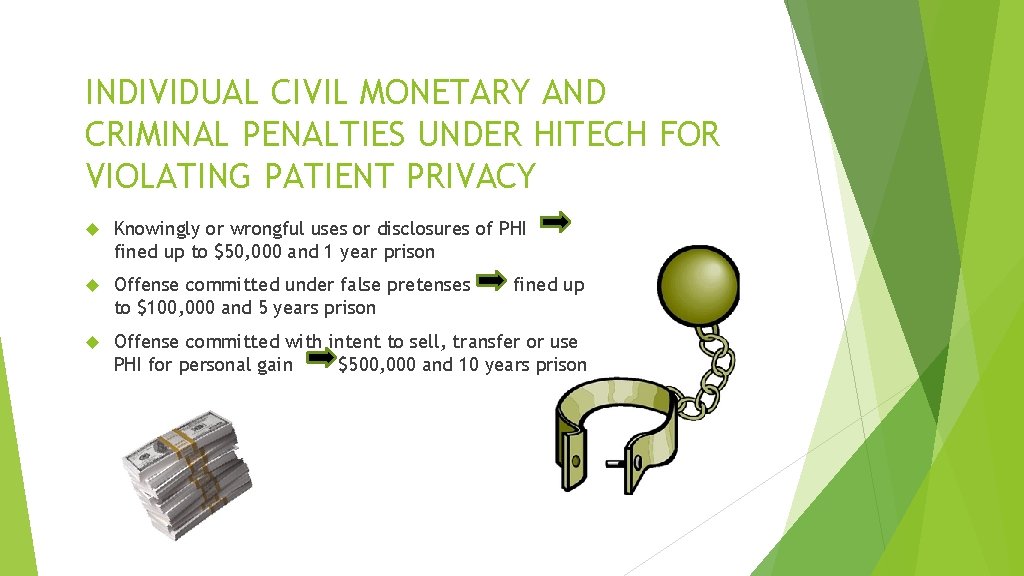
INDIVIDUAL CIVIL MONETARY AND CRIMINAL PENALTIES UNDER HITECH FOR VIOLATING PATIENT PRIVACY Knowingly or wrongful uses or disclosures of PHI fined up to $50, 000 and 1 year prison Offense committed under false pretenses to $100, 000 and 5 years prison Offense committed with intent to sell, transfer or use PHI for personal gain $500, 000 and 10 years prison fined up
SOCIAL NETWORKING SITES Confidential Health Information about a patient should never be posted on a social networking site such as Facebook, My. Space, Twitter, etc. for personal use even if the patient may be the only person who may be able to identify him or herself based on the description. Access to confidential patient information of Mc. Alester Regional Health Center is permitted so care and treatment can be provided to the patient, not for personal use!
WHO DO I CALL? Each organization must have a Privacy and Security Official to ensure compliance with privacy and security policies. If you observe or suspect that the confidentiality or security of a patient’s health information has been violated, you must report it to your supervisor, or the Mc. Alester Regional Health Center Privacy Officer or the Security Officer. We cannot punish your for reporting suspected violations incidents, and in fact, it is considered your responsibility to make such a report!
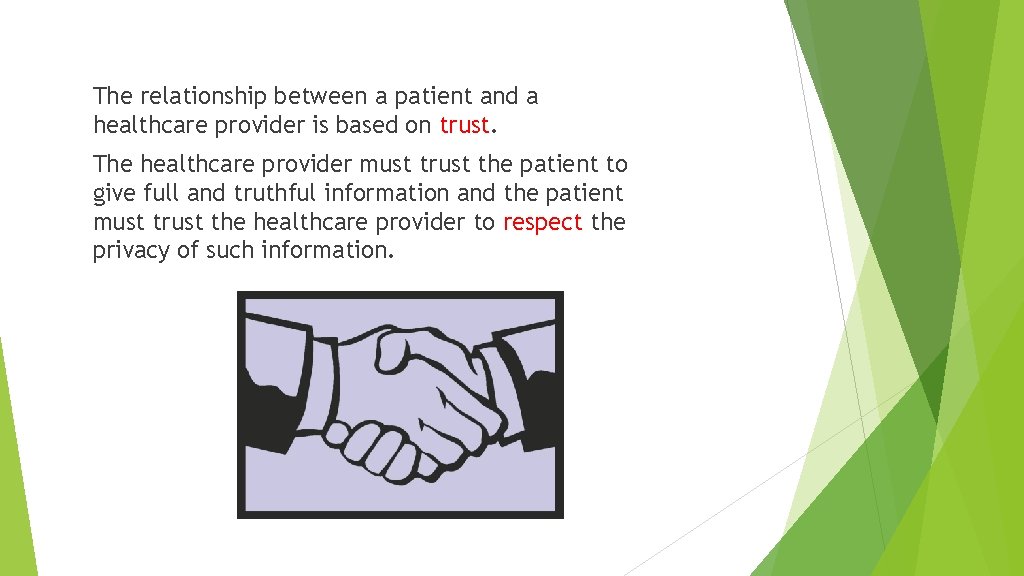
The relationship between a patient and a healthcare provider is based on trust. The healthcare provider must trust the patient to give full and truthful information and the patient must trust the healthcare provider to respect the privacy of such information.
Privacy Issues in the Real World MEDICAL RECORDS RELEASED IN POLITICAL RACE – A congressional candidate, who had once been hospitalized as a result of a suicide attempt, was involved in a heated campaign for elected office. During the campaign someone at the hospital made his medical record available to his opponent. The candidate won the election and then sued the hospital for failing to maintain the privacy of his medical records. MEDICAL RECORDS USED IN A DIVORCE – A man, involved in a bitter divorce, went to the pharmacy where his wife had her prescriptions filled and obtained a list of the drugs she was taking. He then used the information in the divorce proceedings. The woman then sued the pharmacy for releasing her records without her permission. TOO MUCH INFORMATION IN THE WAITING ROOM – A man decided to have a vasectomy after he and his wife had several children. While sitting in a crowded waiting room, a nurse came out and called for another man. When that man stood up, the nurse then asked in front of all those waiting if he was one of the men to have a vasectomy. MEDICAL RECORDS BLOWING IN THE WIND – In Allentown, PA people headed to work in the downtown area literally found hospital records littering the streets and blown about by the wind. All the records were from a nearby hospital and represented about 100 patients. The records contained patients’ names, addresses, doctors’ exam records, nursing notes, lab reports, and radiology reports. The records were all taken by a temporary employee who was going to organize them at home. Exactly how they ended up on the streets has not been determined.