
Protecting our evolutionary companions do our laws measure


- Slides: 38
Protecting our evolutionary companions do our laws measure up? Michelle Maloney, National Convenor Australian Earth Laws Alliance convenor@earthlaws. org. au
Today’s seminar � Overview and intentions � Presentations ◦ Earth jurisprudence ◦ Environmental Law ◦ Animal law � Discussion � Next steps?
My presentation � Questions – our relationship with non-human animals, and the role of law � Overview of Earth jurisprudence � Questions – differences and intersections between these areas of law ◦ Why do these differences exist? ◦ Is there a better way to regulate human relationships with animals? (or not? ) ◦ Trends and issues for discussion
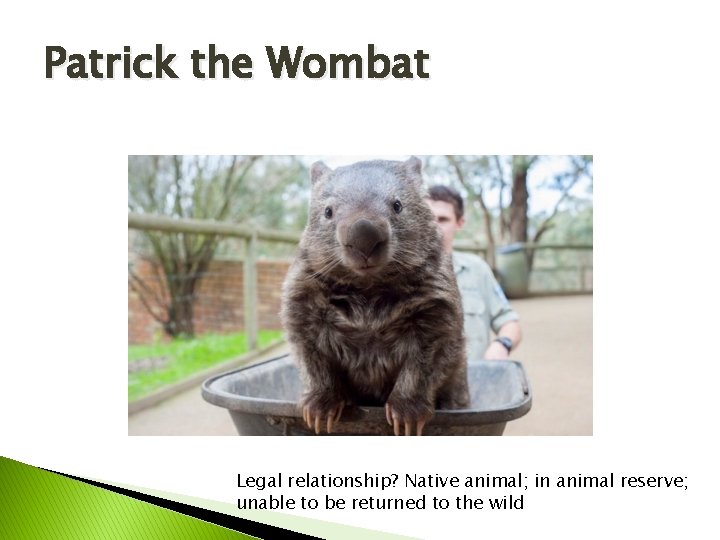
Patrick the Wombat Legal relationship? Native animal; in animal reserve; unable to be returned to the wild
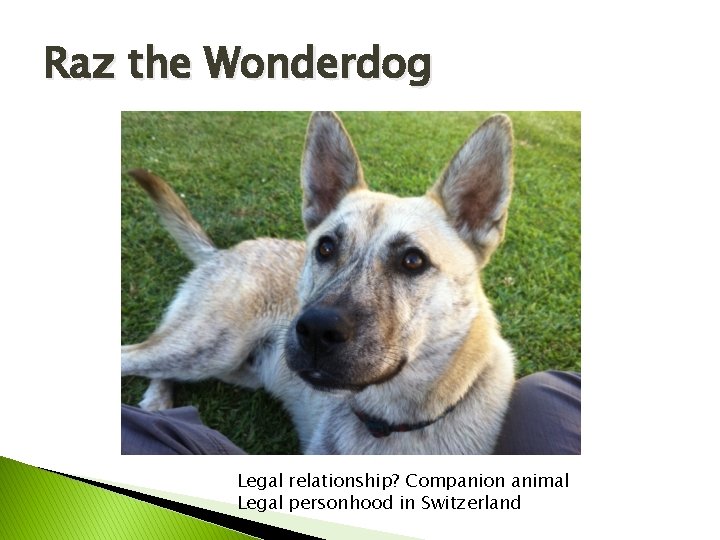
Raz the Wonderdog Legal relationship? Companion animal Legal personhood in Switzerland
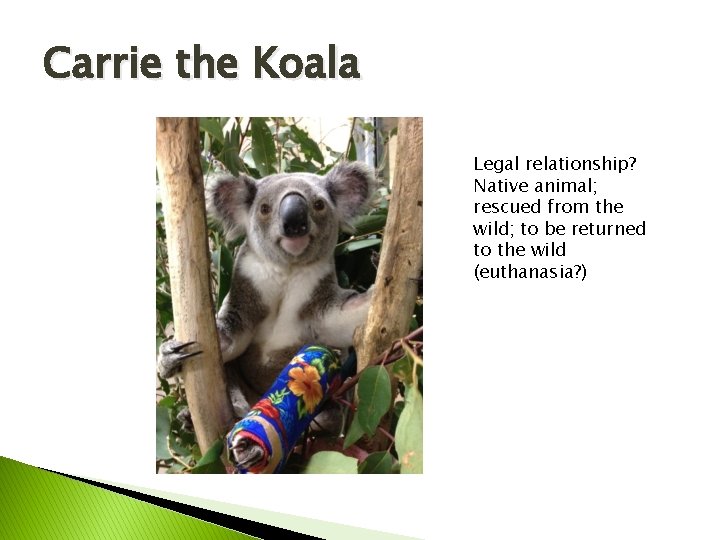
Carrie the Koala Legal relationship? Native animal; rescued from the wild; to be returned to the wild (euthanasia? )
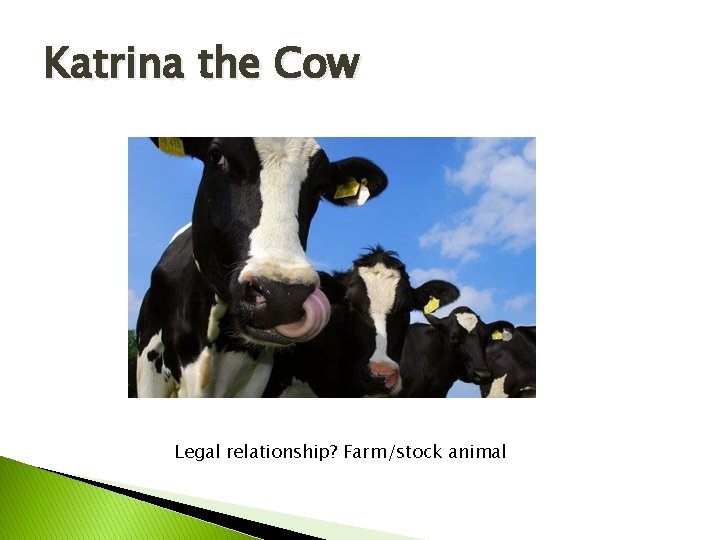
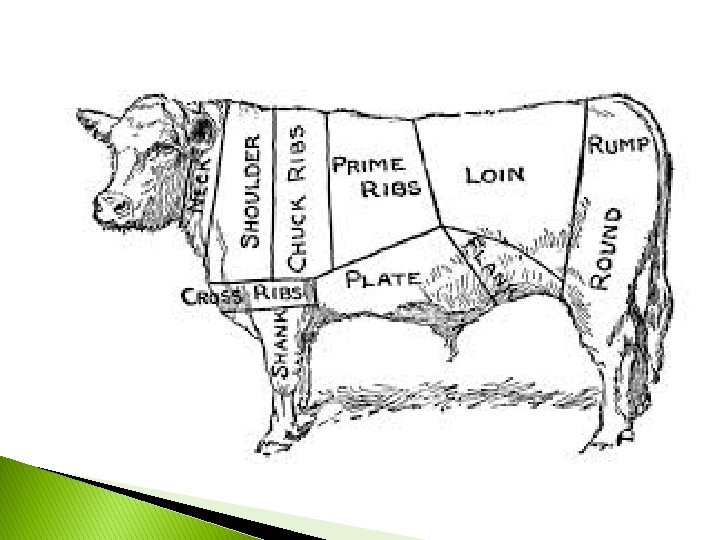
Katrina the Cow Legal relationship? Farm/stock animal
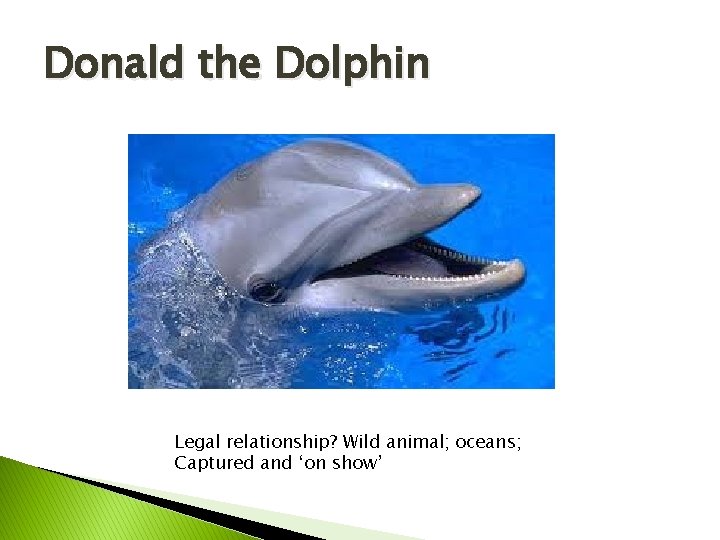
Donald the Dolphin Legal relationship? Wild animal; oceans; Captured and ‘on show’
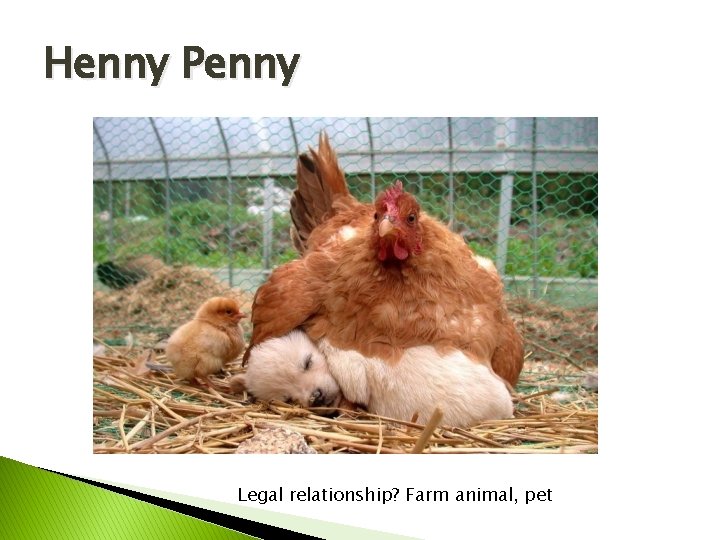
Henny Penny Legal relationship? Farm animal, pet
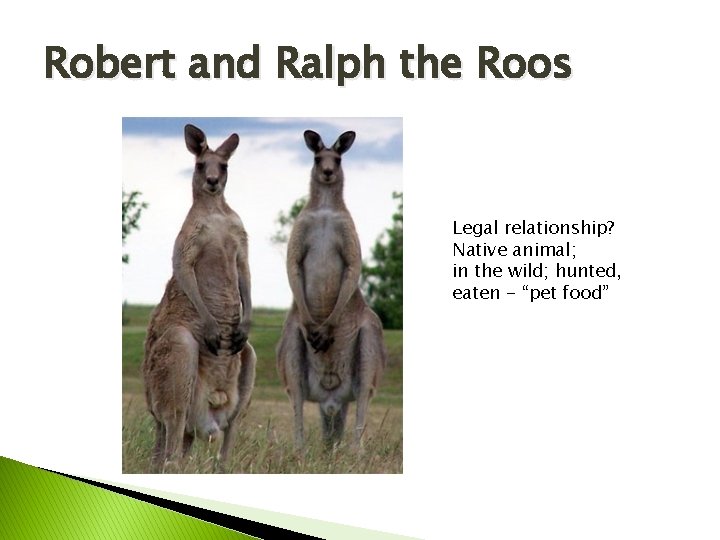
Robert and Ralph the Roos Legal relationship? Native animal; in the wild; hunted, eaten - “pet food”
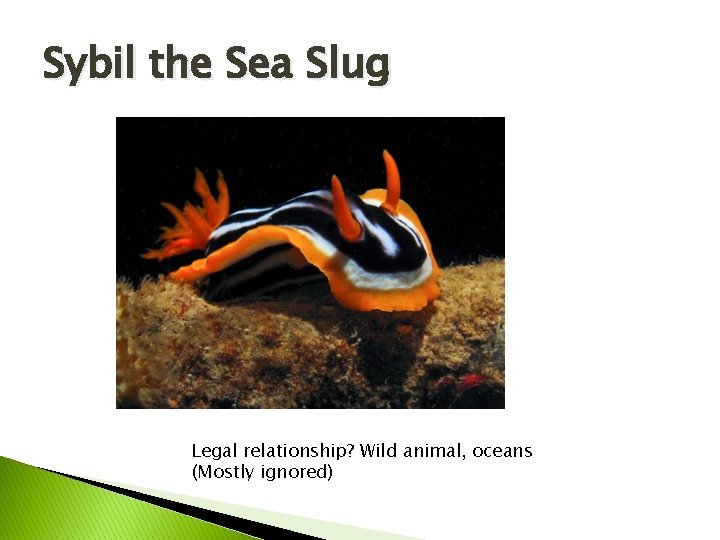
Sybil the Sea Slug Legal relationship? Wild animal, oceans (Mostly ignored)
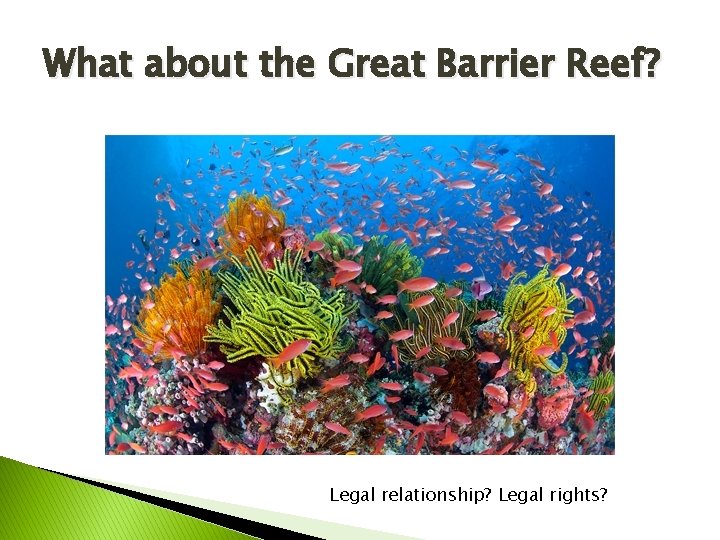
What about the Great Barrier Reef? Legal relationship? Legal rights?
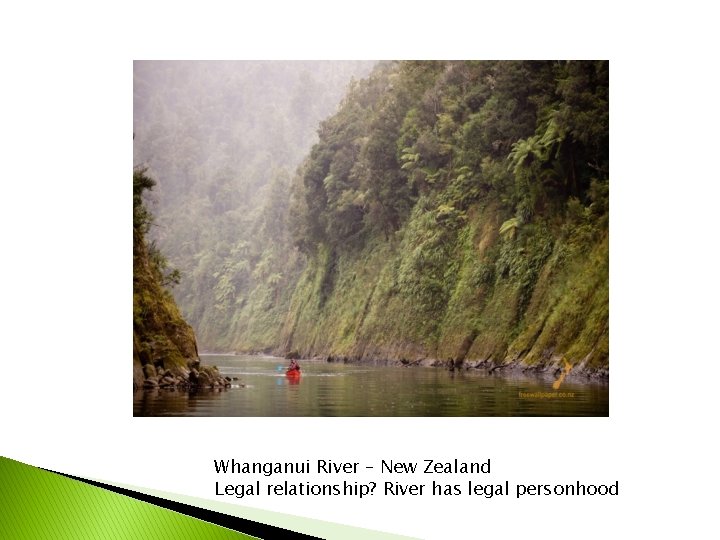
Whanganui River – New Zealand Legal relationship? River has legal personhood
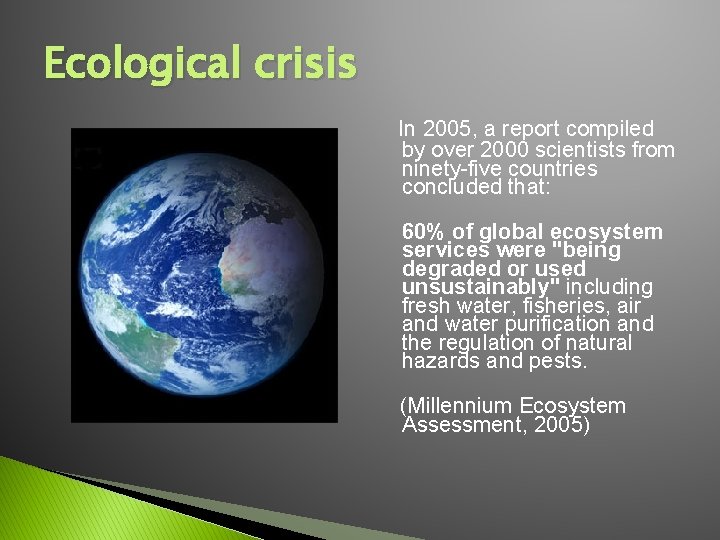
Ecological crisis In 2005, a report compiled by over 2000 scientists from ninety-five countries concluded that: 60% of global ecosystem services were "being degraded or used unsustainably" including fresh water, fisheries, air and water purification and the regulation of natural hazards and pests. (Millennium Ecosystem Assessment, 2005)
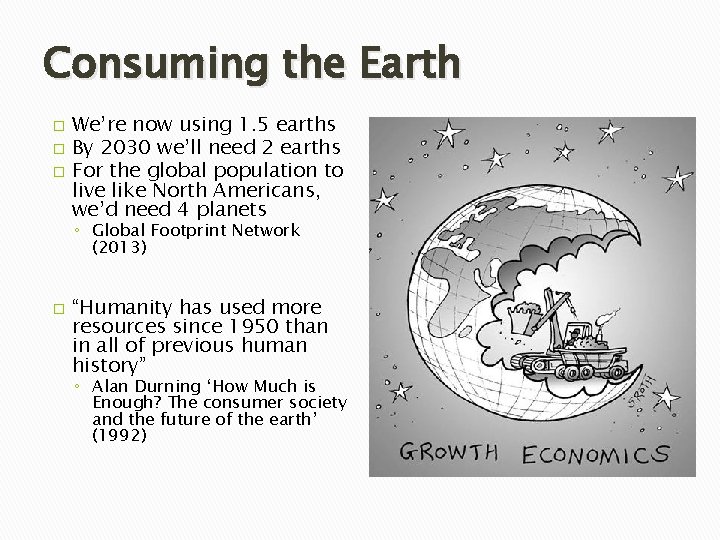
Consuming the Earth � � � We’re now using 1. 5 earths By 2030 we’ll need 2 earths For the global population to live like North Americans, we’d need 4 planets ◦ Global Footprint Network (2013) � “Humanity has used more resources since 1950 than in all of previous human history” ◦ Alan Durning ‘How Much is Enough? The consumer society and the future of the earth’ (1992)
Human responses � Current ecological crisis is pushing humanity to search for new ideas, different ways of thinking, better ways of caring for our planet ◦ Science, politics, engineering and design, economics, philosophy, ethics, spirituality, law and governance
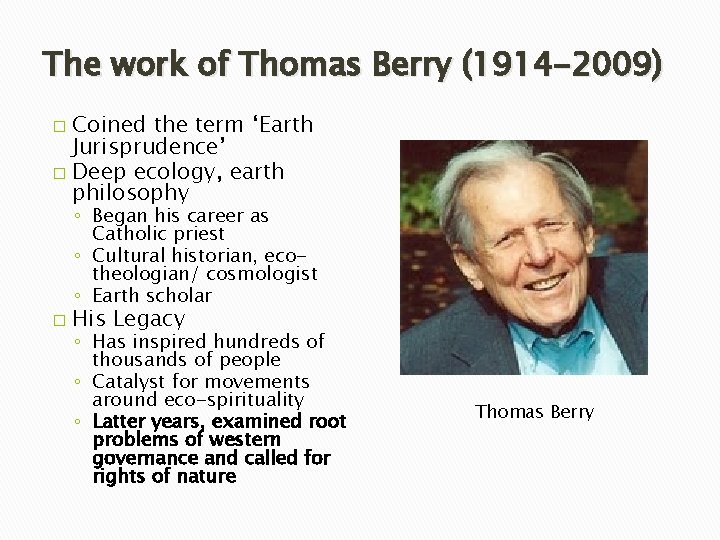
The work of Thomas Berry (1914 -2009) Coined the term ‘Earth Jurisprudence’ � Deep ecology, earth philosophy � ◦ Began his career as Catholic priest ◦ Cultural historian, ecotheologian/ cosmologist ◦ Earth scholar � His Legacy ◦ Has inspired hundreds of thousands of people ◦ Catalyst for movements around eco-spirituality ◦ Latter years, examined root problems of western governance and called for rights of nature Thomas Berry
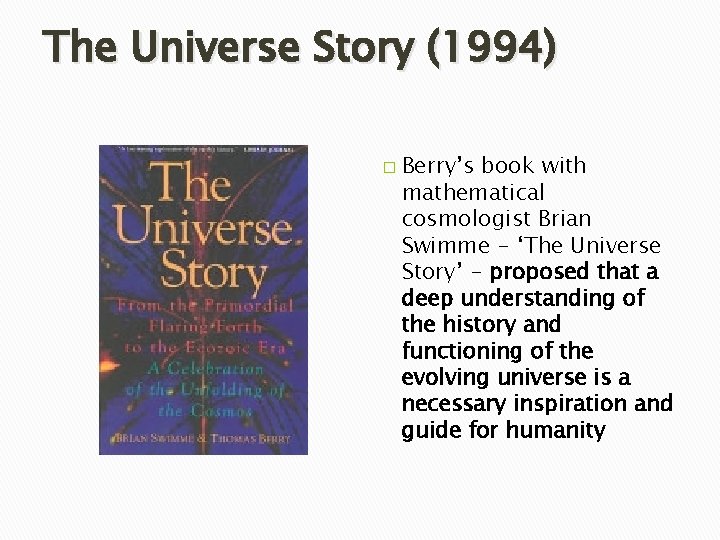
The Universe Story (1994) � Berry’s book with mathematical cosmologist Brian Swimme - ‘The Universe Story’ - proposed that a deep understanding of the history and functioning of the evolving universe is a necessary inspiration and guide for humanity
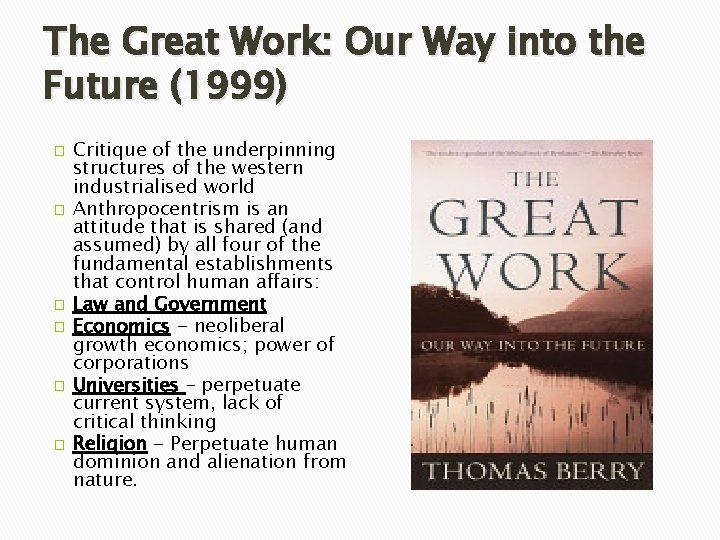
The Great Work: Our Way into the Future (1999) � � � Critique of the underpinning structures of the western industrialised world Anthropocentrism is an attitude that is shared (and assumed) by all four of the fundamental establishments that control human affairs: Law and Government Economics - neoliberal growth economics; power of corporations Universities – perpetuate current system, lack of critical thinking Religion - Perpetuate human dominion and alienation from nature.
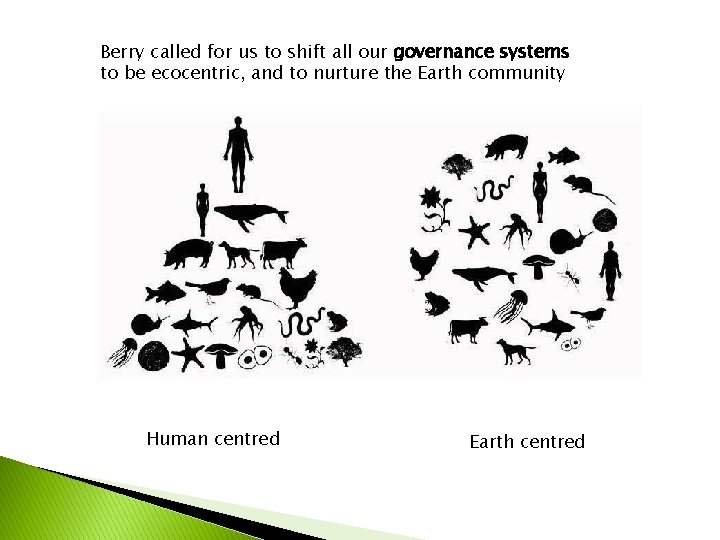
Berry called for us to shift all our governance systems to be ecocentric, and to nurture the Earth community Human centred Earth centred
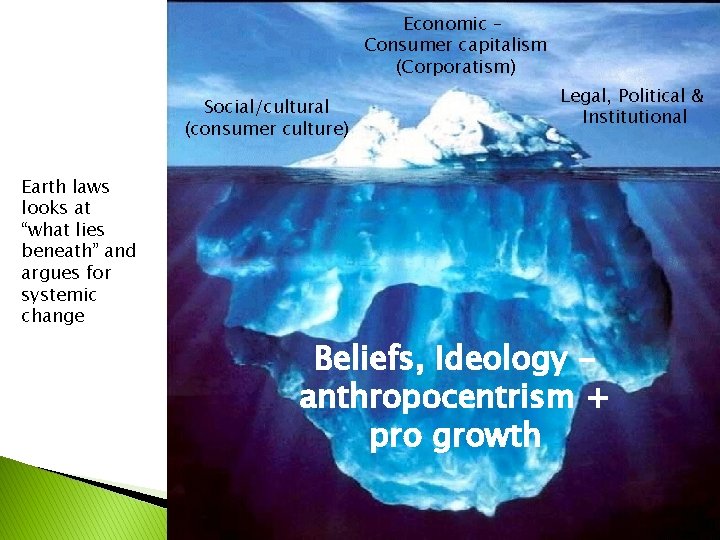
Economic – Consumer capitalism (Corporatism) Social/cultural (consumer culture) Legal, Political & Institutional Earth laws looks at “what lies beneath” and argues for systemic change Beliefs, Ideology anthropocentrism + pro growth
Earth jurisprudence � Berry called for a new, earth centric governance system for humanity � ‘Earth jurisprudence’ - emerging theory/philosophy of law and human governance that is based on the idea that humans are only one part of a wider community (the Earth community) and the welfare of each member of this community is dependent on the welfare of the earth as a whole � Doesn’t exclude humans – just asks us to re-examine our privileged position on earth
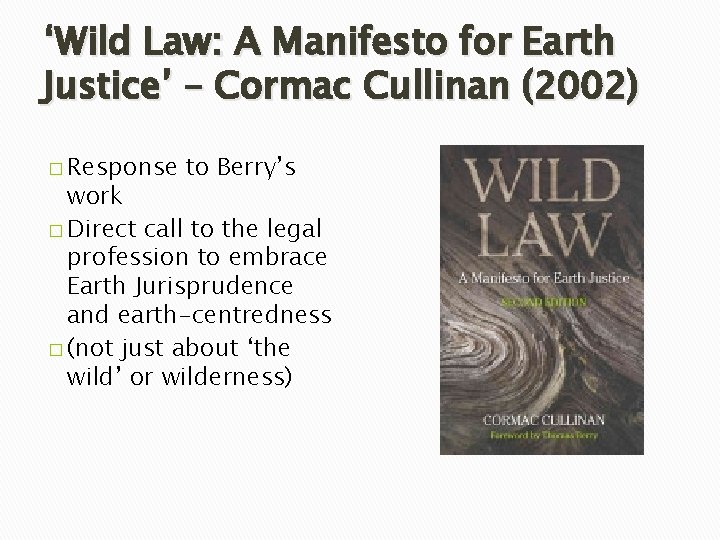
‘Wild Law: A Manifesto for Earth Justice’ – Cormac Cullinan (2002) � Response to Berry’s work � Direct call to the legal profession to embrace Earth Jurisprudence and earth-centredness � (not just about ‘the wild’ or wilderness)
Our evolutionary companions � [T]oday, legally speaking, it is not possible to murder an animal. . . no matter what the magnitude of the slaughter is or what degree of brutality, depravity or cruelty is involved. At worst one might fall foul of animal cruelty laws (which are probably mainly intended to protect human sensibilities). . . � (Cullinan 2011: 70 -1)
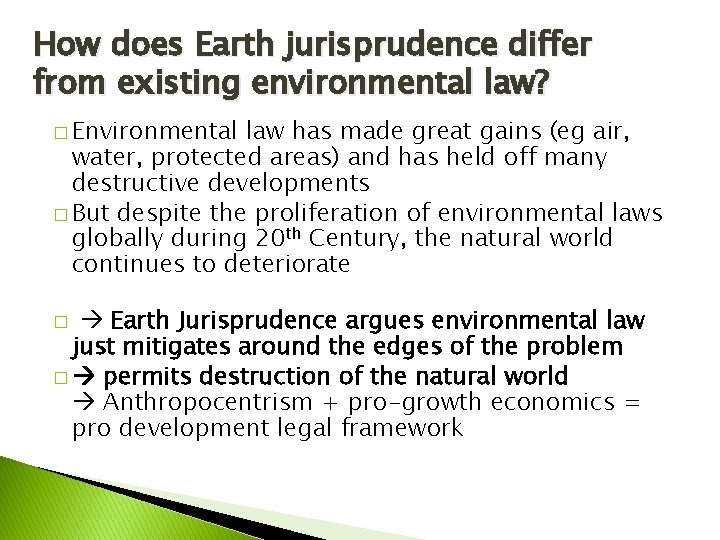
How does Earth jurisprudence differ from existing environmental law? � Environmental law has made great gains (eg air, water, protected areas) and has held off many destructive developments � But despite the proliferation of environmental laws globally during 20 th Century, the natural world continues to deteriorate Earth Jurisprudence argues environmental law just mitigates around the edges of the problem � permits destruction of the natural world Anthropocentrism + pro-growth economics = pro development legal framework �
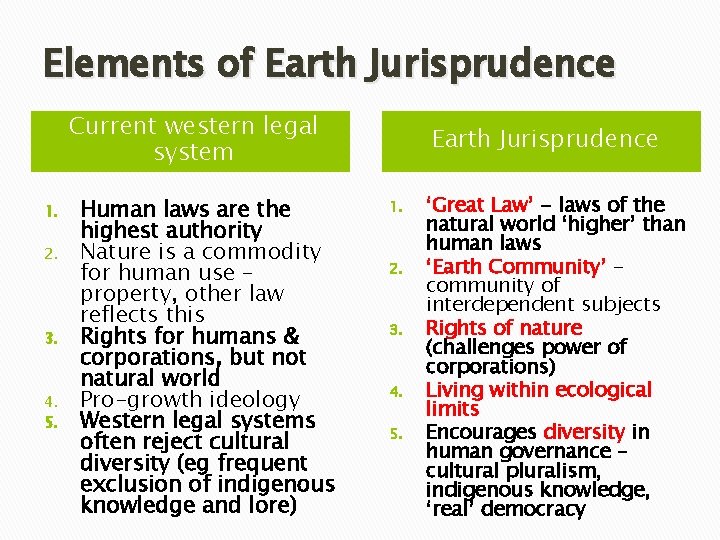
Elements of Earth Jurisprudence Current western legal system 1. 2. 3. 4. 5. Human laws are the highest authority Nature is a commodity for human use – property, other law reflects this Rights for humans & corporations, but not natural world Pro-growth ideology Western legal systems often reject cultural diversity (eg frequent exclusion of indigenous knowledge and lore) Earth Jurisprudence 1. 2. 3. 4. 5. ‘Great Law’ - laws of the natural world ‘higher’ than human laws ‘Earth Community’ community of interdependent subjects Rights of nature (challenges power of corporations) Living within ecological limits Encourages diversity in human governance – cultural pluralism, indigenous knowledge, ‘real’ democracy
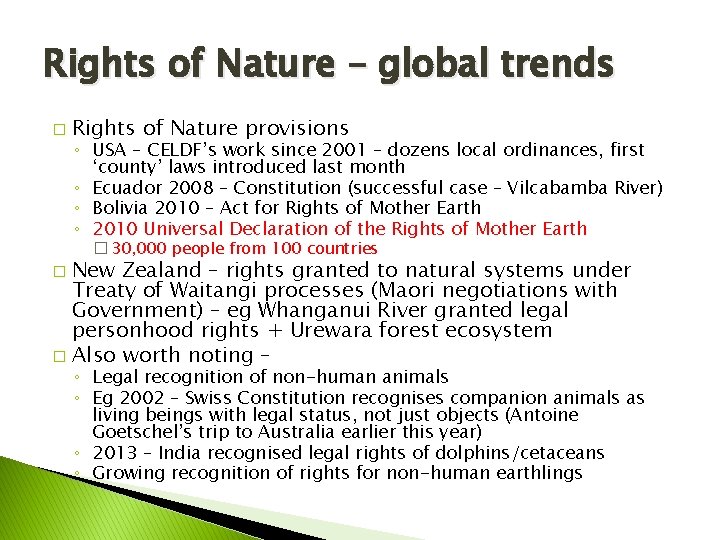
Rights of Nature – global trends � Rights of Nature provisions ◦ USA – CELDF’s work since 2001 – dozens local ordinances, first ‘county’ laws introduced last month ◦ Ecuador 2008 – Constitution (successful case – Vilcabamba River) ◦ Bolivia 2010 – Act for Rights of Mother Earth ◦ 2010 Universal Declaration of the Rights of Mother Earth � 30, 000 people from 100 countries New Zealand – rights granted to natural systems under Treaty of Waitangi processes (Maori negotiations with Government) – eg Whanganui River granted legal personhood rights + Urewara forest ecosystem � Also worth noting – � ◦ Legal recognition of non-human animals ◦ Eg 2002 – Swiss Constitution recognises companion animals as living beings with legal status, not just objects (Antoine Goetschel’s trip to Australia earlier this year) ◦ 2013 – India recognised legal rights of dolphins/cetaceans ◦ Growing recognition of rights for non-human earthlings
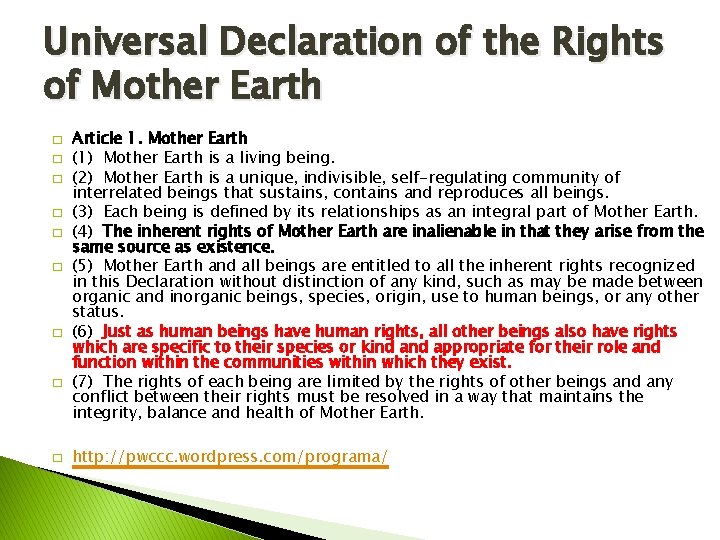
Universal Declaration of the Rights of Mother Earth � � � � � Article 1. Mother Earth (1) Mother Earth is a living being. (2) Mother Earth is a unique, indivisible, self-regulating community of interrelated beings that sustains, contains and reproduces all beings. (3) Each being is defined by its relationships as an integral part of Mother Earth. (4) The inherent rights of Mother Earth are inalienable in that they arise from the same source as existence. (5) Mother Earth and all beings are entitled to all the inherent rights recognized in this Declaration without distinction of any kind, such as may be made between organic and inorganic beings, species, origin, use to human beings, or any other status. (6) Just as human beings have human rights, all other beings also have rights which are specific to their species or kind appropriate for their role and function within the communities within which they exist. (7) The rights of each being are limited by the rights of other beings and any conflict between their rights must be resolved in a way that maintains the integrity, balance and health of Mother Earth. http: //pwccc. wordpress. com/programa/
Steven White “Wild law and animal law: some commonalities and differences” � Animal law – prevention of cruelty laws since colonial settlement; emergence as a strong field since 1990 s � Earth Jurisprudence – 21 st Century � Core areas of examination ◦ Both critique current law for allowing exploitation of animals ◦ Both include rights based discourse – shift from objects to subjects ◦ Wild law doesn’t differentiate species by sentience or other ‘categories’ - everything has a place in the Earth community ◦ Reforming property doctrine – wild law calls for radical transformation
More questions � What would an earth centred legal system look like? ◦ Earth first – ecological integrity � What would it permit and prevent in society? ◦ Eg factory farming does not fit within a vision of Earth jurisprudence; small scale, sustainable organic farms can. But is this enough? � How would we frame legal recognition and protection of animals? � How do we get there from here? ◦ Reminder: civil society movements – votes for women; abolition of slavery
Issues for discussion � Why do our laws treat different animals differently? � Are our laws adequate? � In light of current political trends – retreat of the state, regression of environmental laws (and civil rights) – ◦ What can we do to ensure the protection and just treatment of our evolutionary companions? ◦ How do we handle increasing responsibilities being pushed back onto civil society?