
Protecting Children from Abuse CHILD SAFE ENVIRONMENT TRAINING
Protecting Children from Abuse CHILD SAFE ENVIRONMENT TRAINING PART 1 -C National Bahá’í Centre CHILD PROTECTION POLICY TRAINING Power. Point August 2020 DRAFT version 1 Photos are Copyright © Bahá'í International Community
• your role in protecting children • responding to a child who tells you about harm or abuse • child abuse and neglect • how you can help a child or family you're worried about • reporting requirements • ways to keep children safe in the community
Warning! If you believe a child is in immediate danger, contact 000. Protecting children can be a confronting subject for some people. It can be upsetting to think about vulnerable children being mistreated. It may also bring up experiences of your own childhood which may include memories of abuse, neglect or difficult emotions. It is important to pay attention to your emotions while completing this training module and take a break if you need to.
What’s my role?
Protecting children is about keeping children safe. All children should have loving care and should feel safe. We can all work together to do this, because protecting children is everyone’s business. A child is any person under the age of 18 for the purpose of the Child Protection Policy.
Responding to a child who tells you about harm or abuse
You may have noticed some warning signs of abuse or neglect of a child. Or a child may directly tell you about abuse or harm they are suffering. For example that they are scared to go home because their father is hitting them. Here are some guidelines on how to make sure the child feels supported and safe: • Listen calmly, patiently, and supportively. Let the child use their own words. • Reassure. Let the child know that they are doing the right thing by speaking up. Tell them that what has happened to them is not their fault. • Inform. Tell them that you’ll need to talk to someone whose job it is to keep them safe.
Do not quiz. It is ok to encourage a child to open up by asking some open questions such as ‘Can you tell me what happened’ or ‘Can you tell me more about that’ however quizzing a child for details or asking them to repeat their story can create the impression that you doubt what they have said. Image: Attribution 4. 0 International (CC BY 4. 0)
Child abuse and neglect
What is child abuse? Generally speaking, child abuse is the mistreatment of a child by a parent or caregiver or in the context of any other relationship of responsibility, trust or power. Child abuse is defined as an action or inaction that causes injury, death, emotional harm or risk of harm to a child. Abuse can be separated into 4 different categories: • Physical abuse • Sexual abuse • Emotional abuse • Neglect

Physical Abuse Physical abuse is the non-accidental use of physical force against a child that results in harm to the child. Physical abuse can be punching, kicking or slapping, biting, strangling or choking, shaking, burning or poisoning. Discipline can become abuse when it causes injury, is extreme or unnecessary, or makes the child fearful. Image: Attribution 3. 0 Unported (CC BY 3. 0)
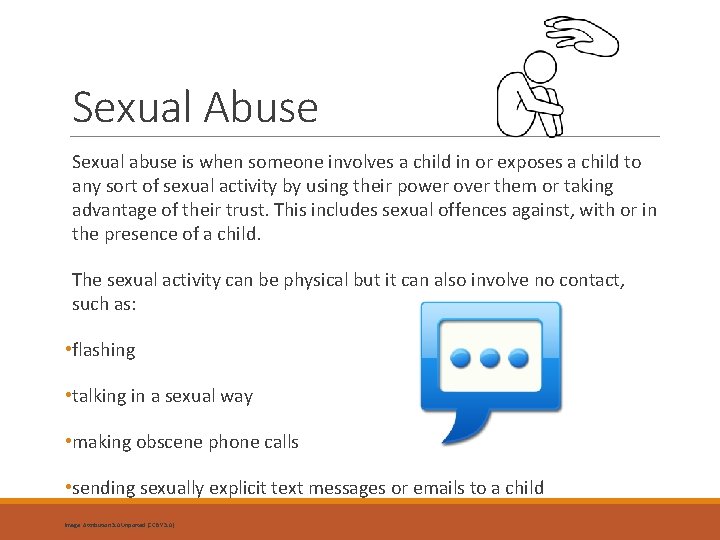
Sexual Abuse Sexual abuse is when someone involves a child in or exposes a child to any sort of sexual activity by using their power over them or taking advantage of their trust. This includes sexual offences against, with or in the presence of a child. The sexual activity can be physical but it can also involve no contact, such as: • flashing • talking in a sexual way • making obscene phone calls • sending sexually explicit text messages or emails to a child Image: Attribution 3. 0 Unported (CC BY 3. 0)
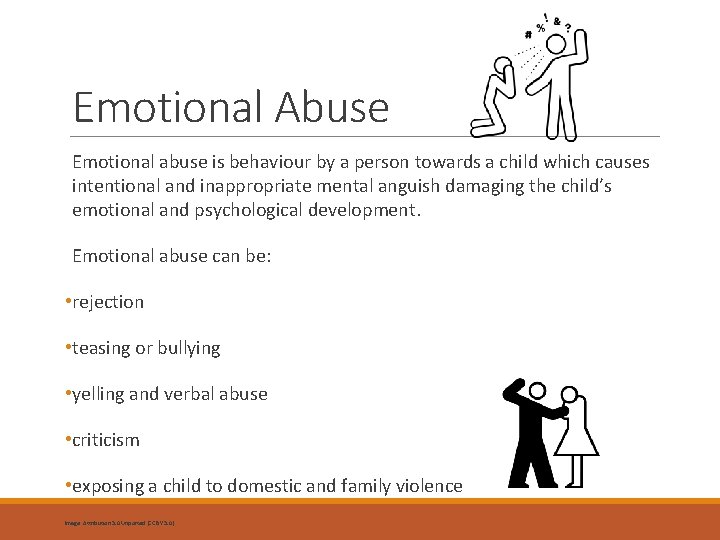
Emotional Abuse Emotional abuse is behaviour by a person towards a child which causes intentional and inappropriate mental anguish damaging the child’s emotional and psychological development. Emotional abuse can be: • rejection • teasing or bullying • yelling and verbal abuse • criticism • exposing a child to domestic and family violence Image: Attribution 3. 0 Unported (CC BY 3. 0)
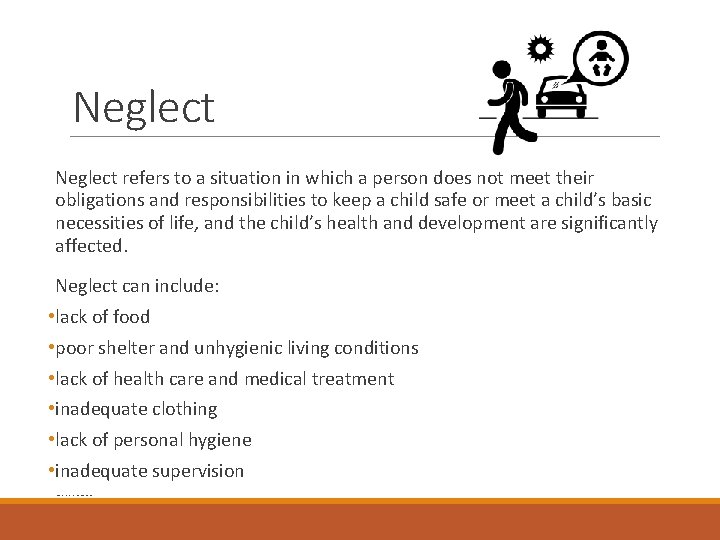
Neglect refers to a situation in which a person does not meet their obligations and responsibilities to keep a child safe or meet a child’s basic necessities of life, and the child’s health and development are significantly affected. Neglect can include: • lack of food • poor shelter and unhygienic living conditions • lack of health care and medical treatment • inadequate clothing • lack of personal hygiene • inadequate supervision Image : Attribution 3. 0 Unported (CC BY 3. 0)
Impacts of abuse and neglect Child abuse and neglect can have both short- and long-term impacts for children. The younger the child and the more vulnerable they are, the more serious the consequences are likely to be. Serious and lasting impacts can happen when nobody responds to the abuse and no support is offered to the child and family. However, children have the best opportunity to recover from the effects of abuse and neglect when they receive the right support early on. Support and counselling can also help them learn ways to stay safe and ask for help if they need it in the future. Image: Attribution 3. 0 Unported (CC BY 3. 0)
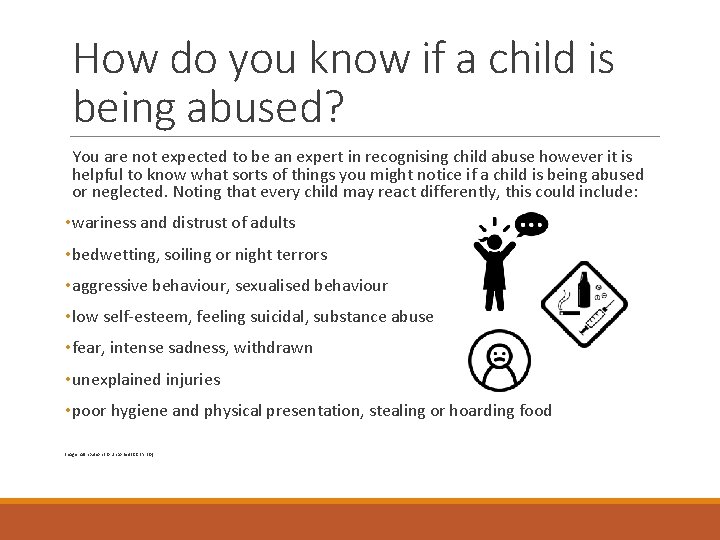
How do you know if a child is being abused? You are not expected to be an expert in recognising child abuse however it is helpful to know what sorts of things you might notice if a child is being abused or neglected. Noting that every child may react differently, this could include: • wariness and distrust of adults • bedwetting, soiling or night terrors • aggressive behaviour, sexualised behaviour • low self-esteem, feeling suicidal, substance abuse • fear, intense sadness, withdrawn • unexplained injuries • poor hygiene and physical presentation, stealing or hoarding food Image: Attribution 3. 0 Unported (CC BY 3. 0)
How can I help?
There a number of people and organisations involved in supporting children and their families. Everyone is responsible for protecting children. In the context of the community building activities in the neighbourhood, such as the programs for the spiritual education of children and the spiritual empowerment of youth, or community events supported by the Baha’is, who may get involved in protecting children? • A child’s family • Local Child Safety Services • The Local Police Service • The Local Spiritual Assembly of the Baha’is: an annually elected body that administers the affairs of the local Baha’i community and is concerned with the wellbeing of everyone in the locality • Auxiliary Board members: adults, aged 21 and over, appointed, amongst other responsibilities, to support community building activities at the grassroots in a specific area • You
Reporting to child safety services If a child is in immediate danger, contact Emergency Services on 000. If you suspect a child has been harmed or is at risk of harm, contact the appropriate government agency for advice. • ACT Child and Youth Protection Services 1300 556 729 (24 hours) • NSW Dept. of Family and Community … 13 21 11 (24 hours) • NT Territory Families 1800 700 250 (24 hours) • QLD Dept. of Child Safety… 1800 177 135 (24 hours) • TAS Children and Youth Services 1300 737 639 (24 hours) • SA Dept. of Child Protection 13 14 78 (24 hours) • VIC Dept. of Health and Human … Visit website for local contact or afterhours: 13 12 78 • WA Dept. of Communities, … (08) 9223 1111 or 1800 199 008 They may refer you to a community support service or give you advice on how you can support the family or get involved directly themselves. Once you have contacted the agency, make a note of what you have said and what advice they have given, including a reference number, and inform the Local Spiritual Assembly (or Auxiliary Board member for Protection). Image: Attribution 3. 0 Unported (CC BY 3. 0)
Mandatory Reporting child abuse and neglect is often mandatory and is a requirement under the Child Protection Policy. 1. Pick up the phone to the government agency! 2. Make a record of the conversation! 3. Send the report to the Local Spiritual Assembly or directly to the National Spiritual Assembly at secretariat@bnc. bahai. org. au In some cases, the Local Spiritual Assembly may need to ask the person accused of abuse to stand aside from working with children while the matter is under investigation. This of course is for the safety of children and not a presumption of guilt. Image: Attribution 3. 0 Unported (CC BY 3. 0)
Respect After reporting, keep the matter strictly confidential and private !!! Be available as a good listener to the child It is not your role to investigate or decide who should know, which is left to child protection agencies and the Local Spiritual Assembly. If the you feel the parents need to know of your report out of courtesy or for the safety of the child, ask the child protection agencies for advice on this. You can of course seek counselling if you are feeling anxious or upset.
How can we keep children safe in the community?
• Check that anyone working with children and young people has a working with children check and is accredited under the Baha’i Child protection Policy. • Be well familiar with the standards of conduct for working with children and young people and undertake further training in child-safety • Assess and mitigate risks of harm when planning overnight activities, high-risk excursions or special events • Where no supervision is formally provided at activities and events, encourage parents to actively supervise their children , making sure their child is in safe spaces with people that they trust. Image: Attribution 3. 0 Unported (CC BY 3. 0)
Working with Children and young people?
Take time to complete the Child Protection Accreditation Application Form You will need to have read the outline of the Child Protection Policy and Standards of Conduct (www. cppt. bahai. org. au) and submit a Working with Children Check. Image: Attribution 4. 0 International (CC BY 4. 0)
THANK YOU! If having participated in this training module, you feel distressed, here are some counselling and support services to contact that may have email and chat options too: • If you have experienced childhood trauma, you can speak with a Blue Knot Helpline trauma counsellor : 1300 657 380 or via email helpline@blueknot. org. au • Lifeline: 13 11 14; www. lifeline. org. au • Australian Childhood Foundation: 1800 174 453; www. childhood. org. au
- Slides: 26