
Protected Leave Navigating the Intersections Between FMLA OFLA
Protected Leave: Navigating the Intersections Between FMLA, OFLA, the ADA and Other Legal Requirements H IGH LAUREN LESTER S TAFF A TTORNEY D ESERT E DUCATION S ERVICE D ISTRICT R EDMOND , OR O S P A S PRING C ONFERENCE A P R I L 2 3 , 2 0 1 8
Roadmap �Overview of legal requirements governing protected leave for illness, injury, impairment, or physical or mental condition FMLA OFLA ADA/ADAAA Sick leave/time laws Workers’ compensation Collective bargaining agreements �Hypothetical scenarios �Best practices �Questions
FMLA Overview � Federal law allowing eligible employees to take up to 12 workweeks of FMLA leave per year: For the birth or placement of a child for adoption or foster care; To care for a spouse, child, or parent with a serious health condition; and For the employee’s own serious health condition Special additional rules for military families � To be eligible for FMLA, an employee must have worked for a total of at least 12 months (not necessarily consecutive, but within the previous 7 years) and worked for at least 1250 hours during the 12 month period preceding the leave and 50 or more employees must work within 75 miles of the employee’s worksite � Applies to public agencies (including school districts) regardless of the number of employees
OFLA Overview � State law allowing eligible employees to take up to 12 weeks of leave per year for: For the employee’s serious health condition For the serious health condition of an employee’s covered family member Pregnancy disability Parental leave to bond with and care for new child 2 weeks of bereavement leave per covered family member (unlike FMLA) Non-serious health condition of an employee’s child (unlike FMLA) � To be eligible for OFLA, employee must have worked for a period of of 180 calendar days immediately preceding the date leave begins and must have worked an average of 25 hours per week during the 180 -day period 25 hour requirement inapplicable to parental leave No minimum period of employment requirement under Oregon Military Family Leave Act (must work for employer for an average of 20 hours per week) Special rules for public school teachers (OAR 839 -009 -0290) � Applies to employers with 25 or more employees in Oregon
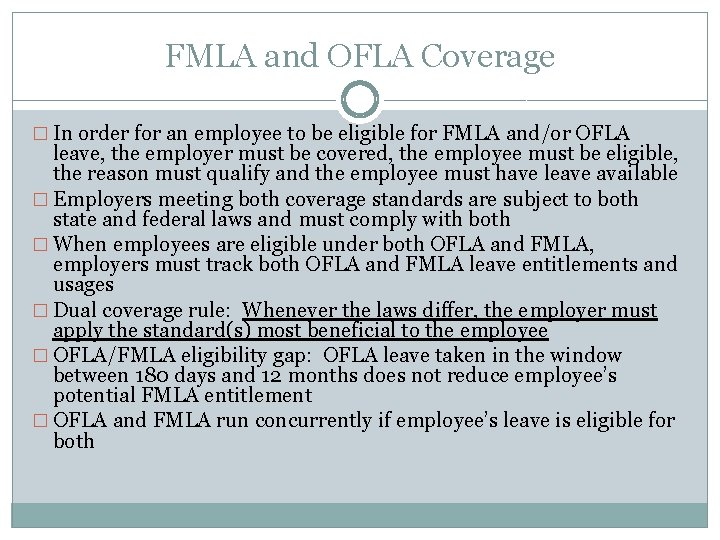
FMLA and OFLA Coverage � In order for an employee to be eligible for FMLA and/or OFLA leave, the employer must be covered, the employee must be eligible, the reason must qualify and the employee must have leave available � Employers meeting both coverage standards are subject to both state and federal laws and must comply with both � When employees are eligible under both OFLA and FMLA, employers must track both OFLA and FMLA leave entitlements and usages � Dual coverage rule: Whenever the laws differ, the employer must apply the standard(s) most beneficial to the employee � OFLA/FMLA eligibility gap: OFLA leave taken in the window between 180 days and 12 months does not reduce employee’s potential FMLA entitlement � OFLA and FMLA run concurrently if employee’s leave is eligible for both

FMLA/OFLA Serious Health Condition � A “serious health condition” is an illness, injury, impairment, or physical or mental condition that falls into one or more of the following categories: Inpatient care (e. g. , back surgery) Chronic conditions (e. g. , diabetes) Constant or continuing treatment (e. g. , broken collar bone, assuming incapacity for more than 3 consecutive days and subsequent treatment) Permanent, long-term or terminal illnesses (e. g. , Alzheimer’s disease) Conditions requiring multiple treatments to forestall incapacity (e. g. , physical therapy for severe arthritis) Pregnancy-related conditions (e. g. , hyperemesis gravidarum) � Be mindful of FMLA/OFLA definitions of “health care provider” � Note that there a number of qualifying absences that may involve less than 3 days off work (e. g. , migraines, miscarriage), and some longer absences may not qualify (e. g. , the flu) � Intersections with workers’ compensation and disability laws— independent legal obligations arising from same condition
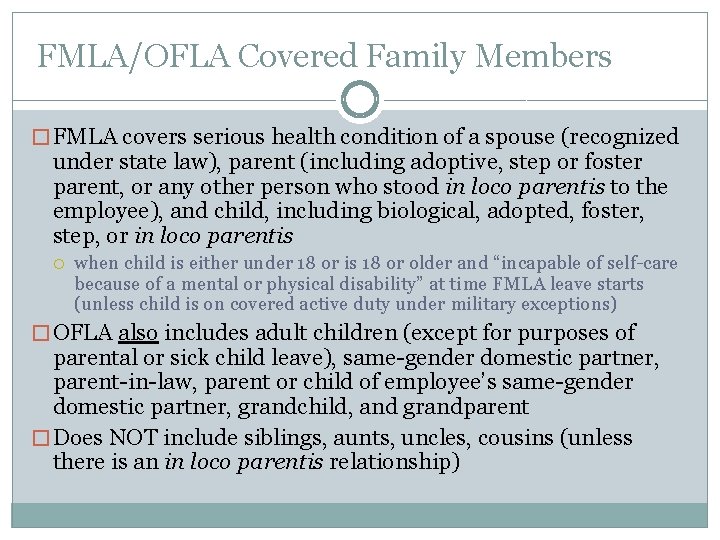
FMLA/OFLA Covered Family Members � FMLA covers serious health condition of a spouse (recognized under state law), parent (including adoptive, step or foster parent, or any other person who stood in loco parentis to the employee), and child, including biological, adopted, foster, step, or in loco parentis when child is either under 18 or is 18 or older and “incapable of self-care because of a mental or physical disability” at time FMLA leave starts (unless child is on covered active duty under military exceptions) � OFLA also includes adult children (except for purposes of parental or sick child leave), same-gender domestic partner, parent-in-law, parent or child of employee’s same-gender domestic partner, grandchild, and grandparent � Does NOT include siblings, aunts, uncles, cousins (unless there is an in loco parentis relationship)
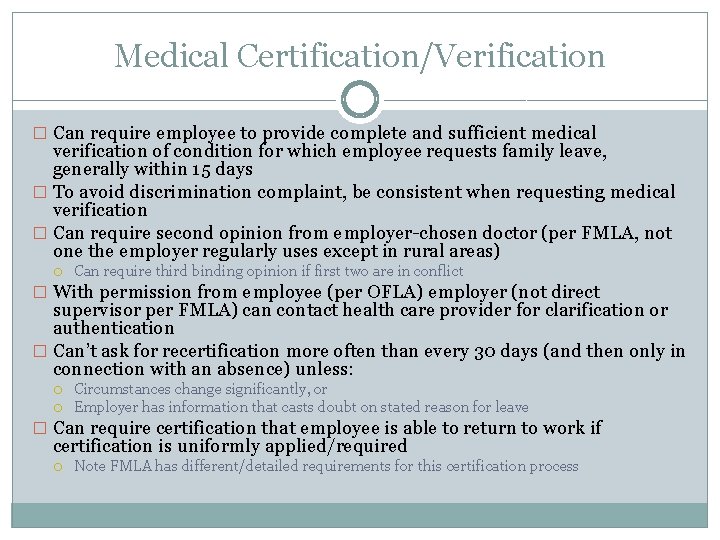
Medical Certification/Verification � Can require employee to provide complete and sufficient medical verification of condition for which employee requests family leave, generally within 15 days � To avoid discrimination complaint, be consistent when requesting medical verification � Can require second opinion from employer-chosen doctor (per FMLA, not one the employer regularly uses except in rural areas) Can require third binding opinion if first two are in conflict � With permission from employee (per OFLA) employer (not direct supervisor per FMLA) can contact health care provider for clarification or authentication � Can’t ask for recertification more often than every 30 days (and then only in connection with an absence) unless: Circumstances change significantly, or Employer has information that casts doubt on stated reason for leave � Can require certification that employee is able to return to work if certification is uniformly applied/required Note FMLA has different/detailed requirements for this certification process
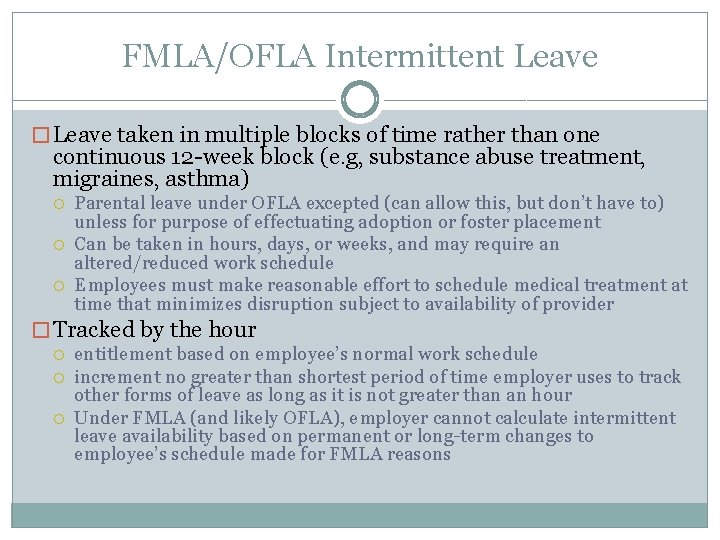
FMLA/OFLA Intermittent Leave � Leave taken in multiple blocks of time rather than one continuous 12 -week block (e. g, substance abuse treatment, migraines, asthma) Parental leave under OFLA excepted (can allow this, but don’t have to) unless for purpose of effectuating adoption or foster placement Can be taken in hours, days, or weeks, and may require an altered/reduced work schedule Employees must make reasonable effort to schedule medical treatment at time that minimizes disruption subject to availability of provider � Tracked by the hour entitlement based on employee’s normal work schedule increment no greater than shortest period of time employer uses to track other forms of leave as long as it is not greater than an hour Under FMLA (and likely OFLA), employer cannot calculate intermittent leave availability based on permanent or long-term changes to employee’s schedule made for FMLA reasons
FMLA/OFLA: Special Rules for School Employees � Leave taken for a period that ends with the school year and begins the next semester is consecutive rather than intermittent summer is not counted against leave entitlement � If instructional employee (FMLA)/public school teacher (OFLA) needs foreseeable intermittent leave and employee would be on leave more than 20% of the total number of working days over the leave period, employee may require: Take leave for a period or periods of a particular duration not greater than duration of planned treatment or Transfer temporarily to better suited open position for which employee is qualified and has equivalent pay/benefits � Limitations on instructional employee (FMLA)/public school teacher (OFLA) taking leave near end of term OFLA: OAR 839 -009 -0290(4), (5) FMLA: 29 CFR § 825. 602(a)(2), (3) Additional leave required by the employer under this rule may not be charged against the employee’s available OFLA/FMLA leave (and must maintain insurance benefit)
OFLA/FLMA Unlawful Employer Practices � Denying an eligible employee qualifying OFLA and/or FMLA leave � Interfering with, restraining, retaliating or in any way discriminating against an employee or applicant, or denying the exercise (or attempt to exercise) any right provided by OFLA or FMLA � Counting OFLA leave against an employee in determining the employee’s compliance with attendance policies � Counting OFLA leave against an employee in determining eligibility for bonuses based on attendance � Discharging or otherwise discriminating against any person because the person has participated or assisted in any proceeding in connection with OFLA or FMLA � For any person (employer or employee) to aid, abet, incite, compel or coerce the doing of any of the acts in violating of OFLA, or the attempt to do so � Failure to post required OFLA and FMLA notices
Workers’ Compensation Overview � Compensable injuries may often also qualify as serious health conditions under FMLA and/or OFLA � Cannot deduct OFLA for absences due to a injury covered by workers’ comp Can deduct OFLA while claim is pending, but must restore it if claim is accepted Can deduct OFLA after employee refuses a suitable offer of light duty or modified employment Employee may become OFLA ineligible if workers’ comp absences reduce weekly average below 25 hours/week � A workers’ compensation absence and FMLA leave may run concurrently (assuming injury qualifies under FMLA) Cannot sub paid leave, but employer may agree to have paid leave supplement workers’ comp payment to extent permissible by law (no more than 100% total compensation). Substitution requirement also becomes applicable if employee refuses light duty position but has remaining FMLA time Acceptance of light duty position does not waive restoration rights under FMLA � Employee may have more than 12 weeks of combined FMLA/OFLA
ADA/ADAAA Overview �Oregon and federal law provide protections to employees with disabilities �“Disability” means: A physical or mental impairment that substantially limits (i. e. , as compared to most people) one or more major life activities (e. g. , lifting, interacting with others, concentrating, sleeping) A record of such an impairment; or Being regarded as having such an impairment (whether or not the impairment limits or is perceived to limit a major life activity) �Construed in favor of broad coverage �Protects only qualified employees: employees who can perform the essential functions of the job with or without reasonable accommodation
ADA: Interactive Process � Interactive process required to determine whether the employer can provide reasonable accommodation(s) to allow employee to complete essential job functions � Process starts when: Employee or someone acting on employee’s behalf makes a request, either in writing or orally, for an accommodation; or Employer has knowledge of disability and observes employee having difficulty performing essential functions of the job � Employee can be required to provide documentation from qualified health care professional when disability or need for accommodation is not obvious, but only info related to the disability Documentation should address nature of disability, limitations, need for accommodation, suggestions for specific accommodations Employer not required to implement suggested/preferred accommodation, nor is employee required to accept employer-proposed accommodation Employer may choose between effective accommodation options, and may choose option that is less expensive or easier to provide
ADA: Leave as Reasonable Accommodation �A reasonable accommodation may include providing a leave of absence and/or job restructuring if doing so would allow employee to complete essential functions Part-time or modified work schedule Reassignment to vacant position �This process is independent of FMLA/OFLA eligibility— an employee may have a right to leave under the ADA even if they are not eligible for FMLA/OFLA or even if they have exhausted their FMLA/OFLA protected leave �Exhaustion of FMLA/OFLA leave may trigger need for interactive process
ADA: Undue Hardship Exception �Employer not required to provide accommodation if doing so would create an undue hardship (i. e. , requires significant difficulty or expense) �Factors considered: Nature and cost of accommodation Overall financial resources of facility/facilities involved, the number of persons employed at facility and resources or other impacts on operation of facility Overall financial resources/size of the employer Type of operations conducted by employer, including composition, structure and functions of the workforce and geographic separateness and administrative or fiscal relationship of the facility or facilities in question �Case-by-case analysis based on specific facts
Fitness for Duty Exams �Reasonable belief based on objective evidence that: Employee’s duty to perform essential job functions is impaired by a medical condition; or Employee poses a direct threat because of a medical condition �Must be based on observed incidents/articulable facts �Check district policy, if any If policy permits employee to submit own report, consider getting it first so district-chosen provider can consider it �District pays for costs of exam/time �Send provider relevant information, including specific concerns, copy of job description/essential job functions, and what exactly you want the doctor to assess
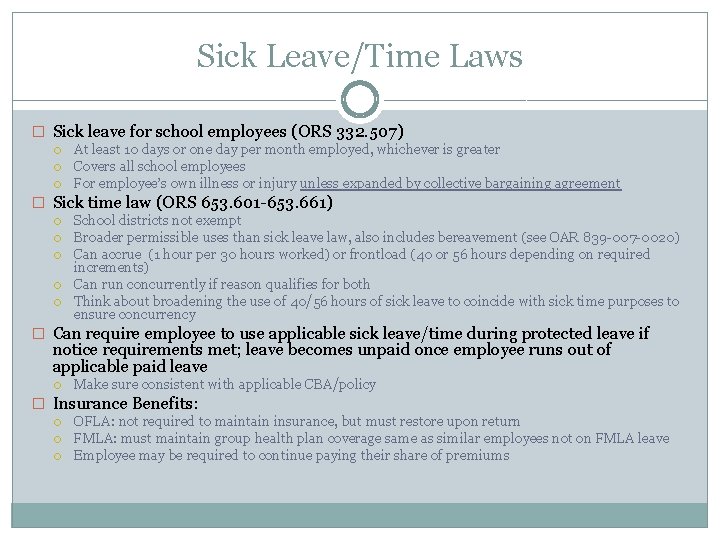
Sick Leave/Time Laws � Sick leave for school employees (ORS 332. 507) At least 10 days or one day per month employed, whichever is greater Covers all school employees For employee’s own illness or injury unless expanded by collective bargaining agreement � Sick time law (ORS 653. 601 -653. 661) School districts not exempt Broader permissible uses than sick leave law, also includes bereavement (see OAR 839 -007 -0020) Can accrue (1 hour per 30 hours worked) or frontload (40 or 56 hours depending on required increments) Can run concurrently if reason qualifies for both Think about broadening the use of 40/56 hours of sick leave to coincide with sick time purposes to ensure concurrency � Can require employee to use applicable sick leave/time during protected leave if notice requirements met; leave becomes unpaid once employee runs out of applicable paid leave Make sure consistent with applicable CBA/policy � Insurance Benefits: OFLA: not required to maintain insurance, but must restore upon return FMLA: must maintain group health plan coverage same as similar employees not on FMLA leave Employee may be required to continue paying their share of premiums
Collective Bargaining Agreements �Always check collective bargaining agreement (if applicable) to see if it has expanded these requirements, or if it provides for any other types of protected leave �For example, some CBAs have a provision that provides for additional unpaid leave at the discretion of the district �Make sure you apply discretionary leave provisions consistently Otherwise, you may open yourself up to a discrimination claim Keep good records so that you know if/when/how you have applied a provision in the past
Hypothetical #1 School district hires a regular bus driver, who is a veteran and has PTSD related to her time in the service. When she is hired she affirms that she is able to complete the essential functions of her job with or without reasonable accommodation. She has been working for the school district for 14 months when, during the weekend, she experiences a severe triggering event while driving her personal vehicle. As a result, she has submitted a request for six weeks of leave to obtain treatment. Her request is supported by a medical certification. The school district front loaded her the legally mandated sick leave and sick time when she was hired. She has not taken any protected leave during her time with the district other than the personal days and holidays to which she is entitled under the CBA. � Can she take the requested leave? If so, will it be paid or unpaid? Would your answer change if she had been with the district for six months? � If she can take leave, will it be paid or unpaid? When she returns to work, she submits a medical release stating that she can return to work, but only if she is permitted to have her emotional support pot bellied pig on the bus while she drives. � What is the district’s response? � Would the response change if she was a night custodian? Educational assistant? Would the district’s response change if the triggering event occurred while she was driving the school bus? What if it resulted in an accident?
Hypothetical #2 Teacher, who has been employed with the school district for four years, is pregnant. She has not taken any FMLA/OFLA leave during that time. Eight months into her pregnancy (in early October of the 17 -18 school year) her doctor orders her on bed rest for the remainder of her pregnancy. Three weeks later she has her baby. � How many weeks of protected leave can she take to care for healthy baby? Shortly before she is scheduled to come back from her parental leave, she submits a request, supported by documentation from her doctor, for an additional nine weeks of leave on the basis that she is suffering from postpartum depression. � What is the district’s response? Assume the district grants the additional leave. At the end of the nine week period the district receives another request from her stating that she is still suffering from postpartum depression and will not be able to teach for the rest of the school year. � What is the district’s response? � Would any of your responses change if teacher was on a plan of assistance when she became pregnant? � What if the district (before it became aware of her pregnancy) was planning on putting her on a plan of assistance at the beginning of the 17 -18 school year? Should the district delay the plan until her return (or scrap the plan altogether)? � What if her husband also works for us, is OFLA/FMLA eligible, and requests leave to care for his wife? What if he has already taken 12 weeks of parental leave? What if he takes the leave to care for his sick child instead of his wife? What if he only took 6 weeks of parental leave?
Hypothetical #3 Educational assistant, who has worked for the school district for five months, is scheduled to work five days a week for six hours (30 hours/week) to assist a medically fragile student. It is difficult to find a substitute for him because the student requires specialized assistance for which special training is necessary. He submits a medical certification from his doctor stating that he has unidentified back pain, and, as a result, cannot work more than two shifts per week while he receives treatment for the pain. The treatment is expected to last for six weeks. � What is the district’s response? � Would the response change if he has worked for the district for 10 years? � What if he only works 3. 5 hour shifts (17. 5 hours/week)? � Would the response change if the doctor said that the restriction would be indefinite until they determine the cause of the pain?
Hypothetical #4 Janet, a school secretary, has been working for the district for three years. She performs the technical aspects of her job well, but she struggles with interpersonal relationships with other staff members, which has been reflected in her evaluations. She worked in one school for two years, and was involuntarily transferred to a new school this year. She was not happy about the change. Last week one of her coworkers in the front office filed a complaint with the principal of the school in which she stated that Janet has become increasingly difficult to work with through the school year and has displayed some “paranoid and concerning” behaviors, such as accusing her and other people in the office of rummaging through her desk and purse and moving the personal belongings on her desk. The principal interviews four other school employees who work in the front office with or near her about the complaint. They all deny touching or going through any of Janet’s things, with the exception of one employee who admits that she did rummage through the papers on Janet’s desk on one occasion when she was looking for a form, and Janet saw her and questioned her about it. They all confirm that Janet regularly accuses them of going through her personal effects. One person states that she “obsessively” checks the refrigerator in the staff lounge throughout the morning to ensure that no one has eaten her lunch. All four employees state that these behaviors have magnified as the school year has gone on. Two people state that these behaviors make them fear for their personal safety. When the principal questions her former coworkers at her old school as to whether she exhibited such behaviors, they say she did not, but that she was generally a little bit “odd” and “dour. ” � What do you do?
Best Practices �Separate protected leave from employment actions Rule of thumb: When navigating protected leave, treat all employees as if they were your star employee (even if they are not!) �Be methodical: take it one law at a time �Be consistent (otherwise you may face a discrimination claim) �Have systems in place for processing requests (forms, checklists, etc) �Document, document—keep records of all meetings, phone calls, emails, texts, etc. �When in doubt, call your lawyer!
QUESTIONS? THANK YOU!
- Slides: 25