
Prosthetic Arms By Ryan Mc Donough History of
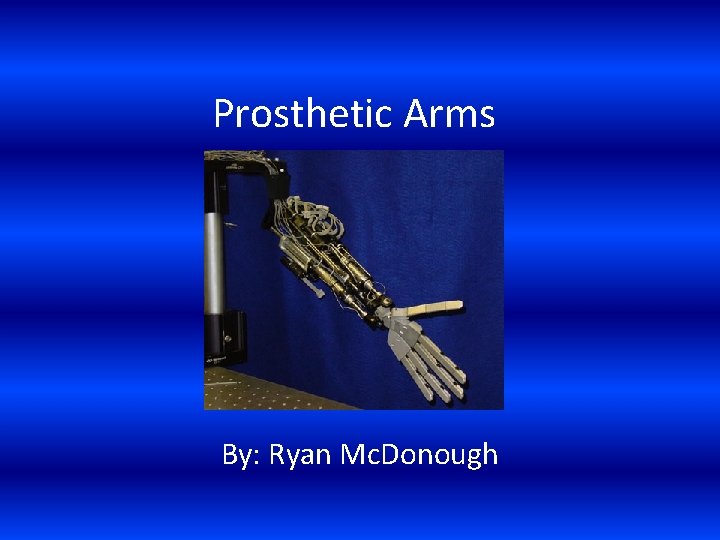
Prosthetic Arms By: Ryan Mc. Donough
History of Prosthetic Arms Before this mainly prosthetic hands were made out of iron • But in 1508 a knight had two hands replace his right arm and this was one of the first jointed prosthetics in history. Its used springs and leather straps • During the Civil War was when prosthetics started to take off in America because there were over 30, 000 amputees.
History Continued • In World War II the government started funding engineering programs at universities so that soldiers with amputations would have better technology to work with. • Around the 1960’s the united states developed the first movable prosthetic arm • Today developing arms that can read brain signals.
The Problem its Solving • Many amputation victims have a hard time going about their daily lives. • Hard for them to complete the simplest of tasks • The prosthetic arm will help them complete these simple tasks • With the prosthetic arms being better developed they will be able to do tasks as if they weren't even missing their arm. • Makes people feel as though they are capable of doing things even though they are missing an arm • Patients can now do things that people with arms would be able to do.

Top of the Line Prosthetic Arms • Today engineers must first use a process called targeted muscle reinnervation. • This process requires doctors to take nerves from the spot where the arm was amputated and reattach it to nerves in the chest. • Electrodes are then placed on the chest to make it possible for the person to move the arm with their brain signals • The signals pass from the brain, into the chest and into the arm making it move in the direction the patient wants
Continued • These new prosthetic arms are able to preform ten different hand, wrist, and elbow • There were tests preformed where people with prosthetic arms did the same tests as people with real arms, the patients with fake arms were able to preform the tasks a tiny bit slower then people with real arms. • Before this prosthetic arm people were very limited with what they could do with it. • Also before this arm it was very difficult to find a way to attach the arm to the body while making it comfortable for the patient • Now they have harness that attaches the arm to the person that goes along your chest around your body and attaches on your back. • More finger like • By doing this the arm uses the rest of the body to move things instead of just the stump of the arm making it able to lift a lot more weight
Videos • http: //www. nytimes. com/2009/02/11/health /research/11 arm. html? pagewanted=1&_r=2& exprod=permalink&adxnnlx=1302373454 Tq 6 po 7 U 0 G/m. Bl 3 Fmq 6 r. SJw
How Engineers Fit Into This • Biomedical – need to know what part of the brain would be used to send those signal to the arm – Where to place the electrodes on your body – How much strain it would put on your body • Mechanical – Have to design how the arm moves – Figure out how much weight could be put onto the machine/ motor • Electrical – Need to set up all the wiring for the arms
Limitations - Weight Movement Not easy to operate for everyone Not enough funding
Future Prosthetic arms eventually having feeling Making it easier for people to move with them Make them out of a lighter material Government should put more money into this process • Videogames using prosthetic arms as controllers • •
Sources • Singer, Emily. "A Prosthetic Arm That Acts Like a Real One - Technology Review. " Technology Review: The Authority on the Future of Technology. 2 Feb. 2007. Web. 11 Apr. 2011. <http: //www. technologyreview. com/Biotech/18134/? a=f>. • "History of Prosthetic Devices. " Www. unc. edu. Web. 9 Apr. 2011. <http: //www. unc. edu/~mbritt/Prosthetics%20 History%20 Webpage%20%20 Phys 24. html>. • Belluck, Pam. "In a New Procedure, Artificial Arm Listens to Brain. " Www. nytimes. com. New York Times, 10 Feb. 2009. Web. 9 Apr. 2011. <http: //www. nytimes. com/2009/02/11/health/research/11 arm. html? adxnnl=1&ex prod=permalink&adxnnlx=1302373454 -Tq 6 po 7 U 0 G/m. Bl 3 Fmq 6 r. SJw>. • Smith, Kevin. "Open Access for Hardware? " Duke University Libraries Blogs. 24 Oct. 2009. Web. 11 Apr. 2011. <http: //blogs. library. duke. edu/scholcomm/2009/10/24/open-access-forhardware/>. • 2008, Sarah Adee / February. "Reengineering the Prosthetic-Arm Socket - IEEE Spectrum. " IEEE Spectrum: Technology, Engineering, and Science News. Feb. 2008. Web. 11 Apr. 2011. <http: //spectrum. ieee. org/biomedical/devices/reengineering-the-prostheticarmsocket>.
- Slides: 11