
Prospective Motion Correction Is it better J Andrew
Prospective Motion Correction: Is it better? J. Andrew Derbyshire Functional MRI Core NIMH
Motivation • MRI is a slow imaging technique – Vulnerable to motion during acquisition – Motion of 50% pixel size can yield significant artifacts
Motivation • MRI is a slow imaging technique – Vulnerable to motion during acquisition – Motion of 50% pixel size can yield significant artifacts (Oliver Speck says it is more like 20%) Why will motion tracking be important? • Higher resolution scanning – Increased scan time • Increase resolution by 2 x requires 64 x scan time! • Increased likelihood of subject motion – Smaller motions become significant
Sources of motion • Physiological – Cardiac motion – Respiratory – Blood flow – CSF Flow – Swallowing – Coughing – Sneezing – Blinking – Peristalsis • Tremors • Children
Sources of motion • Physiological – Cardiac motion – Respiratory – Blood flow – CSF Flow – Swallowing – Coughing – Sneezing – Blinking – Peristalsis • Tremors • Children • Motion types: – Fast versus slow – Periodic – Continuous/sporadic – In/through plane – Local / global – Translation – Rotation – Expansion/contraction
Sources of motion • Physiological – Cardiac motion – Respiratory – Blood flow – CSF Flow – Swallowing – Coughing – Sneezing – Blinking – Peristalsis • Motion types: – Fast versus slow – Periodic – Continuous/sporadic – In/through plane – Local / global – Translation – Rotation – Expansion/contraction • Tremors • Children Do we need motion correction? . . . YES!
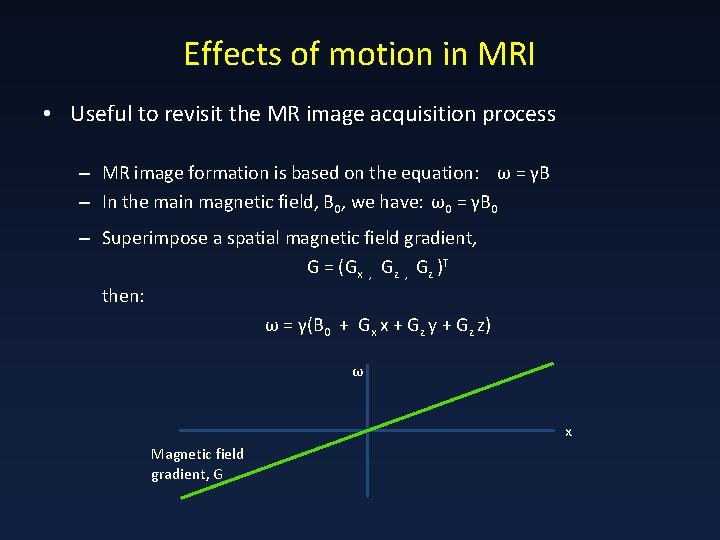
Effects of motion in MRI • Useful to revisit the MR image acquisition process – MR image formation is based on the equation: ω = γB – In the main magnetic field, B 0, we have: ω0 = γB 0 – Superimpose a spatial magnetic field gradient, G = (Gx , Gz )T then: ω = γ(B 0 + Gx x + Gz y + Gz z) ω x Magnetic field gradient, G
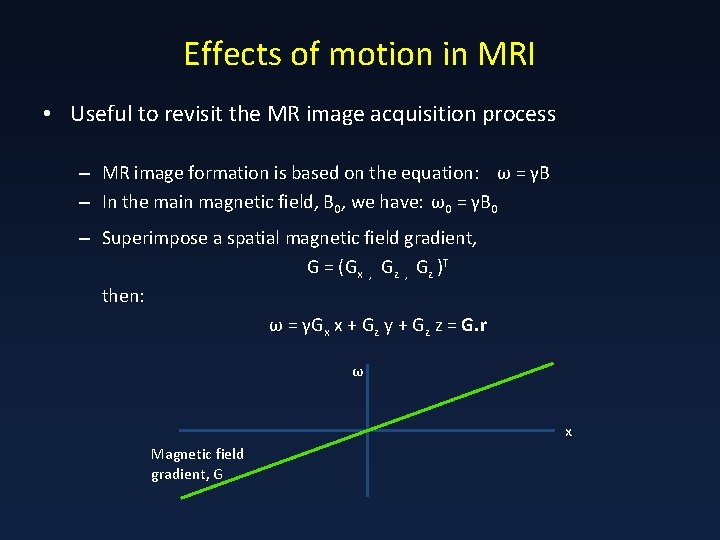
Effects of motion in MRI • Useful to revisit the MR image acquisition process – MR image formation is based on the equation: ω = γB – In the main magnetic field, B 0, we have: ω0 = γB 0 – Superimpose a spatial magnetic field gradient, G = (Gx , Gz )T then: ω = γGx x + Gz y + Gz z = G. r ω x Magnetic field gradient, G
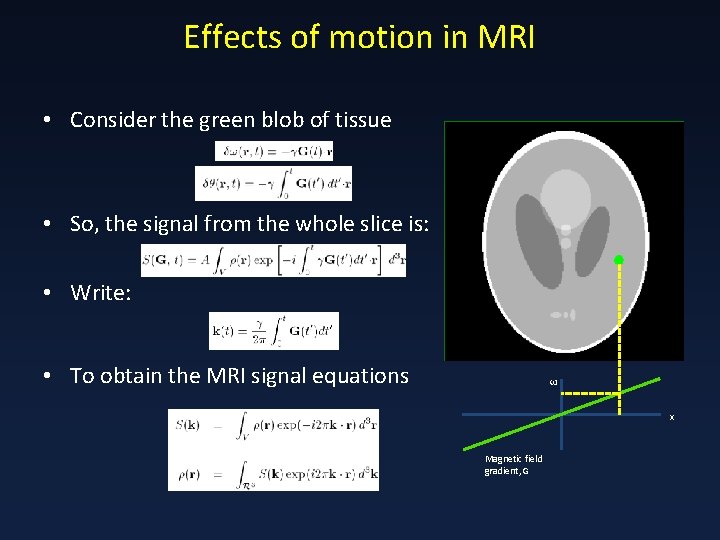
Effects of motion in MRI • Consider the green blob of tissue • So, the signal from the whole slice is: • Write: • To obtain the MRI signal equations ω x Magnetic field gradient, G
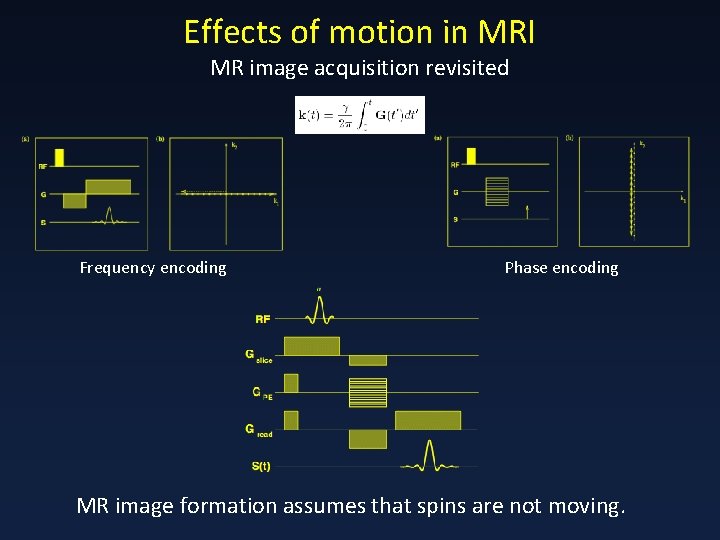
Effects of motion in MRI MR image acquisition revisited Frequency encoding Phase encoding MR image formation assumes that spins are not moving.
Effects of motion in MRI • MRI scans typically comprise multiple repetitions – Each repetition of the basic pulse sequence is separated by TR – Phase encode steps (or similar) • Useful to distinguish between motion time-scales: – intra-TR : i. e. motion within each measurement – inter-TR : i. e. motion across / between measurements

Intra-TR motion and Gradients • MR image formation is based on the equation: ω = γB • In the main magnetic field, B 0, we have: ω0 = γB 0 • Superimpose a spatial magnetic field gradient, G = (Gx , Gz )T then: ω = γGx x + Gz y + Gz z = G. r ω x Magnetic field gradient, G

Intra-TR motion and Gradients • Moving spins: • Accumulated phase in presence of gradient: • In particular, for uniform motion: r(t) = r 0 + v 0 t, we have additional phase: Φ = m 0. r 0 + m 1. v 0 where m 1 is the first moment of the gradient waveform.
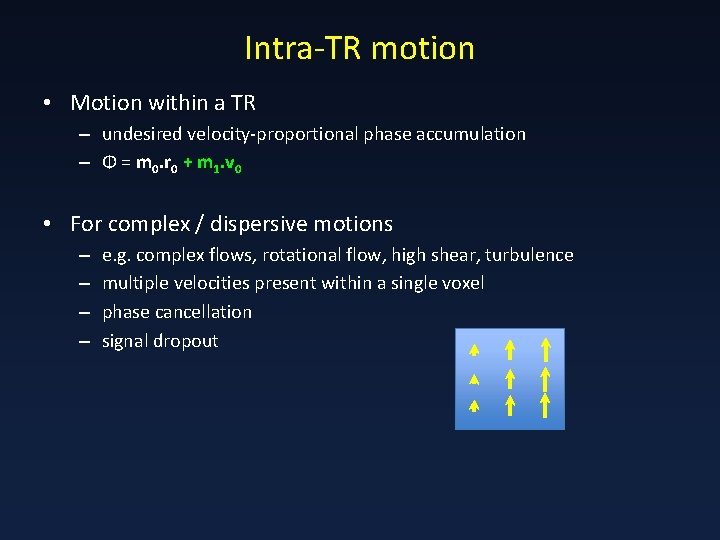
Intra-TR motion • Motion within a TR – undesired velocity-proportional phase accumulation – Φ = m 0. r 0 + m 1. v 0 • For complex / dispersive motions – – e. g. complex flows, rotational flow, high shear, turbulence multiple velocities present within a single voxel phase cancellation signal dropout
Inter-TR motion • Motion that varies between TRs will – cause phase changes from one TR to the next (gradient m 1 effect) – possibly cause amplitude changes (e. g. ) through plane motion • This causes modulations of the expected MRI signal in the phase encoding direction, resulting in motion artifacts. • Artifacts are always in the phase encode direction! – independent of the actual direction of motion • Periodic / pulsatile motions (e. g. blood flow) causes ghosting artifacts

Flow Ghosting MRM 19: 422: 1993 • Provides an elegant geometric description of the flow ghost formation
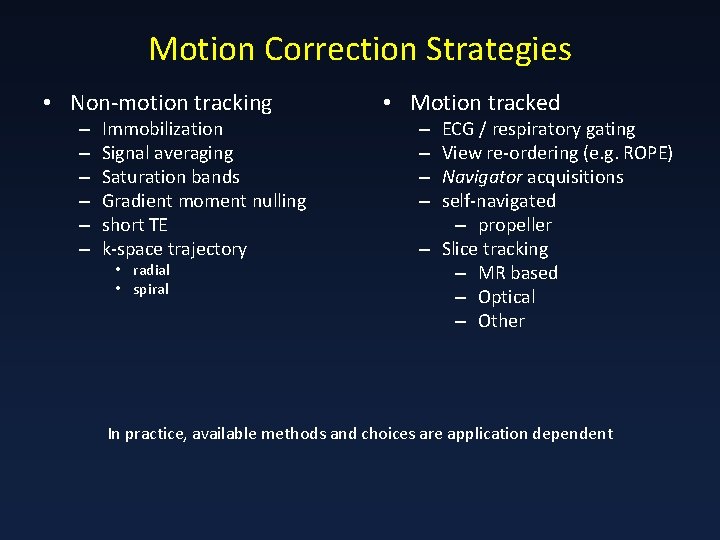
Motion Correction Strategies • Non-motion tracking – – – Immobilization Signal averaging Saturation bands Gradient moment nulling short TE k-space trajectory • radial • spiral • Motion tracked ECG / respiratory gating View re-ordering (e. g. ROPE) Navigator acquisitions self-navigated – propeller – Slice tracking – MR based – Optical – Other – – In practice, available methods and choices are application dependent
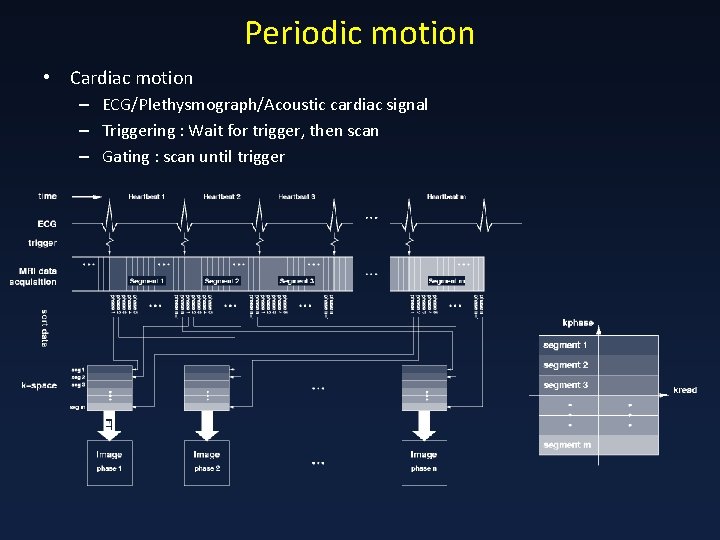
Periodic motion • Cardiac motion – ECG/Plethysmograph/Acoustic cardiac signal – Triggering : Wait for trigger, then scan – Gating : scan until trigger
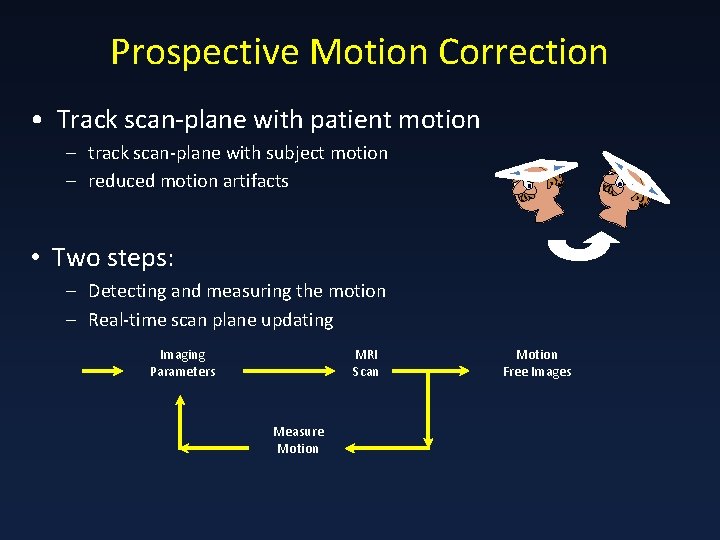
Prospective Motion Correction • Track scan-plane with patient motion – track scan-plane with subject motion – reduced motion artifacts • Two steps: – Detecting and measuring the motion – Real-time scan plane updating Imaging Parameters MRI Scan Measure Motion Free Images
Prospective Motion Correction • Multiple approaches to position measurement are possible – – MR based navigator echoes MR based external tracking Optical based tracking Other methods • Imaging scan-plane feedback: similar for all approaches – Typically model motion as rigid body – Global motion model for whole image
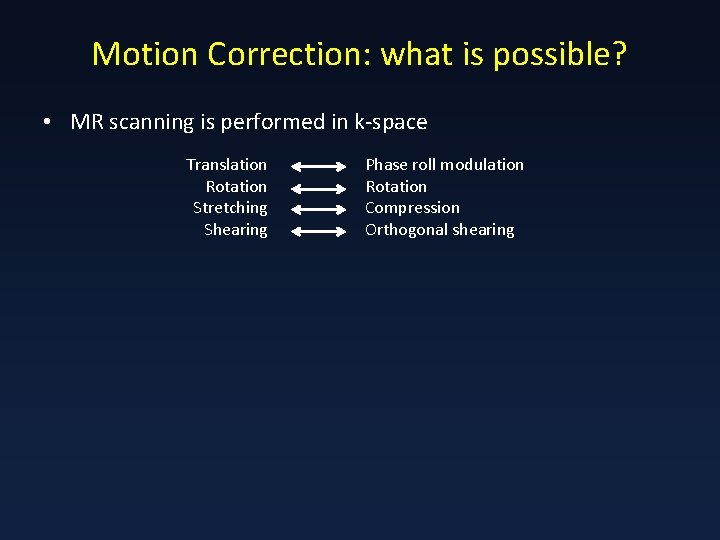
Motion Correction: what is possible? • MR scanning is performed in k-space Translation Rotation Stretching Shearing Phase roll modulation Rotation Compression Orthogonal shearing
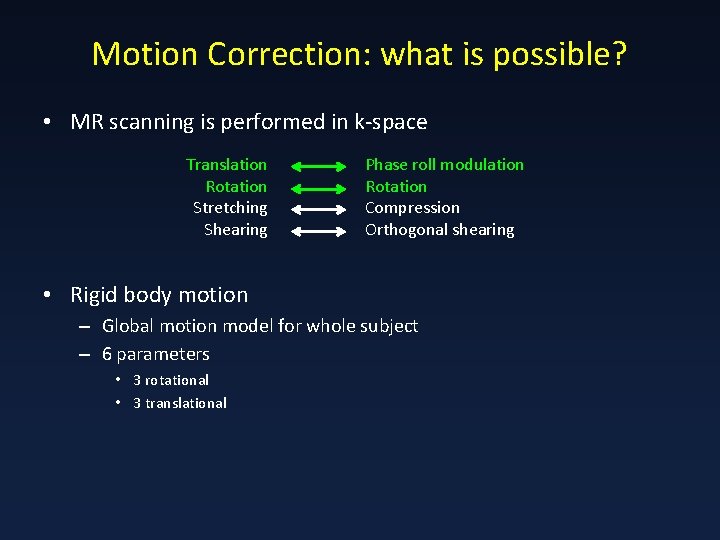
Motion Correction: what is possible? • MR scanning is performed in k-space Translation Rotation Stretching Shearing Phase roll modulation Rotation Compression Orthogonal shearing • Rigid body motion – Global motion model for whole subject – 6 parameters • 3 rotational • 3 translational
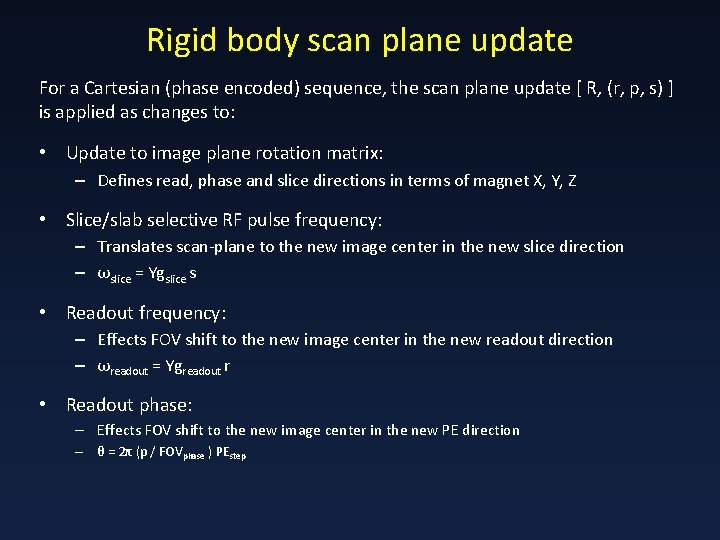
Rigid body scan plane update For a Cartesian (phase encoded) sequence, the scan plane update [ R, (r, p, s) ] is applied as changes to: • Update to image plane rotation matrix: – Defines read, phase and slice directions in terms of magnet X, Y, Z • Slice/slab selective RF pulse frequency: – Translates scan-plane to the new image center in the new slice direction – ωslice = Υgslice s • Readout frequency: – Effects FOV shift to the new image center in the new readout direction – ωreadout = Υgreadout r • Readout phase: – Effects FOV shift to the new image center in the new PE direction – θ = 2π (p / FOVphase ) PEstep
Rigid body scan plane update For a Cartesian (phase encoded) sequence, the scan plane update [ R, (r, p, s) ] is applied as changes to: • Update to image plane rotation matrix: – Defines read, phase and slice directions in terms of magnet X, Y, Z • Slice/slab selective RF pulse frequency: – Translates scan-plane to the new image center in the new slice direction – ωslice = Υgslice s • Readout frequency: – Effects FOV shift to the new image center in the new readout direction – ωreadout = Υgreadout r • Readout phase: – Effects FOV shift to the new image center in the new PE direction – θ = 2π (p / FOVphase ) PEstep Note that no changes to gradient waveforms are required!
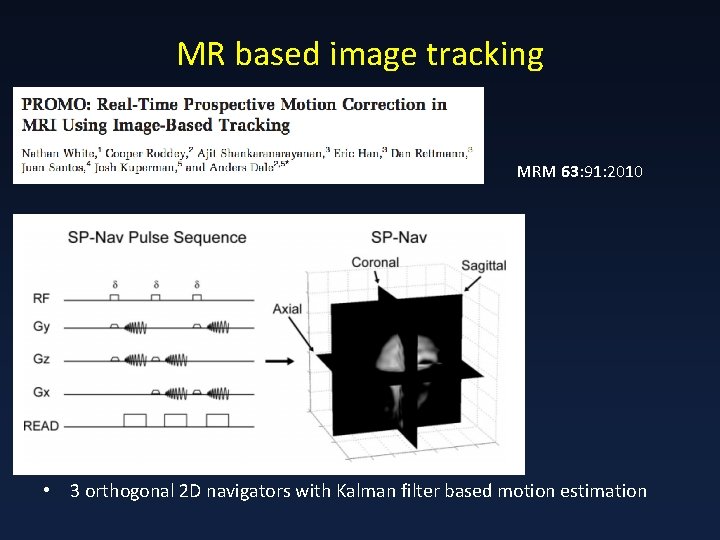
MR based image tracking MRM 63: 91: 2010 • 3 orthogonal 2 D navigators with Kalman filter based motion estimation
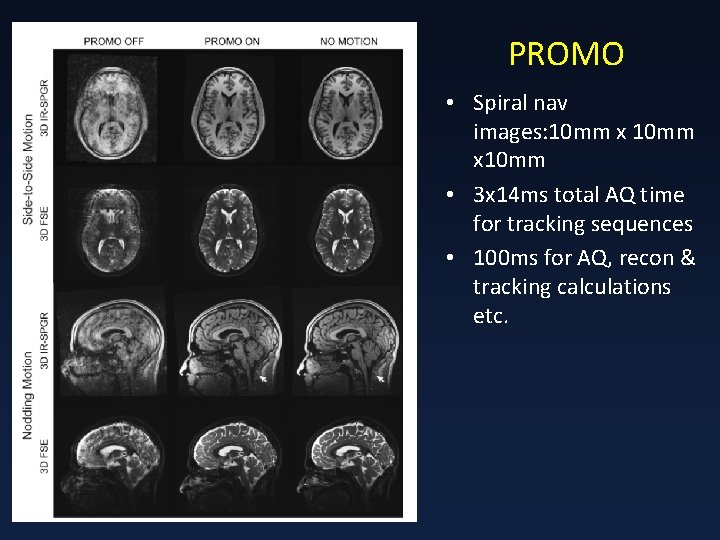
PROMO • Spiral nav images: 10 mm x 10 mm • 3 x 14 ms total AQ time for tracking sequences • 100 ms for AQ, recon & tracking calculations etc.
PROMO • VR has developed multi-echo implementation at NIH – Seems to work well – See e. g. their ISMRM Motion Workshop poster • Requires time for Navigator AQ, reconstruction and tracking calculations • Works well with MP-RAGE type scan – Fits in the inversion time • Spin history effects – must use low flip angle • Can be compared to other MR super-navigators methods – EPI based instead of spiral – Orbital navigators – Cloverleaf, etc.
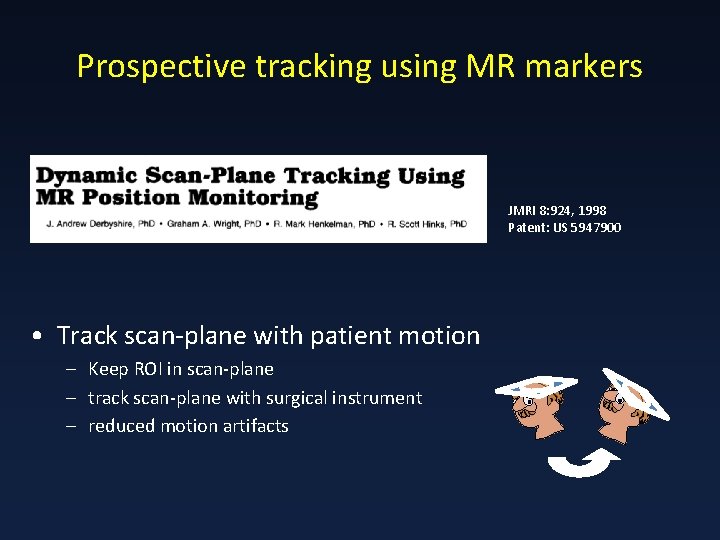
Prospective tracking using MR markers JMRI 8: 924, 1998 Patent: US 5947900 • Track scan-plane with patient motion – Keep ROI in scan-plane – track scan-plane with surgical instrument – reduced motion artifacts
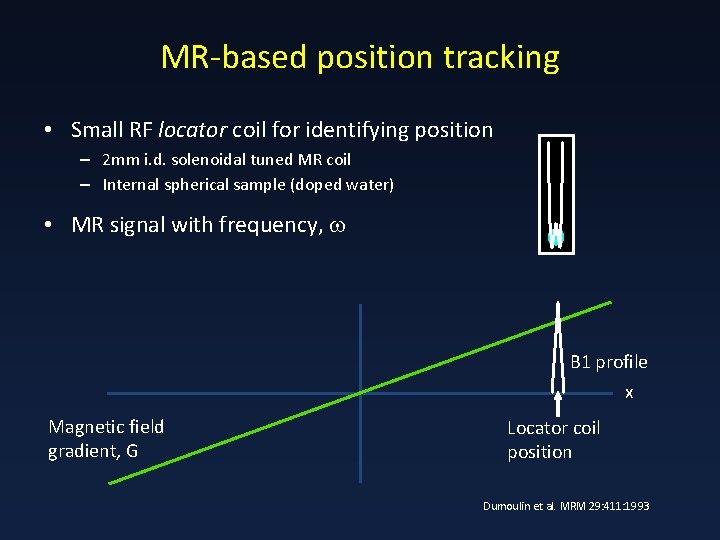
MR-based position tracking • Small RF locator coil for identifying position – 2 mm i. d. solenoidal tuned MR coil – Internal spherical sample (doped water) • MR signal with frequency, w B 1 profile x Magnetic field gradient, G Locator coil position Dumoulin et al. MRM 29: 411: 1993
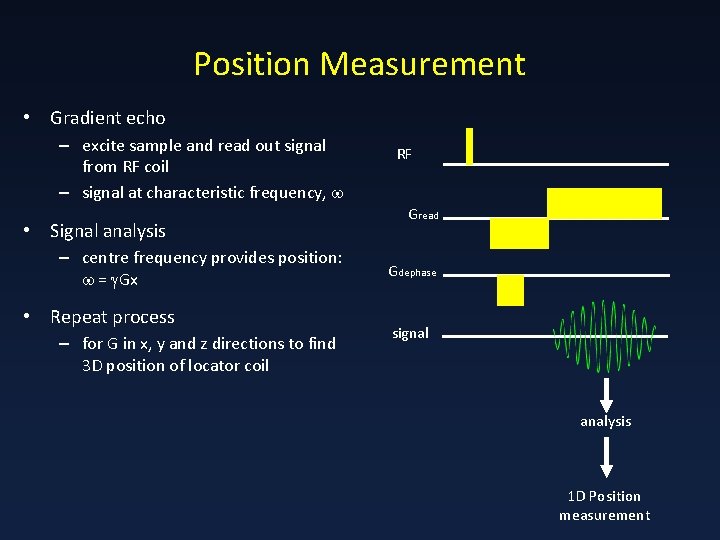
Position Measurement • Gradient echo – excite sample and read out signal from RF coil – signal at characteristic frequency, w • Signal analysis – centre frequency provides position: w = g. Gx • Repeat process – for G in x, y and z directions to find 3 D position of locator coil RF Gread Gdephase signal analysis 1 D Position measurement
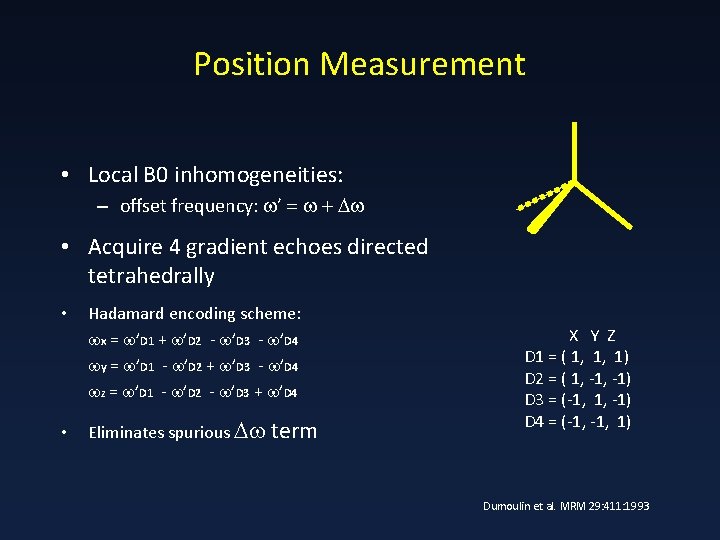
Position Measurement • Local B 0 inhomogeneities: – offset frequency: w’ = w + Dw • Acquire 4 gradient echoes directed tetrahedrally • • Hadamard encoding scheme: wx = w’D 1 + w’D 2 - w’D 3 - w’D 4 wy = w’D 1 - w’D 2 + w’D 3 - w’D 4 wz = w’D 1 - w’D 2 - w’D 3 + w’D 4 Eliminates spurious Dw term X Y Z D 1 = ( 1, 1, 1) D 2 = ( 1, -1) D 3 = (-1, 1, -1) D 4 = (-1, 1) Dumoulin et al. MRM 29: 411: 1993
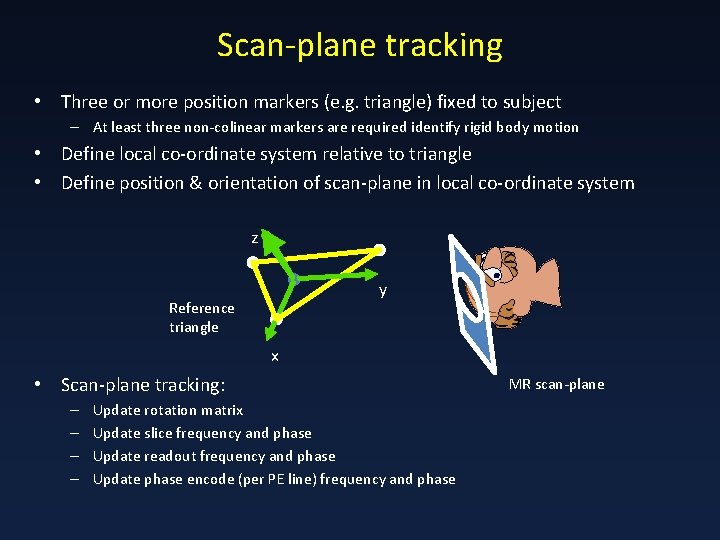
Scan-plane tracking • Three or more position markers (e. g. triangle) fixed to subject – At least three non-colinear markers are required identify rigid body motion • Define local co-ordinate system relative to triangle • Define position & orientation of scan-plane in local co-ordinate system z y Reference triangle x • Scan-plane tracking: – – Update rotation matrix Update slice frequency and phase Update readout frequency and phase Update phase encode (per PE line) frequency and phase MR scan-plane
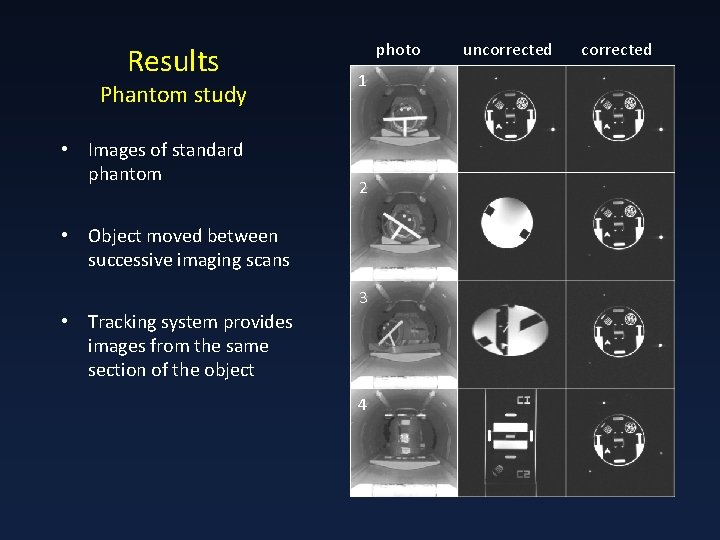
Results Phantom study • Images of standard phantom photo 1 2 • Object moved between successive imaging scans 3 • Tracking system provides images from the same section of the object 4 uncorrected
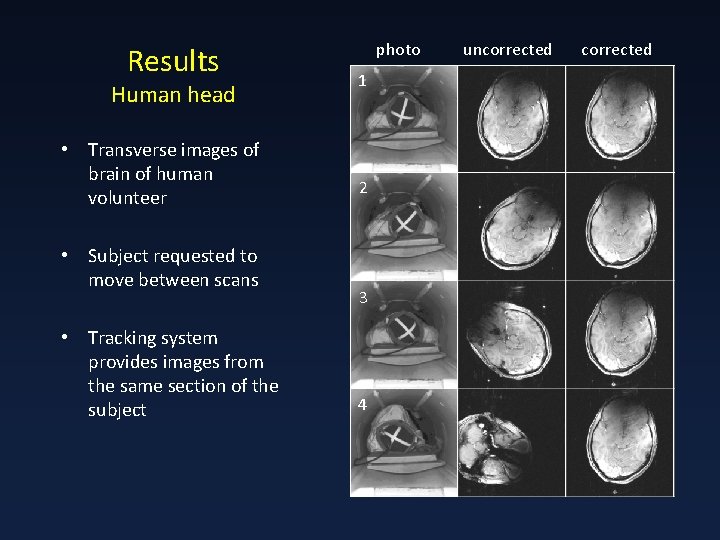
Results Human head • Transverse images of brain of human volunteer • Subject requested to move between scans • Tracking system provides images from the same section of the subject photo 1 2 3 4 uncorrected
Prospective tracking using MR markers • Intra-image scan-plane updates – once per full image scan – Slow-tracking for GRE type scans, OK for EPI • Inter-image scan-plane updates – OK for small motions – B 0 non-uniformity – changes phase mid scan – B 1 non-uniformity – changes phase mid scan • Precision – Position measurements ~ 0. 1 mm – Rotation/Tilting • Slice distance from reference markers – Angular amplification of errors. • Need triangle to be close to scan-plane of interest • Time required for MR position measurement (15 -20 ms)
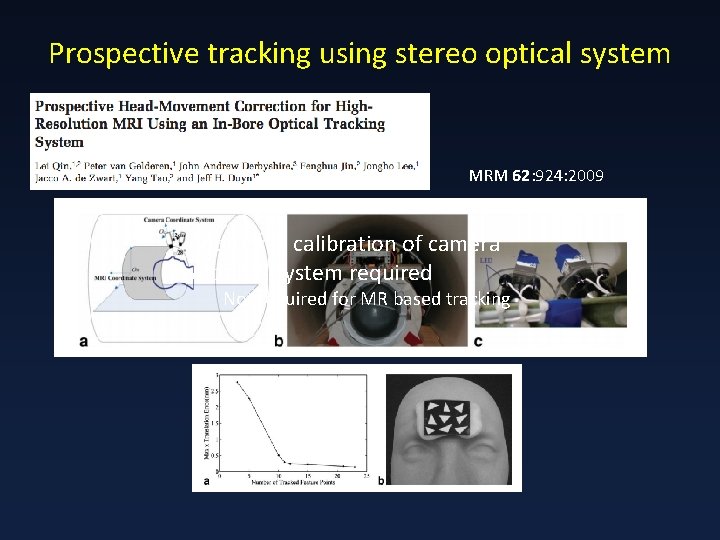
Prospective tracking using stereo optical system MRM 62: 924: 2009 Additional calibration of camera with MR system required Not required for MR based tracking
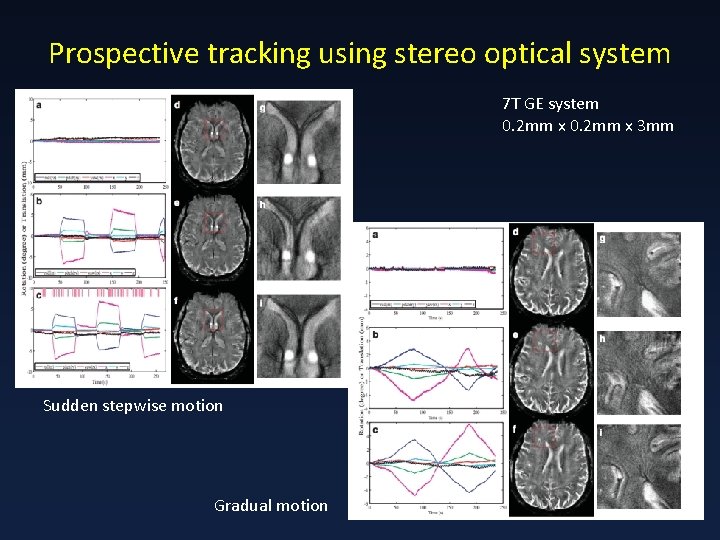
Prospective tracking using stereo optical system 7 T GE system 0. 2 mm x 3 mm Sudden stepwise motion Gradual motion
Prospective tracking using stereo optical system • Additional calibration of camera with MR system required – Not required for MR based tracking • Camera mounted on coil – table motion • Accuracy: – 0. 1 mm translation – 0. 15° rotation • Tracking rate: 10 Hz
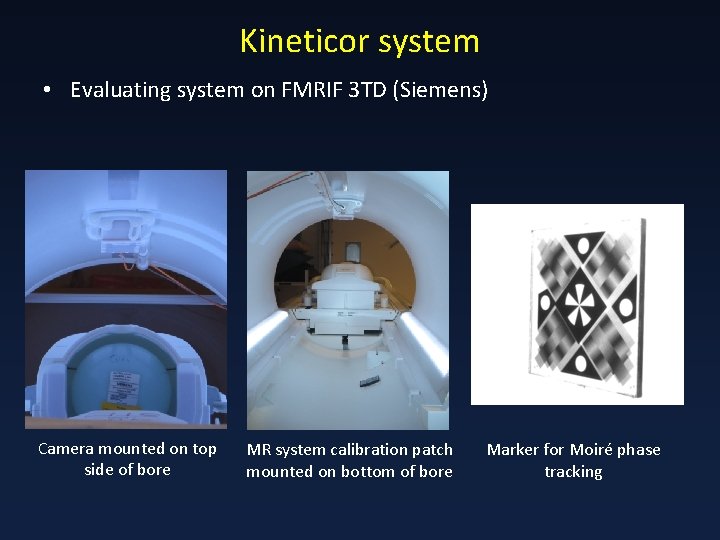
Kineticor system • Evaluating system on FMRIF 3 TD (Siemens) Camera mounted on top side of bore MR system calibration patch mounted on bottom of bore Marker for Moiré phase tracking
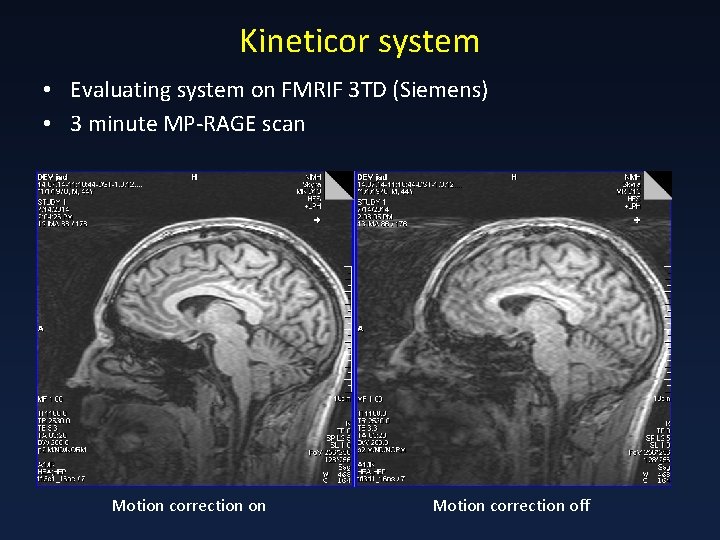
Kineticor system • Evaluating system on FMRIF 3 TD (Siemens) • 3 minute MP-RAGE scan Motion correction off
Discussion • Rigid body motion model – difficult to generalize to more complex motions types – local motion (e. g. tongue, eyes, etc. ) • Requires specially modified pulse sequence – to handle real-time imaging parameter feedback – vendors may develop an API to support these concepts • Verification – by definition we change the acquisition – difficult to know how much improvement was made • Fixation of external markers for MR or optical tracking – markers on skin can move – limited visual FOV of camera with 32 -channel head coil etc. • Optical systems need additional camera/MR calibration • MR tracking systems usually reduce scanning efficiency
Prospective Motion Correction • Is it better? I think so – at least for applications where it is reasonable to assume rigid body motion • Given the demands of high (i. e better than 0. 5 mm isotropic) resolution, we will probably need to use all the available tricks in out MR toolbox. • A very active area of research at the moment: – MRM review article 2012 – MRM virtual issue – ISMRM workshop, 2014 (most articles from 2010 -2014)

Thanks for your attention
- Slides: 43