
Prospect for bs measurement at LHC Alessia Satta
Prospect for bs measurement at LHC Alessia Satta on behalf of the LHCb collaboration + some Atlas and CMS results Physics at LHC, 3 rd october 2008 10/03/2008 Alessia Satta INFN
Content n n n Introduction Analysis strategy LHC prospects 10/03/2008 Alessia Satta INFN 2
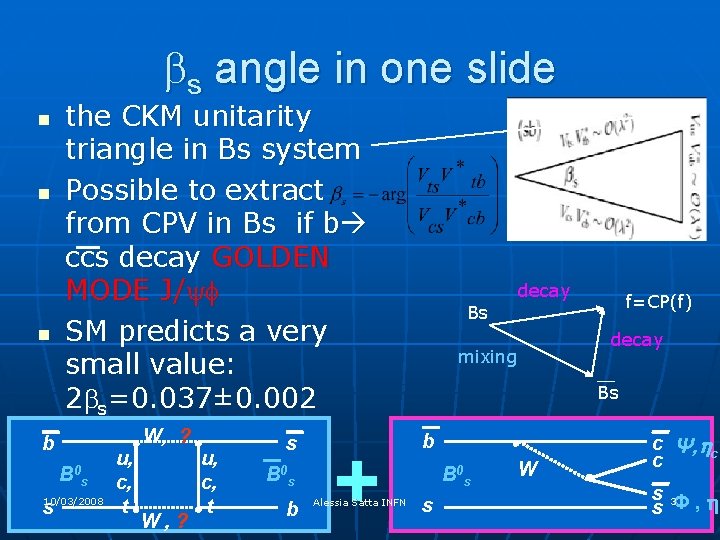
bs angle in one slide n n n the CKM unitarity triangle in Bs system Possible to extract from CPV in Bs if b ccs decay GOLDEN MODE J/yf SM predicts a very small value: 2 bs=0. 037± 0. 002 b B 0 s 10/03/2008 s u, c, t W, ? u, c, t s B 0 s b + Alessia Satta INFN decay f=CP(f) Bs mixing decay Bs b B 0 s s W c Ψ, hc c s 3Φ , h s
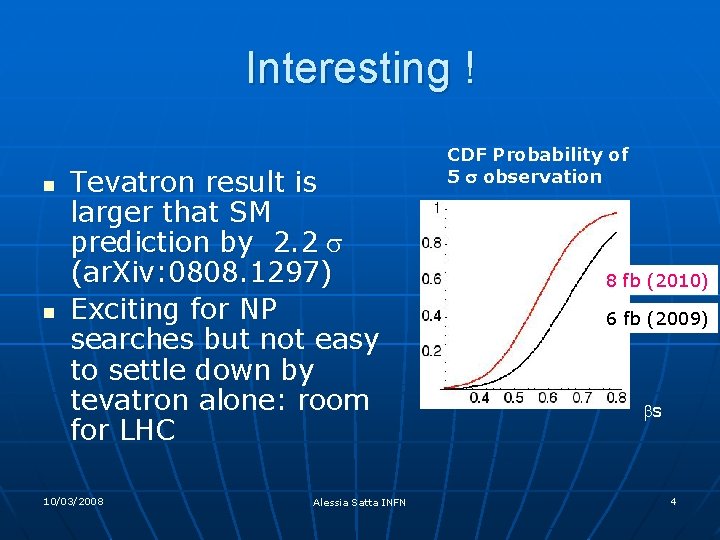
Interesting ! n n Tevatron result is larger that SM prediction by 2. 2 s (ar. Xiv: 0808. 1297) Exciting for NP searches but not easy to settle down by tevatron alone: room for LHC 10/03/2008 Alessia Satta INFN CDF Probability of 5 s observation 8 fb (2010) 6 fb (2009) bs 4
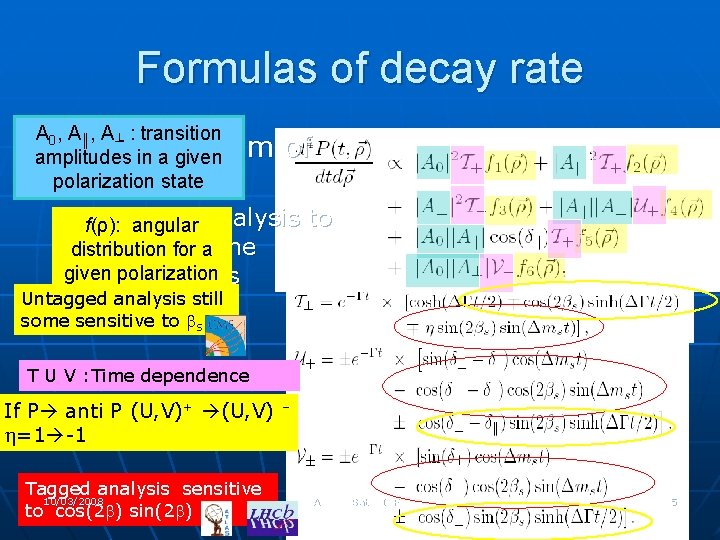
Formulas of decay rate A 0, A║, A┴ : transition n Bs in J/ayf amplitudes givensum polarization CP +/-state of • f(ρ): Angular analysis to decouple distribution for a the given polarization eigenstates state still Untagged analysis some sensitive to bs T U V : Time dependence If P anti P (U, V)+ (U, V) h=1 -1 Tagged analysis sensitive 10/03/2008 to cos(2 b) sin(2 b) – Alessia Satta INFN 5
Analysis in a nutshell n Fit time dependent angular distribution • Large statistics is mandatory n Large sbb , good trigger • Good signal background separation n –benefit a lot for dimuon in final state • Good 10/03/2008 time resolution tracking (angular resolution) tagging (for tagged analysis) Alessia Satta INFN 6
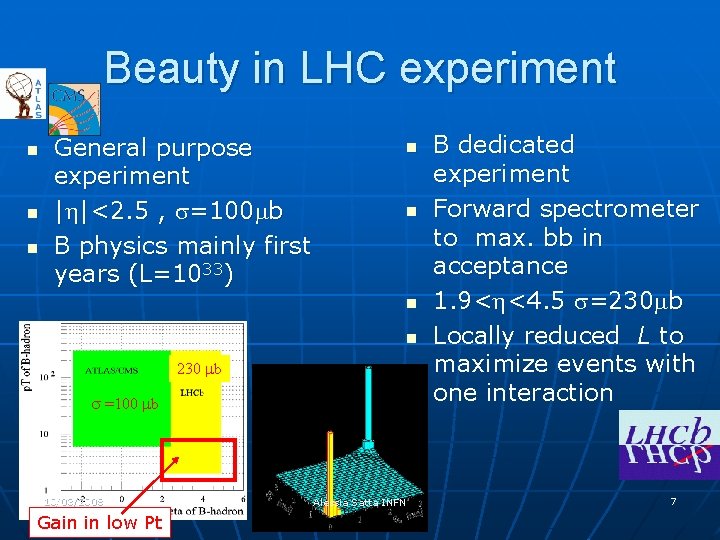
Beauty in LHC experiment n n n General purpose experiment |h|<2. 5 , s=100 mb B physics mainly first years (L=1033) n n 230 mb s =100 mb 10/03/2008 Gain in low Pt Alessia Satta INFN B dedicated experiment Forward spectrometer to max. bb in acceptance 1. 9<h<4. 5 s=230 mb Locally reduced L to maximize events with one interaction 7
Trigger n n Crucial since only 1% of stot is b production and decay chain of interest has BR 3*10 -5 Hardware and sw levels for all experiments: • L 0 rate 1 MHz (LHCb) ~100 k. Hz (ATLAS CMS) • HLT rate 2 k. Hz (LHCb) ~100 Hz (ATLAS CMS) n n ATLAS and CMS general purpose so limited bandwidth for b physics ( O(10%)) All experiments have a dimuon trigger to select signal events • ATLAS /CMS Pt and Mass based cut + IP, rate ~Hz • LHCb : 600 Hz of IP unbiased dimuon trigger signal recostruction as offline (loser cut) no. IP. Very high efficiency on selected events of trigger ( ~ 70%) 10/03/2008 Alessia Satta INFN 8
Signal reconstruction n n Standard cuts : Pt, invariant mass, PID, vertex quality, B pointing to primary vertex, B decay length (only ATLAS & CMS) PID • Similar muon ID performance for ATLAS CMS and LHCb • ATLAS and CMS no Kaon pid capability, LHCb has 2 Riches that ensures good K identification e(K K)~80% e(p->K)~ 3% 10/03/2008 Alessia Satta INFN 9
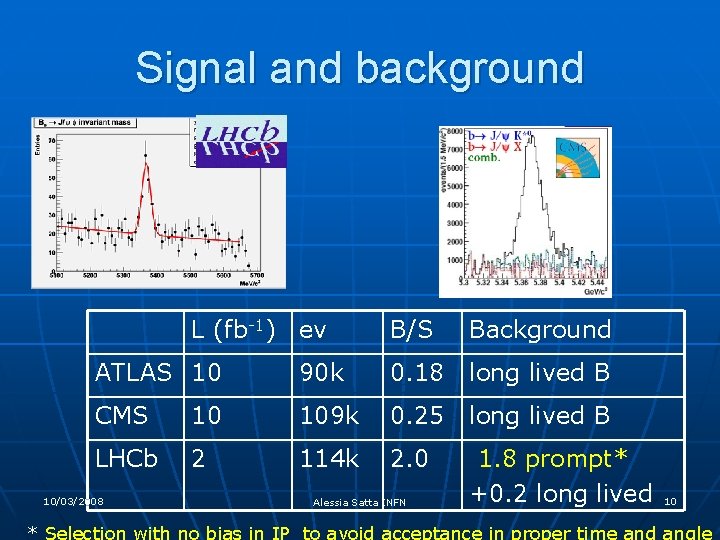
Signal and background L (fb-1) ev B/S Background ATLAS 10 90 k 0. 18 long lived B CMS 10 109 k 0. 25 long lived B LHCb 2 114 k 2. 0 10/03/2008 Alessia Satta INFN 1. 8 prompt* +0. 2 long lived 10 * Selection with no bias in IP to avoid acceptance in proper time and angle
Proper time resolution n n Need to resolve fast Bs oscillation: bs extraction sensitivity ~ exp(-0. 5*st 2 D m s 2) Atlas 83 fs CMS 77 fs LHCb 39 fs • LHCb vertex detector close to IP (0. 8 cm wtr 4. 4 cm) • LHCb P resolution a factor 2 better • LHCb trigger collects 600 Hz unbiased dimuon (also) to calibrate proper time on data 10/03/2008 Alessia Satta INFN 11
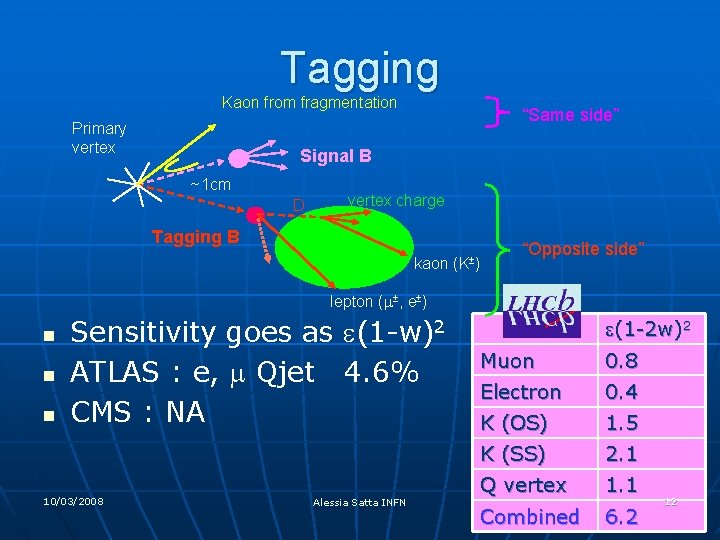
Tagging Kaon from fragmentation Primary vertex “Same side” Signal B ~1 cm D vertex charge Tagging B kaon (K±) “Opposite side” lepton (m±, e±) n n n Sensitivity goes as e(1 -w)2 ATLAS : e, m Qjet 4. 6% CMS : NA 10/03/2008 Alessia Satta INFN e(1 -2 w)2 Muon 0. 8 Electron 0. 4 K (OS) 1. 5 K (SS) 2. 1 Q vertex 1. 1 Combined 6. 2 12
Tagging from data n n LHCb plans to extract the mistag fraction from control sample with large statistics Opposite Side is extracted from B+ J/y K+ or Bd J/y K* • Common selection as much as possible with signal sample to avoid phase space bias to opposite b • Large statistics is expected: in 2 fb-1 n n n 650 k Bd J/y K* 1 million for B+ J/y K* Same Side • From Bs->Dsp 10/03/2008 Alessia Satta INFN 13
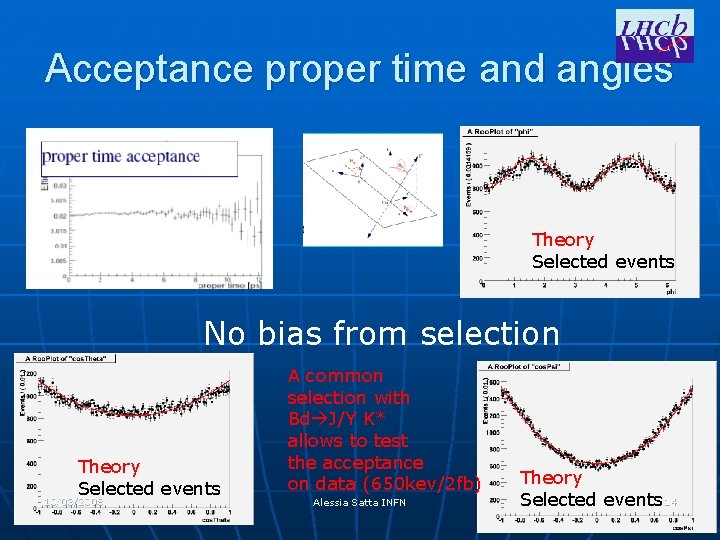
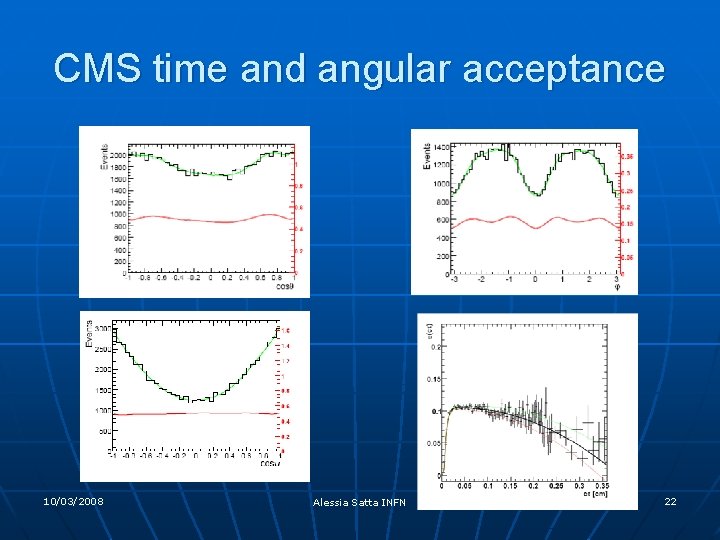
Acceptance proper time and angles Theory Selected events No bias from selection Theory Selected events 10/03/2008 A common selection with Bd J/Y K* allows to test the acceptance on data (650 kev/2 fb) Alessia Satta INFN Theory Selected events 14
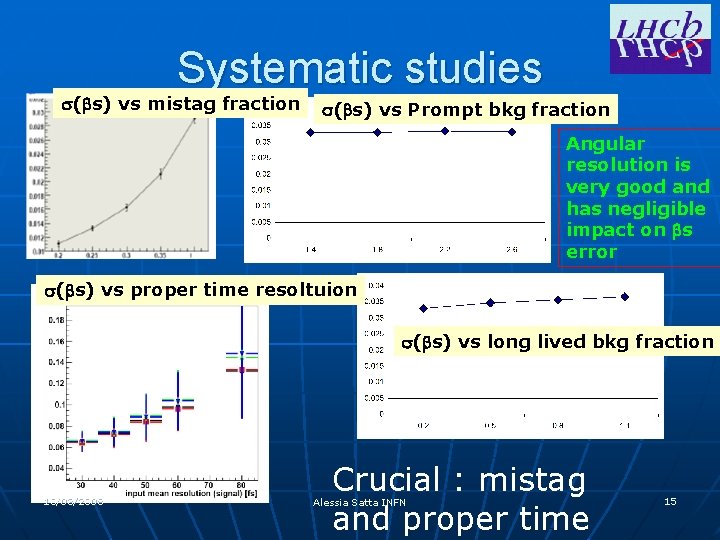
Systematic studies s(bs) vs mistag fraction s(bs) vs Prompt bkg fraction Angular resolution is very good and has negligible impact on bs error s(bs) vs proper time resoltuion s(bs) vs long lived bkg fraction 10/03/2008 Crucial : mistag and proper time Alessia Satta INFN 15
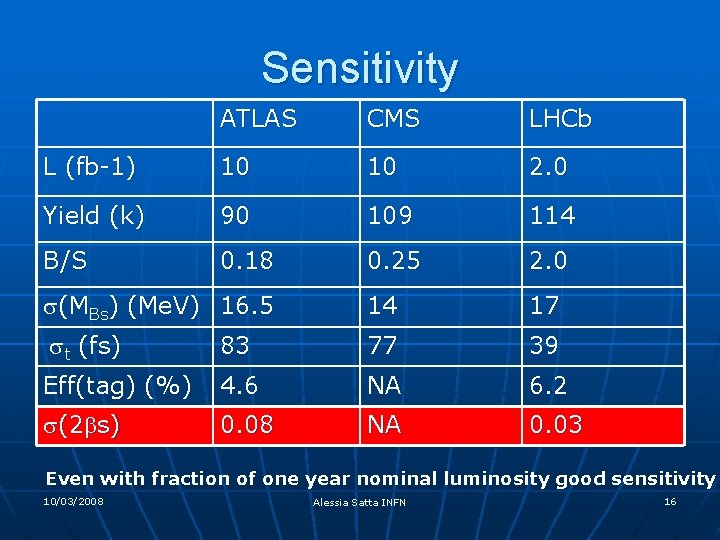
Sensitivity ATLAS CMS LHCb L (fb-1) 10 10 2. 0 Yield (k) 90 109 114 B/S 0. 18 0. 25 2. 0 s(MBs) (Me. V) 16. 5 14 17 st (fs) 83 77 39 Eff(tag) (%) 4. 6 NA 6. 2 s(2 bs) 0. 08 NA 0. 03 Even with fraction of one year nominal luminosity good sensitivity 10/03/2008 Alessia Satta INFN 16
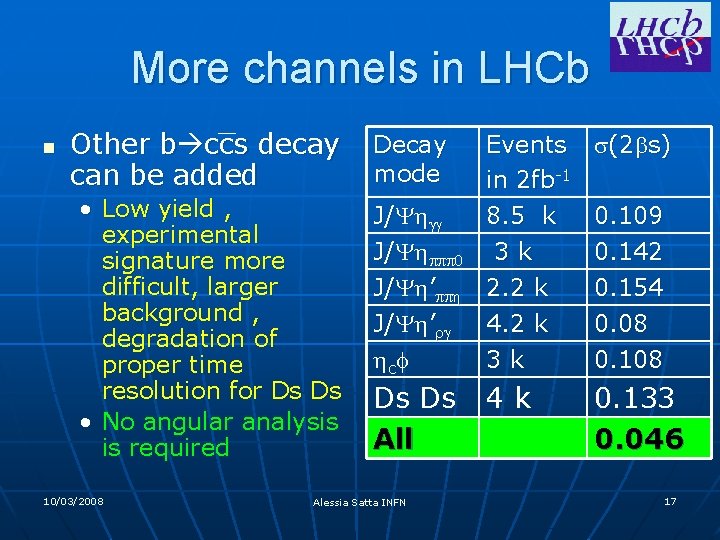
More channels in LHCb n Other b ccs decay can be added • Low yield , experimental signature more difficult, larger background , degradation of proper time resolution for Ds Ds • No angular analysis is required 10/03/2008 Decay mode J/Yhgg J/Yhppp 0 J/Yh’pph J/Yh’rg hc f Ds Ds All Alessia Satta INFN Events in 2 fb-1 8. 5 k 3 k s(2 bs) 2. 2 4. 2 3 k 0. 154 0. 08 0. 108 4 k k k 0. 109 0. 142 0. 133 0. 046 17
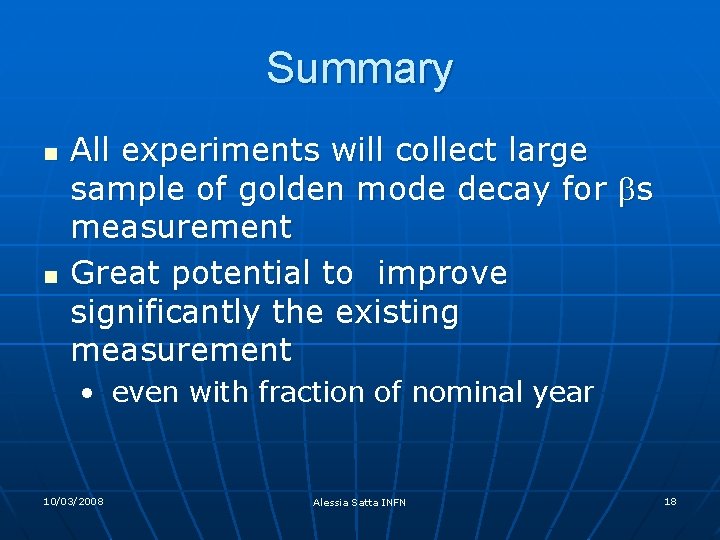
Summary n n All experiments will collect large sample of golden mode decay for bs measurement Great potential to improve significantly the existing measurement • even with fraction of nominal year 10/03/2008 Alessia Satta INFN 18

Spares 10/03/2008 Alessia Satta INFN
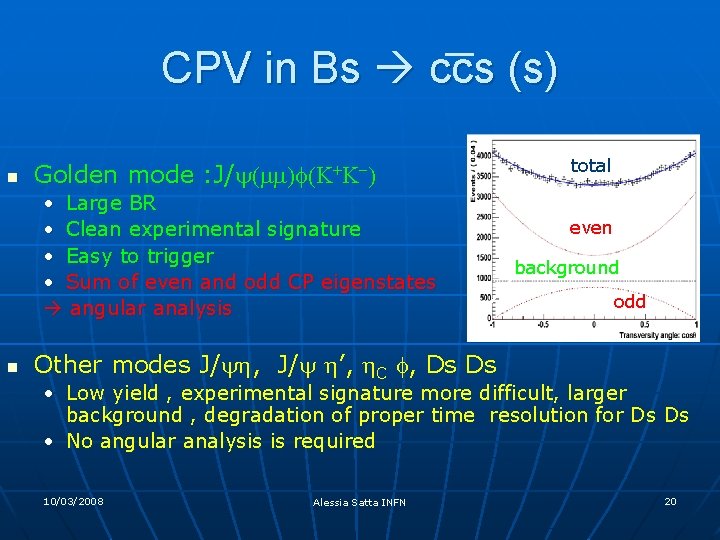
CPV in Bs ccs (s) n Golden mode : J/y(mm)f(K+K-) • Large BR • Clean experimental signature • Easy to trigger • Sum of even and odd CP eigenstates angular analysis n total even background odd Other modes J/yh, J/y h’, h. C f, Ds Ds • Low yield , experimental signature more difficult, larger background , degradation of proper time resolution for Ds Ds • No angular analysis is required 10/03/2008 Alessia Satta INFN 20
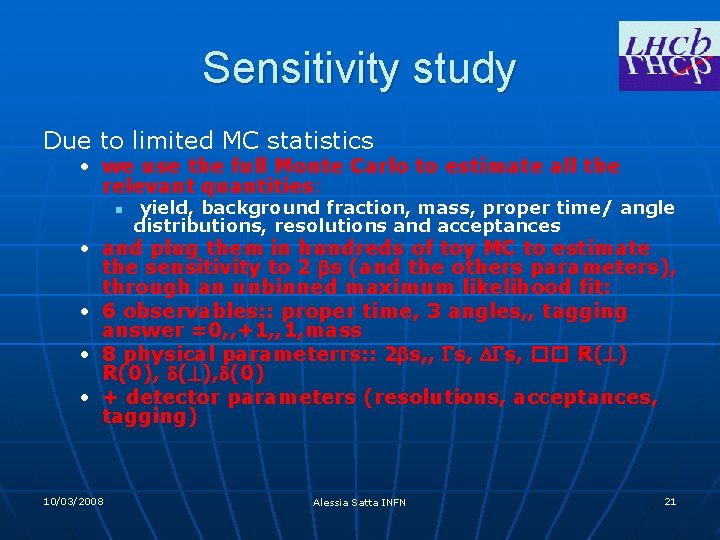
Sensitivity study Due to limited MC statistics • we use the full Monte Carlo to estimate all the relevant quantities: n yield, background fraction, mass, proper time/ angle distributions, resolutions and acceptances • and plug them in hundreds of toy MC to estimate the sensitivity to 2 bs (and the others parameters), through an unbinned maximum likelihood fit: • 6 observables: : proper time, 3 angles, , tagging answer =0, , +1, , 1, mass • 8 physical parameterrs: : 2 bs, , Gs, DGs, �� R( ) R(0), d(0) • + detector parameters (resolutions, acceptances, tagging) 10/03/2008 Alessia Satta INFN 21
CMS time and angular acceptance 10/03/2008 Alessia Satta INFN 22
- Slides: 22