
Prosocial Behavior Why Do People Help A Kent
Prosocial Behavior: Why Do People Help? A. Kent Van Cleave, Jr. , Ph. D.
Helping Behavior: Objectives • Define and discuss altruism and prosocial behavior • Understand discuss several theoretical perspectives on helping – Evolutionary perspective – Sociocultural perspective – Learning perspective – Decision making perspective
Helping Behavior: Objectives • Understand characteristics of the helper —why are some people more likely than others to help? – Mood – Motives for helping – Personality – Gender

Helping Behavior: Objectives • Understand bystander intervention and factors affecting it. – Presence of others – Environmental variables – Time pressures • Understand volunteerism and factors affecting it.
Helping Behavior: Objectives • Understand reactions to receiving help and theories predicting reactions. – Attribution theory – Norm of reciprocity – Reactance theory • Understand the appeal of self-help and computer-based help.
Basic Motives Underlying Prosocial Behavior: Why Do People Help?
Basic Motives of Prosocial Behavior • Prosocial behavior is any act performed with the goal of benefiting another person.
Basic Motives of Prosocial Behavior • Altruism is the desire to help another • person even if it involves a cost to the helper… And with no prospect of reward.
Basic Motives of Prosocial Behavior • How to tell the difference? –Ask whether people are willing to help when there is nothing to gain, –or if they only help when there is some benefit for them.
Basic Motives of Prosocial Behavior Evolutionary Psychology: Instincts and Genes Explains social behavior in terms of genetic factors that evolved over time according to the principles of natural selection.
Theoretical Perspectives • Evolutionary Psychology Darwin: altruistic behavior posed a problem for his theory. If an organism acts altruistically, it may decrease its own reproductive fitness (e. g. , get killed). To deal with this issue, Kin selection theory
Theoretical Perspectives • Evolutionary Psychology Darwin… Kin selection: Behaviors that help a genetic relative are favored by natural selection. Even if the helper dies in helping kin, his/her kin’s genes, which s/he shares, are passed on.
Theoretical Perspectives • Sociocultural Perspective We help others because others help us. Social factors are more important than evolutionary factors. The norm of social responsibility is the belief that we are morally obligated to help others. Generally, we are more likely to feel obligated to help family and friends.
Theoretical Perspectives • Sociocultural Perspective We help others because others help us… The norm of reciprocity is the expectation that helping others will increase the likelihood that they will help us in the future. Simon: The best learners of societal norms have a competitive advantage. One important societal norm is altruism.
Theoretical Perspectives • Sociocultural Perspective We help others because others help us… The norm of social justice is the belief that fairness and equity should occur between people—result is helping the less fortunate. …but it may also result in blaming the victim.
Theoretical Perspectives • Learning Perspective We help others because we have been reinforced for doing so (reinforcement). Or because we are influenced by some other person who is helpful (modeling, observational learning).
Theoretical Perspectives • Learning Perspective The learning perspective is limited by its external focus. It can predict or explain transient helping behavior, but cannot address why individuals are or are not predisposed to help.
Theoretical Perspectives • Decision-Making Perspective This perspective proposes a four-step model leading up to helping: 1. Notice that help is needed. 2. Take responsibility. 3. Weigh the costs and benefits of helping. 4. Decide how to help. More on this later…
Theoretical Perspectives • Social Exchange: The Costs and Rewards of Helping (A step in the Decision making perspective) What we do stems from the desire to maximize our outcomes and minimize our costs. Like evolutionary psychology, it is a theory based on self-interest. One may apply the M=V*I*E formula here…
Theoretical Perspectives • Social Exchange: The Costs and Rewards of Helping can be rewarding in three ways: • may increase the probability that someone will help us in return; • may relieve the personal distress of the bystander; • may gain us social approval and increased self-worth.
Theoretical Perspectives • Social Exchange: The Costs and Rewards of Helping can also be costly; so it decreases when costs are high.
Theoretical Perspectives • Attribution Theory: Do you deserve help? Is the situation outside the subject’s control? Is the help requested for some socially desirable purpose? External attribution or socially desirable purpose increase help.
Theoretical Perspectives • Empathy and Altruism: The Pure Motive for Helping People often help purely out of the goodness of their hearts.
Theoretical Perspectives • Empathy and Altruism: The Pure Motive for Helping Pure altruism is most likely when we experience empathy for the person in need; that is, when we are able to experience events and emotions the way that person experiences them.
Theoretical Perspectives • Empathy and Altruism: The Pure Motive for Helping Batson’s empathy-altruism hypothesis: When we feel empathy for a person, we will help purely for altruistic reasons, regardless of what we have to gain. …In Milgram’s shocking obedience studies, when the “teacher” was in the same room as the learner, he was less likely to continue to administer shocks.
Personal Determinants of Prosocial Behavior: Why Do Some People Help More Than Others Do?
Personal Determinants of Prosocial Behavior • Individual Differences: The Altruistic Personality Developmental psychologists find helping in very young children. …but is this really altruism? Piaget’s research on conservation suggests not…
Personal Determinants of Prosocial Behavior • Individual Differences… Altruistic personality – A person is likely to help others in a wide variety of situations because it is part of his/her personality to do so. We are socialized towards altruism…
Personal Determinants of Prosocial Behavior • Individual Differences… Helping can be encouraged by rewards, …but rewards should not be emphasized too much.
Personal Determinants of Prosocial Behavior • Individual Differences… Parents can increase prosocial behavior in their children by modeling. Children learn from observation what is valued and desired. Active church participation socializes altruistic behavior.
Personal Determinants of Prosocial Behavior • Individual Differences… In young children, superheroes may play a role in prosocial behavior (My current research…)
Personal Determinants of Prosocial Behavior • Individual Differences… There is little evidence of consistency in altruism. Different kinds of people are likely to help in different situations.
Personal Determinants of Prosocial Behavior • Gender Differences… Men are more likely to help in chivalrous, heroic ways. Women are more likely to help in nurturant ways involving long-term commitment. …as both have been socialized to do…
Personal Determinants of Prosocial Behavior • The Effects of Mood: Feel Good, Do Good People in a good more likely to help: • good moods make us interpret events in a sympathetic way; • helping another prolongs the good mood; and good moods increase selfattention, • this leads us to be more likely to behave according to our values and beliefs.
Personal Determinants of Prosocial Behavior • The Effects of Mood But people in a negative mood help, also… Negative-state relief hypothesis – people help in order to alleviate their own sadness and distress.
III. Situational Determinants of Prosocial Behavior: When Will People Help? Much of the research in this area was spurred by the very public murder of Kitty Genovese
Situational Determinants of Prosocial Behavior • Rural Versus Urban Environments People in rural areas are more helpful. This effect holds over a wide variety of ways of helping and in many countries. One explanation: People from rural settings are brought up to be more neighborly and are more likely to trust strangers.
Situational Determinants of Prosocial Behavior • Rural Versus Urban Environments People in rural areas are more helpful. . . Other explanations: • Lower resource density… • Know neighbors better, thus communal relationship rather than exchange relationship • Perceived interdependency is greater.
Situational Determinants of Prosocial Behavior • Rural Versus Urban Environments An alternative hypothesis, by Milgram, is the urban-overload hypothesis, the idea that people living in cities are likely to keep to themselves in order to avoid being overloaded by all the stimulation they receive. (related to crowding…)
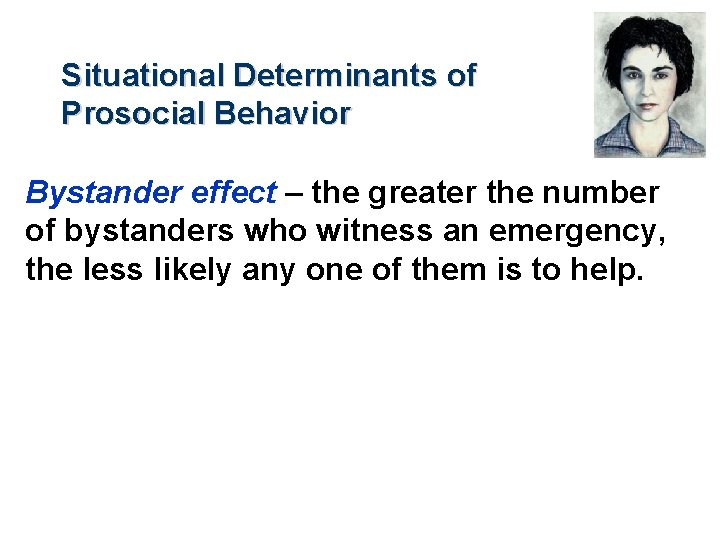
Situational Determinants of Prosocial Behavior Bystander effect – the greater the number of bystanders who witness an emergency, the less likely any one of them is to help.
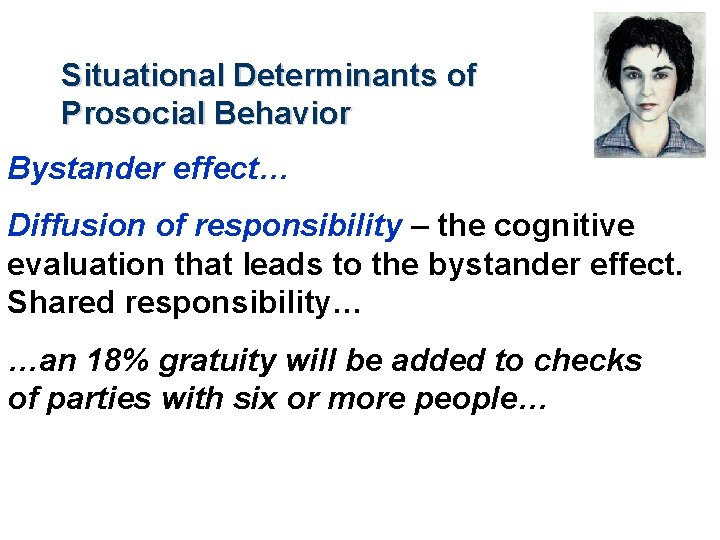
Situational Determinants of Prosocial Behavior Bystander effect… Diffusion of responsibility – the cognitive evaluation that leads to the bystander effect. Shared responsibility… …an 18% gratuity will be added to checks of parties with six or more people…
Situational Determinants of Prosocial Behavior Bystander effect… Referent interpretation – If we see others not reacting, we are less likely to respond.
Situational Determinants of Prosocial Behavior • The Bystander Effect Latané and Darley: step by step description of how people decide whether to help in an emergency: 1. Noticing an Event 2. Interpreting the Event as an Emergency 3. Assuming responsibility 4. Knowing How to Help 5. Deciding to Implement the Help
Situational Determinants of Prosocial Behavior • The Bystander Effect—Who steps in? Some demographic and personality attributes that predict helping behavior: 1. Male 2. Taller and stronger than average 3. Well-trained in handling emergencies 4. Describe selves as strong, principled. 5. Acted from sense of competence & responsibility
Other Situational Determinants of Prosocial Behavior Time Pressures—Research shows people are less likely to help if under time pressures. Environmental Conditions—Weather and time of day matters; people help more in nice weather; in smaller cities.
Situational Determinants of Prosocial Behavior • Communal Versus Exchange Relationships Communal relationships—people’s primary concern is with the welfare of the other Exchange relationships are governed by equity concerns (norm of reciprocity).
Situational Determinants of Prosocial Behavior • Communal Versus Exchange Relationships Generally we are more helpful towards friends (communal) than strangers (exchange). The exception—when the other is beating us in a domain that is personally important and thus threatens our selfesteem.
Volunteerism Leading Volunteers—Very diverse motives bring volunteers, and their motives change. Position power does not work in leading them. Only referent power is really effective. The leader of volunteers should focus volunteers’ attention on personal growth and the intrinsic rewards of service.
Effects of Receiving Help Recipients of help don’t always welcome it. Those receiving help may feel dependent, weak, or incapable. They may feel a loss of self-respect, and may resent receiving help.
Effects of Receiving Helpers often experience frustration and other negative emotions as they help. Conflict and hostility arise between helper and helped over time. Several theories have been offered for these outcomes:
Effects of Receiving Help Attribution Theory: Receiving help is not so aversive when one can attribute the need for help to an outside force. But if an external attribution is not possible, selfesteem is threatened. Norm of Reciprocity: If the person being helped feels unable to reciprocate, s/he may have an oppressive feeling of indebtedness. The relationship also becomes power-imbalanced.
Effects of Receiving Help Reactance: People want to maximize their freedom of choice. When we feel that freedom is threatened, we experience reactance—annoyance and hostility. Senior citizens experience reactance when they must accept help in doing daily living activities, because it “proves” their loss of capacity.
IV. How Can Helping Be Increased?
How Can Helping Be Increased? • If being helped means that they appear incompetent, they will often suffer in silence, even at the cost of failing at the task.
How Can Helping Be Increased? • People do not always want to be • • helped, even if they appear to need it. Simply being aware of the barriers to helping can increase people’s chances of overcoming those barriers. How help is framed is important.
How Can Helping Be Increased? We can teach others about framing help: • When helping, make it supportive, highlighting concern for the recipient. • Watch out for giving help that merely threatens the other’s self-esteem. • Do it in a low-profile way that does not attract bystander attention.
How Can Helping Be Increased? We can teach others about framing help: • Make sure the recipient really needs and wants to be helped. • Present help in a way that allows the recipient to minimize its importance and/or allows an external attribution. • Offer an external attribution when you help.
Course revisions Reduced coverage of chapter 15 and 16 on law. Chapter 15 Politics • p. 464 on terrorist attacks and their effects (reactions of groups to external threats) • p. 472 -475 on political socialization • p. 480 -493. Chapter 16 Law • p. 497 -503 Eyewitness testimony • p. 508 -511 Juries and jury decision making
Study Questions What is the difference between prosocial behavior and altruism?
Study Questions What are two basic assumptions of evolutionary psychology? How does this approach explain altruism?
Study Questions What is the basic assumption of social exchange theory as it relates to helping behavior? How is social exchange theory’s explanation different from the evolutionary psychology approach?
Study Questions How does empathy-altruism hypothesis explain altruistic behavior? What are experimental strategies used to test the strength of this hypothesis?
Study Questions What are three main motives that could explain prosocial behavior?
Study Questions What is the altruistic personality? How can this personality be developed? How should rewards be used to encourage prosocial behavior in children?
Study Questions Why is knowing a person’s personality not enough information to predict whether this person will engage in prosocial behavior? What other factors are important?
Study Questions How do males and females differ in the area of prosocial behavior?
Study Questions When and why do people in a good mood help others?
Study Questions What is the negative-state relief hypothesis and what does it attempt to explain?
Study Questions What aspects of the social situation are important for prosocial behavior to occur? What is the relationship between population size and prosocial behavior?
Study Questions How does the urban-overload hypothesis explain the greater likelihood of prosocial behavior in towns of certain population sizes?
Study Questions What are the five steps that depict what people consider when deciding whether to intervene in an emergency? What influences whether people will continue through the steps and eventually help?
Study Questions Why does the presence of other people influence people’s interpretation of an event as an emergency? How does informational social influence lead to the bystander effect?
Study Questions How do motives to help differ in exchange versus communal relationships?
Study Questions What are strategies to increase prosocial behavior? What factors are important to consider when attempting to make prosocial behavior more common?
- Slides: 74