
Prosocial behavior and Human strengths Gratitude Kindness Compassion
Prosocial behavior and Human strengths Gratitude, Kindness, Compassion and the Value in Action project
About me • Rui Sun (孙睿) – rs 770@cam. ac. uk || sunrui. cam@gmail. com – Ph. D candidate, Cambridge Prosociality and Wellbeing Lab, Department of Psychology – Research Interest: Prosociality, Wellbeing, Socioeconomic Status, Big data
BEFORE WE START…
“Three Good Things” • Please list three good things happened yesterday • What caused these three good things?
What is prosocial behaviour? Can you think of any example?
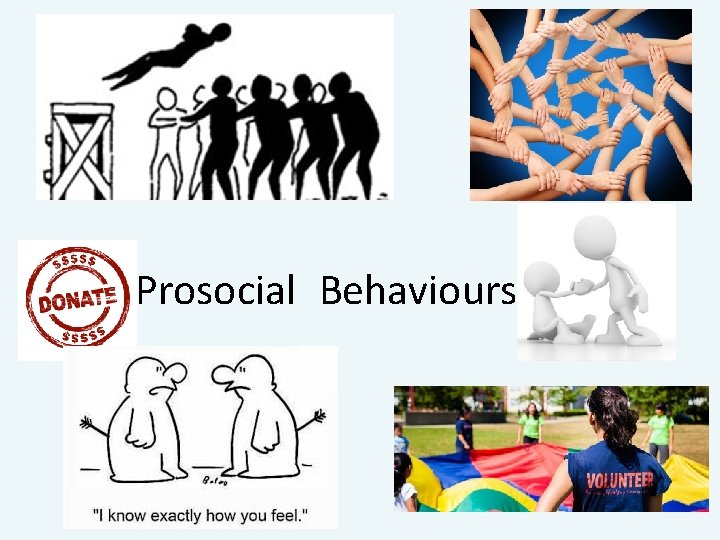
Prosocial Behaviours
Prosocial Behaviour • Voluntary behavior intended to benefit another • A social behavior that "benefits other people or society as a whole” – helping, sharing, donating, co-operating, and volunteering – Obeying the rules and conforming to socially accepted behaviors (such as stopping at a "Stop" sign or paying for groceries) are also regarded as prosocial behaviours.
Question for you: • Why do people act prosocially rather than selfishly?
Why do people act prosocially? • Motivated by empathy – Giving money to the homeless? • Concerns about the welfare and rights of others – Help and donate those in need • Gain social status • Egoistic or practical concerns – Hope for direct or indirect reciprocity – Adherence to one's perceived system of fairness • Motivated by altruism – Is there “pure altruism”?
Question for you: • Do you think whethere is pure altruism? Or always involves reciprocity? – People feel guilty when they do not reciprocate and they may feel angry when someone else does not reciprocate. Reciprocal altruism suggests that "such helping is driven by a genetic tendency
Why can prosociality be preserved? • Kin-selection theory – Help your relatives – Give presents according to how closely related they are to the recipient • Encouraging prosocial behavior may also require decreasing or eliminating undesirable social behaviors.
Question for you: • What’s the benefit of being prosocial? – Compassion: being kind activates the reward system in your brain – Happier (prosocial spending) – Volunteering boosts Satisfaction with life ……
COMPASSION
Definition The feeling that you have when you witness someone else who is suffering or who is in need, and then you have this motivation to help them, to ameliorate their condition or to enhance their welfare. You FEEL concern
Compassion is different from… • Empathy: put yourself in others’ shoes – Others feel pain, you understand feel their pain, but you not necessarily feel concerns for them • Mimicry: mimic or imitate yawns, laughs, tones of voice, face scratching, postural movements, eyebrow movements, gaze activity… – separate from the feeling of concern about somebody’s welfare with compassion. • Pity: feeling of concern for someone that you feel is inferior to you – from compassion, there isn’t a sense of superiority or
Why we’re compassionate? • “Sympathy will have been increased through natural selection for those communities which included the greatest number of the most sympathetic members would flourish the best and raise the greatest number of offspring. ” - <The Descent of Man> Charles Darwin, 1871 • Compassion (Sympathy) helps us get along in communities, it helps us take care of those offspring who are the carriers of our genes, lots of good evolutionary reasons for being sympathetic and compassionate.
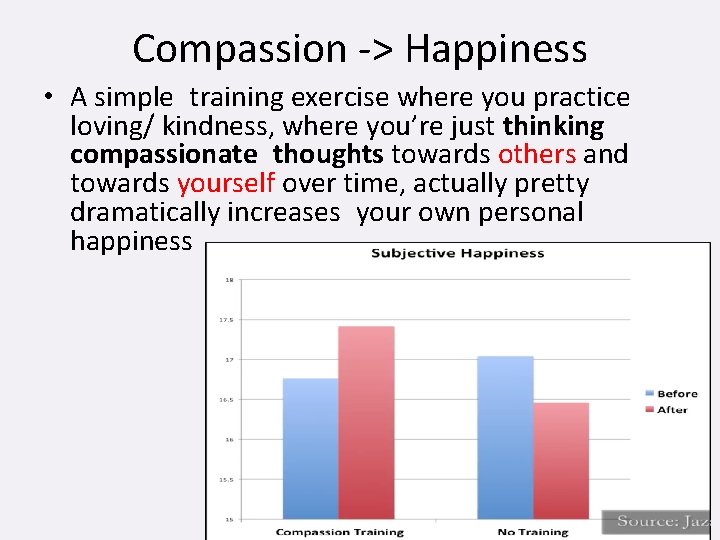
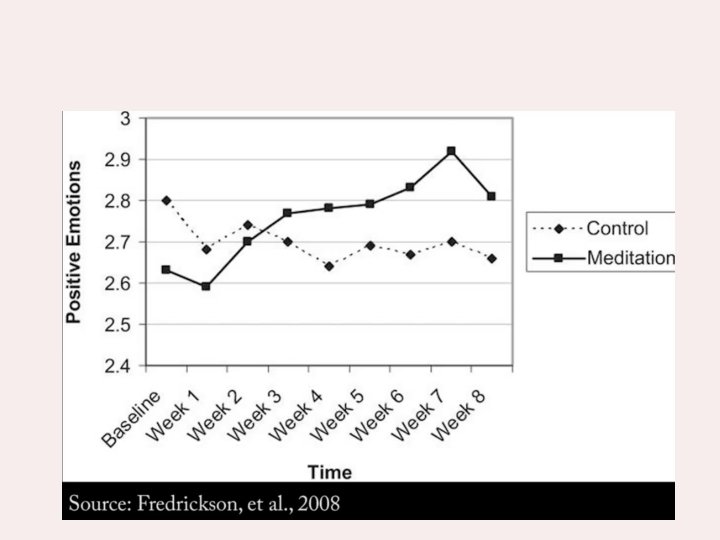
Compassion -> Happiness • A simple training exercise where you practice loving/ kindness, where you’re just thinking compassionate thoughts towards others and towards yourself over time, actually pretty dramatically increases your own personal happiness
The Kindness-Happiness Loop • Volunteering enhances well-being and life expectancy – caregivers in their later stages of life – if they provide care for others 14 hours a week or more, they are 36% less likely to die in a seven year period than people who provide less than 14 hours a week
The Kindness-Happiness Loop • The more practicing kindness, the more enhancing the welfare of others – Less loneliness on a regular basis, stronger immune profiles, better health (Post, 2005) – Less pain, fewer bodily aches, lower levels of depression (Post, 2005) – Protects from heart disease – twice effective as much as aspirin (Post & Neimark, 2007) • Age 55+: volunteering for 2+ charities reduces overall likelihood of death by 44% (Omen et al, 1999)
PROSOCIAL SPENDING
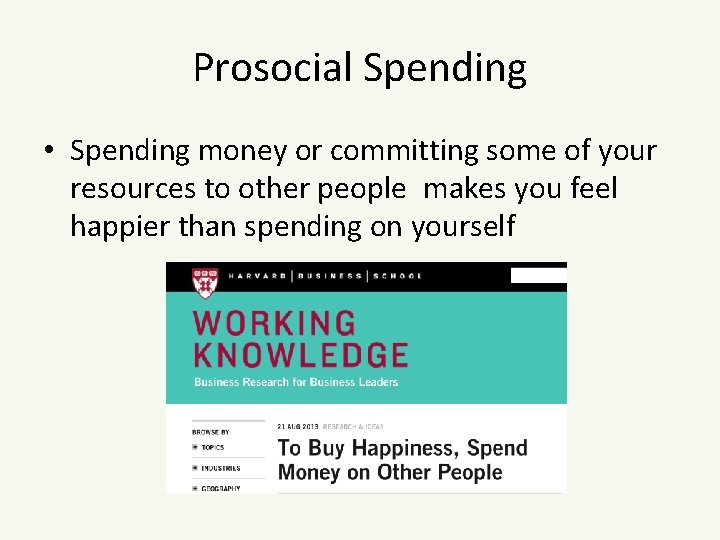
Prosocial Spending • Spending money or committing some of your resources to other people makes you feel happier than spending on yourself
Researchers say…
How to Practice: KINDNESS MEDITATION
VALUE IN ACTION
Value In Action • “Many people have aspirational values, but the ones that really count are those that you enact every day. ” • Self assessment: – 1 (least) – 5 (most)
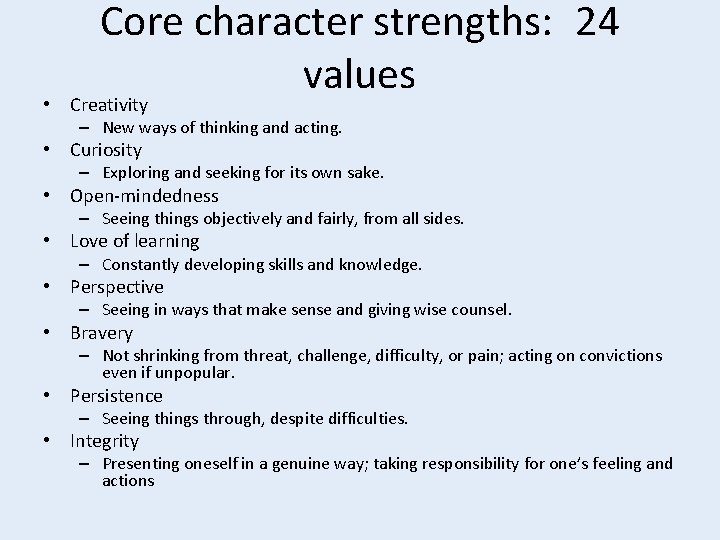
Core character strengths: 24 values • Creativity – New ways of thinking and acting. • Curiosity – Exploring and seeking for its own sake. • Open-mindedness – Seeing things objectively and fairly, from all sides. • Love of learning – Constantly developing skills and knowledge. • Perspective – Seeing in ways that make sense and giving wise counsel. • Bravery – Not shrinking from threat, challenge, difficulty, or pain; acting on convictions even if unpopular. • Persistence – Seeing things through, despite difficulties. • Integrity – Presenting oneself in a genuine way; taking responsibility for one’s feeling and actions
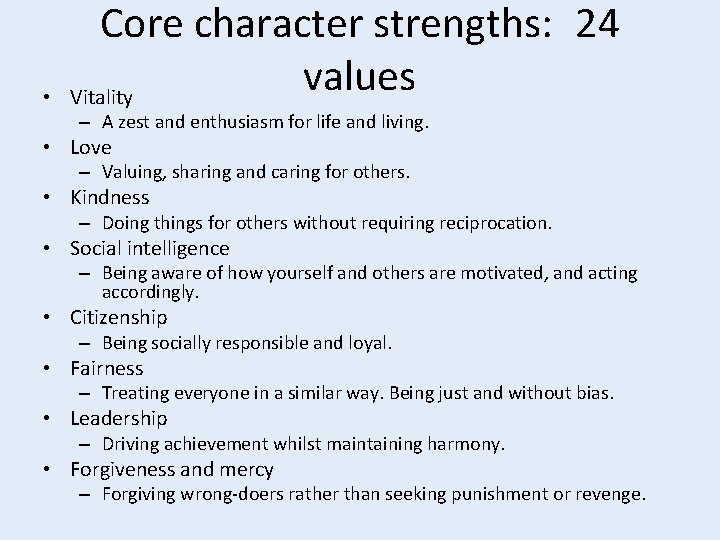
• Core character strengths: 24 values Vitality – A zest and enthusiasm for life and living. • Love – Valuing, sharing and caring for others. • Kindness – Doing things for others without requiring reciprocation. • Social intelligence – Being aware of how yourself and others are motivated, and acting accordingly. • Citizenship – Being socially responsible and loyal. • Fairness – Treating everyone in a similar way. Being just and without bias. • Leadership – Driving achievement whilst maintaining harmony. • Forgiveness and mercy – Forgiving wrong-doers rather than seeking punishment or revenge.
• Core character strengths: 24 values Humility / Modesty – Not putting oneself above others. Letting achievements speak for themselves. • Prudence – Not taking undue risks or doing what you will regret. • Self-regulation – Controlling one's emotions and actions according to one's values. • Wonder – Appreciating beauty and excellence. • Gratitude – Knowing, feeling and being thankful for all the good things in life. • Hope – Positively expecting the best and working to achieve it. • Humor – Enjoying laughter and making people laugh. Seeing the lighter side of life. • Spirituality – Having coherent beliefs higher purpose and the meaning of life.
Discussion • In the 24 values, which are you doing very well? Which you need to improve?
10 ways to become more grateful 1. Keep a Gratitude Journal. Establish a daily practice in which you remind yourself of the gifts, grace, benefits, and good things you enjoy. Setting aside time on a daily basis to recall moments of gratitude associated with ordinary events, your personal attributes, or valued people in your life gives you the potential to interweave a sustainable life theme of gratefulness.
10 ways to become more grateful 2. Remember the Bad. To be grateful in your current state, it is helpful to remember the hard times that you once experienced. When you remember how difficult life used to be and how far you have come, you set up an explicit contrast in your mind, and this contrast is fertile ground for gratefulness.
10 ways to become more grateful 3. Ask Yourself Three Questions. Utilize the meditation technique known as Naikan, which involves reflecting on three questions: “What have I received from __? ”, “What have I given to __? ”, and “What troubles and difficulty have I caused? ”
10 ways to become more grateful 4. Learn Prayers of Gratitude. In many spiritual traditions, prayers of gratitude are considered to be the most powerful form of prayer, because through these prayers people recognize the ultimate source of all they are and all they will ever be.
10 ways to become more grateful 5. Come to Your Senses. Through our senses—the ability to touch, see, smell, taste, and hear—we gain an appreciation of what it means to be human and of what an incredible miracle it is to be alive. Seen through the lens of gratitude, the human body is not only a miraculous construction, but also a gift.
10 ways to become more grateful 6. Use Visual Reminders. Because the two primary obstacles to gratefulness are forgetfulness and a lack of mindful awareness, visual reminders can serve as cues to trigger thoughts of gratitude. Often times, the best visual reminders are other people.
10 ways to become more grateful 7. Make a Vow to Practice Gratitude. Research shows that making an oath to perform a behavior increases the likelihood that the action will be executed. Therefore, write your own gratitude vow, which could be as simple as “I vow to count my blessings each day, ” and post it somewhere you will be reminded of it every day.
10 ways to become more grateful 8. Watch your Language. Grateful people have a particular linguistic style that uses the language of gifts, givers, blessings, blessed, fortune, fortunate, and abundance. In gratitude, you should not focus on how inherently good you are, but rather on the inherently good things that others have done on your behalf.
10 ways to become more grateful 9. Go Through the Motions. If you go through grateful motions, the emotion of gratitude should be triggered. Grateful motions include smiling, saying thank you, and writing letters of gratitude.
10 ways to become more grateful 10. Think Outside the Box. If you want to make the most out of opportunities to flex your gratitude muscles, you must creatively look for new situations and circumstances in which to feel grateful.
HAPPINESS PRACTICE & HOMEWORK
1. Who are you grateful for? Why? 2. “Three good things” practice 3. “Random kindness” – Do five kind things per day (small or big), and write them down – Have to be different kinds of kindness, to different people – Write it down, describe what you did, how you did it, and whethere was any impact
- Slides: 42