
Prosecution before international courts and tribunals Learning objectives

Prosecution before international courts and tribunals
Learning objectives • To introduce participants to how international prosecutions of international criminal law can be undertaken. • To provide understanding of the relationship between the international criminal courts and domestic courts, namely the principle of primacy and the principle of complementarity. • To familiarise participants with the organisation and functioning of various international courts and tribunals, namely the structure of their organs, various stages of their procedures and the nature of cooperation between the courts and tribunals and states.
Overview • Relationship between international and national jurisdictions. • Organisation of international courts and tribunals. • International criminal proceedings.
The relationship between international and national jurisdictions • Primacy versus complementarity. • Admissibility: – Libya; – Kenya. • States’ obligation of cooperation.
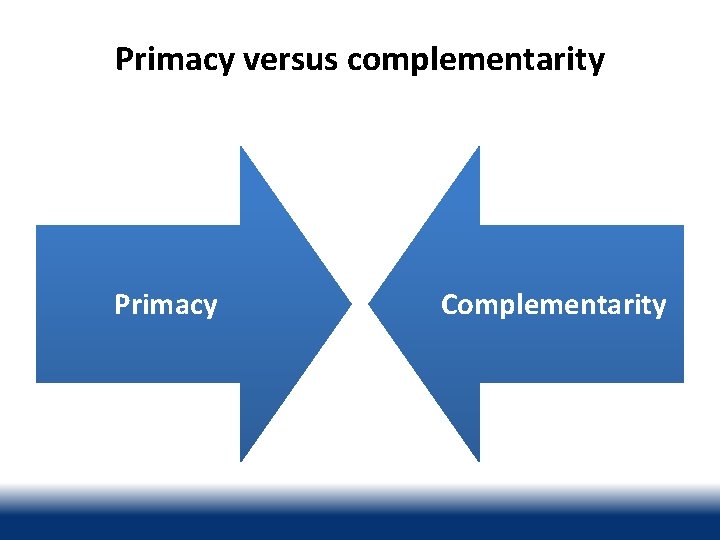
Primacy versus complementarity Primacy Complementarity
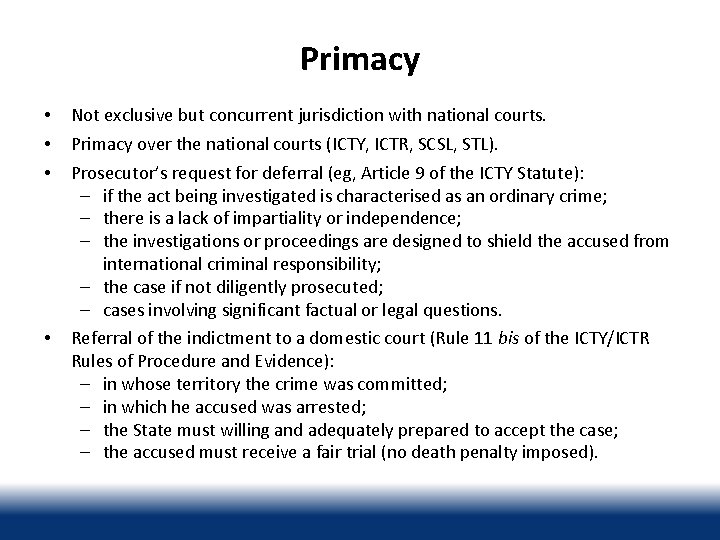
Primacy • • • Not exclusive but concurrent jurisdiction with national courts. • Referral of the indictment to a domestic court (Rule 11 bis of the ICTY/ICTR Rules of Procedure and Evidence): – in whose territory the crime was committed; – in which he accused was arrested; – the State must willing and adequately prepared to accept the case; – the accused must receive a fair trial (no death penalty imposed). Primacy over the national courts (ICTY, ICTR, SCSL, STL). Prosecutor’s request for deferral (eg, Article 9 of the ICTY Statute): – if the act being investigated is characterised as an ordinary crime; – there is a lack of impartiality or independence; – the investigations or proceedings are designed to shield the accused from international criminal responsibility; – the case if not diligently prosecuted; – cases involving significant factual or legal questions.
Complementarity Preamble of the ICC Statute ‘Emphasizing that the International Criminal Court established under this Statute shall be complementary to national criminal jurisdictions. ’ Article 1 of the ICC Statute ‘An International Criminal Court… shall be complementary to national criminal jurisdictions…’.
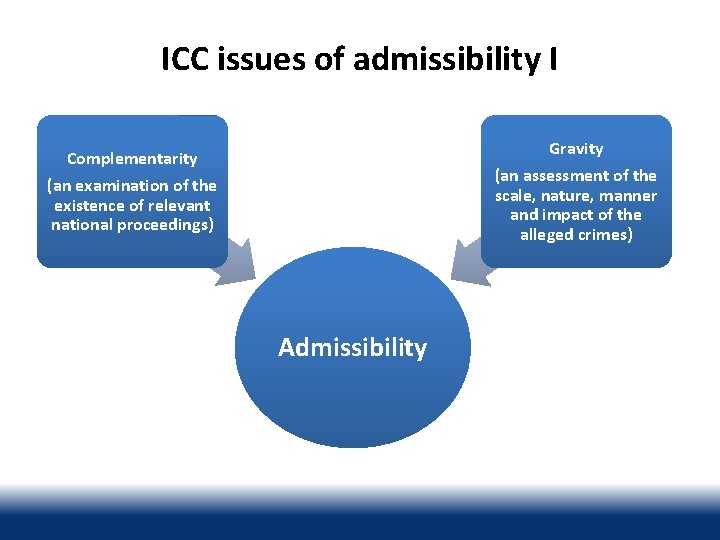
ICC issues of admissibility I Gravity (an assessment of the scale, nature, manner and impact of the alleged crimes) Complementarity (an examination of the existence of relevant national proceedings) Admissibility
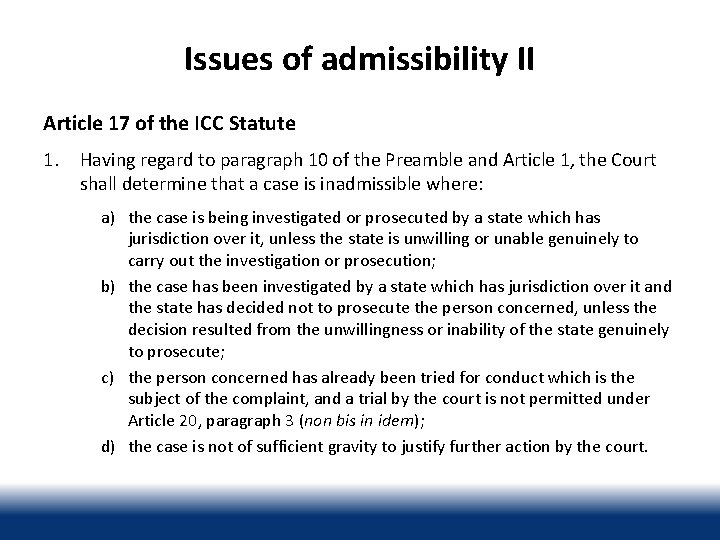
Issues of admissibility II Article 17 of the ICC Statute 1. Having regard to paragraph 10 of the Preamble and Article 1, the Court shall determine that a case is inadmissible where: a) the case is being investigated or prosecuted by a state which has jurisdiction over it, unless the state is unwilling or unable genuinely to carry out the investigation or prosecution; b) the case has been investigated by a state which has jurisdiction over it and the state has decided not to prosecute the person concerned, unless the decision resulted from the unwillingness or inability of the state genuinely to prosecute; c) the person concerned has already been tried for conduct which is the subject of the complaint, and a trial by the court is not permitted under Article 20, paragraph 3 (non bis in idem); d) the case is not of sufficient gravity to justify further action by the court.
Issues of admissibility: ‘unwillingness’ Article 17 of the ICC Statute 2. In order to determine unwillingness in a particular case, the court shall consider, having regard to the principles of due process recognised by international law, whether one or more of the following exist, as applicable: a) the proceedings were or are being undertaken or the national decision was made for the purpose of shielding the person concerned from criminal responsibility for crimes within the jurisdiction of the court referred to in Article 5; b) there has been an unjustified delay in the proceedings which in the circumstances is inconsistent with an intent to bring the person concerned to justice; c) the proceedings were not or are not being conducted independently or impartially, and they were or are being conducted in a manner which, in the circumstances, is inconsistent with an intent to bring the person concerned to justice.
Issues of admissibility: ‘inability’ Article 17 of the ICC Statute 3. In order to determine inability in a particular case, the court shall consider whether, due to a total or substantial collapse or unavailability of its national judicial system, the state is unable to obtain the accused or the necessary evidence and testimony or otherwise unable to carry out its proceedings.
Government of Kenya admissibility challenge • Two cases relating to the Kenya situation involving crimes committed during the post-election violence in 2007/08: – Prosecutor v Ruto & Sang; – Prosecutor v Muthaura & Kenyatta. • Kenya challenged the admissibility of the cases arguing that the cases are being investigated by domestic authorities. • The ICC dismissed the admissibility challenge: burden of proof is on the party that challenges the admissibility. • Reasoning: Kenya failed to provide sufficient evidence to convince the court that it was investigating the same individuals now suspects before the ICC and the substantially same conduct alleged in the ICC proceedings.
Cooperation with the ICC Article 86 of the ICC Statute • General obligation of states parties to cooperate fully with the court in its investigation and prosecution of crimes, in accordance with the provisions of the ICC Statute. Article 88 of the ICC Statute • Requires states parties to ensure there are procedures available under their national law for all the forms of cooperation. Article 89 of the ICC Statute • States parties are required to execute arrest warrants and surrender persons. Article 90 of the ICC Statute • Competing requests (a request from the court for the surrender and a request from any other state for the extradition of the same person for the same conduct).
Sanctions for non-cooperation with the ICC Article 87(7) of the ICC Statute • The court may make a finding that a state party failed to comply with a request to cooperate by the court, thereby preventing the court from exercising its functions and powers under the ICC Statute; and • Refer the matter to: 1. the Assembly of States Parties – may recommend resolution of non-cooperation issue through diplomatic means, such as through ‘good offices’ intervention by the President of the Assembly; 2. the Security Council – where the Security Council referred the situation to the court).
Organisation of international court and tribunals • Structure of international courts and tribunals. • Organs of international courts and tribunals. • The role of amicus curiae before international courts and tribunals.
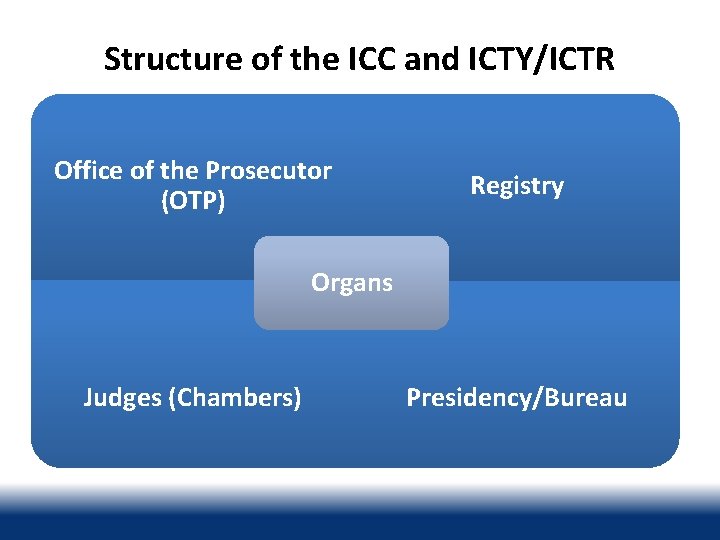
Structure of the ICC and ICTY/ICTR Office of the Prosecutor (OTP) Registry Organs Judges (Chambers) Presidency/Bureau
Judges (chambers) ICTY/ICTR • Three trial chambers sitting in panels of three judges. • Appeals chamber sitting in panels of five judges (ICTY and ICTR have a joint appeals chamber). ICC • Pre-trial Division. • Trial division. • Appeals division.
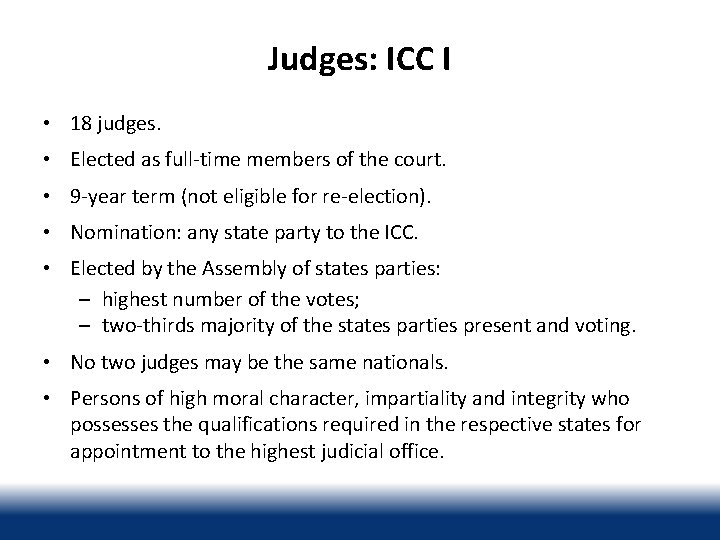
Judges: ICC I • 18 judges. • Elected as full-time members of the court. • 9 -year term (not eligible for re-election). • Nomination: any state party to the ICC. • Elected by the Assembly of states parties: – highest number of the votes; – two-thirds majority of the states parties present and voting. • No two judges may be the same nationals. • Persons of high moral character, impartiality and integrity who possesses the qualifications required in the respective states for appointment to the highest judicial office.
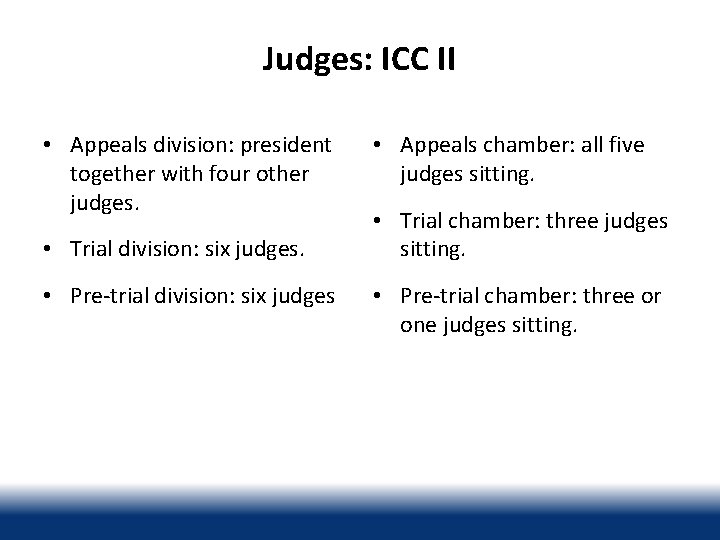
Judges: ICC II • Appeals division: president together with four other judges. • Trial division: six judges. • Pre-trial division: six judges • Appeals chamber: all five judges sitting. • Trial chamber: three judges sitting. • Pre-trial chamber: three or one judges sitting.
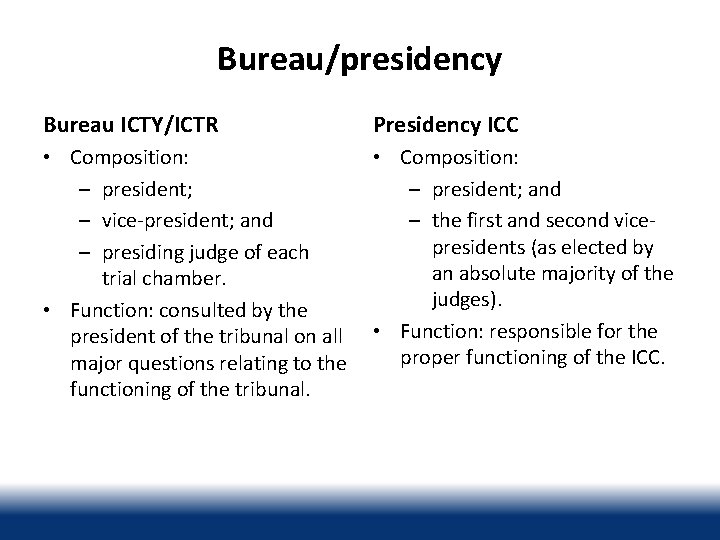
Bureau/presidency Bureau ICTY/ICTR Presidency ICC • Composition: – president; – vice-president; and – presiding judge of each trial chamber. • Function: consulted by the president of the tribunal on all major questions relating to the functioning of the tribunal. • Composition: – president; and – the first and second vicepresidents (as elected by an absolute majority of the judges). • Function: responsible for the proper functioning of the ICC.
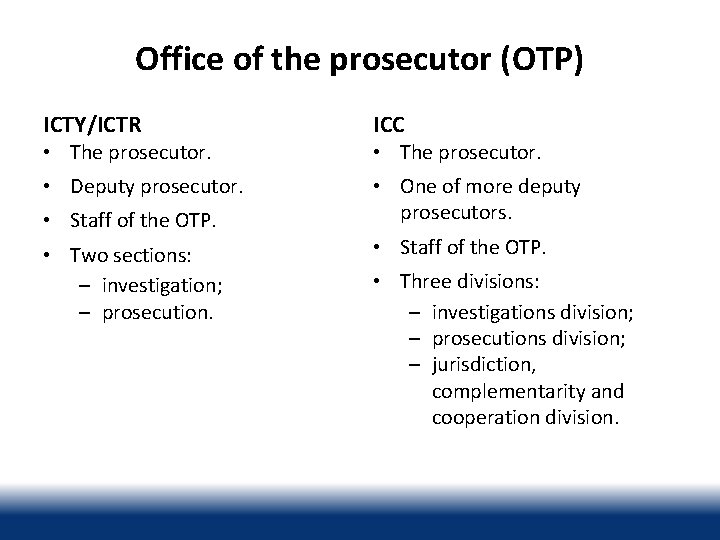
Office of the prosecutor (OTP) ICTY/ICTR ICC • Deputy prosecutor. • One of more deputy prosecutors. • The prosecutor. • Staff of the OTP. • Two sections: – investigation; – prosecution. • The prosecutor. • Staff of the OTP. • Three divisions: – investigations division; – prosecutions division; – jurisdiction, complementarity and cooperation division.
The registry: ICTY/ICTR • Composition: – the registrar; – the deputy registrar; and – staff. • Tasks: – responsible for the administration and servicing of the tribunal; – supports the work of the chambers, the prosecution and the defence for the purpose of conducting trials; – administers the legal aid system of assigning defence counsels to indigent accused; – manages a unit for the protection of victims and witnesses; – superintends the UN Detention Unit; – maintains diplomatic contact with states and embassies.
The registry: ICC • Composition: – the registrar; – the deputy registrar; and – staff. • Tasks: – responsible for the non-judicial aspects of the administration and servicing of the court, without prejudice to the functions and powers of the prosecutor; – provides judicial and administrative support to all organs of the court and carries out its specific responsibilities in the areas of defence, victims and witnesses, outreach and detention; – responsible for the victims and witnesses unit set up within the registry.
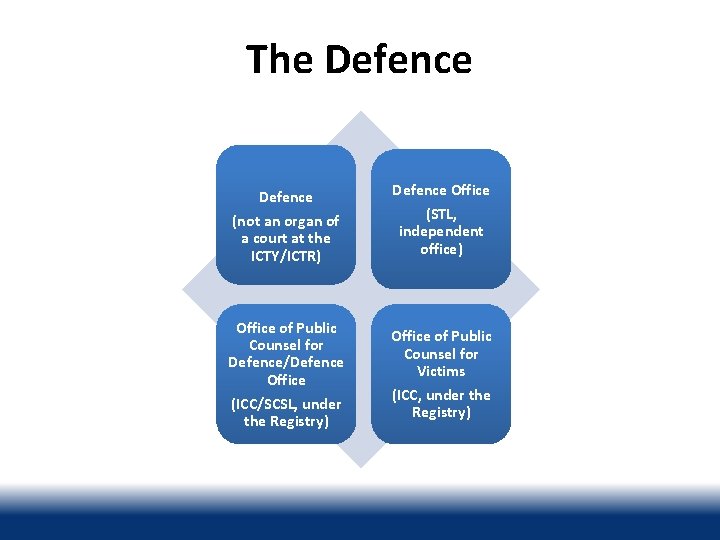
The Defence (not an organ of a court at the ICTY/ICTR) Office of Public Counsel for Defence/Defence Office (ICC/SCSL, under the Registry) Defence Office (STL, independent office) Office of Public Counsel for Victims (ICC, under the Registry)
The defence counsel • The registrar usually maintains a list of counsel who fulfill the requirements for qualifications of counsel. • Requirements: – – – admitted into practice or a university law professor; proficiency in English or French; competence in international criminal law; criminal law and/or international humanitarian law/human rights; necessary relevant experience, whether as a judge, prosecutor or attorney. • The defendant may freely choose his or her counsel from the list (or, at the ICC, any other counsel who meets the required criteria and is willing to be included in the list).
Office of public counsel for the defendant (ICC) • Representing and protecting the rights of the defence during the initial stages of investigation. • Providing support and assistance to defence counsel and to persons entitled to legal assistance (eg, legal advice). • Acting as ad hoc counsel, if appointed by a chamber, or as duty counsel if selected by a suspect who has not yet secured permanent legal representation. • Acting as a mediator in disputes between defendants entitled to legal assistance and their counsel.
Amicus curiae • Definition: ‘friend of the court’. • No general right for amicus curiae submissions before international courts. • Rules of the courts allow submissions of amicus curiae briefs (eg, Rule 103(1) of the ICC Rules). • Presentation: – when: at any stage of the proceedings; – who: a state organisation or person; – how: in writing or orally. • Discretion: a chamber may, if it considers desirable for the proper determination of the case, invite or grant leave to amicus curiae to submit any observation on any issue that a chamber deems appropriate.
International criminal proceedings • Rules of Procedure and Evidence. • Adversarial and inquisitorial systems. • General principles governing international proceedings. • Stages of the proceedings. • Protection of victims and witnesses. • Victims’ participation in the proceedings. • Reparations to victims.
Rules of Procedure and Evidence • No uniform international criminal procedure. • Each international criminal court has its own rules of procedure. • Statutes of international criminal court (the main instrument). • Rules of Procedure and Evidence: – judge-made rules at the ICTY/ICTR; – adopted by the Assembly of States Parties at the ICC; – procedural rules are sometimes drawn from domestic practice.
Adversarial versus inquisitorial system ICTY/ICTR: ICC: • Elements of adversarial procedure: • States indicate their willingness to court to accept sentenced persons. • The court chooses a state where imprisonment is to be served from a list of these states. • Conditions: Article 103(3) of the ICC Statute. – the prosecution collects the evidence, the defence is entitled to disclosure of all relevant evidence, including exculpatory evidence; – at trial parties present their respective cases as they would in adversarial proceedings. • Elements of inquisitorial procedure: – no jury; – no technical rules for the admissibility of evidence; – no plea-bargaining.
General principles governing international proceedings • Impartiality and independence of the judges. • Presumption of innocence. • Fair, public and expeditious trial: – – equality of arms; right to a public hearing; expeditiousness of the proceedings; right to self-representation. • Presence of the accused at the trial. • Rights of persons during an investigation: Article 55 of the ICC Statute. • Rights of the accused: Article 67 of the ICC Statute.
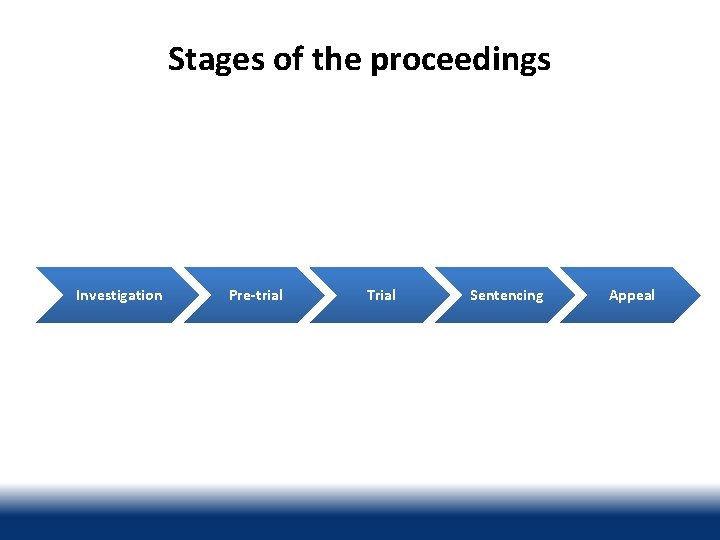
Stages of the proceedings Investigation Pre-trial Trial Sentencing Appeal
Investigation I ICTY/ICTR • Investigations triggered by the prosecutor ex officio, on the basis of information obtained from any source. • Broad discretion by the prosecutor. • Strategy: those who are the most responsible for the crimes, for example, leadership figures. ICC • Investigation may be triggered at the request of a state party to the Statute, by the prosecutor acting proprio motu, at the request of the UN Security Council acting under Chapter VII of the UN Charter. • Proprio motu investigations by the prosecutor must be authorised by the pre-trial chamber. • Interests of justice: the gravity of the crimes and interests of the victims are taken into account.

Investigation II • The prosecutor: – is in charge of investigation; – questions the suspects, victims and witnesses and record their statements; – collects evidence and conducts on-situ investigations. • Pre-trial chamber may during an investigation issue: – arrest warrants/summonses; – measures to protect victims; – measures to protect evidence.
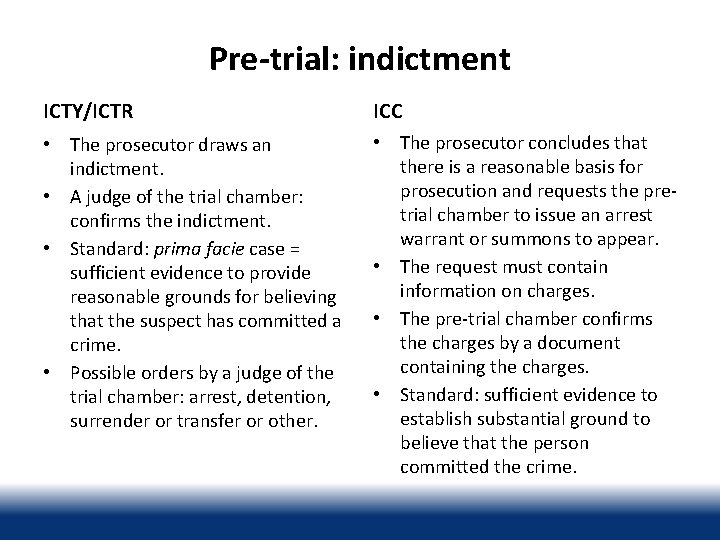
Pre-trial: indictment ICTY/ICTR ICC • The prosecutor draws an indictment. • A judge of the trial chamber: confirms the indictment. • Standard: prima facie case = sufficient evidence to provide reasonable grounds for believing that the suspect has committed a crime. • Possible orders by a judge of the trial chamber: arrest, detention, surrender or transfer or other. • The prosecutor concludes that there is a reasonable basis for prosecution and requests the pretrial chamber to issue an arrest warrant or summons to appear. • The request must contain information on charges. • The pre-trial chamber confirms the charges by a document containing the charges. • Standard: sufficient evidence to establish substantial ground to believe that the person committed the crime.
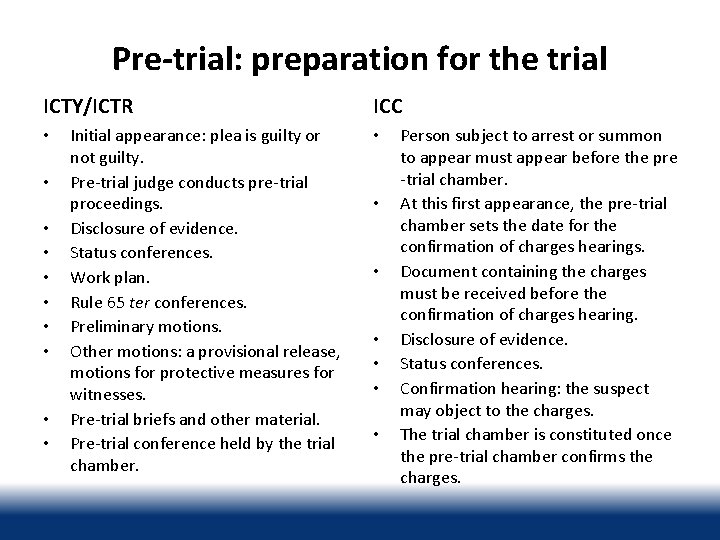
Pre-trial: preparation for the trial ICTY/ICTR • • • Initial appearance: plea is guilty or not guilty. Pre-trial judge conducts pre-trial proceedings. Disclosure of evidence. Status conferences. Work plan. Rule 65 ter conferences. Preliminary motions. Other motions: a provisional release, motions for protective measures for witnesses. Pre-trial briefs and other material. Pre-trial conference held by the trial chamber. ICC • • Person subject to arrest or summon to appear must appear before the pre -trial chamber. At this first appearance, the pre-trial chamber sets the date for the confirmation of charges hearings. Document containing the charges must be received before the confirmation of charges hearing. Disclosure of evidence. Status conferences. Confirmation hearing: the suspect may object to the charges. The trial chamber is constituted once the pre-trial chamber confirms the charges.
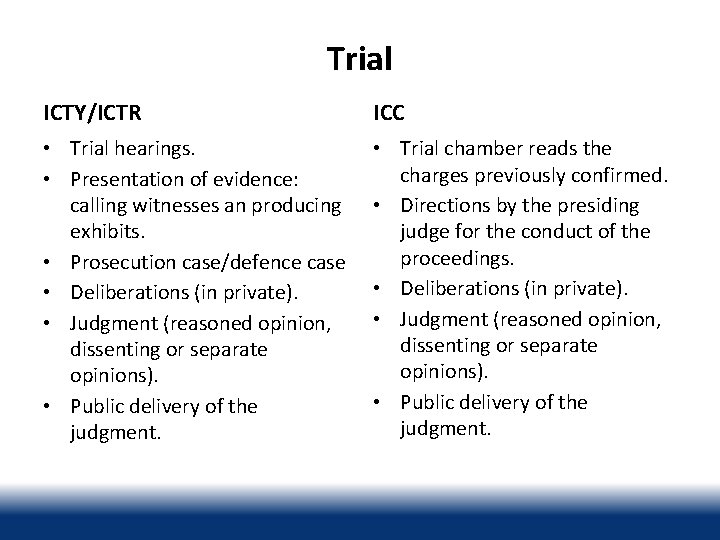
Trial ICTY/ICTR ICC • Trial hearings. • Presentation of evidence: calling witnesses an producing exhibits. • Prosecution case/defence case • Deliberations (in private). • Judgment (reasoned opinion, dissenting or separate opinions). • Public delivery of the judgment. • Trial chamber reads the charges previously confirmed. • Directions by the presiding judge for the conduct of the proceedings. • Deliberations (in private). • Judgment (reasoned opinion, dissenting or separate opinions). • Public delivery of the judgment.
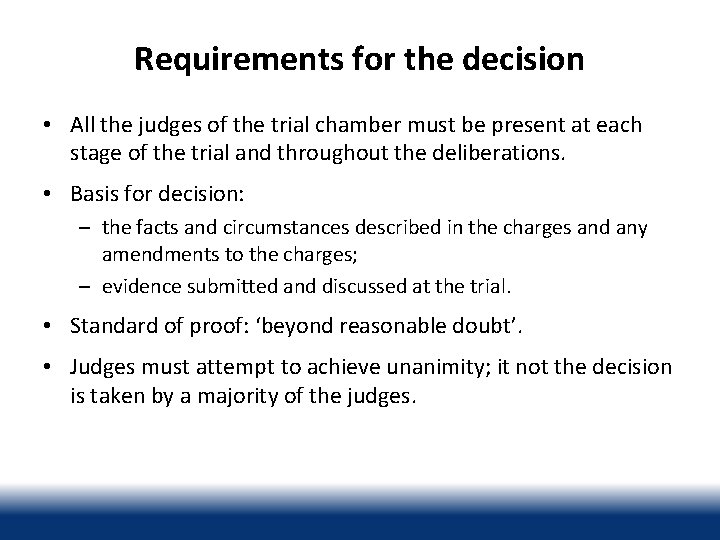
Requirements for the decision • All the judges of the trial chamber must be present at each stage of the trial and throughout the deliberations. • Basis for decision: – the facts and circumstances described in the charges and any amendments to the charges; – evidence submitted and discussed at the trial. • Standard of proof: ‘beyond reasonable doubt’. • Judges must attempt to achieve unanimity; it not the decision is taken by a majority of the judges.
Sentencing I • No death penalty (except Nuremberg and Tokyo). • Imprisonment: – specified number of years (at the ICC the maximum is 30 years); – life imprisonment (when justified by the extreme gravity of the crime and the individual circumstances of the convicted person). • Additional measures: – forfeiture of property and proceeds acquired by the criminal conduct; – a fine. • Determining the sentence: – factors to be taken into account (eg, extent of damage, ICC Rule 145(1)(c)); – aggravating circumstances (eg, abuse of power or official capacity, ICC Rule 145(2)); – mitigating circumstances (eg, substantial cooperation with the Prosecutor, ICC Rule 145(2)).
Sentencing II • Determining the sentence: – factors to be taken into account (eg, extent of damage, ICC Rule 145(1)(c)); – aggravating circumstances (eg, abuse of power or official capacity, ICC Rule 145(2)); – mitigating circumstances (eg, substantial cooperation with the prosecutor, ICC Rule 145(2)). • Procedure: – ICTY/ICTR: consideration of guilt and sentencing in a unified process; – ICC: a further hearing at the request of the prosecutor or the accused in order to hear any additional evidence or submission relevant to the sentence.
Appeal • Appeal against: – conviction and/or sentence; – acquittal. • Appeal judgment: – affirm; – reverse or amend ; – order a new trial before different trial chamber; – unanimous/majority of the judges (reasoned, delivered in open court, separate/ dissenting opinions). • Brought by: – the prosecutor; – the convicted person; – the prosecutor on convicted person’s behalf. • ICC (not ICTY/ICTR): – if appealed only by the person convicted, or the prosecutor on that person’s behalf, it cannot be amended to his/her detriment.
Grounds of appeal ICTY/ICTR ICC • An error on a question of law invalidating the decisions. • Procedural error. • An error of fact which has occasioned a miscarriage of justice. • Error of fact. • Error of law. • Any other ground that affects the fairness or reliability of the proceedings or decisions.
Protection of victims and witnesses • When necessary and consistent with the rights of the accused and a fair and impartial trial. • Measures to protect victims’ identity: – – in camera proceedings; use of pseudonym; facial and voice distortion; expunging from the public record any details of the victim’s identity. • Other protective measures: – closed sessions; – testimony by electronic or other special means. • Victims and witnesses unit: proposes appropriate protective measures.
Victims’ participation in the proceedings ICTY/ICTR • Victims do not participate in the proceedings. ICC • • Victims may participate in the proceedings. Victims may make their views and concerns known to the ICC at all stages of the proceedings. Where their personal interests are affected. In a manner which is not prejudicial or inconsistent with the rights of the accused and a fair and impartial trial. Two ways of participation: – directly before the court (in person or video-link); or – in absentia through a common legal representative. Represented by the legal representatives of the victims. Office of Public Counsel for victims.
Reparations to victims ICTY/ICTR • Upon a conviction, a victim may bring an action in a national court or other competent body to obtain compensation. ICC Statute (Article 75) • Reparations: – – restitution; compensation; rehabilitation; other: outreach. • Individual or collective, concerning a whole group of victims or a community, or both. • The court can order that an award for reparation be implemented through the Trust Fund for Victims.
Trust Fund For Victims (TFV) • Two mandates for victims of crimes under jurisdiction of the ICC: 1. Reparations: implementing court-ordered reparations awards against a convicted person when directed by the court to do so: (a) the court may order money and other property collected through fines or forfeiture form a convicted person to be transferred to the TFV; (b) voluntary contributions from donors to complement courtordered reparations. 2. General assistance: using voluntary contributions from donors to provide victims and their families in situations where the court is active with physical rehabilitation, material support and/or psychological rehabilitation (supported by voluntary contributions solely).
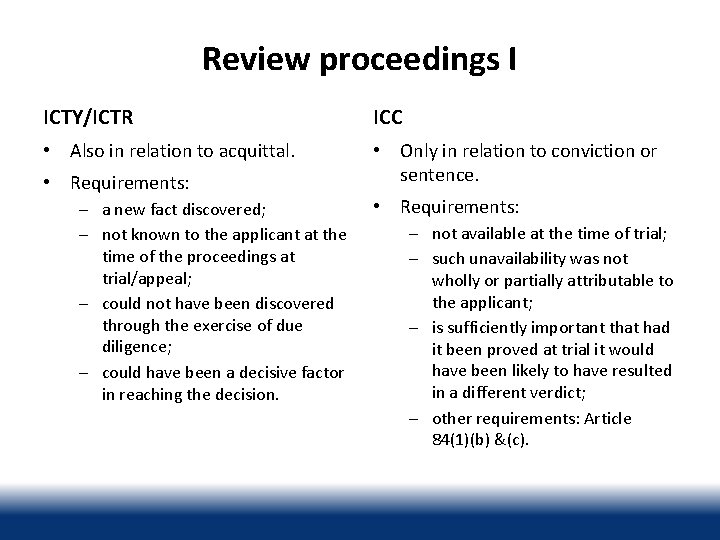
Review proceedings I ICTY/ICTR ICC • Also in relation to acquittal. • Only in relation to conviction or sentence. • Requirements: – a new fact discovered; – not known to the applicant at the time of the proceedings at trial/appeal; – could not have been discovered through the exercise of due diligence; – could have been a decisive factor in reaching the decision. • Requirements: – not available at the time of trial; – such unavailability was not wholly or partially attributable to the applicant; – is sufficiently important that had it been proved at trial it would have been likely to have resulted in a different verdict; – other requirements: Article 84(1)(b) &(c).
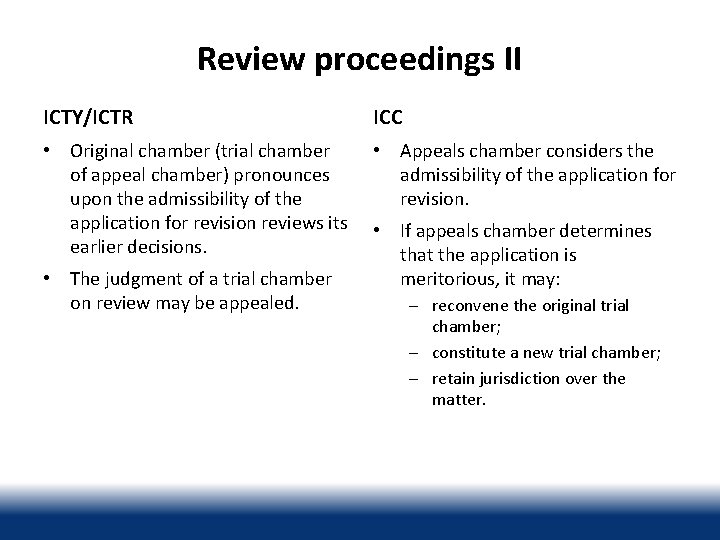
Review proceedings II ICTY/ICTR ICC • Original chamber (trial chamber of appeal chamber) pronounces upon the admissibility of the application for revision reviews its earlier decisions. • Appeals chamber considers the admissibility of the application for revision. • The judgment of a trial chamber on review may be appealed. • If appeals chamber determines that the application is meritorious, it may: – reconvene the original trial chamber; – constitute a new trial chamber; – retain jurisdiction over the matter.

Enforcement of sentences ICTY/ICTR ICC • States indicate their willingness to the Security Council to accept sentenced persons. • States indicate their willingness to court to accept sentenced persons. • The tribunal chooses a state where imprisonment is to be served from a list of these states. • The court choses a state where imprisonment is to be served from a list of these states. • ICTY: not in prisons of the former Yugoslavia. • Conditions: Article 103(3) of the ICC Statute. • ICTR: possible to serve a sentence in Rwanda.
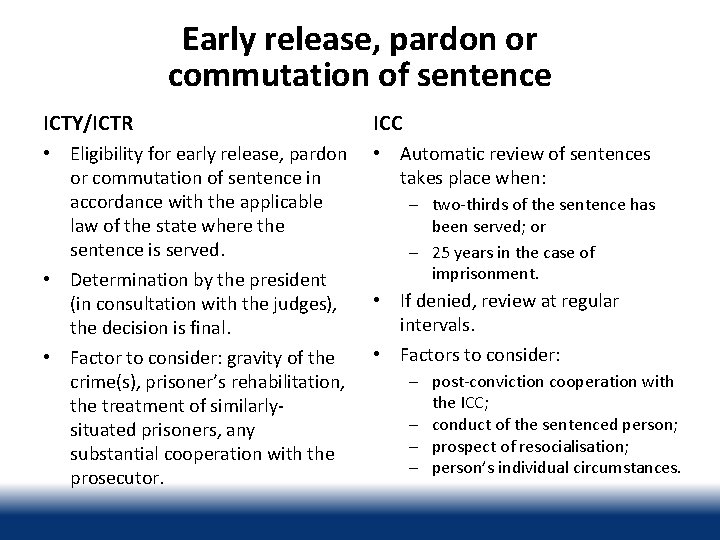
Early release, pardon or commutation of sentence ICTY/ICTR ICC • Eligibility for early release, pardon or commutation of sentence in accordance with the applicable law of the state where the sentence is served. • Determination by the president (in consultation with the judges), the decision is final. • Factor to consider: gravity of the crime(s), prisoner’s rehabilitation, the treatment of similarlysituated prisoners, any substantial cooperation with the prosecutor. • Automatic review of sentences takes place when: – two-thirds of the sentence has been served; or – 25 years in the case of imprisonment. • If denied, review at regular intervals. • Factors to consider: – post-conviction cooperation with the ICC; – conduct of the sentenced person; – prospect of resocialisation; – person’s individual circumstances.
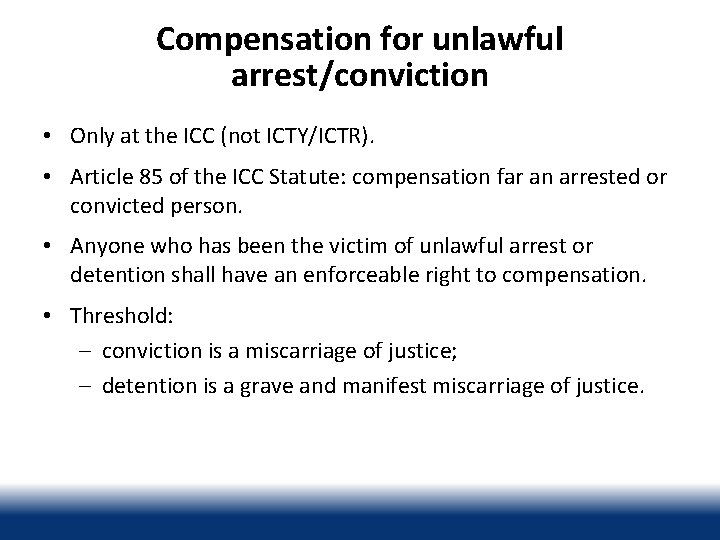
Compensation for unlawful arrest/conviction • Only at the ICC (not ICTY/ICTR). • Article 85 of the ICC Statute: compensation far an arrested or convicted person. • Anyone who has been the victim of unlawful arrest or detention shall have an enforceable right to compensation. • Threshold: – conviction is a miscarriage of justice; – detention is a grave and manifest miscarriage of justice.
- Slides: 51