
Prose Poetry Starting at the Beginning With the
Prose & Poetry: Starting at the Beginning (With the end in mind) Presented by Maribeth Albor and Joan Albor
Objectives: ● Define Oral Interpretation ● Differences between Poetry & Prose ● Identifying Categories & knowing the rules! ● Finding pieces. . . ● Documentation - what is it? ● Contest day. . .
What is Oral Interpretation? Oral Interpretation is the art of communicating works of literature by reading aloud! If you love literature and performance, you are in the right place! What types of literature are read for Poetry or Prose? In the beginning of the UIL contest, it was easy to define the differences in Poetry and Prose. Poetry was in verse, Prose was in paragraph (ex: novel, short story, fiction, non-fiction, etc. ), and Drama was easily identified in a play format (with stage directions and characters identified).
What is the purpose of Oral Interpretation contest? The purpose of this contest is to encourage the student to understand, experience and share prose (or poetry) works through the art of oral interpretation. (A) Oral interpretation, or the study of literature through its performance, can be defined as a combination of analysis, performance and communication skills offered publicly on behalf of literature. (B) Oral interpretation focuses on literature in performance through expressive oral reading. The goals of this contest are to encourage the contestant’s exploration of a variety of literary selections and to enhance the performer’s and audience’s appreciation of literature through the performer’s interpretation of the work.
Differences between Poetry & Prose
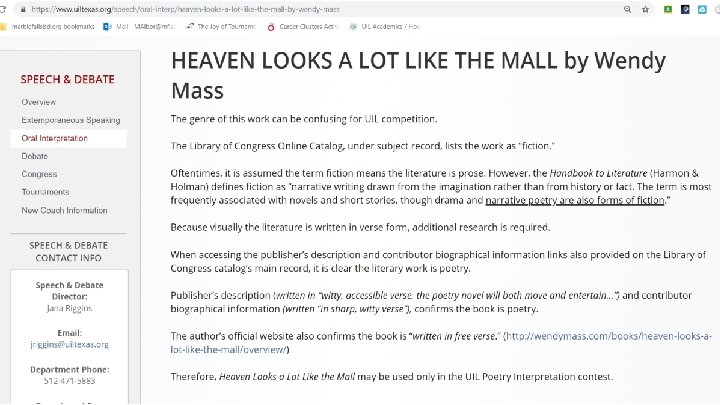
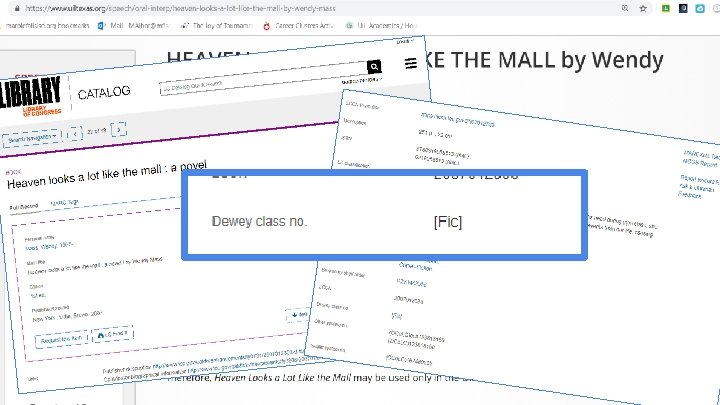
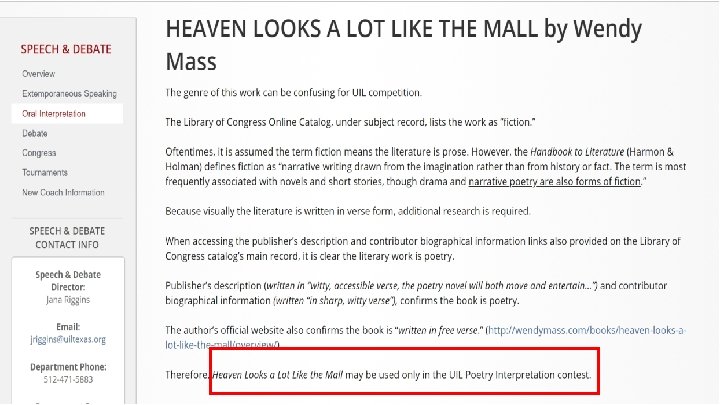
Is it POETRY? Is it PROSE? The lines have blurred between types of literature. Now there are “novels-in-verse”, performance pieces, slam poetry, lyrics in publication, and so much more! When in doubt, start at the UIL website OR The Library of Congress (and the good old Dewey decimal system) are the definitive sources. Typically Poetry titles are numbered 811 in the Dewey decimal system. The following example is unique, but UIL has made the ruling.
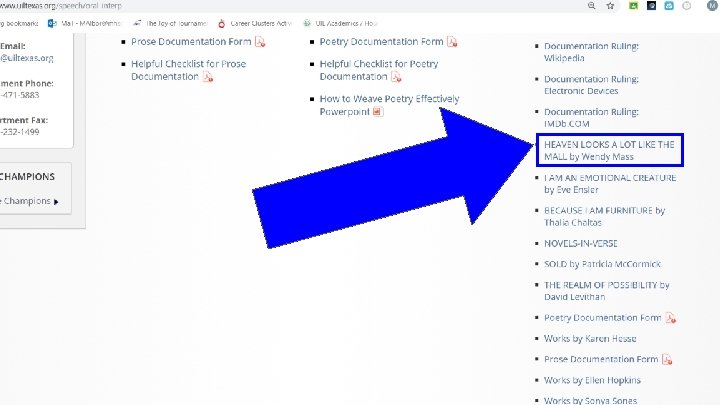
Is it POETRY? Is it PROSE?
Identifying Categories & knowing the rules
The A & B of “C”ategories. . . Categories are developed for a deeper analysis of literature. They are changed about every three years or so. 2018 -2019 Poetry & Prose Categories include Category A: Examining Our Changing World (Inform) & Category B: Taking A Stand (Persuade)
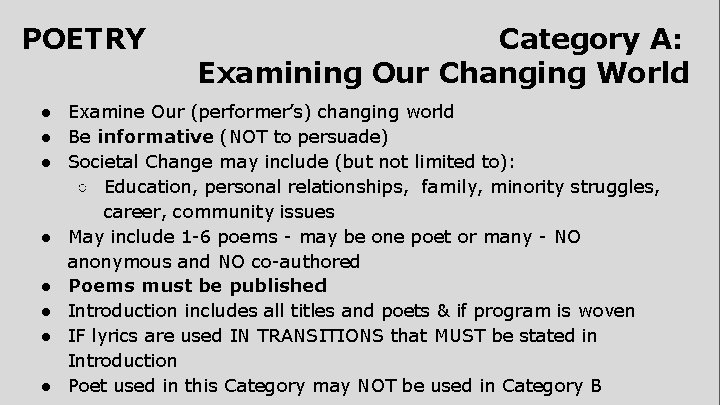
POETRY Category A: Examining Our Changing World ● Examine Our (performer’s) changing world ● Be informative (NOT to persuade) ● Societal Change may include (but not limited to): ○ Education, personal relationships, family, minority struggles, career, community issues ● May include 1 -6 poems - may be one poet or many - NO anonymous and NO co-authored ● Poems must be published ● Introduction includes all titles and poets & if program is woven ● IF lyrics are used IN TRANSITIONS that MUST be stated in Introduction ● Poet used in this Category may NOT be used in Category B
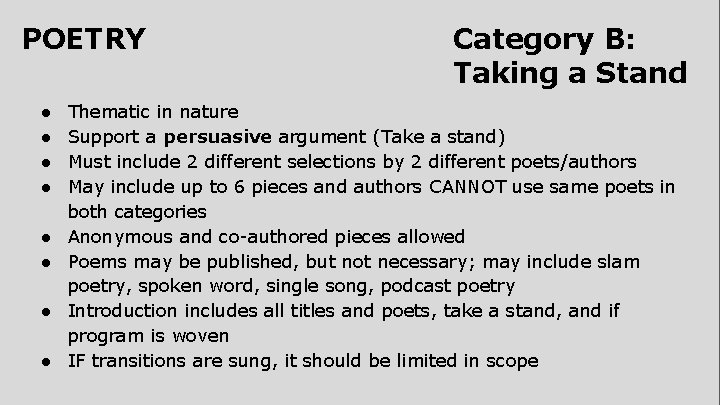
POETRY ● ● ● ● Category B: Taking a Stand Thematic in nature Support a persuasive argument (Take a stand) Must include 2 different selections by 2 different poets/authors May include up to 6 pieces and authors CANNOT use same poets in both categories Anonymous and co-authored pieces allowed Poems may be published, but not necessary; may include slam poetry, spoken word, single song, podcast poetry Introduction includes all titles and poets, take a stand, and if program is woven IF transitions are sung, it should be limited in scope
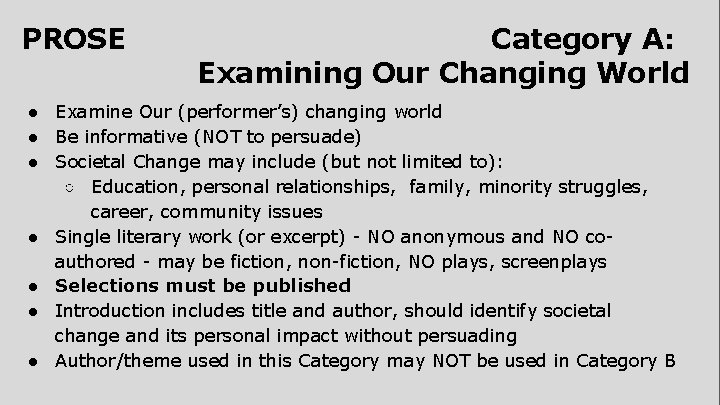
PROSE Category A: Examining Our Changing World ● Examine Our (performer’s) changing world ● Be informative (NOT to persuade) ● Societal Change may include (but not limited to): ○ Education, personal relationships, family, minority struggles, career, community issues ● Single literary work (or excerpt) - NO anonymous and NO coauthored - may be fiction, non-fiction, NO plays, screenplays ● Selections must be published ● Introduction includes title and author, should identify societal change and its personal impact without persuading ● Author/theme used in this Category may NOT be used in Category B
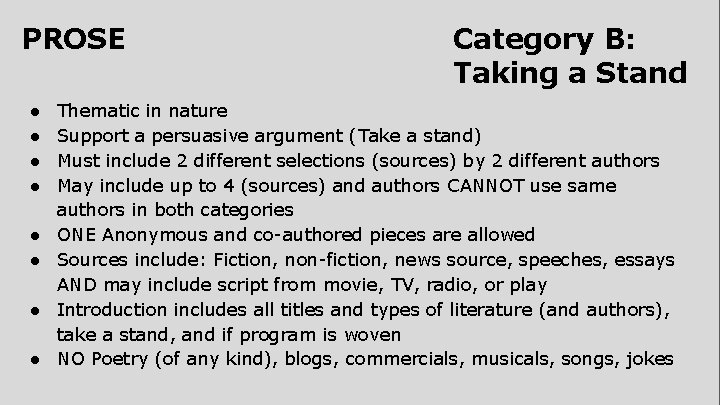
PROSE ● ● ● ● Category B: Taking a Stand Thematic in nature Support a persuasive argument (Take a stand) Must include 2 different selections (sources) by 2 different authors May include up to 4 (sources) and authors CANNOT use same authors in both categories ONE Anonymous and co-authored pieces are allowed Sources include: Fiction, non-fiction, news source, speeches, essays AND may include script from movie, TV, radio, or play Introduction includes all titles and types of literature (and authors), take a stand, and if program is woven NO Poetry (of any kind), blogs, commercials, musicals, songs, jokes
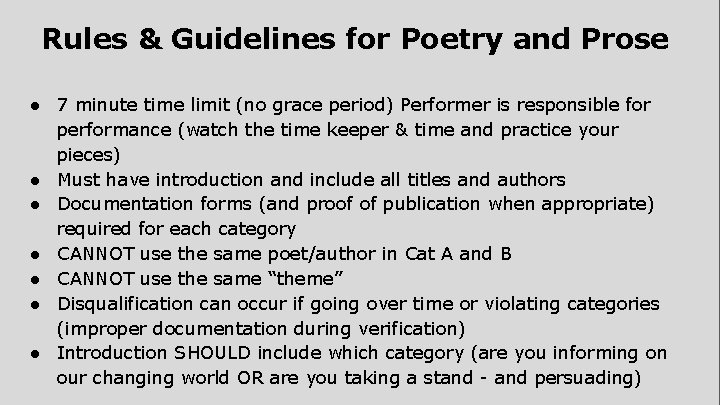
Rules & Guidelines for Poetry and Prose ● 7 minute time limit (no grace period) Performer is responsible for performance (watch the time keeper & time and practice your pieces) ● Must have introduction and include all titles and authors ● Documentation forms (and proof of publication when appropriate) required for each category ● CANNOT use the same poet/author in Cat A and B ● CANNOT use the same “theme” ● Disqualification can occur if going over time or violating categories (improper documentation during verification) ● Introduction SHOULD include which category (are you informing on our changing world OR are you taking a stand - and persuading)

Finding pieces
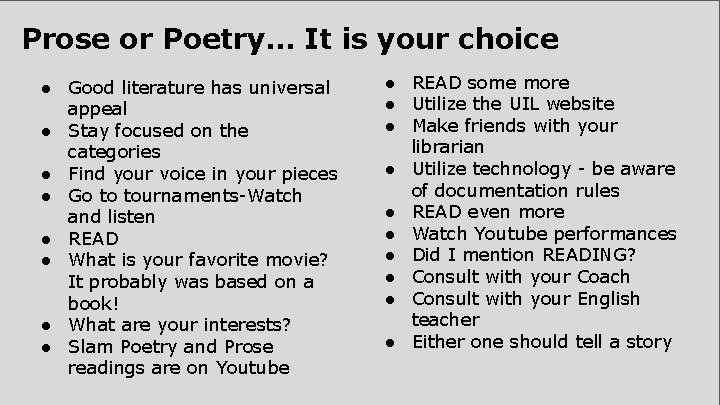
Prose or Poetry… It is your choice ● Good literature has universal appeal ● Stay focused on the categories ● Find your voice in your pieces ● Go to tournaments-Watch and listen ● READ ● What is your favorite movie? It probably was based on a book! ● What are your interests? ● Slam Poetry and Prose readings are on Youtube ● READ some more ● Utilize the UIL website ● Make friends with your librarian ● Utilize technology - be aware of documentation rules ● READ even more ● Watch Youtube performances ● Did I mention READING? ● Consult with your Coach ● Consult with your English teacher ● Either one should tell a story
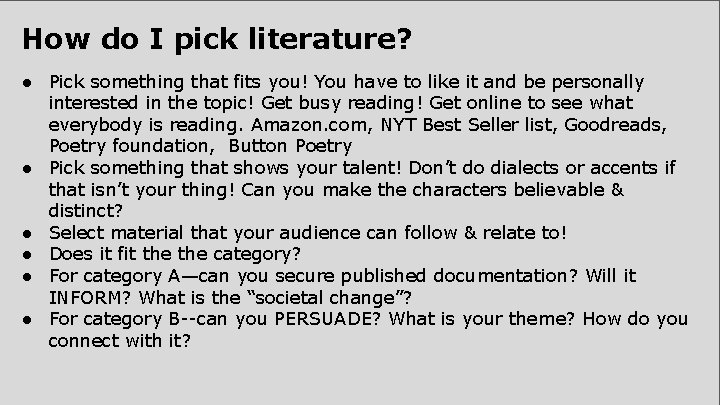
How do I pick literature? ● Pick something that fits you! You have to like it and be personally interested in the topic! Get busy reading! Get online to see what everybody is reading. Amazon. com, NYT Best Seller list, Goodreads, Poetry foundation, Button Poetry ● Pick something that shows your talent! Don’t do dialects or accents if that isn’t your thing! Can you make the characters believable & distinct? ● Select material that your audience can follow & relate to! ● Does it fit the category? ● For category A—can you secure published documentation? Will it INFORM? What is the “societal change”? ● For category B--can you PERSUADE? What is your theme? How do you connect with it?
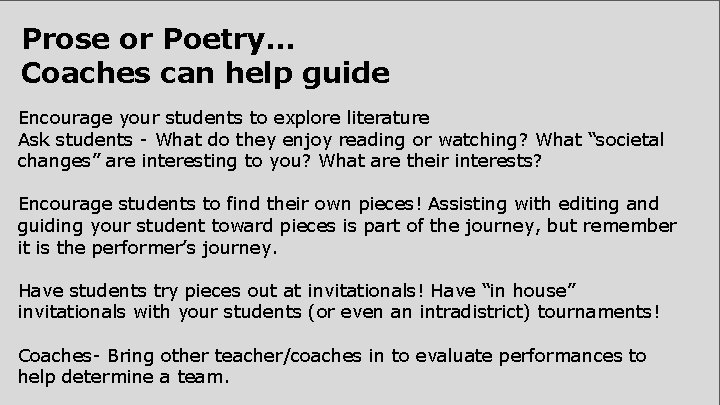
Prose or Poetry… Coaches can help guide Encourage your students to explore literature Ask students - What do they enjoy reading or watching? What “societal changes” are interesting to you? What are their interests? Encourage students to find their own pieces! Assisting with editing and guiding your student toward pieces is part of the journey, but remember it is the performer’s journey. Have students try pieces out at invitationals! Have “in house” invitationals with your students (or even an intradistrict) tournaments! Coaches- Bring other teacher/coaches in to evaluate performances to help determine a team.

Documentation?
Verification and Documentation Verifying publication is part of the process before contest day. . . it is never too early to start! While proof of publication is not always required in both categories, it is always a good idea to have your original sources available (books, not kindle edition), or information from the Library of Congress Card Catalog, or copies of the cover, title page, and excerpt of piece (or pieces). These links (on the UIL website) are helpful (literally “Helpful Checklist”) https: //www. uiltexas. org/files/academics/aplus/Doc. Check. Poetry 17_18 -2. pdf https: //www. uiltexas. org/files/academics/aplus/Doc. Check. Prose 17_18. pdf
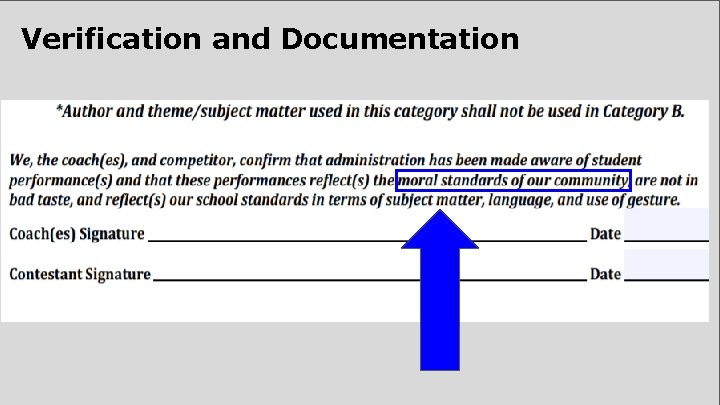
Verification and Documentation The UIL website is a GREAT resource for you and your coach! USE it. Documentation Forms are required for both categories and both Poetry and Prose. The specific requirements are outlined on each document (and available on the website) http: //www. uiltexas. org/files/academics/speech/Interp_Poetry_Form_18_19 w. Waterma rk. pdf http: //www. uiltexas. org/files/academics/speech/Interp_Prose_Form_18_19 w. Watermar k. pdf These are interactive forms that must be completed and signed by both the performer and coach, prior to contest. Most Invitational Meets do NOT require this form, but the sooner you start on documentation, the better!
Verification and Documentation
What to expect at contests How to dress Performance What to bring. . .
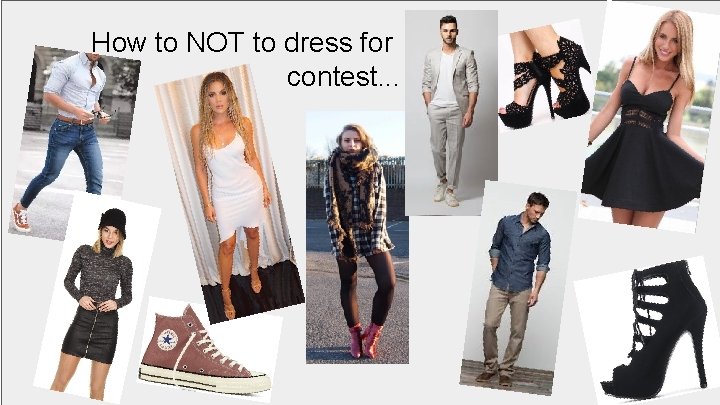
How to NOT to dress for contest. . .
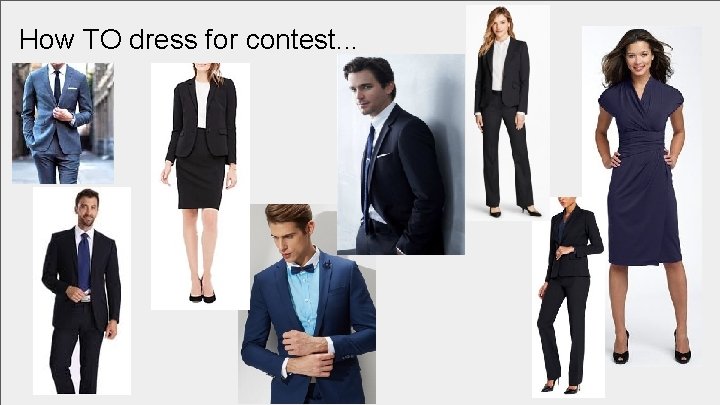
How TO dress for contest. . .
Oral Interpretation requires a manuscript Unlike actors on stage, the interpreter is creating a believable performance through suggestion using only voice, focus, and posture to distinguish characters. Work to create a believable performance interpreting the author’s message in your performance. You must use a physical manuscript to keep the focus on the literature. Do NOT hold the manuscript and never use it. Look down “in character” and at “appropriate times”. Find the right use of “body and movement” in your performance. There is no imaginary box, but make sure your choices in gesture, posture, and place-to-place movement add to the literature in a believable and motivated way. Make your literature come to life with the words you are speaking.
Performance How to hold your binder? The “L” or the “V” Don’t hold a dying swan Introduction - “Diamond” ST N O EM D Preparing your binder… 5 ½” x 8 ½” black binder 3 ring binder (1” bind) Clear sleeves Card stock Formatting your pages Practice page turns N IO T A R
Performance Be Prepared! Practice Performance and time your performance. Vocal Warm-ups and water are a great idea before your round. Know which piece is to be performed, remove everything else from your binder. Memorized introduction! Be Polite! Do not enter a room without a judge present. Be respectful of other performers. Do not talk during or between performances. Do NOT be on your phone, give it to your coach or turn it off and put it away. Thank your judges for judging. Be Prompt! Be at your room before the round should start.
What to bring to contest ● YOUR BINDER -- with your pieces ● Hard copies of pieces (for documentation) ● Your documentation forms - several copies completed and signed ● Performance clothes - A change of clothes (it may be a long day) ● Water, mints, cough drops ● Shout wipes or Tide to go (just in case) ● Phone charger (so you can call family when you advance!)
What to expect on contest day… before preliminary round ● Documentation Check-Be sure you have both online forms filled out and proof your Category A piece is published in hard copy. ● You will be assigned a holding room where you will draw (or flip) for categories sometimes the same room where documentation has occurred -Perform one for prelims and your other one when you make it to finals -- Know which piece is to be performed, remove everything else from your binder. ● Draw for speaker order in contest room OR sections and order may be done by contest director before and posted-- Be prepared to give your online form to each judge. (may have single judge or panel of 3) ● Get to your room early! 15 minutes before - if you are “on time” you are late! ● You will be a part of the audience before and after you speak - be respectful of all performers
What to expect on contest day. . . after preliminary round ● 15 minute Verification Period-coaches will be allowed to view the unofficial rankings and verify tabulations. This is NOT a time to question judge decisions. ● Speakers that make it to the final round will perform for places and points. (opposite category from prelims) Go watch even if you did not make it!! ● Again, get to room early-stay in touch with your coach as sometimes room numbers and contest times change. ● If you are watching the finals round, take notes on pieces and performances - not on your phone - be respectful of all performers ● Respect the judge or judges’ decision 2 Block rule---You can discuss with your coach the judge’s decision when you are two blocks from the contest site
When in doubt, check it out. . . Have fun! Make friends! Enjoy the competition! http: //www. uiltexas. org/speech/oral-interp https: //www. uiltexas. org/policy/constitution/academics/speech-debate
Questions? Comments Concerns
How to contact us. . . Joan Albor, Theatre Major, San Antonio College, former UIL Speech & Debate State Qualifier, 3 A State finalist in Poetry (3 rd place), Congress, CX qualifier, joanalbor 00@gmail. com Maribeth Albor, UIL Academic Coordinator and Speech & Debate Coach mmalbor 67@gmail. com
- Slides: 37