
Propositional Logic and Methods of Inference SEG 7450
- Slides: 44
Propositional Logic and Methods of Inference SEG 7450 1
Logic n n n Knowledge can also be represented by the symbols of logic, which is the study of the rules of exact reasoning. Logic is also of primary importance in expert systems in which the inference engine reasons from facts to conclusions. A descriptive term for logic programming and expert systems is automated reasoning systems. SEG 7450 2
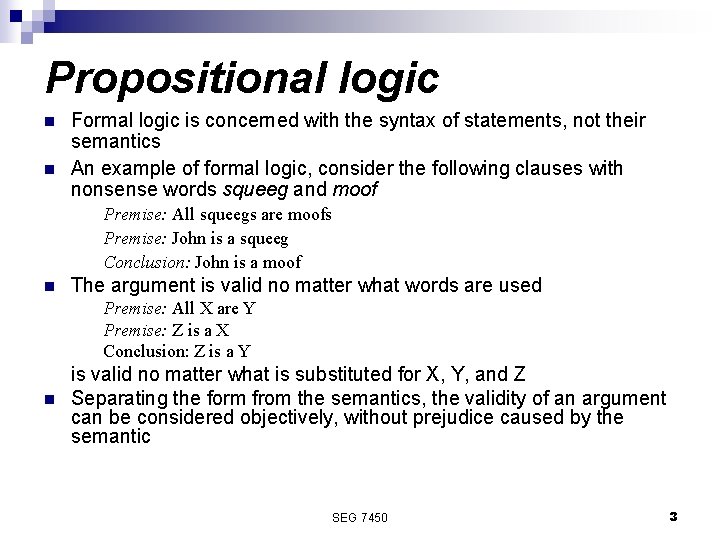
Propositional logic n n Formal logic is concerned with the syntax of statements, not their semantics An example of formal logic, consider the following clauses with nonsense words squeeg and moof Premise: All squeegs are moofs Premise: John is a squeeg Conclusion: John is a moof n The argument is valid no matter what words are used Premise: All X are Y Premise: Z is a X Conclusion: Z is a Y n is valid no matter what is substituted for X, Y, and Z Separating the form from the semantics, the validity of an argument can be considered objectively, without prejudice caused by the semantic SEG 7450 3
Propositional logic n Propositional logic is a symbolic logic for manipulating propositions ¨ n propositional logic deals with the manipulation of logical variables, which represent propositions Propositional logic is concerned with the subset of declarative sentences that can be classified as either true or false SEG 7450 4
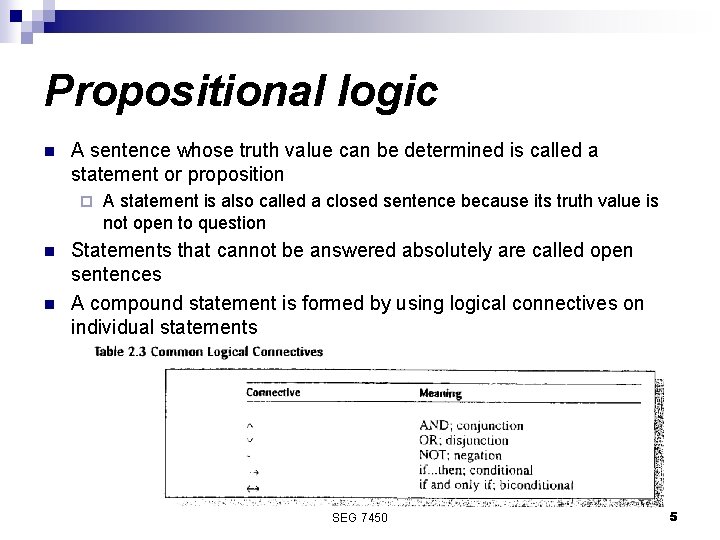
Propositional logic n A sentence whose truth value can be determined is called a statement or proposition ¨ n n A statement is also called a closed sentence because its truth value is not open to question Statements that cannot be answered absolutely are called open sentences A compound statement is formed by using logical connectives on individual statements SEG 7450 5
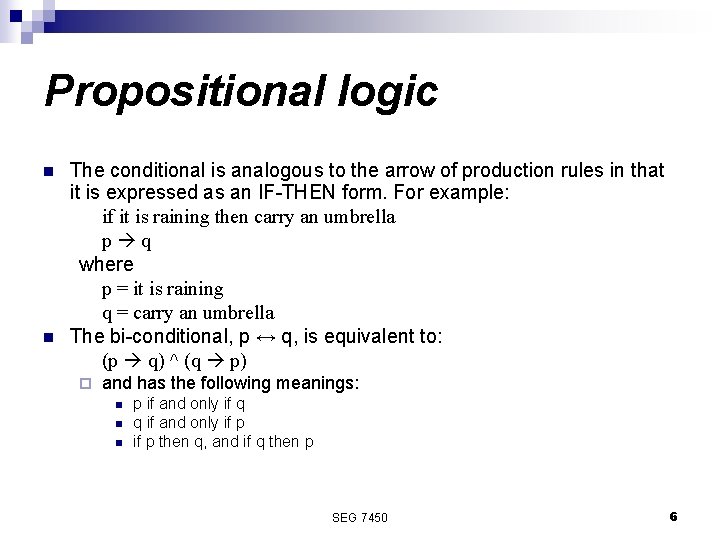
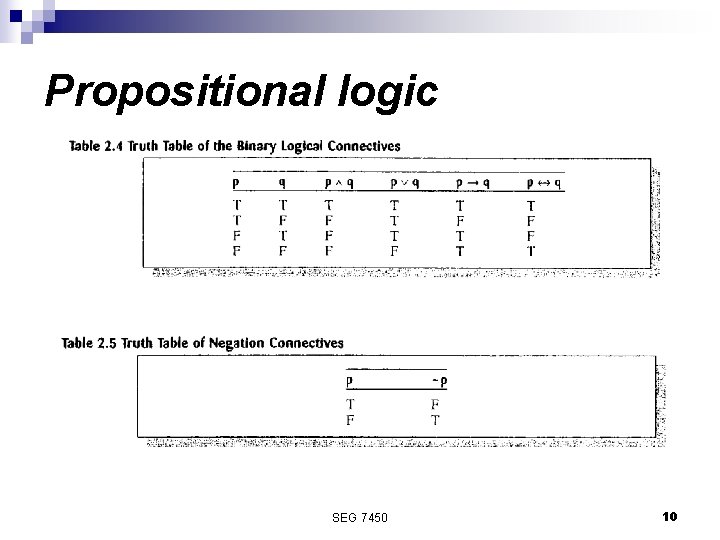
Propositional logic n n The conditional is analogous to the arrow of production rules in that it is expressed as an IF-THEN form. For example: if it is raining then carry an umbrella p q where p = it is raining q = carry an umbrella The bi-conditional, p ↔ q, is equivalent to: (p q) ^ (q p) ¨ and has the following meanings: n n n p if and only if q q if and only if p then q, and if q then p SEG 7450 6
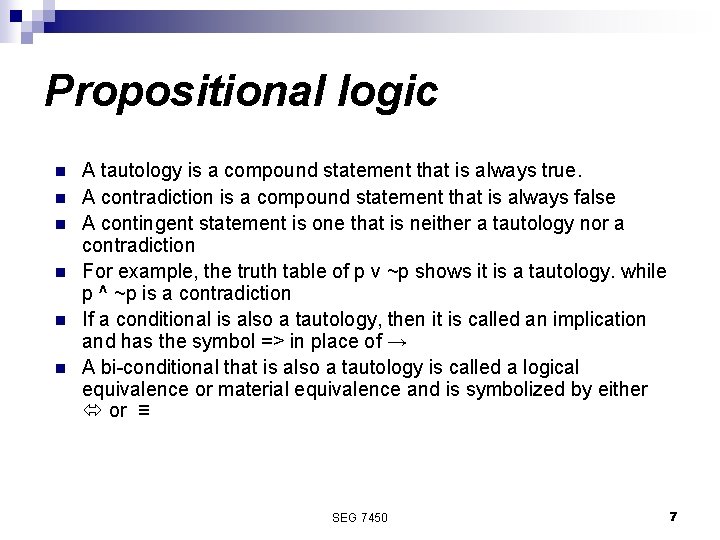
Propositional logic n n n A tautology is a compound statement that is always true. A contradiction is a compound statement that is always false A contingent statement is one that is neither a tautology nor a contradiction For example, the truth table of p v ~p shows it is a tautology. while p ^ ~p is a contradiction If a conditional is also a tautology, then it is called an implication and has the symbol => in place of → A bi-conditional that is also a tautology is called a logical equivalence or material equivalence and is symbolized by either or ≡ SEG 7450 7
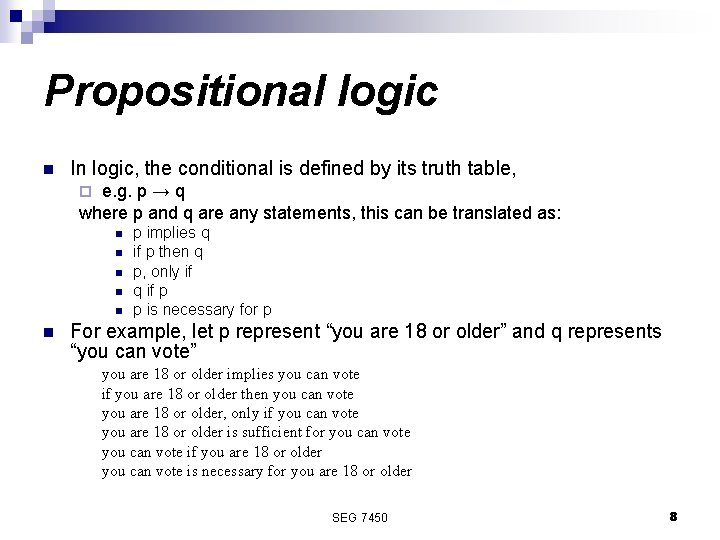
Propositional logic n In logic, the conditional is defined by its truth table, e. g. p → q where p and q are any statements, this can be translated as: ¨ n n n p implies q if p then q p, only if q if p p is necessary for p For example, let p represent “you are 18 or older” and q represents “you can vote” you are 18 or older implies you can vote if you are 18 or older then you can vote you are 18 or older, only if you can vote you are 18 or older is sufficient for you can vote if you are 18 or older you can vote is necessary for you are 18 or older SEG 7450 8
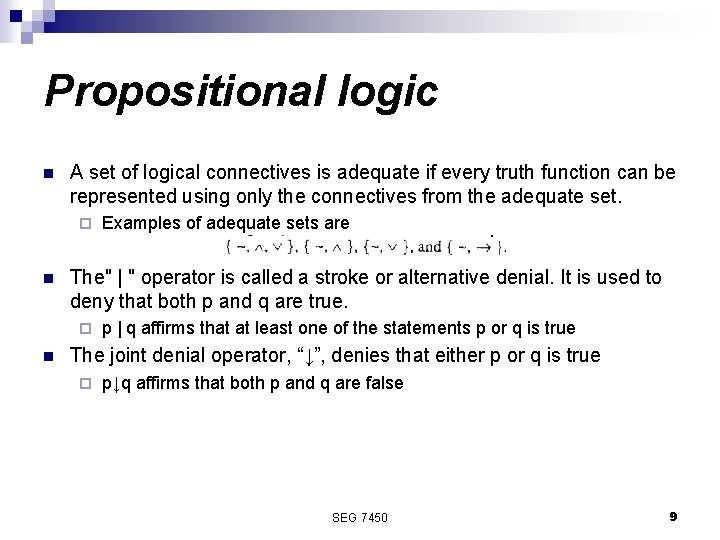
Propositional logic n A set of logical connectives is adequate if every truth function can be represented using only the connectives from the adequate set. ¨ n The" | " operator is called a stroke or alternative denial. It is used to deny that both p and q are true. ¨ n Examples of adequate sets are p | q affirms that at least one of the statements p or q is true The joint denial operator, “↓”, denies that either p or q is true ¨ p↓q affirms that both p and q are false SEG 7450 9
Propositional logic SEG 7450 10
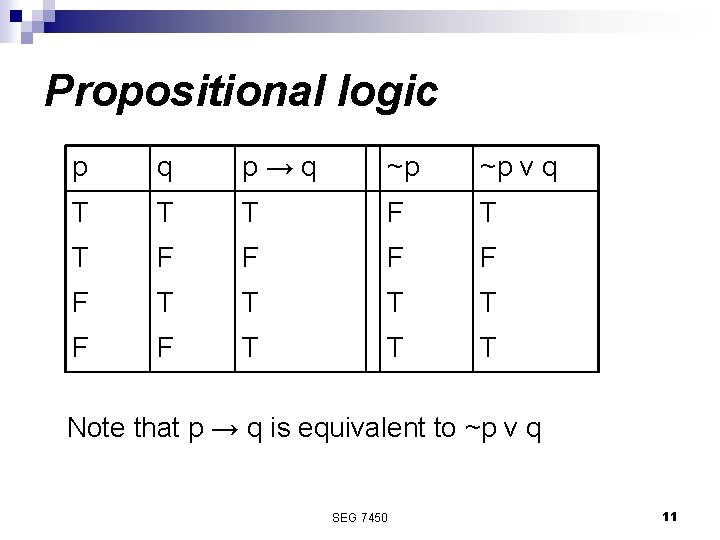
Propositional logic p q p→q ~p ~p v q T T T F F F T T T Note that p → q is equivalent to ~p v q SEG 7450 11
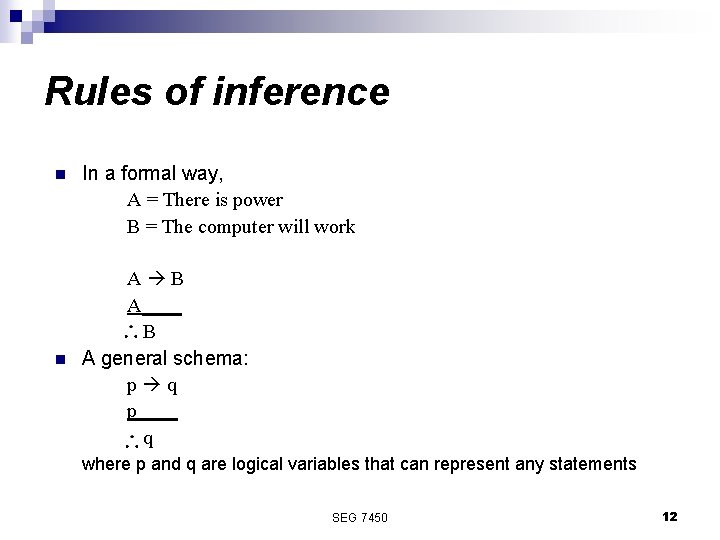
Rules of inference n n In a formal way, A = There is power B = The computer will work A B A____ : . B A general schema: p q p____ : . q where p and q are logical variables that can represent any statements SEG 7450 12
Rules of inference n n The use of logical variables in propositional logic allows more complex types. Inference schema of this propositional form is called by a variety of names: ¨ n This modus ponens schema could also have been written with differently named logical variables as: r s r___ : . s ¨ n direct reasoning, modus ponens, law of detachment, and assuming the antecedent Another notation for this schema is: r, r s; : . s A more general form of an argument is: P 1, P 2, … PN ; : . C ¨ where the uppercase letters Pi represent premises such as r, r s, and C is the conclusion SEG 7450 13
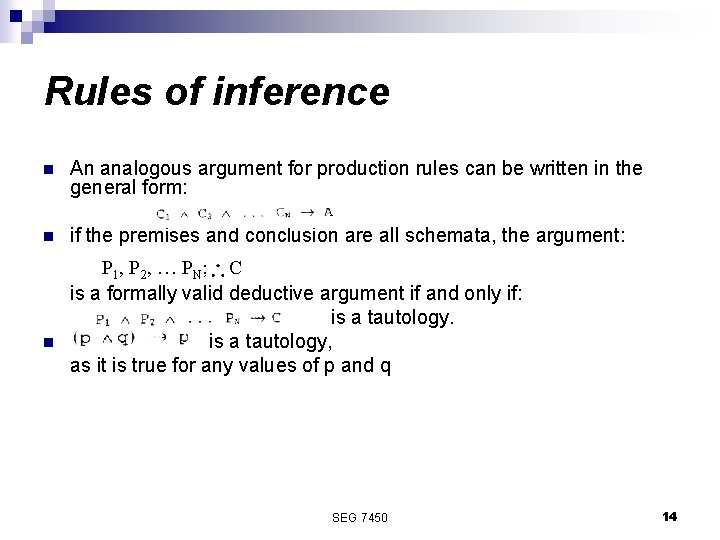
Rules of inference n An analogous argument for production rules can be written in the general form: n if the premises and conclusion are all schemata, the argument: n P 1, P 2, … PN; : . C is a formally valid deductive argument if and only if: is a tautology, as it is true for any values of p and q SEG 7450 14
Rules of inference SEG 7450 15
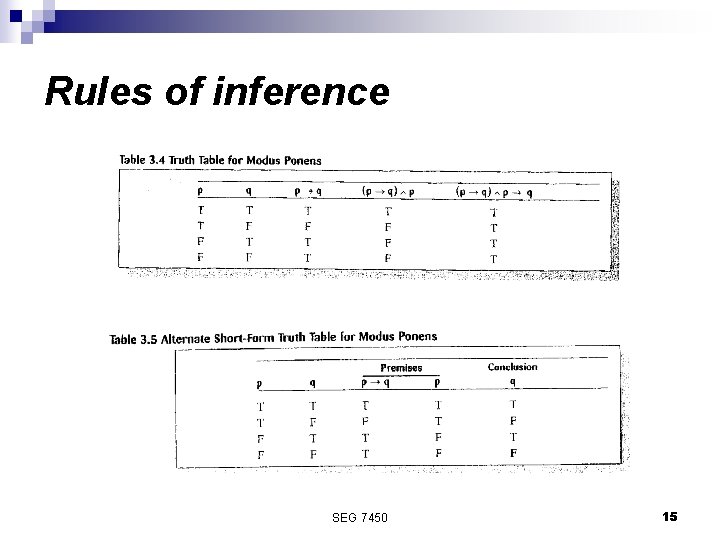
Rules of inference n n n A shorter method of determining a valid argument is to consider only those rows of the truth table in which the premises are all true For modus ponens, the p q premise and p premise are both true only in the first row, and so is the conclusion. Hence, modus ponens is a valid argument SEG 7450 16
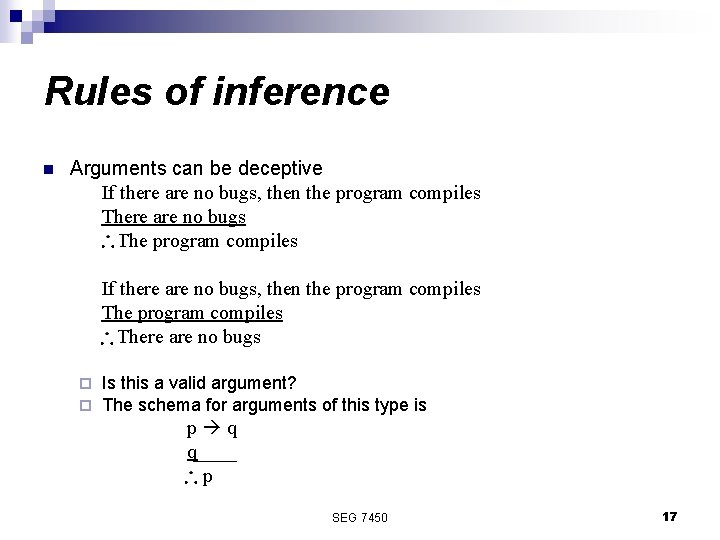
Rules of inference n Arguments can be deceptive If there are no bugs, then the program compiles There are no bugs : . The program compiles If there are no bugs, then the program compiles The program compiles : . There are no bugs ¨ ¨ Is this a valid argument? The schema for arguments of this type is p q q____ : . p SEG 7450 17
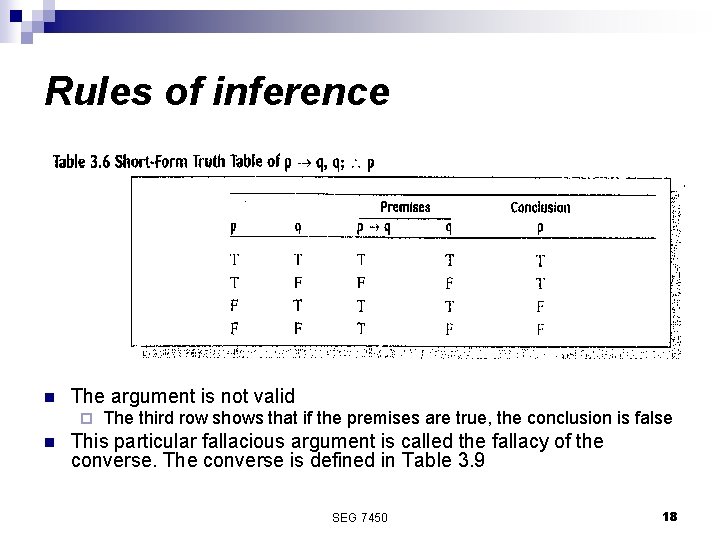
Rules of inference n The argument is not valid ¨ n The third row shows that if the premises are true, the conclusion is false This particular fallacious argument is called the fallacy of the converse. The converse is defined in Table 3. 9 SEG 7450 18
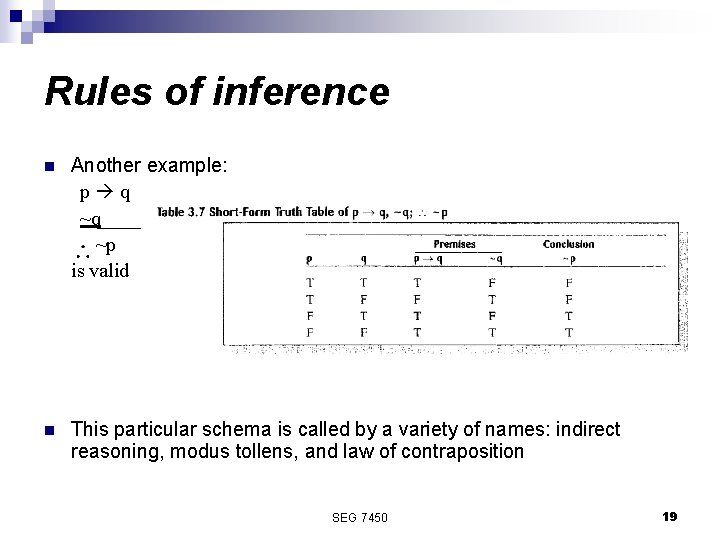
Rules of inference n Another example: p q ~q____ : . ~p is valid n This particular schema is called by a variety of names: indirect reasoning, modus tollens, and law of contraposition SEG 7450 19
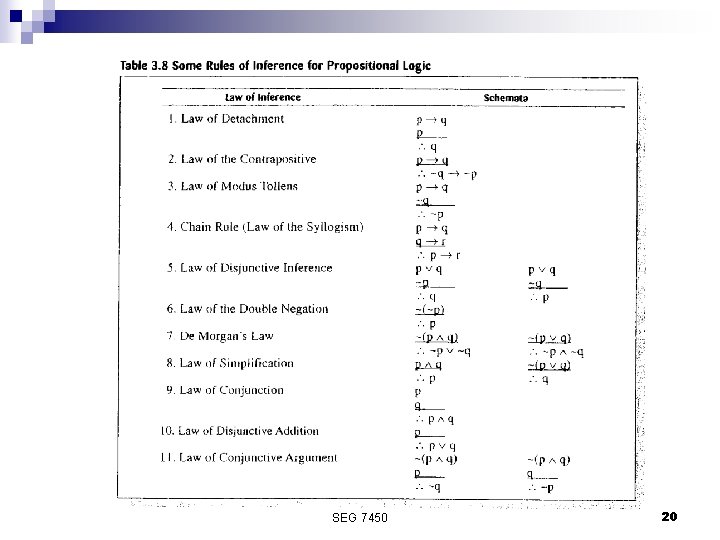
SEG 7450 20
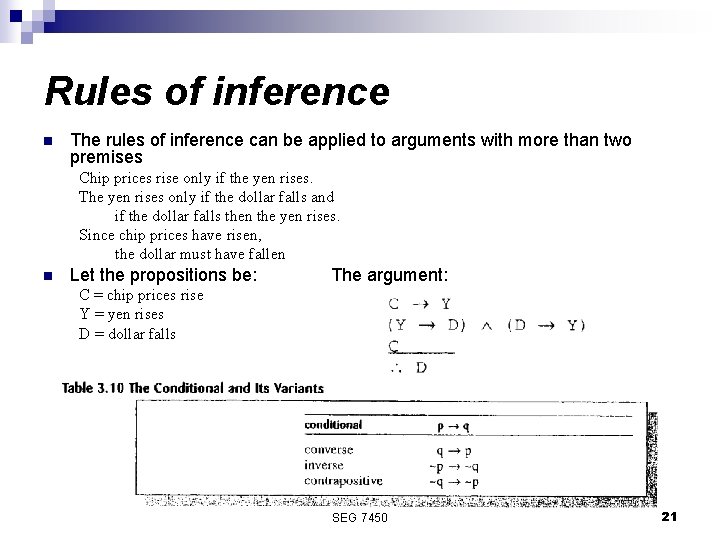
Rules of inference n The rules of inference can be applied to arguments with more than two premises Chip prices rise only if the yen rises. The yen rises only if the dollar falls and if the dollar falls then the yen rises. Since chip prices have risen, the dollar must have fallen n Let the propositions be: The argument: C = chip prices rise Y = yen rises D = dollar falls SEG 7450 21
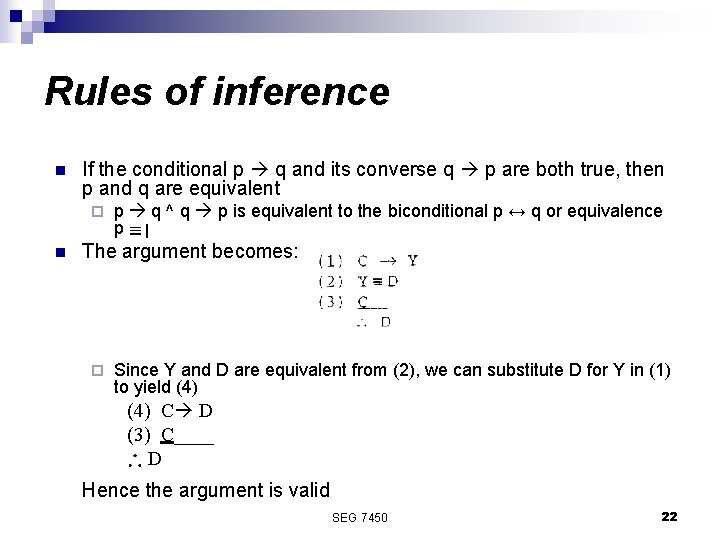
Rules of inference n If the conditional p q and its converse q p are both true, then p and q are equivalent ¨ n p q ^ q p is equivalent to the biconditional p ↔ q or equivalence p≡ q The argument becomes: ¨ Since Y and D are equivalent from (2), we can substitute D for Y in (1) to yield (4) C D (3) C____ : . D Hence the argument is valid SEG 7450 22
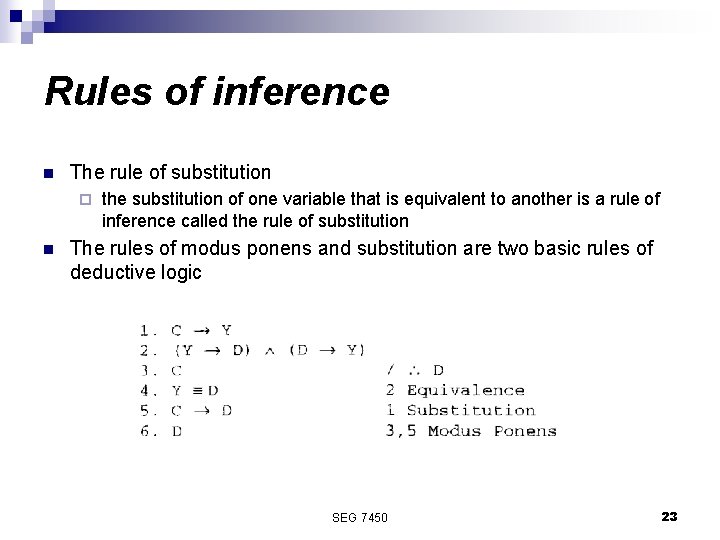
Rules of inference n The rule of substitution ¨ n the substitution of one variable that is equivalent to another is a rule of inference called the rule of substitution The rules of modus ponens and substitution are two basic rules of deductive logic SEG 7450 23
Resolution n n Resolution makes automatic theorem provers practical tools for solving problems. Before resolution can be applied, the well-formed formulas (wffs) must be in a normal or standard form. ¨ n n n The three main types of normal forms are conjunctive normal form, clausal form, and its Horn clause subset The basic idea of normal form is to express wffs in a standard form that uses only the ^, v, and possibly ~ The resolution method is then applied to normal form wffs in which all other connectives and quantifiers have been eliminated Resolution is an operation on pairs of disjuncts, which produces new disjuncts, which simplifies the wff SEG 7450 24
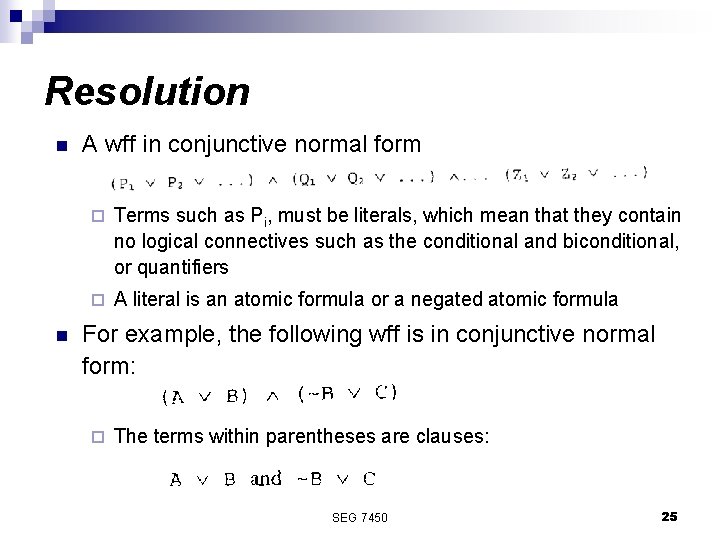
Resolution n n A wff in conjunctive normal form ¨ Terms such as Pi, must be literals, which mean that they contain no logical connectives such as the conditional and biconditional, or quantifiers ¨ A literal is an atomic formula or a negated atomic formula For example, the following wff is in conjunctive normal form: ¨ The terms within parentheses are clauses: SEG 7450 25
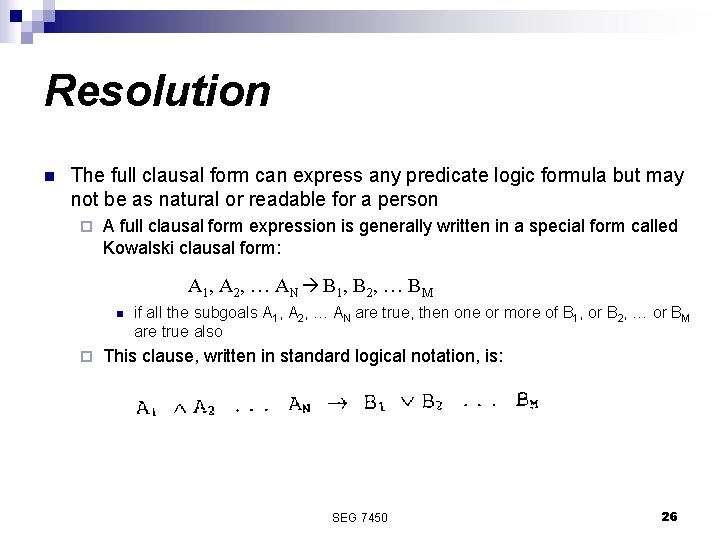
Resolution n The full clausal form can express any predicate logic formula but may not be as natural or readable for a person ¨ A full clausal form expression is generally written in a special form called Kowalski clausal form: A 1 , A 2 , … AN B 1 , B 2 , … B M n ¨ if all the subgoals A 1, A 2, … AN are true, then one or more of B 1, or B 2, … or BM are true also This clause, written in standard logical notation, is: SEG 7450 26
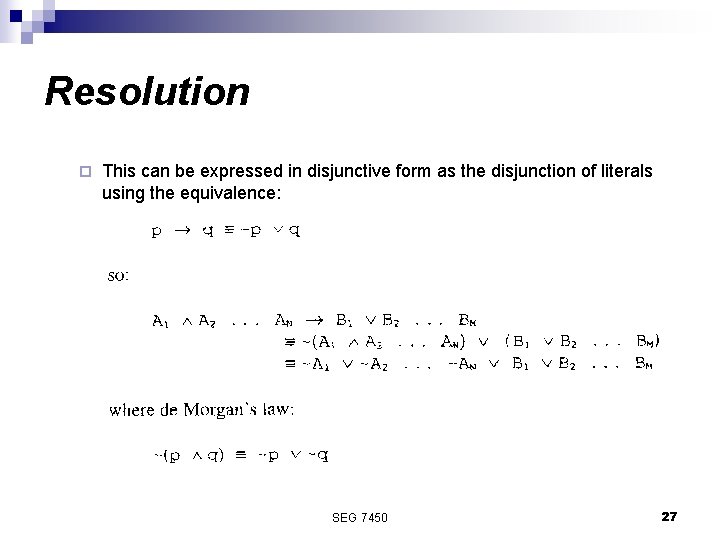
Resolution ¨ This can be expressed in disjunctive form as the disjunction of literals using the equivalence: SEG 7450 27
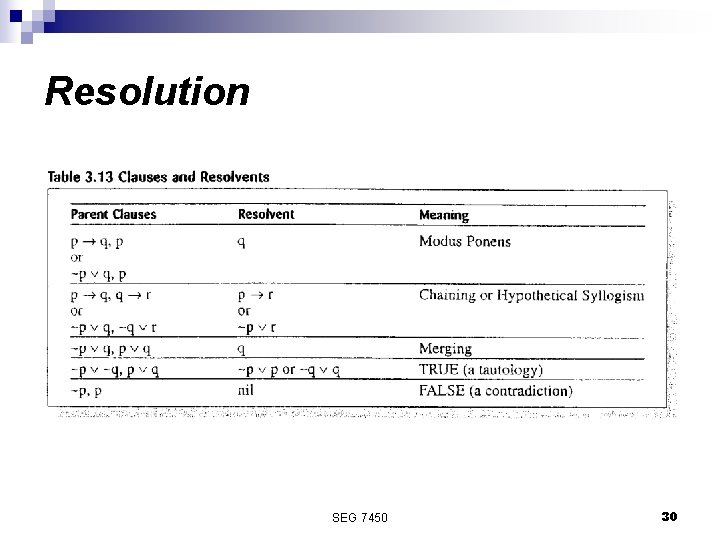
Resolution n The problem with trying to prove a theorem directly ¨ n the difficulty of deducing it using only the rules of inference and axioms of the system To prove a theorem is true the classical method of reductio ad absurdum, or method of contradiction, is used We try to prove the negated wff is a theorem. ¨ If a contradiction results, then the original non-negated wff is a theorem. ¨ n n The basic goal of resolution is to infer a new clause, the resolvent, from two other clauses called parent clauses By continuing the process of resolution, eventually a contradiction will be obtained or the process is terminated because no progress is being made SEG 7450 28
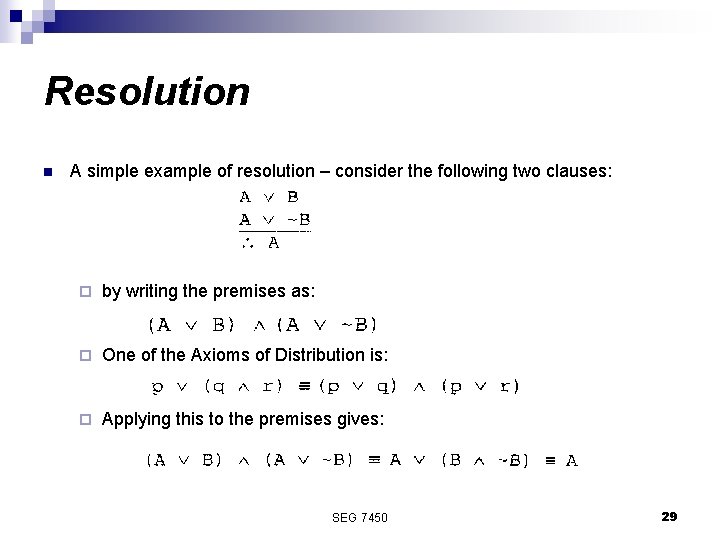
Resolution n A simple example of resolution – consider the following two clauses: ¨ by writing the premises as: ¨ One of the Axioms of Distribution is: ¨ Applying this to the premises gives: SEG 7450 29
Resolution SEG 7450 30
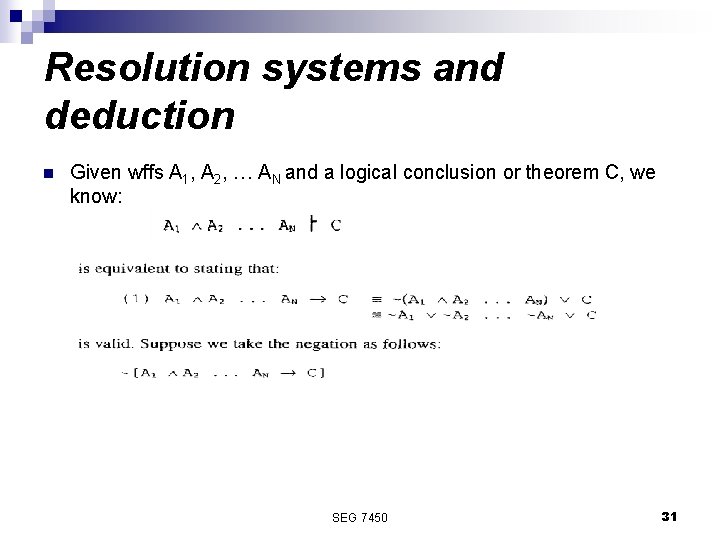
Resolution systems and deduction n Given wffs A 1, A 2, … AN and a logical conclusion or theorem C, we know: SEG 7450 31
Resolution systems and deduction SEG 7450 32
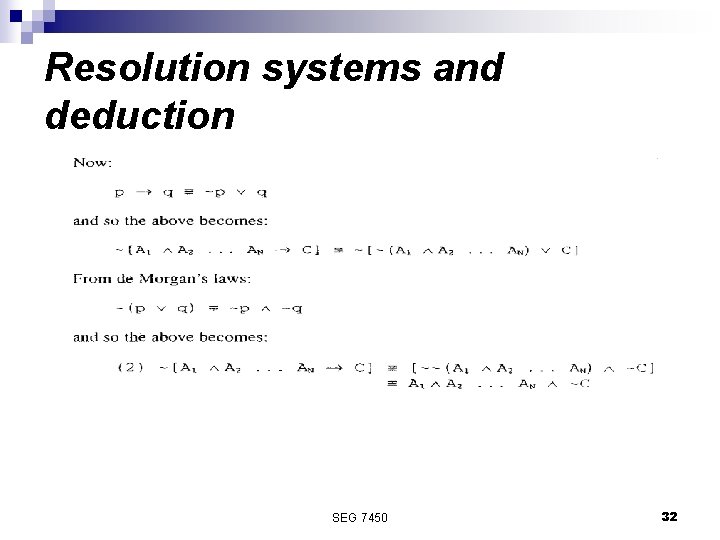
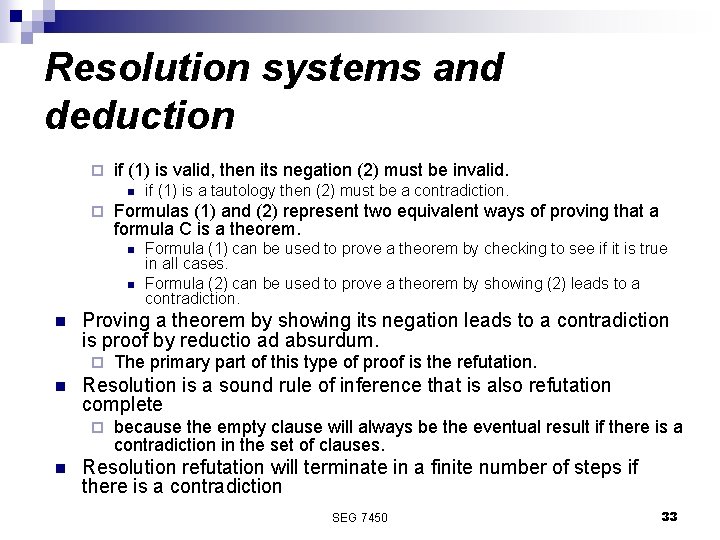
Resolution systems and deduction ¨ if (1) is valid, then its negation (2) must be invalid. n ¨ Formulas (1) and (2) represent two equivalent ways of proving that a formula C is a theorem. n n n The primary part of this type of proof is the refutation. Resolution is a sound rule of inference that is also refutation complete ¨ n Formula (1) can be used to prove a theorem by checking to see if it is true in all cases. Formula (2) can be used to prove a theorem by showing (2) leads to a contradiction. Proving a theorem by showing its negation leads to a contradiction is proof by reductio ad absurdum. ¨ n if (1) is a tautology then (2) must be a contradiction. because the empty clause will always be the eventual result if there is a contradiction in the set of clauses. Resolution refutation will terminate in a finite number of steps if there is a contradiction SEG 7450 33
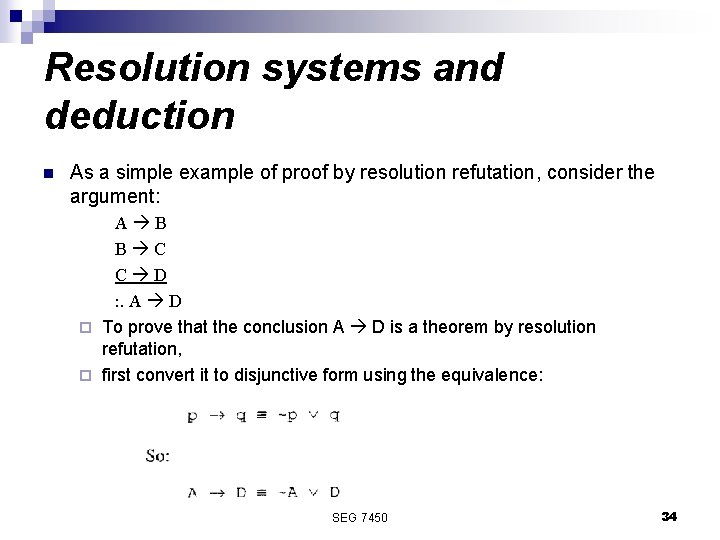
Resolution systems and deduction n As a simple example of proof by resolution refutation, consider the argument: A B B C C D : . A D ¨ To prove that the conclusion A D is a theorem by resolution refutation, ¨ first convert it to disjunctive form using the equivalence: SEG 7450 34
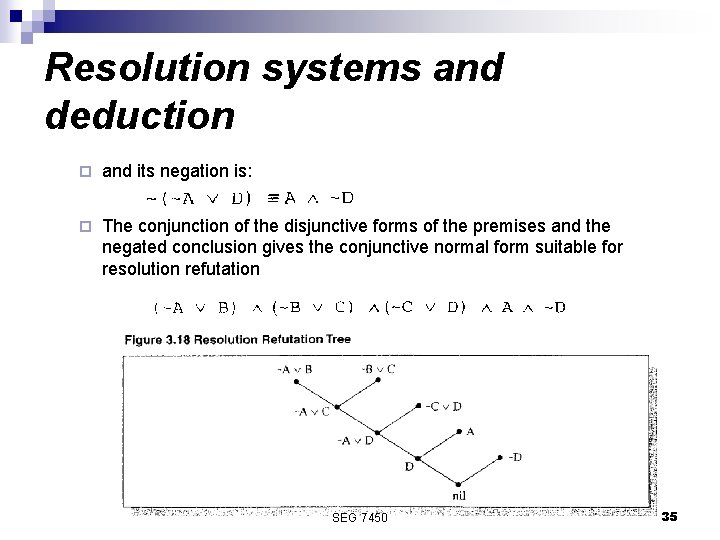
Resolution systems and deduction ¨ and its negation is: ¨ The conjunction of the disjunctive forms of the premises and the negated conclusion gives the conjunctive normal form suitable for resolution refutation SEG 7450 35
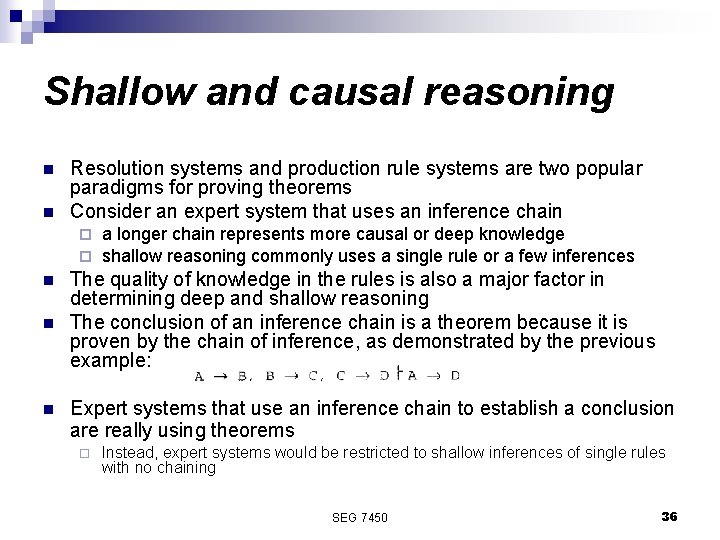
Shallow and causal reasoning n n Resolution systems and production rule systems are two popular paradigms for proving theorems Consider an expert system that uses an inference chain ¨ ¨ n n n a longer chain represents more causal or deep knowledge shallow reasoning commonly uses a single rule or a few inferences The quality of knowledge in the rules is also a major factor in determining deep and shallow reasoning The conclusion of an inference chain is a theorem because it is proven by the chain of inference, as demonstrated by the previous example: Expert systems that use an inference chain to establish a conclusion are really using theorems ¨ Instead, expert systems would be restricted to shallow inferences of single rules with no chaining SEG 7450 36
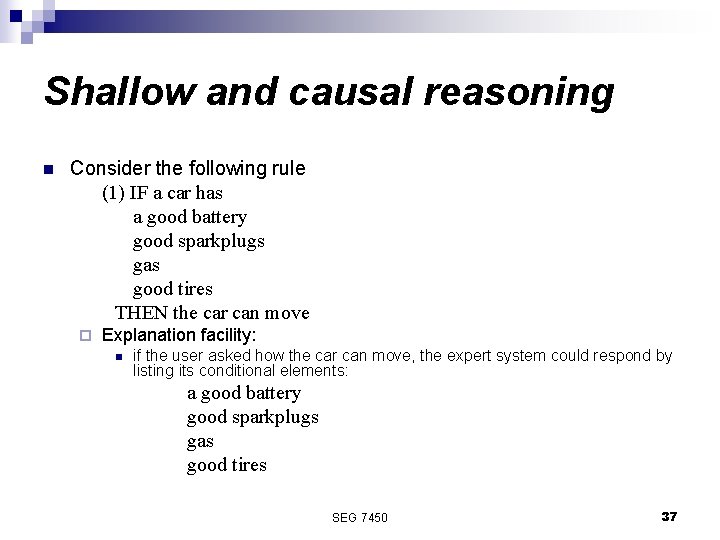
Shallow and causal reasoning n Consider the following rule (1) IF a car has a good battery good sparkplugs gas good tires THEN the car can move ¨ Explanation facility: n if the user asked how the car can move, the expert system could respond by listing its conditional elements: a good battery good sparkplugs gas good tires SEG 7450 37
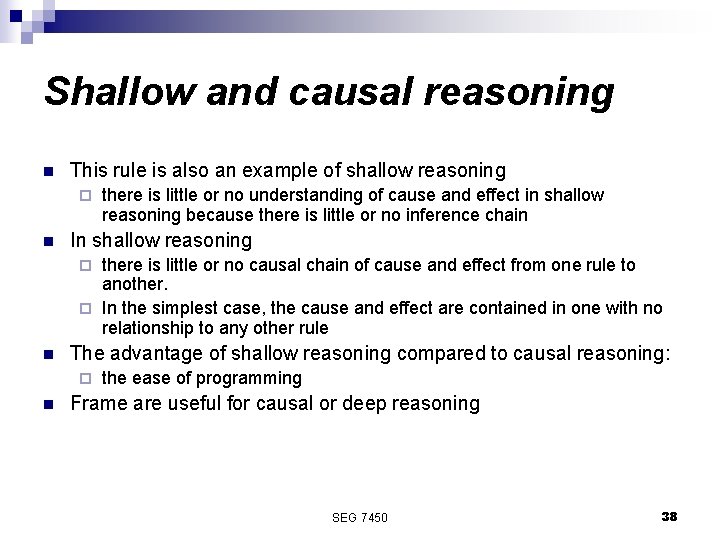
Shallow and causal reasoning n This rule is also an example of shallow reasoning ¨ n there is little or no understanding of cause and effect in shallow reasoning because there is little or no inference chain In shallow reasoning there is little or no causal chain of cause and effect from one rule to another. ¨ In the simplest case, the cause and effect are contained in one with no relationship to any other rule ¨ n The advantage of shallow reasoning compared to causal reasoning: ¨ n the ease of programming Frame are useful for causal or deep reasoning SEG 7450 38
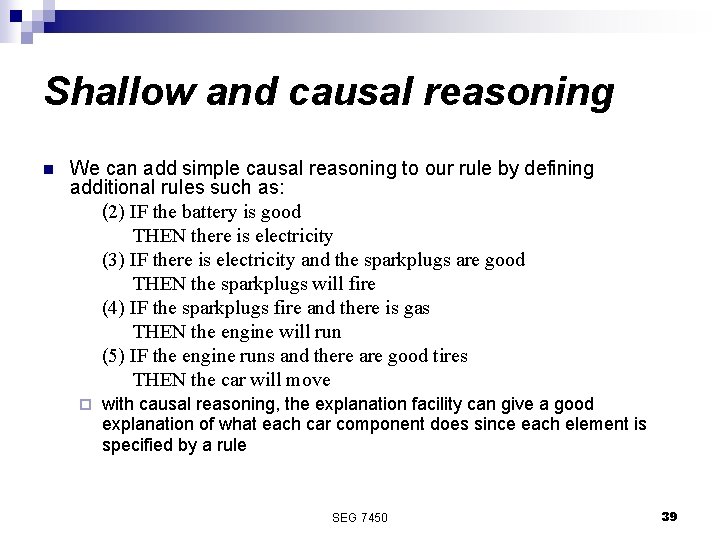
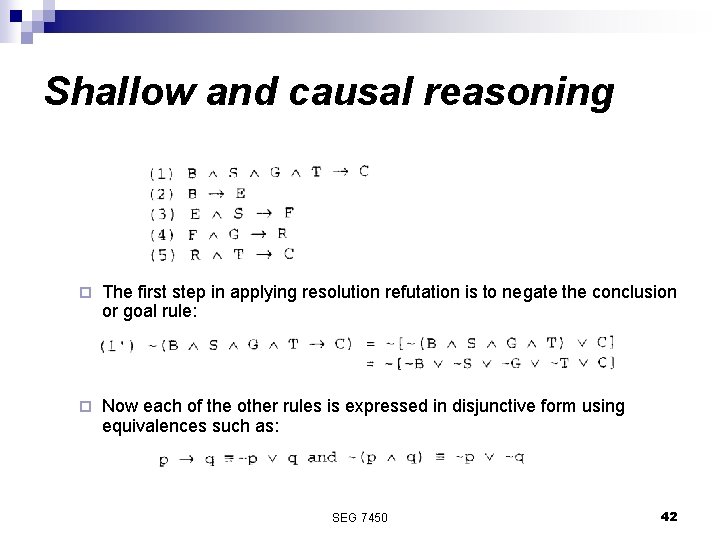
Shallow and causal reasoning n We can add simple causal reasoning to our rule by defining additional rules such as: (2) IF the battery is good THEN there is electricity (3) IF there is electricity and the sparkplugs are good THEN the sparkplugs will fire (4) IF the sparkplugs fire and there is gas THEN the engine will run (5) IF the engine runs and there are good tires THEN the car will move ¨ with causal reasoning, the explanation facility can give a good explanation of what each car component does since each element is specified by a rule SEG 7450 39
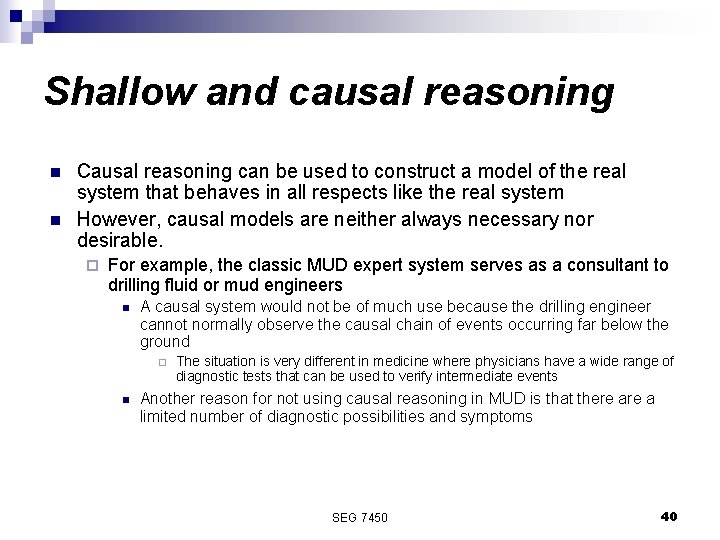
Shallow and causal reasoning n n Causal reasoning can be used to construct a model of the real system that behaves in all respects like the real system However, causal models are neither always necessary nor desirable. ¨ For example, the classic MUD expert system serves as a consultant to drilling fluid or mud engineers n A causal system would not be of much use because the drilling engineer cannot normally observe the causal chain of events occurring far below the ground ¨ n The situation is very different in medicine where physicians have a wide range of diagnostic tests that can be used to verify intermediate events Another reason for not using causal reasoning in MUD is that there a limited number of diagnostic possibilities and symptoms SEG 7450 40
Shallow and causal reasoning n Because of the increased requirements for causal reasoning, it may become necessary to combine certain rules into a shallow reasoning one. ¨ n The resolution method with refutation can be used to prove that a single rule is a true conclusion of multiple rules Suppose to prove that rule (1) is a logical conclusion of rules (2) - (5) Using the following propositional definitions B = battery is good C = car will move E = there is electricity F = sparkplugs will fire G = there is gas R = engine will run S = sparkplugs are good T = there are good tires ¨ SEG 7450 41
Shallow and causal reasoning ¨ The first step in applying resolution refutation is to negate the conclusion or goal rule: ¨ Now each of the other rules is expressed in disjunctive form using equivalences such as: SEG 7450 42
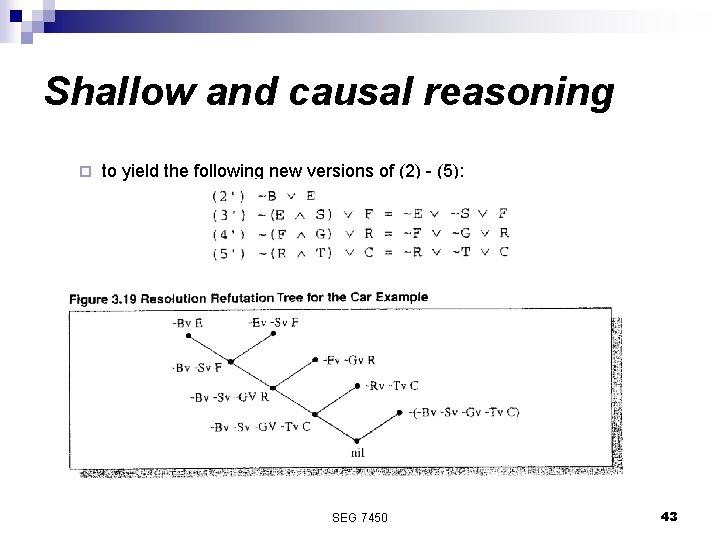
Shallow and causal reasoning ¨ to yield the following new versions of (2) - (5): SEG 7450 43
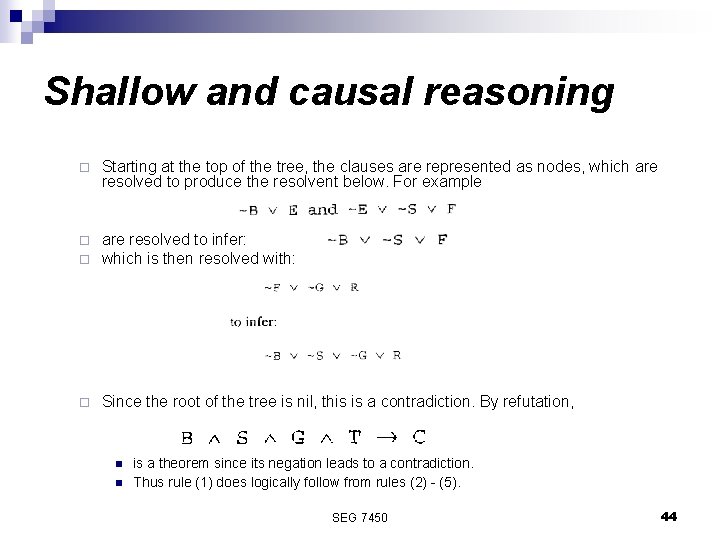
Shallow and causal reasoning ¨ Starting at the top of the tree, the clauses are represented as nodes, which are resolved to produce the resolvent below. For example ¨ ¨ are resolved to infer: which is then resolved with: ¨ Since the root of the tree is nil, this is a contradiction. By refutation, n n is a theorem since its negation leads to a contradiction. Thus rule (1) does logically follow from rules (2) - (5). SEG 7450 44