
Proposing a phenotypic and polygenic model of ADHD
- Slides: 1
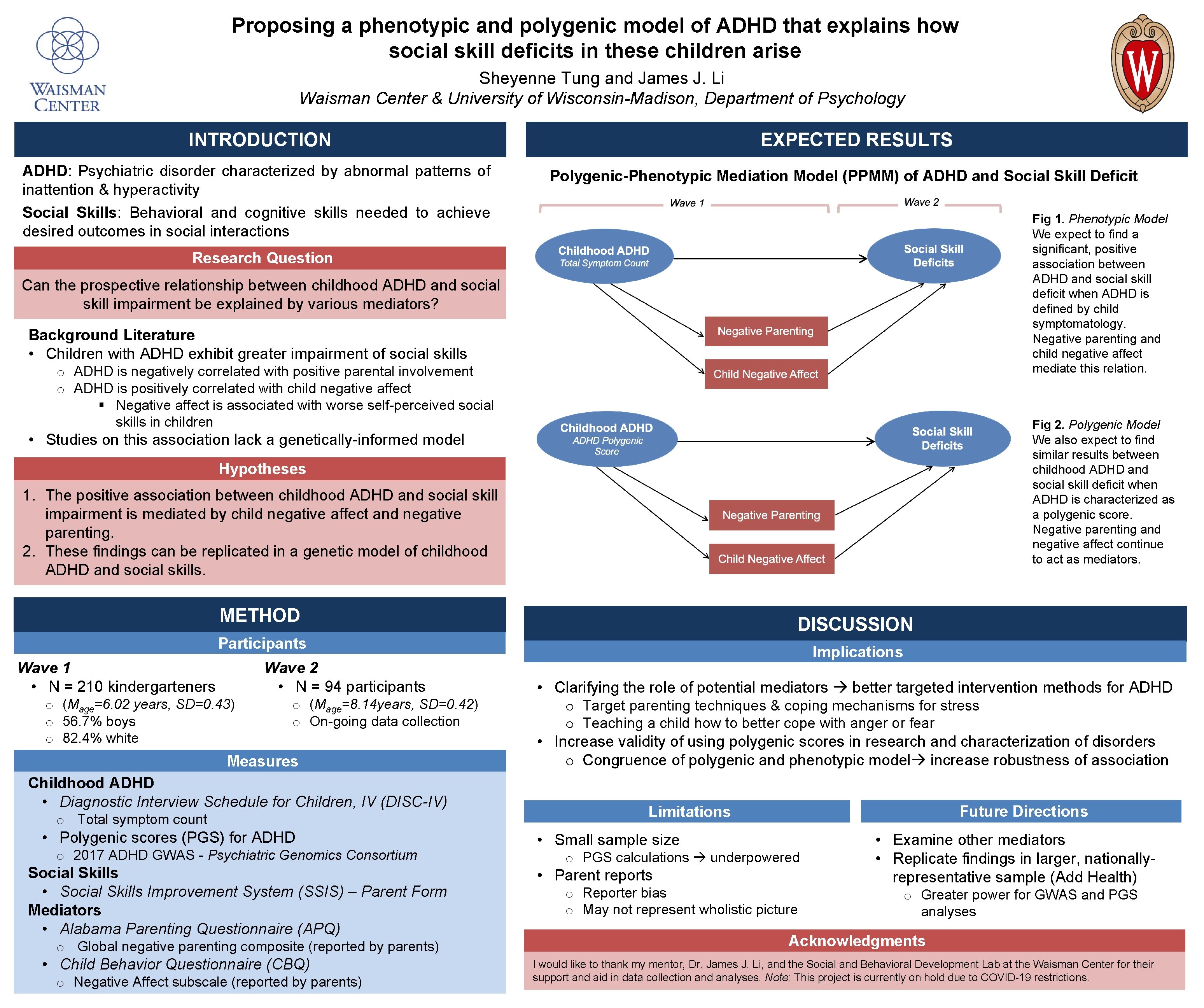
Proposing a phenotypic and polygenic model of ADHD that explains how social skill deficits in these children arise Sheyenne Tung and James J. Li Waisman Center & University of Wisconsin-Madison, Department of Psychology INTRODUCTION ADHD: Psychiatric disorder characterized by abnormal patterns of inattention & hyperactivity Social Skills: Behavioral and cognitive skills needed to achieve desired outcomes in social interactions EXPECTED RESULTS Polygenic-Phenotypic Mediation Model (PPMM) of ADHD and Social Skill Deficit Fig 1. Phenotypic Model We expect to find a significant, positive association between ADHD and social skill deficit when ADHD is defined by child symptomatology. Negative parenting and child negative affect mediate this relation. Research Question Can the prospective relationship between childhood ADHD and social skill impairment be explained by various mediators? Background Literature • Children with ADHD exhibit greater impairment of social skills o ADHD is negatively correlated with positive parental involvement o ADHD is positively correlated with child negative affect § Negative affect is associated with worse self-perceived social skills in children Fig 2. Polygenic Model We also expect to find similar results between childhood ADHD and social skill deficit when ADHD is characterized as a polygenic score. Negative parenting and negative affect continue to act as mediators. • Studies on this association lack a genetically-informed model Hypotheses 1. The positive association between childhood ADHD and social skill impairment is mediated by child negative affect and negative parenting. 2. These findings can be replicated in a genetic model of childhood ADHD and social skills. METHOD DISCUSSION Participants Wave 1 • N = 210 kindergarteners Wave 2 • N = 94 participants o (Mage=6. 02 years, SD=0. 43) o 56. 7% boys o 82. 4% white o (Mage=8. 14 years, SD=0. 42) o On-going data collection Measures Childhood ADHD • Diagnostic Interview Schedule for Children, IV (DISC-IV) o Total symptom count • Polygenic scores (PGS) for ADHD o 2017 ADHD GWAS - Psychiatric Genomics Consortium Social Skills • Social Skills Improvement System (SSIS) – Parent Form Mediators • Alabama Parenting Questionnaire (APQ) o Global negative parenting composite (reported by parents) • Child Behavior Questionnaire (CBQ) o Negative Affect subscale (reported by parents) Implications • Clarifying the role of potential mediators better targeted intervention methods for ADHD o Target parenting techniques & coping mechanisms for stress o Teaching a child how to better cope with anger or fear • Increase validity of using polygenic scores in research and characterization of disorders o Congruence of polygenic and phenotypic model increase robustness of association Future Directions Limitations • Small sample size o PGS calculations underpowered • Parent reports o Reporter bias o May not represent wholistic picture • Examine other mediators • Replicate findings in larger, nationallyrepresentative sample (Add Health) o Greater power for GWAS and PGS analyses Acknowledgments I would like to thank my mentor, Dr. James J. Li, and the Social and Behavioral Development Lab at the Waisman Center for their support and aid in data collection and analyses. Note: This project is currently on hold due to COVID-19 restrictions.