
Proposed Spatial and Temporal Reconstruction of the Environment

- Slides: 13
Proposed Spatial and Temporal Reconstruction of the Environment for the Iqaluktuuq Archaeological Project, Victoria Island, Nunavut, Canada J. M. Ross M. A Ph. D. Candidate julesross@hotmail. com
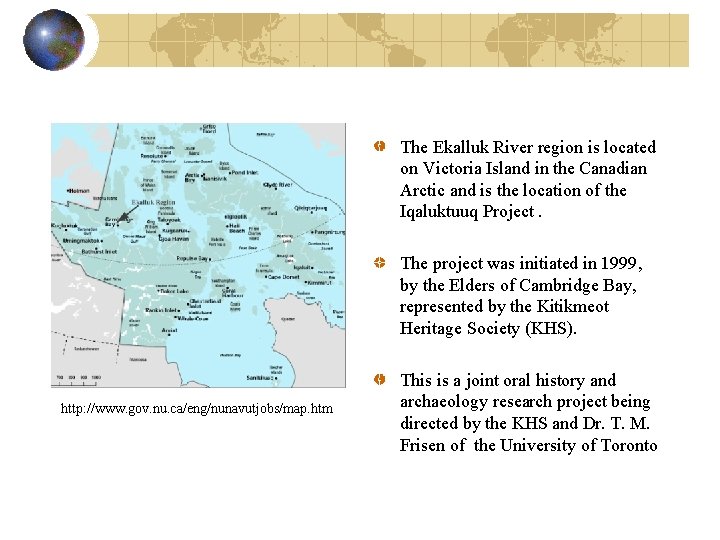
The Ekalluk River region is located on Victoria Island in the Canadian Arctic and is the location of the Iqaluktuuq Project. The project was initiated in 1999, by the Elders of Cambridge Bay, represented by the Kitikmeot Heritage Society (KHS). http: //www. gov. nu. ca/eng/nunavutjobs/map. htm This is a joint oral history and archaeology research project being directed by the KHS and Dr. T. M. Frisen of the University of Toronto
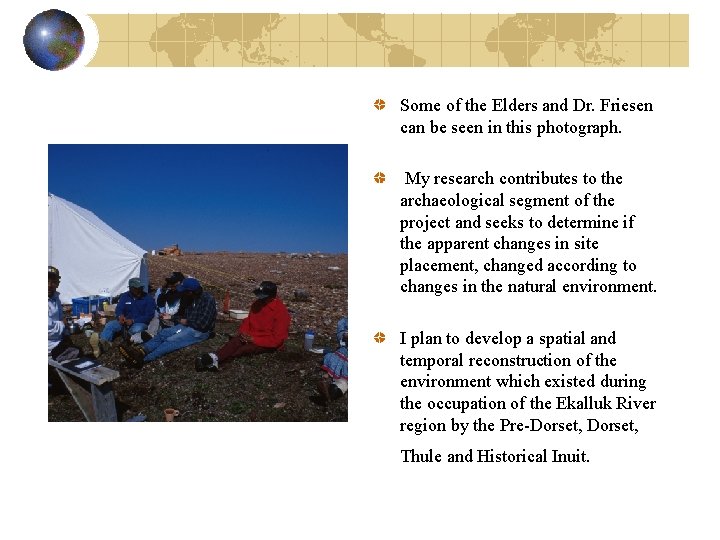
Some of the Elders and Dr. Friesen can be seen in this photograph. My research contributes to the archaeological segment of the project and seeks to determine if the apparent changes in site placement, changed according to changes in the natural environment. I plan to develop a spatial and temporal reconstruction of the environment which existed during the occupation of the Ekalluk River region by the Pre-Dorset, Thule and Historical Inuit.
In order to answer if environmental changes correlate with changes in site location I will: Analysize four proxy environmental indicators including: raised beaches, diatoms, pollen, and soils Consider the type of archaeological sites present as well as their location, and cultural affiliation. This data will be used to explore if Palaeo- and Neoeskimo groups utilised the landscape differently through time All of the environmental and archaeological data will be developed into coverages in Arc/Info 8
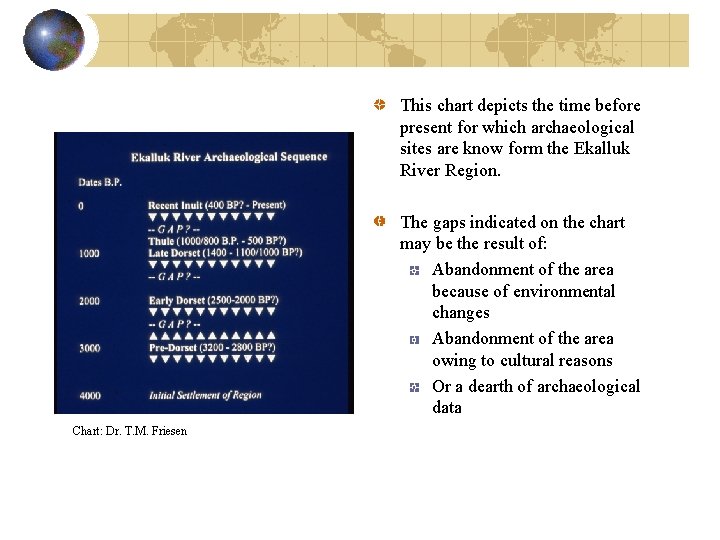
This chart depicts the time before present for which archaeological sites are know form the Ekalluk River Region. The gaps indicated on the chart may be the result of: Abandonment of the area because of environmental changes Abandonment of the area owing to cultural reasons Or a dearth of archaeological data Chart: Dr. T. M. Friesen
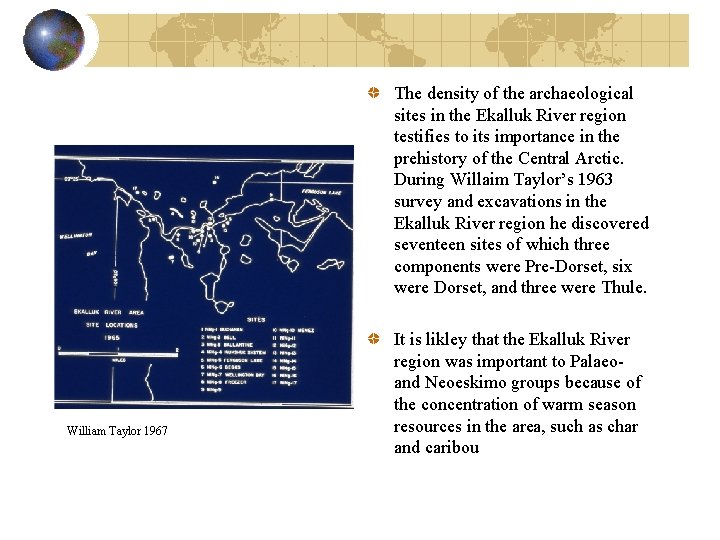
The density of the archaeological sites in the Ekalluk River region testifies to its importance in the prehistory of the Central Arctic. During Willaim Taylor’s 1963 survey and excavations in the Ekalluk River region he discovered seventeen sites of which three components were Pre-Dorset, six were Dorset, and three were Thule. William Taylor 1967 It is likley that the Ekalluk River region was important to Palaeoand Neoeskimo groups because of the concentration of warm season resources in the area, such as char and caribou
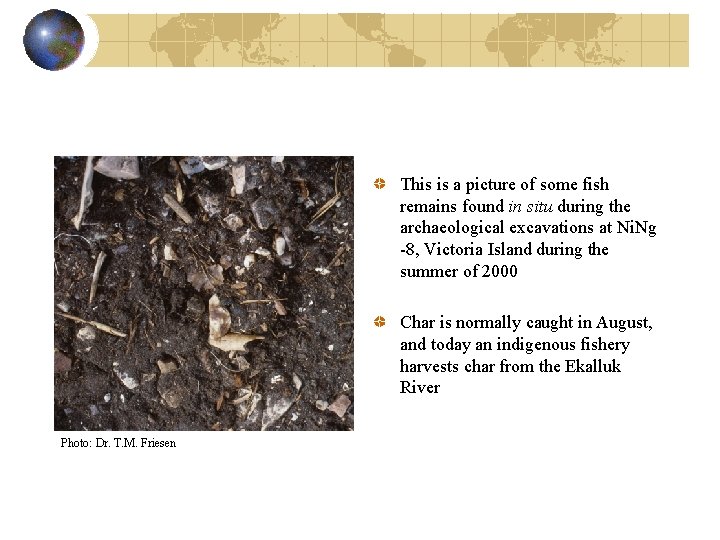
This is a picture of some fish remains found in situ during the archaeological excavations at Ni. Ng -8, Victoria Island during the summer of 2000 Char is normally caught in August, and today an indigenous fishery harvests char from the Ekalluk River Photo: Dr. T. M. Friesen
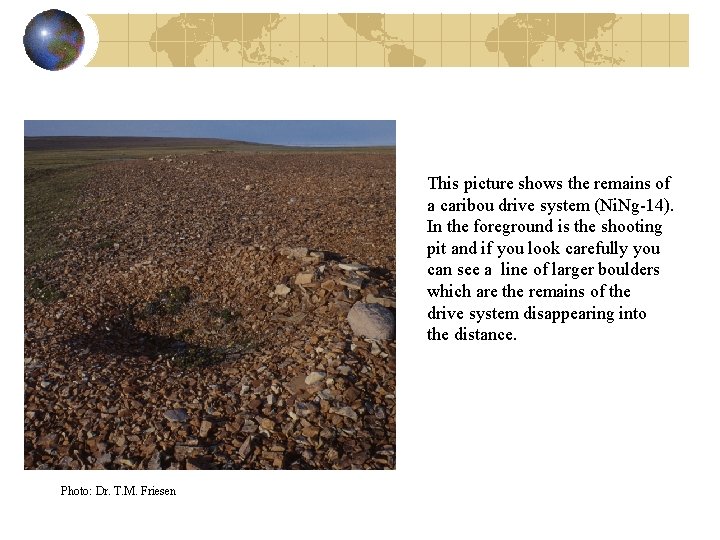
This picture shows the remains of a caribou drive system (Ni. Ng-14). In the foreground is the shooting pit and if you look carefully you can see a line of larger boulders which are the remains of the drive system disappearing into the distance. Photo: Dr. T. M. Friesen
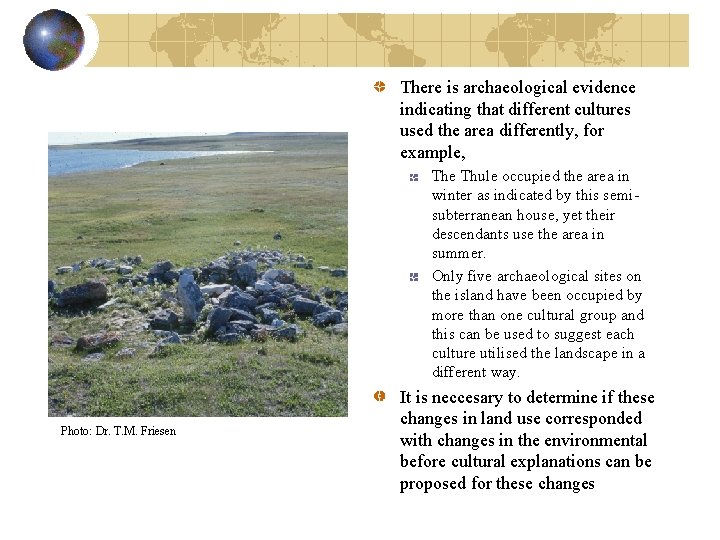
There is archaeological evidence indicating that different cultures used the area differently, for example, The Thule occupied the area in winter as indicated by this semisubterranean house, yet their descendants use the area in summer. Only five archaeological sites on the island have been occupied by more than one cultural group and this can be used to suggest each culture utilised the landscape in a different way. Photo: Dr. T. M. Friesen It is neccesary to determine if these changes in land use corresponded with changes in the environmental before cultural explanations can be proposed for these changes
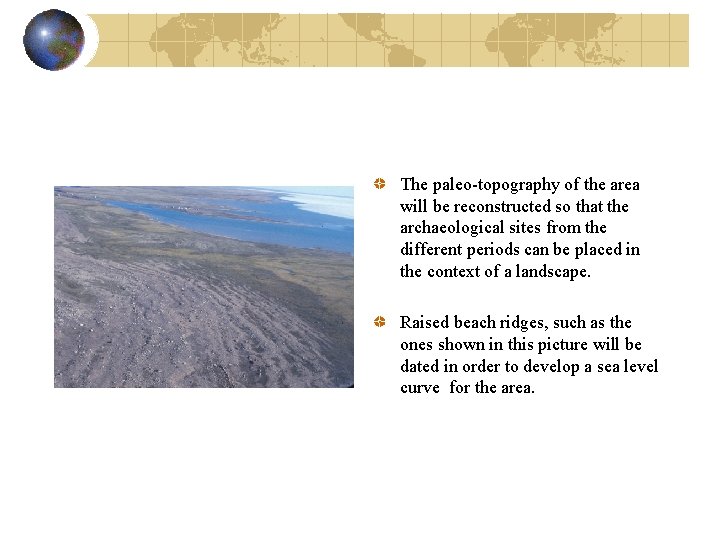
The paleo-topography of the area will be reconstructed so that the archaeological sites from the different periods can be placed in the context of a landscape. Raised beach ridges, such as the ones shown in this picture will be dated in order to develop a sea level curve for the area.
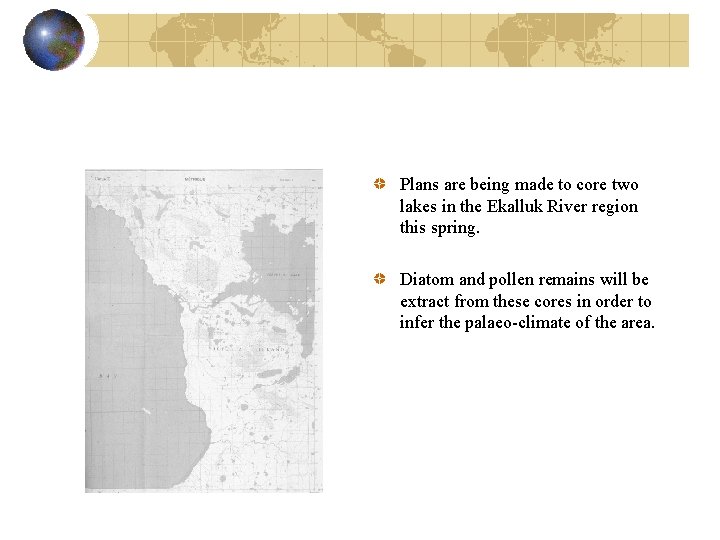
Plans are being made to core two lakes in the Ekalluk River region this spring. Diatom and pollen remains will be extract from these cores in order to infer the palaeo-climate of the area.
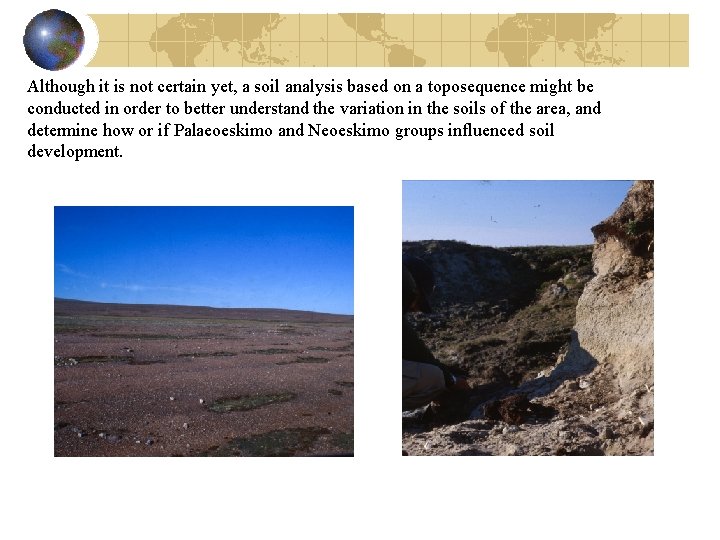
Although it is not certain yet, a soil analysis based on a toposequence might be conducted in order to better understand the variation in the soils of the area, and determine how or if Palaeoeskimo and Neoeskimo groups influenced soil development.
Thank You: -ARCUS -Kitikmeot Heritage Society -Northern Student Training Program -Social Science Humanities Research Council