
Proposed ISA 220 Quality Management for an Audit
- Slides: 31
Proposed ISA 220, Quality Management for an Audit of Financial Statements (ED-220) Lyn Provost, IAASB Member and Task Force Chair IAASB Meeting September 18, 2019 Agenda Item 8
Introduction • Objectives of this session are to: Provide an overview of the feedback received on ED-220 Obtain views on three key issues And potentially two other issues Page 2 |
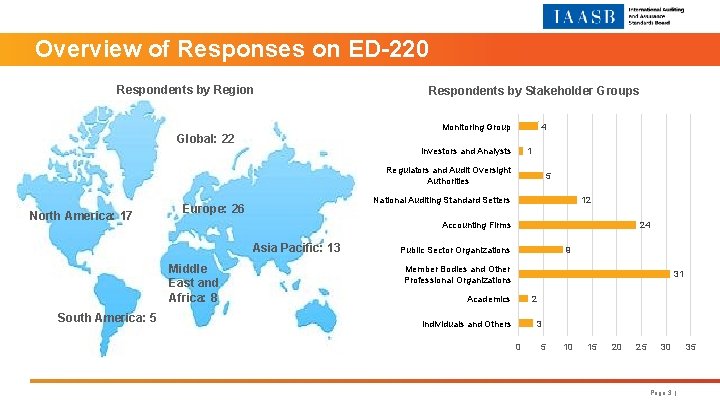
Overview of Responses on ED-220 Respondents by Region Respondents by Stakeholder Groups 4 Monitoring Group Global: 22 Investors and Analysts 1 Regulators and Audit Oversight Authorities North America: 17 National Auditing Standard Setters Europe: 26 12 Accounting Firms Asia Pacific: 13 Middle East and Africa: 8 South America: 5 5 24 Public Sector Organizations 9 Member Bodies and Other Professional Organizations 31 Academics 2 Individuals and Others 3 0 5 10 15 20 25 30 Page 3 | 35
Overall Feedback Received • Comments were generally positive, but raised some issues • Key issues will be discussed in this session • Other issues will be discussed at future meetings: o Professional skepticism o Modern auditing environment o Documentation o Other matters e. g. the objective, stand-back provision, terminology, shared service centers, more guidance, overlaps, and editorial comments
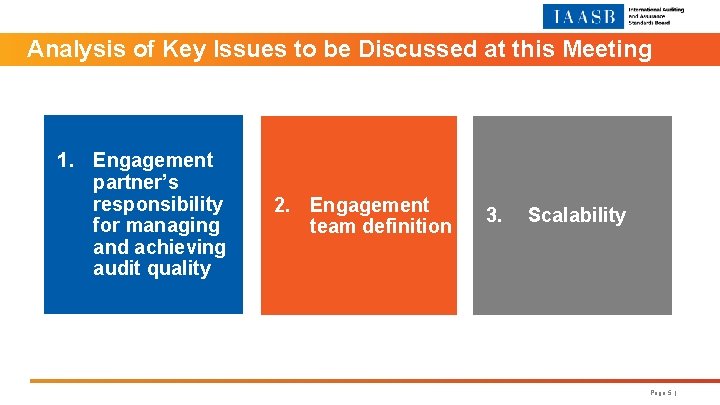
Analysis of Key Issues to be Discussed at this Meeting 1. Engagement partner’s responsibility for managing and achieving audit quality 2. Engagement team definition 3. Scalability Page 5 |
Engagement Partner’s Responsibility for Audit Quality Question 1 of the Explanatory Memorandum (EM) to ED-220 asked: Do you support the focus on the sufficient and appropriate involvement of the engagement partner (see particularly paragraphs 11– 13 and 37 of ED-220)? Does the proposed ISA appropriately reflect the role of other senior members of the engagement team? other partners? Page 6 |
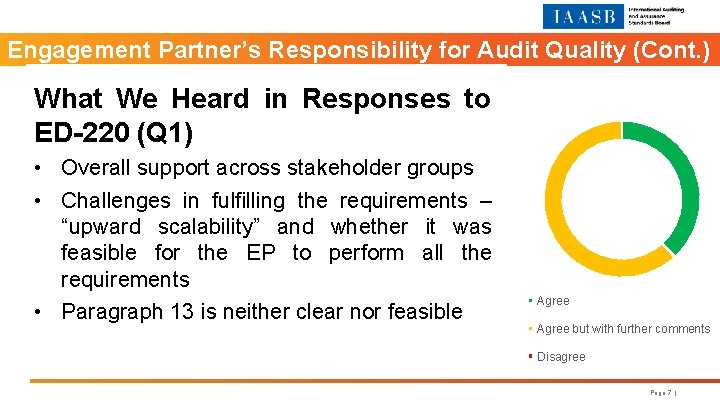
Engagement Partner’s Responsibility for Audit Quality (Cont. ) What We Heard in Responses to ED-220 (Q 1) • Overall support across stakeholder groups • Challenges in fulfilling the requirements ‒ “upward scalability” and whether it was feasible for the EP to perform all the requirements • Paragraph 13 is neither clear nor feasible Agree but with further comments Disagree Page 7 |
Engagement Partner’s Responsibility for Audit Quality (Cont. ) What We Heard from the CAG • Support for the engagement partner’s overall responsibility for audit quality • Concerns that the table in Appendix 6 might undermine that overall responsibility • Support for the indicative wording in Appendix 5 • No support for notion of “shared responsibility” raised by some respondents Page 8 |
Engagement Partner’s Responsibility for Audit Quality (Cont. ) Task Force’s Preliminary Views • Amend requirements on “leadership responsibilities” (Appendix 5) • Clarify which requirements the engagement partner may assign to other engagement team members (Appendix 6 of issues paper) Page 9 |
Engagement Partner’s Responsibility for Audit Quality (Cont. ) Indicative Wording for Paragraph 13 13. If the engagement partner assigns procedures, tasks or actions to other members of the engagement team to assist the engagement partner in complying with the requirements of this ISA, the engagement partner shall continue to take overall responsibility for managing and achieving quality on the audit engagement, and remains accountable for managing and achieving quality on the engagement through direction and supervision of members of the engagement team, and review of their work, as required by paragraph 27. When assigning procedures, tasks or actions to other members of the engagement team, the engagement partner shall: (Ref: Para. A 30) (a) Appropriately inform assignees about the nature of their responsibilities and authority, the scope of the work being assigned, the objectives thereof and any other necessary instructions and relevant information; and (b) Monitor the performance of the work of assignees and review selected related documentation in order to evaluate the conclusions reached. Page 10 |
Engagement Partner’s Responsibility for Audit Quality (Cont. ) Matters for IAASB Consideration 1. Does the IAASB support the proposed changes to paragraph 13 set out in Appendix 5? 2. Does the IAASB agree with the Task Force’s assessment (in Appendix 6), of the requirements in ED-220: (a)That the engagement partner must personally perform; and (b)Those procedures, tasks or actions that the engagement partner may assign to other members of the engagement team to assist the engagement partner in complying with the requirement? Page 11 |
Engagement Team Definition Question 4 of the EM to ED-220 asked: Does ED-220 deal adequately with the modern auditing environment, including the use of different audit delivery models and technology? (Note: This discussion will focus on the engagement team definition in addressing ADMs. ) Page 12 |
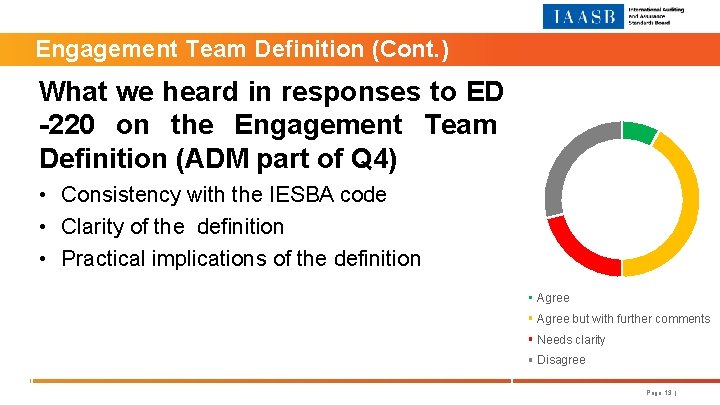
Engagement Team Definition (Cont. ) What we heard in responses to ED -220 on the Engagement Team Definition (ADM part of Q 4) • Consistency with the IESBA code • Clarity of the definition • Practical implications of the definition Agree but with further comments Needs clarity Disagree Page 13 |
Engagement Team Definition (Cont. ) What We Heard from the CAG • Support for retaining the engagement team definition • Assigning responsibilities to engagement team members does not absolve engagement partner of overall responsibility for audit quality Page 14 |
Engagement Team Definition (Cont. ) Task Force’s Preliminary Views • Retain component auditors in the revised definition in ED 220 • Address the practical issues • Coordinate with IESBA on the engagement team definition • Coordinate with the ISA 600 Task Force Page 15 |
Engagement Team Definition (Cont. ) Matters for IAASB Consideration 3. Does the IAASB agree, in light of the responses and analysis in Appendix 7, and subject to further input from the IESBA representatives, that the engagement team definition should include component auditors as they perform audit procedures on the engagement? 4. Does the IAASB agree with the Task Force’s proposals to clarify the scope of the definition with additional application material? Page 16 |
Scalability Question 7 of the EM to ED-220 asked: Is ED-220 appropriately scalable to engagements of different sizes and complexity, including through the focus on the nature and circumstances of the engagement in the requirements? Page 17 |
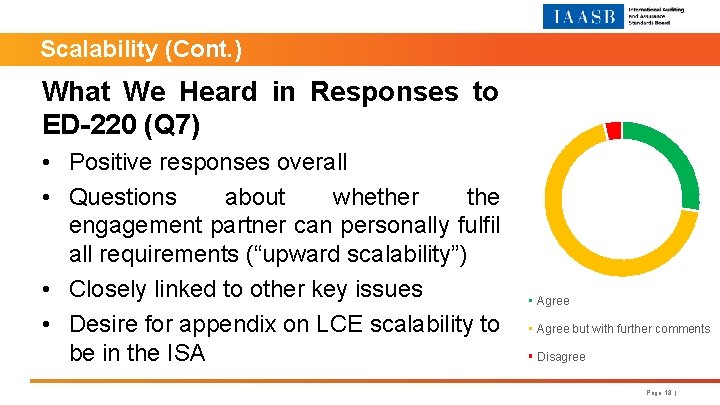
Scalability (Cont. ) What We Heard in Responses to ED-220 (Q 7) • Positive responses overall • Questions about whether the engagement partner can personally fulfil all requirements (“upward scalability”) • Closely linked to other key issues • Desire for appendix on LCE scalability to be in the ISA Agree but with further comments Disagree Page 18 |
Scalability (Cont. ) What We Heard from the CAG • Important to retain a principles-based approach • Need to retain a balance between appropriate assignment of procedures, tasks or actions to engagement team members and overall responsibility for audit quality Page 19 |
Scalability (Cont. ) Task Force’s Preliminary Views • Clarify responsibilities the engagement partner may assign to other engagement team members • For audits of less complex entities (LCEs), put current guidance in a prominent and accessible place Page 20 |
Scalability (Cont. ) Matter for IAASB Consideration 5. Does the IAASB agree with the Task Force’s proposals improving the upward scalability of ED‑ 220 for larger, more complex engagements? Page 21 |
Other Matters 4. Direction, supervision and review 5. Ability to depend on a firm’s system of quality management Page 22 |
Direction, Supervision and Review Question 5 of the EM to ED-220 asked: 0 have appropriate linkages with the ISQMs? Do you support the requirements to follow the firm’s Do you support the revised requirements and guidance on direction, supervision and review? (See paragraphs 27– 31 and A 68–A 80 of ED-220) Page 23 |
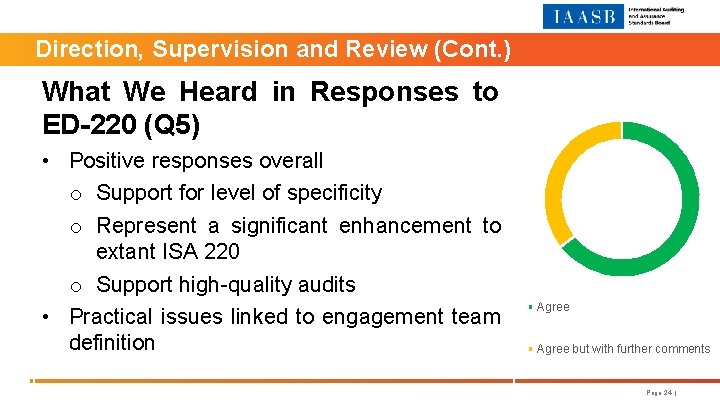
Direction, Supervision and Review (Cont. ) What We Heard in Responses to ED-220 (Q 5) • Positive responses overall o Support for level of specificity o Represent a significant enhancement to extant ISA 220 o Support high-quality audits • Practical issues linked to engagement team definition Agree but with further comments Page 24 |
Direction, Supervision and Review (Cont. ) Task Force’s Preliminary Views • Consider an explicit requirement for the engagement partner to set out planned level of direction, supervision and review • Clarify responsibilities the engagement partner may assign to other engagement team members • Consider application material related to the definition of the engagement team • Coordinate with ISA 600 Task Force on the application of the requirements in group audits Page 25 |
Ability to Depend on the Firm’s System of Quality Management Question 2 of the EM to ED-220 asked: Does ED-220 have appropriate linkages with the ISQMs? Do you support the requirements to follow the firm’s policies and procedures and the material referring to when the engagement partner may depend on the firm’s policies or procedures? Page 26 |
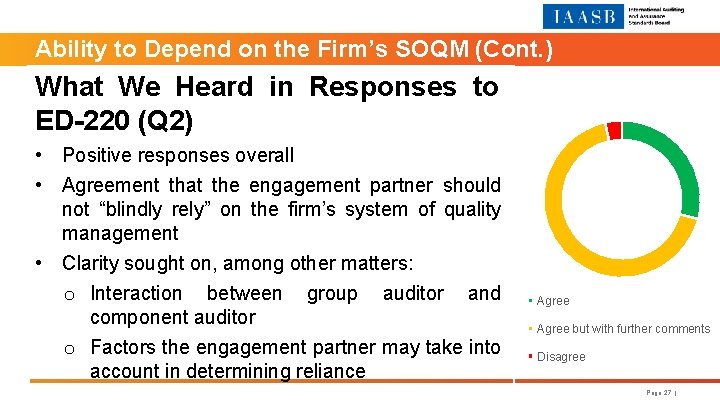
Ability to Depend on the Firm’s SOQM (Cont. ) What We Heard in Responses to ED-220 (Q 2) • Positive responses overall • Agreement that the engagement partner should not “blindly rely” on the firm’s system of quality management • Clarity sought on, among other matters: o Interaction between group auditor and component auditor o Factors the engagement partner may take into account in determining reliance Agree but with further comments Disagree Page 27 |
Ability to Depend on the Firm’s SOQM (Cont. ) Task Force’s Preliminary Views • Provide guidance on factors the engagement partner may take into account in determining reliance on the firm’s system of quality management • Clarify that quality management is implemented throughout the audit engagement (i. e. , single entity or group entity) • Consider developing application material to set out interaction of group auditor and component auditor o Coordinate with ISA 600 Task Force Page 28 |
Other Matters for IAASB Consideration 6. Do you agree with the Task Force’s preliminary thoughts on direction, supervision and review; and the engagement partner’s ability to depend on the firm’s policies or procedures before the Task Force develops them further for the December 2019 IAASB meeting? 7. Are there any other significant matters in the comment letters related to the topics addressed that the Task force should address? Page 29 |
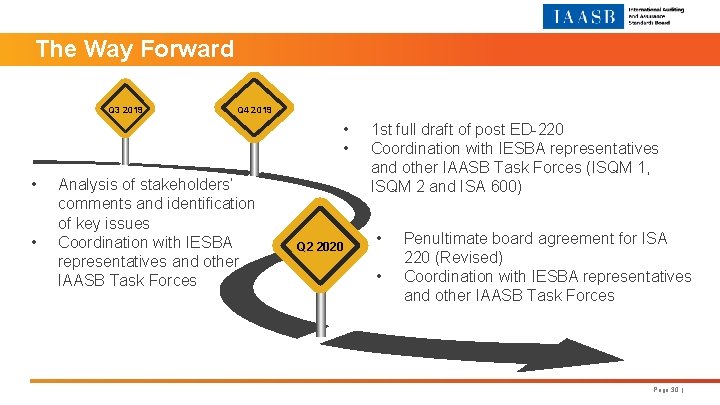
The Way Forward Q 3 2019 Q 4 2019 • • Analysis of stakeholders’ comments and identification of key issues Coordination with IESBA representatives and other IAASB Task Forces Q 2 2020 1 st full draft of post ED-220 Coordination with IESBA representatives and other IAASB Task Forces (ISQM 1, ISQM 2 and ISA 600) • • Penultimate board agreement for ISA 220 (Revised) Coordination with IESBA representatives and other IAASB Task Forces Page 30 |
www. iaasb. org For copyright, trademark, and permissions information, please go to permissions or contact permissions@ifac. org. Page 31 |