
Proposed Disposal Routes for NORM Contaminated Soil and

![Disposal Option 1 • ICRP draft 2005 recommendation of 1 Bq[226 Ra]/g activity for](https://slidetodoc.com/presentation_image_h2/e377d8723d00a4f1f98f64bdc454a3c7/image-9.jpg "Disposal Option 1 • ICRP draft 2005 recommendation of 1 Bq[226 Ra]/g activity for")
- Slides: 19
Proposed Disposal Routes for NORM Contaminated Soil and Sludges. By G. T. Tan, PDO, NORM Workshop 21 -23 rd, February 2005 Muscat, Oman
Objective • To propose safe disposal options for long term disposal of NORM suspect soil/sludges in PDO
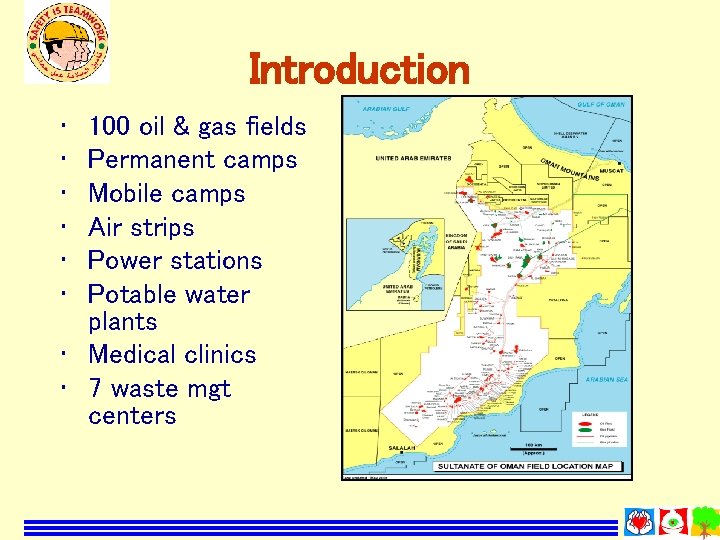
Introduction • • • 100 oil & gas fields Permanent camps Mobile camps Air strips Power stations Potable water plants • Medical clinics • 7 waste mgt centers
Sources and Quantity of NORM Contaminated Soil/Sludges • Oil contaminated soil collected from oil spills • Oily sludges ( from tank bottom and pigging) • These have been mixed in the past for land farming • Inventory has been made • Samples > 5 cps (MI AA meter) sent to SQU for radiation analysis • For long term disposal, 226 Ra is has been used for classification of various NORM level in the soil/sludges.
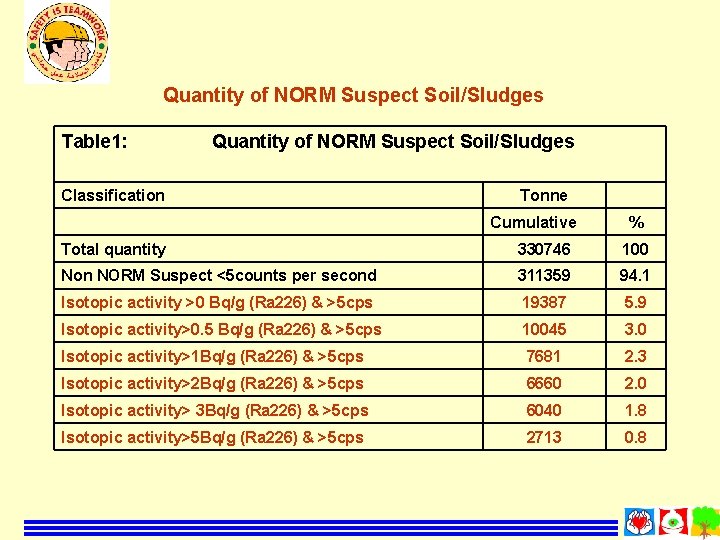
Quantity of NORM Suspect Soil/Sludges Table 1: Quantity of NORM Suspect Soil/Sludges Classification Tonne Cumulative % Total quantity 330746 100 Non NORM Suspect <5 counts per second 311359 94. 1 Isotopic activity >0 Bq/g (Ra 226) & >5 cps 19387 5. 9 Isotopic activity>0. 5 Bq/g (Ra 226) & >5 cps 10045 3. 0 Isotopic activity>1 Bq/g (Ra 226) & >5 cps 7681 2. 3 Isotopic activity>2 Bq/g (Ra 226) & >5 cps 6660 2. 0 Isotopic activity> 3 Bq/g (Ra 226) & >5 cps 6040 1. 8 Isotopic activity>5 Bq/g (Ra 226) & >5 cps 2713 0. 8
Quantity of NORM Suspect Contaminated Soil/Sludges >5 cps Table 2 Quantity of NORM Suspect Contaminated Soil/ Sludges >5 cps Isotopic Activity (Ra 226): Tonne Asset >0 Bq/g % >0. 5 Bq/g % >1 Bq/g % >2 Bq/g % >3 Bq/g % >5 Bq/g % 2580 13 1876 19 1173 15 1173 18 938 16 469 17 89 0 89 1 78 1 56 1 0 0 Fahud 4200 22 3080 31 2240 29 1680 25 1400 23 280 10 Qan Alam 912 5 304 3 101 1 101 2 51 1 0 0 Nimr 1476 8 328 3 0 0 0 0 Marmul 2785 14 557 6 279 4 0 0 0 Bahja 5905 30 2531 25 2531 33 2531 38 2531 42 844 31 MAF 1440 7 1280 13 1280 17 1120 19 1120 41 Total 19387 10045 100 7681 100 6660 100 6040 100 2713 100 Lekwair Yibal
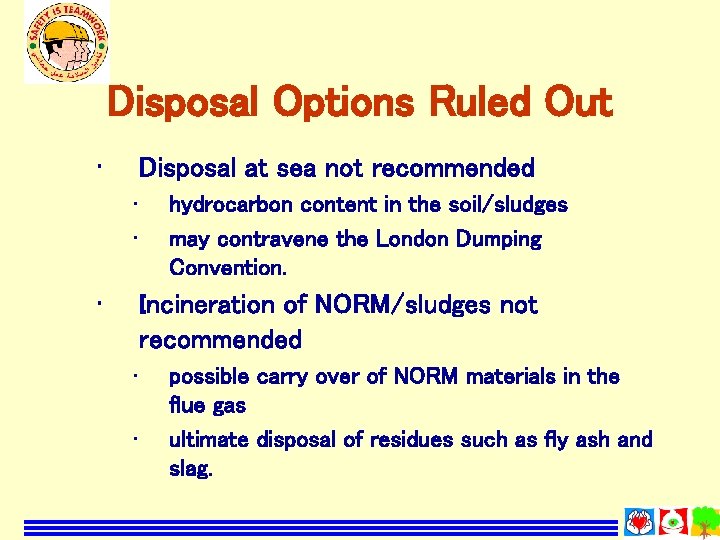
Disposal Options Ruled Out • Disposal at sea not recommended • • • hydrocarbon content in the soil/sludges may contravene the London Dumping Convention. Incineration of NORM/sludges not recommended • • possible carry over of NORM materials in the flue gas ultimate disposal of residues such as fly ash and slag.
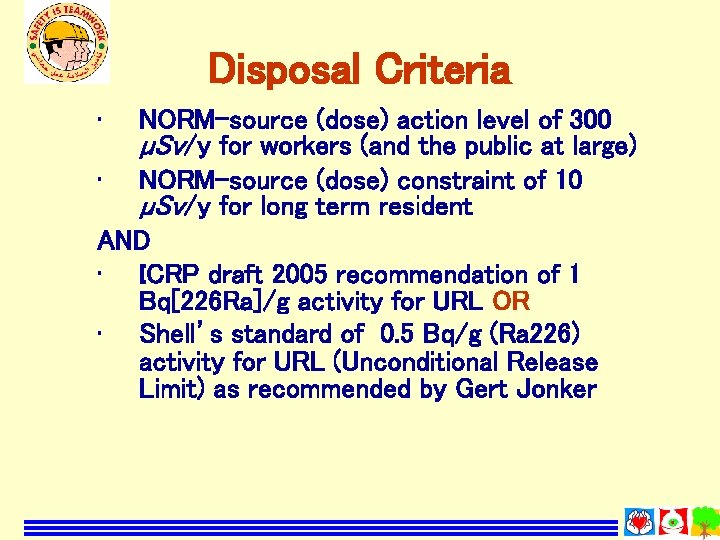
Disposal Criteria • NORM-source (dose) action level of 300 µSv/y for workers (and the public at large) • NORM-source (dose) constraint of 10 µSv/y for long term resident AND • ICRP draft 2005 recommendation of 1 Bq[226 Ra]/g activity for URL OR • Shell’s standard of 0. 5 Bq/g (Ra 226) activity for URL (Unconditional Release Limit) as recommended by Gert Jonker
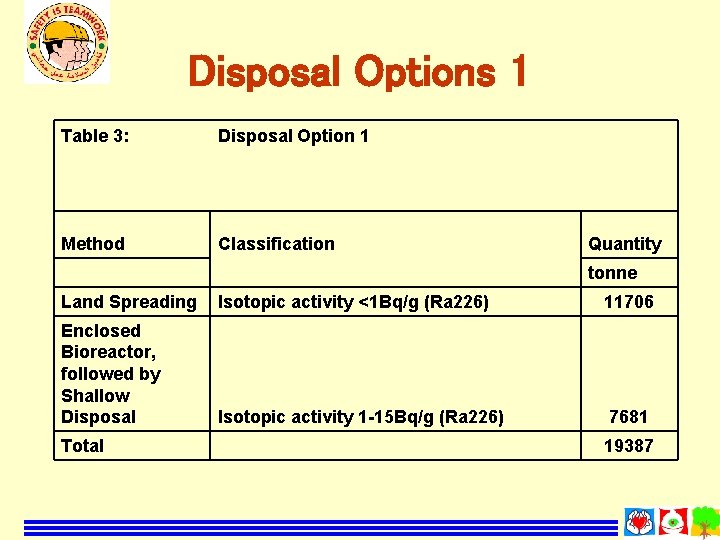
Disposal Option 1 • ICRP draft 2005 recommendation of 1 Bq[226 Ra]/g activity for URL Option: • Isotopic activity of less than 1 Bq/g (isotopic Ra 226): Land spreading • Isotopic activity from 1 to 15 Bq/g (isotopic Ra 226): CRL for soil/sludges. Land farming method cannot be used as the workers exposure will exceed 300 micro. S/yr • Alternative treatment of HC to regulatory limit is needed, e. g. fully enclosed high rate bioreactor. The residue soil/sludges disposed via shallow disposal URL: Unconditional Release Limit CRL: Conditional Release Limit
Disposal Options 1 Table 3: Disposal Option 1 Method Classification Quantity tonne Land Spreading Isotopic activity <1 Bq/g (Ra 226) 11706 Enclosed Bioreactor, followed by Shallow Disposal Isotopic activity 1 -15 Bq/g (Ra 226) 7681 Total 19387
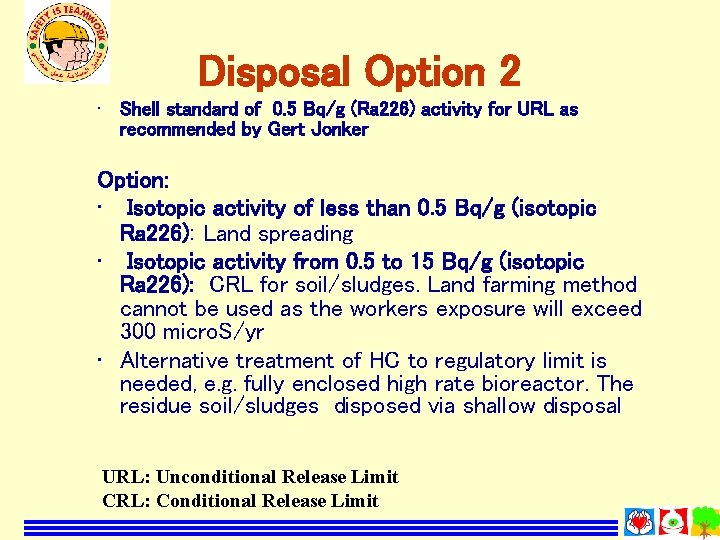
Disposal Option 2 • Shell standard of 0. 5 Bq/g (Ra 226) activity for URL as recommended by Gert Jonker Option: • Isotopic activity of less than 0. 5 Bq/g (isotopic Ra 226): Land spreading • Isotopic activity from 0. 5 to 15 Bq/g (isotopic Ra 226): CRL for soil/sludges. Land farming method cannot be used as the workers exposure will exceed 300 micro. S/yr • Alternative treatment of HC to regulatory limit is needed, e. g. fully enclosed high rate bioreactor. The residue soil/sludges disposed via shallow disposal URL: Unconditional Release Limit CRL: Conditional Release Limit
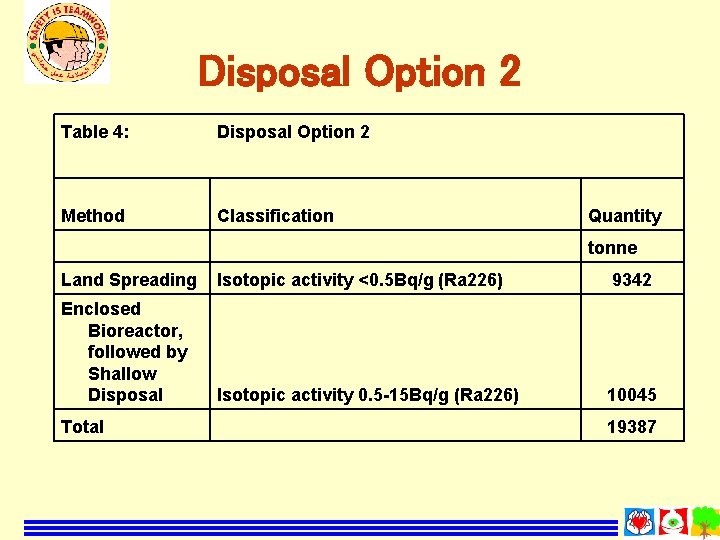
Disposal Option 2 Table 4: Disposal Option 2 Method Classification Quantity tonne Land Spreading Isotopic activity <0. 5 Bq/g (Ra 226) 9342 Enclosed Bioreactor, followed by Shallow Disposal Isotopic activity 0. 5 -15 Bq/g (Ra 226) 10045 Total 19387
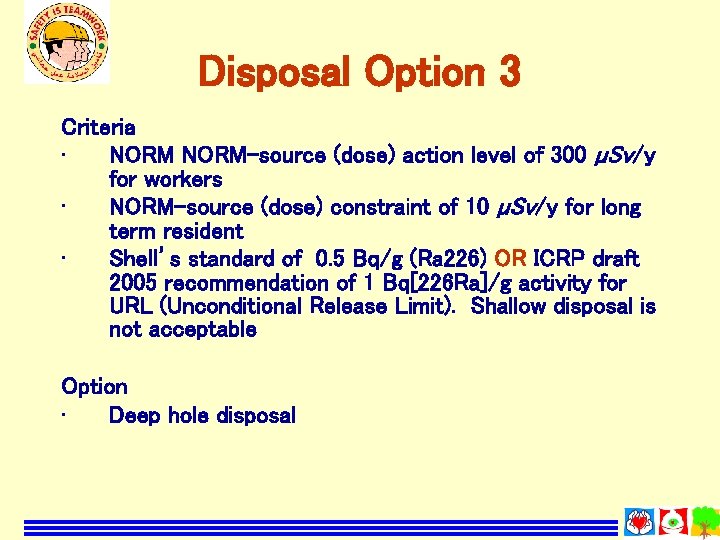
Disposal Option 3 Criteria • NORM-source (dose) action level of 300 µSv/y for workers • NORM-source (dose) constraint of 10 µSv/y for long term resident • Shell’s standard of 0. 5 Bq/g (Ra 226) OR ICRP draft 2005 recommendation of 1 Bq[226 Ra]/g activity for URL (Unconditional Release Limit). Shallow disposal is not acceptable Option • Deep hole disposal
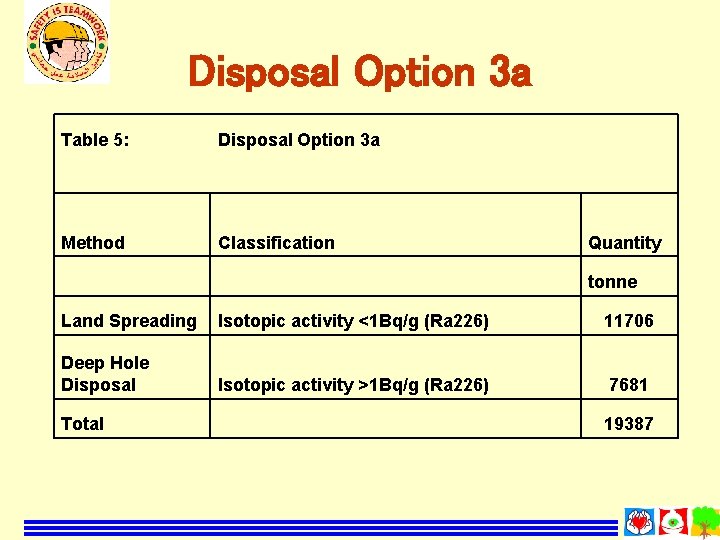
Disposal Option 3 a Table 5: Disposal Option 3 a Method Classification Quantity tonne Land Spreading Isotopic activity <1 Bq/g (Ra 226) 11706 Deep Hole Disposal Isotopic activity >1 Bq/g (Ra 226) 7681 Total 19387
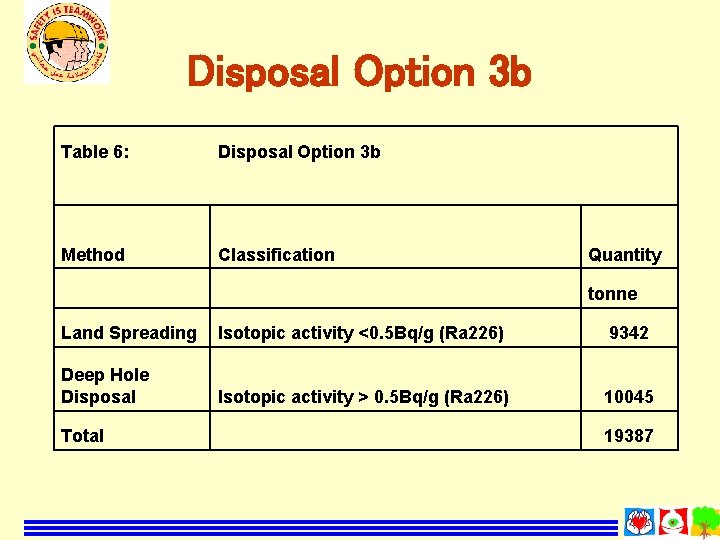
Disposal Option 3 b Table 6: Disposal Option 3 b Method Classification Quantity tonne Land Spreading Isotopic activity <0. 5 Bq/g (Ra 226) 9342 Deep Hole Disposal Isotopic activity > 0. 5 Bq/g (Ra 226) 10045 Total 19387
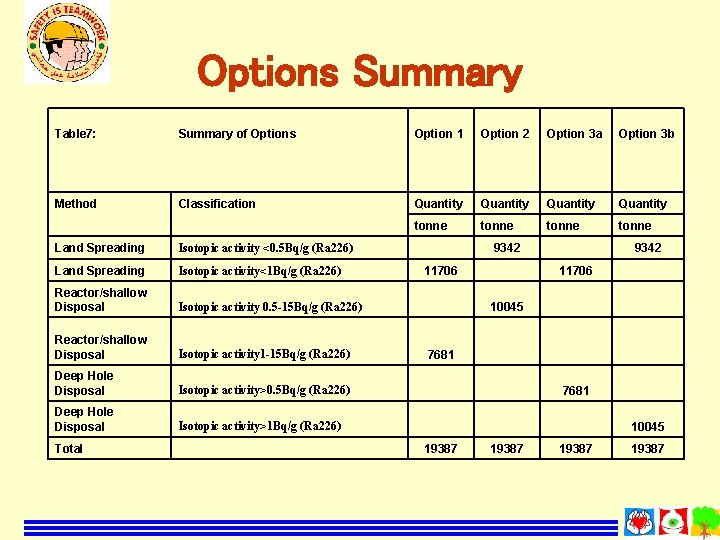
Options Summary Table 7: Summary of Options Option 1 Option 2 Option 3 a Option 3 b Method Classification Quantity tonne Land Spreading Isotopic activity <0. 5 Bq/g (Ra 226) Land Spreading Isotopic activity<1 Bq/g (Ra 226) Reactor/shallow Disposal Isotopic activity 0. 5 -15 Bq/g (Ra 226) Reactor/shallow Disposal Isotopic activity 1 -15 Bq/g (Ra 226) Deep Hole Disposal Isotopic activity>0. 5 Bq/g (Ra 226) Deep Hole Disposal Isotopic activity>1 Bq/g (Ra 226) Total 9342 11706 10045 7681 10045 19387
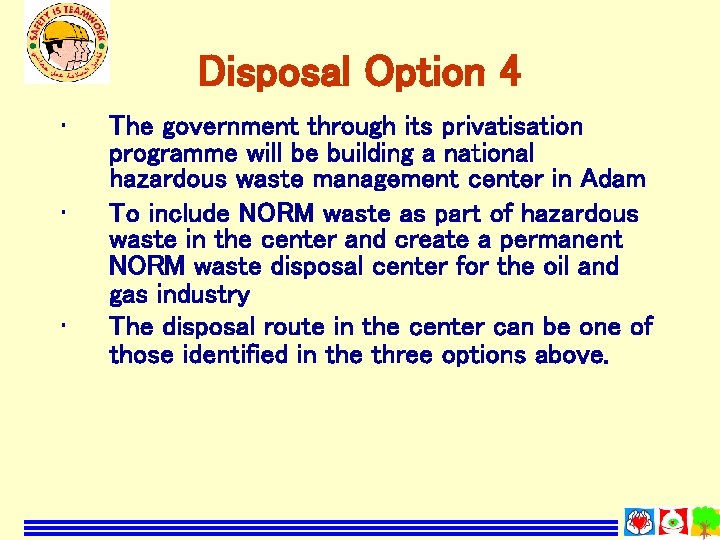
Disposal Option 4 • • • The government through its privatisation programme will be building a national hazardous waste management center in Adam To include NORM waste as part of hazardous waste in the center and create a permanent NORM waste disposal center for the oil and gas industry The disposal route in the center can be one of those identified in the three options above.
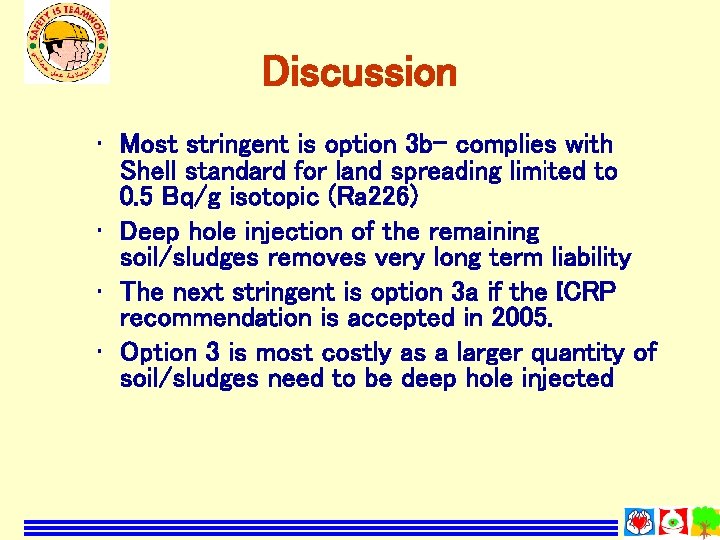
Discussion • Most stringent is option 3 b- complies with Shell standard for land spreading limited to 0. 5 Bq/g isotopic (Ra 226) • Deep hole injection of the remaining soil/sludges removes very long term liability • The next stringent is option 3 a if the ICRP recommendation is accepted in 2005. • Option 3 is most costly as a larger quantity of soil/sludges need to be deep hole injected
Discussion…. cont • Option 1 and 2 have some liability as residue soil/sludges buried under shallow disposal may be disturbed as PDO cannot guarantee future activities when its concession end. • Option 4 is worth exploring a dedicated national NORM disposal site. • Whether PDO liability ends after the privatised waste center has accepted the NORM suspect waste