
Proposals Md AlAmin Mli Proposals Proposals are persuasive

- Slides: 18
Proposals Md. Al-Amin (Mli)
Proposals �Proposals are persuasive messages �They are written in order to convince the reader on a particular action �A document that offers solution to a problem or a course of action in response to a need
Characteristics � Proposals share certain characteristics with reports � Both genres involve collecting and presenting the information carefully � They share similar kinds of prefatory materials such as title page, letter of transmittal, table of content and so forth � Proposals tend to use the direct pattern that most reports use � However, Proposals are intentionally persuasive whereas reports aim to present the information in an orderly, useful manner � Whether they use direct or indirect approach, their purpose is to persuade people
Types of Proposals �Proposals can vary widely in length, purpose and format Purpose: The purpose of proposals can be anything from acquiring a new customer to getting a new computer for the department - Length: Ranging from one page to hundred of pages - Form: They can take the form of an e-mail, a memo, or a letter -
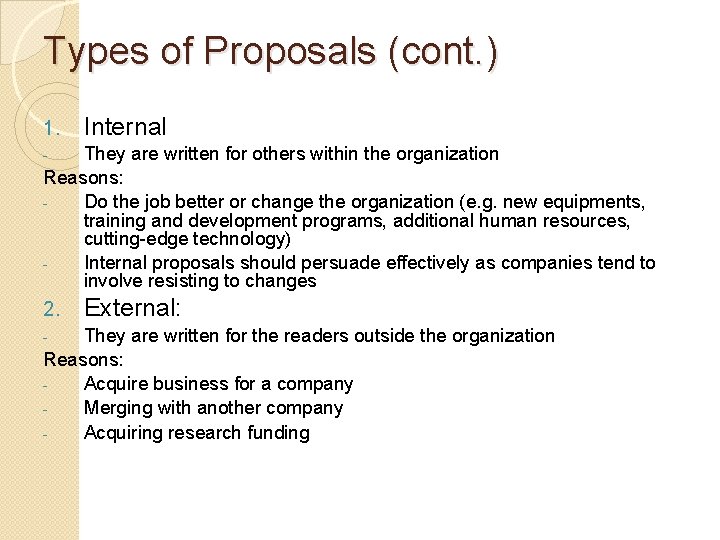
Types of Proposals (cont. ) 1. Internal They are written for others within the organization Reasons: Do the job better or change the organization (e. g. new equipments, training and development programs, additional human resources, cutting-edge technology) Internal proposals should persuade effectively as companies tend to involve resisting to changes - 2. External: They are written for the readers outside the organization Reasons: Acquire business for a company Merging with another company Acquiring research funding -
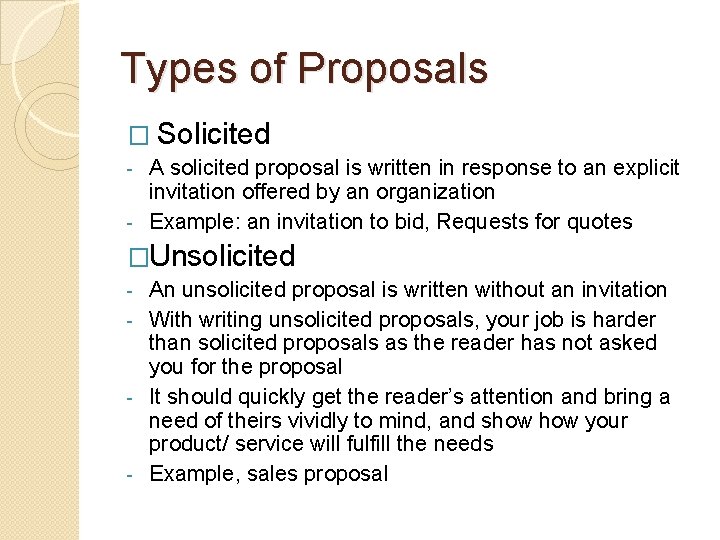
Types of Proposals � Solicited A solicited proposal is written in response to an explicit invitation offered by an organization - Example: an invitation to bid, Requests for quotes - �Unsolicited An unsolicited proposal is written without an invitation - With writing unsolicited proposals, your job is harder than solicited proposals as the reader has not asked you for the proposal - It should quickly get the reader’s attention and bring a need of theirs vividly to mind, and show your product/ service will fulfill the needs - Example, sales proposal -
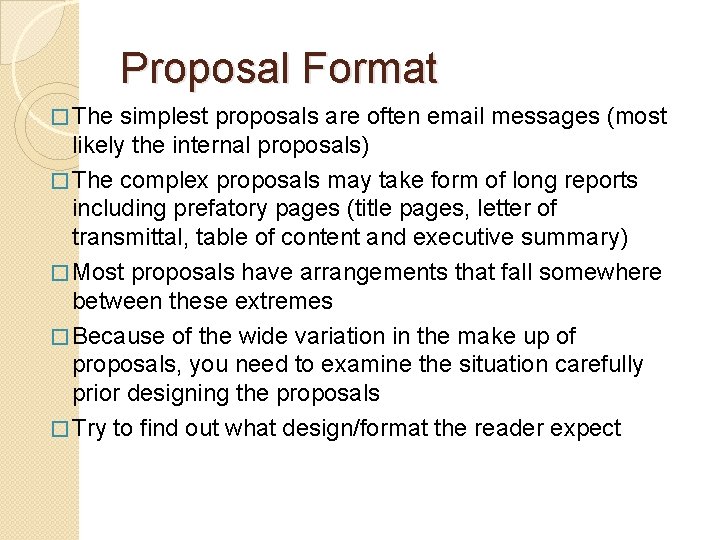
Proposal Format � The simplest proposals are often email messages (most likely the internal proposals) � The complex proposals may take form of long reports including prefatory pages (title pages, letter of transmittal, table of content and executive summary) � Most proposals have arrangements that fall somewhere between these extremes � Because of the wide variation in the make up of proposals, you need to examine the situation carefully prior designing the proposals � Try to find out what design/format the reader expect
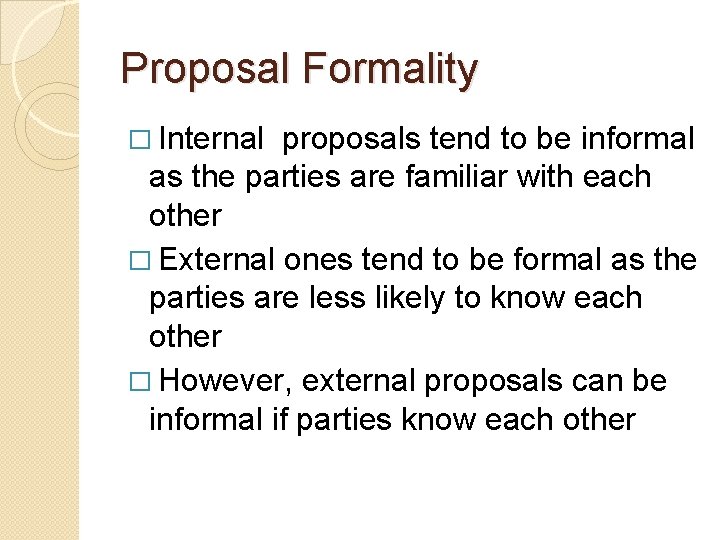
Proposal Formality � Internal proposals tend to be informal as the parties are familiar with each other � External ones tend to be formal as the parties are less likely to know each other � However, external proposals can be informal if parties know each other
Proposal Content � The writer’s purpose and reader’s need - An appropriate beginning is a statement of your purpose (to present a proposal) and the reader’s need - If the proposal is established in response to an invitation, that statement should tie in with the invitation - If the proposal is written without invitation, its beginning must gain attention in order to motivate the reader �
Proposal Content (cont. ) � The background - A review of background information promotes an understanding of the problem - Think about a your course instructor's proposal for gaining research funding - A company’s proposal of a merger with another company - What would be the background information in these cases?
Proposal Content (cont. ) � The need - Paint a picture of the goal or problem in such a way that the readers feel a keen need for what you are proposing - In some cases, although the readers are aware of the needs, you need to reestablish the need
Proposal Content (cont. ) � The - description of your plan The heart of the proposal - You should use the headings and subheadings here to communicate clearly - It should give sufficient information to convince the readers
Proposal Content (cont. ) � The benefit of the proposal The proposal should be presented in such a way that the readers can see how your proposed action will benefit them - A brief statement of the benefits should appear at the front of the proposal, whether in the letter of transmittal, executive summary, opening paragraph or all of the above - Don’t forget to elaborate on those benefits in the body -
Proposal Content (cont. ) � Cost and other particular Once you have established your plan, you need to state clearly what it will cost - Example, a construction company’s proposal to an organization - Your report proposal may not include this section -
Proposal Content (cont. ) � Evidence of your ability to deliver The proposing organization should establish the ability to perform - You can include the qualifications of personnel, success in similar case, and adequacy of relevant equipments and so forth -
Proposal Content (cont. ) � Concluding comments You need to urge or recommend the desired course of action - You might also include a summary of your proposal’s highlights or provide one final persuasive push in concluding section -
�“The most important thing in communicating is hearing what is not said”- Peter Drucker � “Your ability to communicate with others will account for fully 85% of your success in your business and in your life”- Brian Tracy
THANK YOU!