
PROPOSALS BUDGET APEC Project Management Unit APEC Secretariat
PROPOSALS & BUDGET APEC Project Management Unit APEC Secretariat SOM 1, 2019 Santiago, Chile Copyright © 2018 APEC Secretariat Copyright © 2017 APEC Secretariat
Agenda This session covers: Developing Quality Project Proposal Planning the Project Budget Allowable and Non-Allowable Expenses
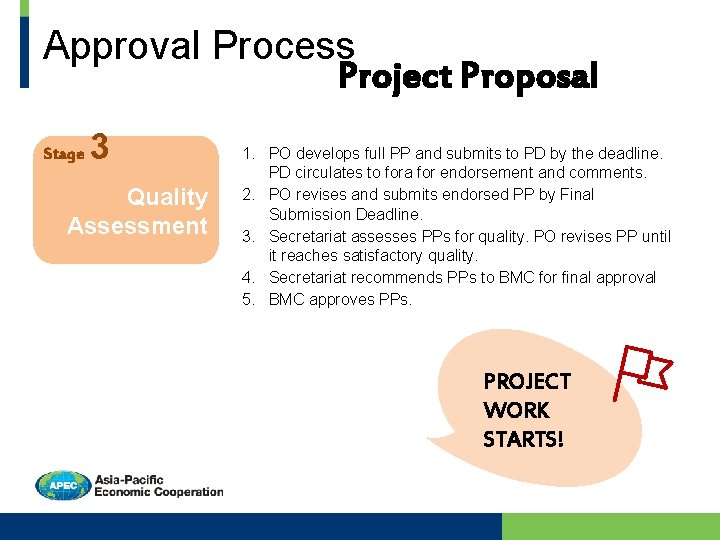
Approval Process Project Proposal Stage 3 Quality Assessment 1. PO develops full PP and submits to PD by the deadline. PD circulates to fora for endorsement and comments. 2. PO revises and submits endorsed PP by Final Submission Deadline. 3. Secretariat assesses PPs for quality. PO revises PP until it reaches satisfactory quality. 4. Secretariat recommends PPs to BMC for final approval 5. BMC approves PPs. PROJECT WORK STARTS!
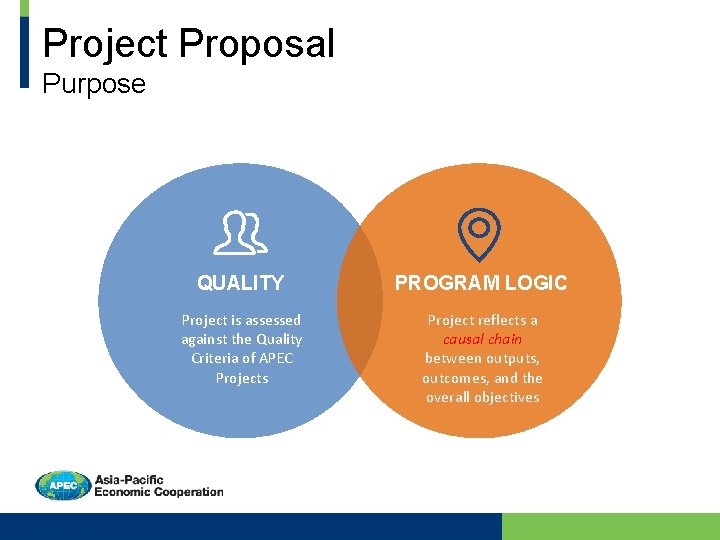
Project Proposal Purpose QUALITY PROGRAM LOGIC Project is assessed against the Quality Criteria of APEC Projects Project reflects a causal chain between outputs, outcomes, and the overall objectives
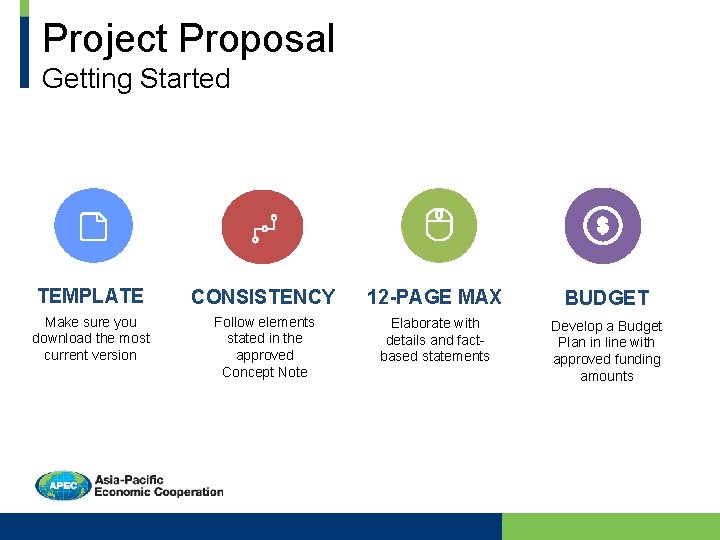
Project Proposal Getting Started TEMPLATE CONSISTENCY 12 -PAGE MAX BUDGET Make sure you download the most current version Follow elements stated in the approved Concept Note Elaborate with details and factbased statements Develop a Budget Plan in line with approved funding amounts
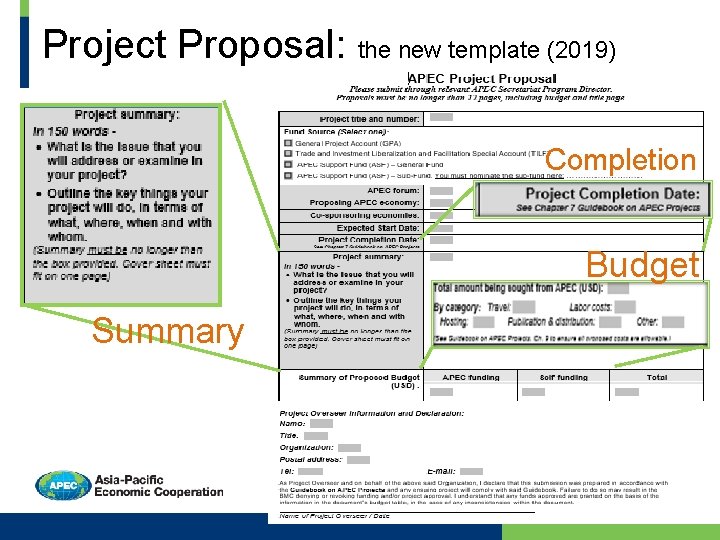
Project Proposal: the new template (2019) Completion Budget Summary
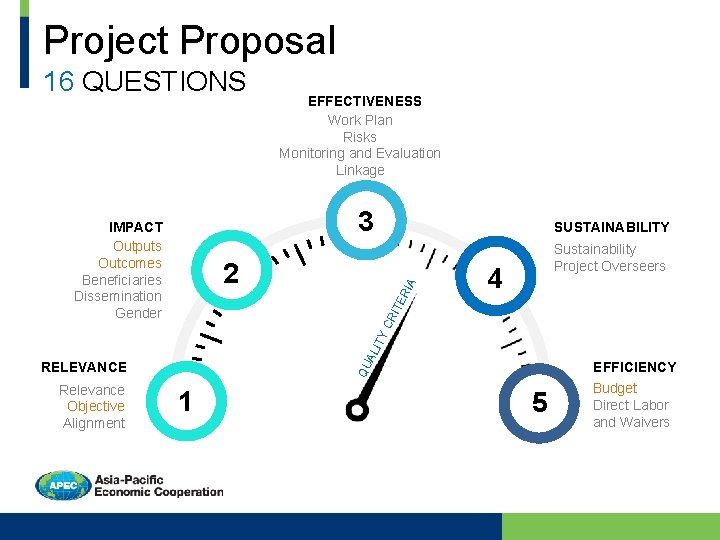
Project Proposal 16 QUESTIONS 3 IMPACT Outputs Outcomes Beneficiaries Dissemination Gender SUSTAINABILITY Sustainability Project Overseers 4 AL ITY CR ITE RIA 2 EFFICIENCY QU RELEVANCE Relevance Objective Alignment EFFECTIVENESS Work Plan Risks Monitoring and Evaluation Linkage 1 5 Budget Direct Labor and Waivers
Project Proposal Section A: Project Relevance 1 a. Relevance – Benefits to the Region: • How does the project benefit the APEC region? • Background info on the project issue; how the issue affects the APEC region; how the project addresses the issue • Fact based information 1 c. Relevance – Capacity Building • How will the project build capacity for APEC economies? • ASF Projects needs to address developing economies
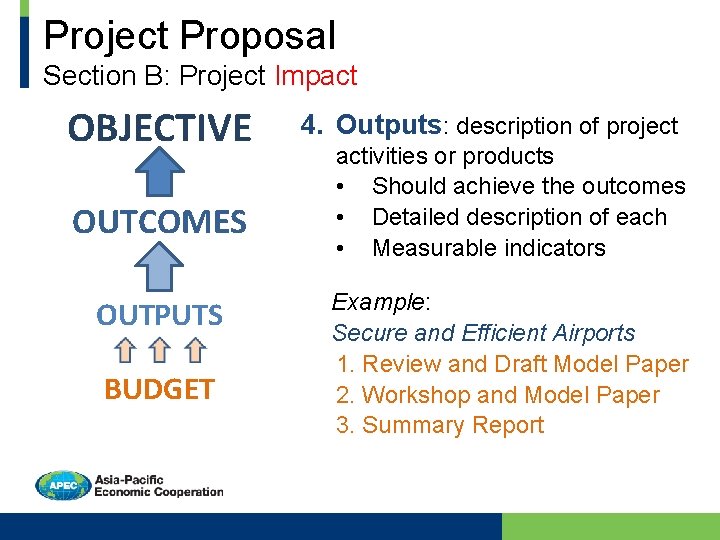
Project Proposal Section B: Project Impact OBJECTIVE OUTCOMES OUTPUTS BUDGET 4. Outputs: description of project activities or products • Should achieve the outcomes • Detailed description of each • Measurable indicators Example: Secure and Efficient Airports 1. Review and Draft Model Paper 2. Workshop and Model Paper 3. Summary Report
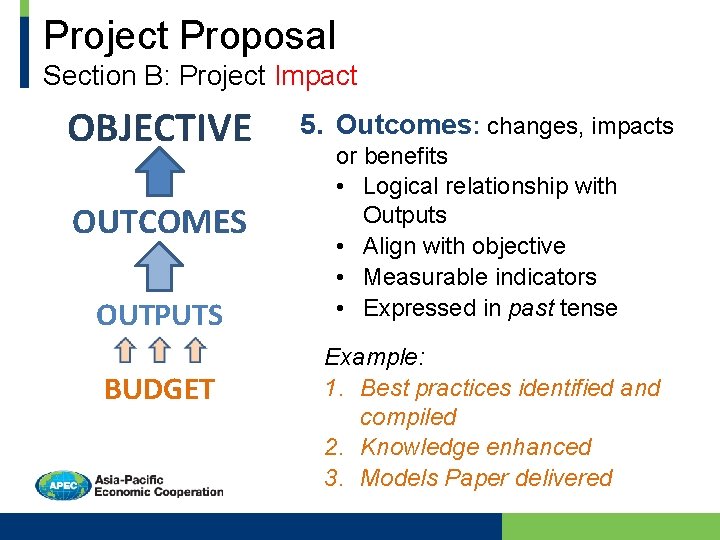
Project Proposal Section B: Project Impact OBJECTIVE OUTCOMES OUTPUTS BUDGET 5. Outcomes: changes, impacts or benefits • Logical relationship with Outputs • Align with objective • Measurable indicators • Expressed in past tense Example: 1. Best practices identified and compiled 2. Knowledge enhanced 3. Models Paper delivered
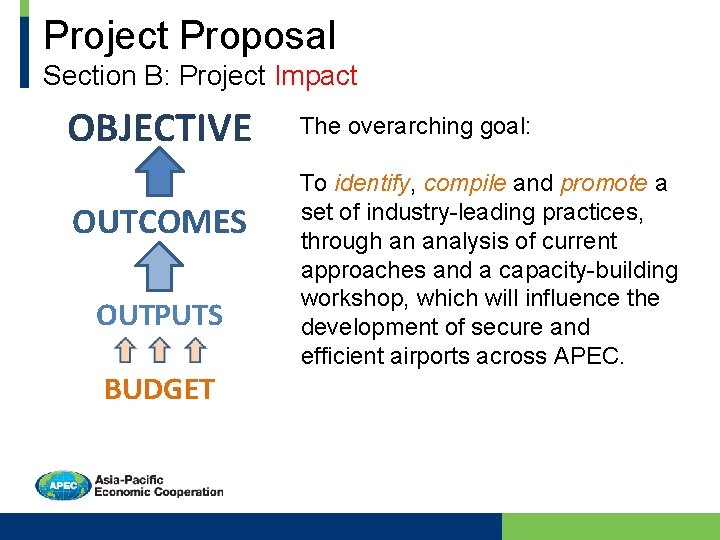
Project Proposal Section B: Project Impact OBJECTIVE OUTCOMES OUTPUTS BUDGET The overarching goal: To identify, compile and promote a set of industry-leading practices, through an analysis of current approaches and a capacity-building workshop, which will influence the development of secure and efficient airports across APEC.
Project Proposal Section B: Project Impact 7. Dissemination • • • How will each information output be promoted? Where will information reside? APEC Publication? 8. Gender: how is this project benefitting women (or men)? • Study the Gender Criteria (Appendix G 5 pillars) • Think beyond participation – deeper inclusion • Tip: google the topic + ‘gender’ to see similar work done
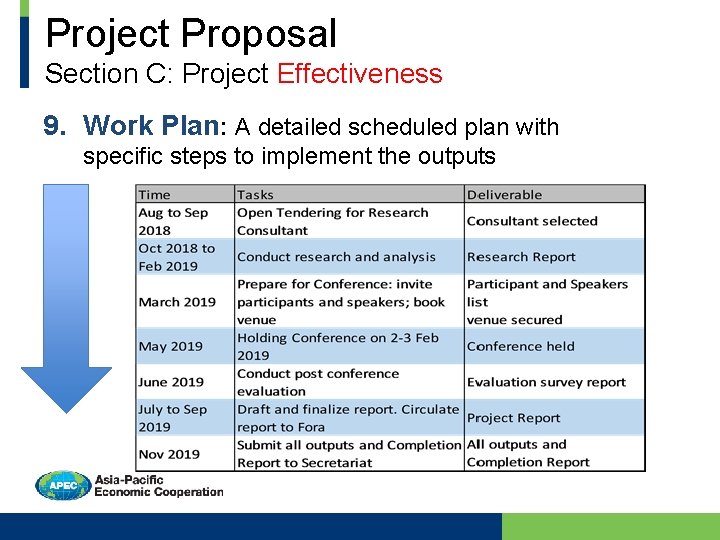
Project Proposal Section C: Project Effectiveness 9. Work Plan: A detailed scheduled plan with specific steps to implement the outputs
Project Proposal Section C: Project Effectiveness 10. Risks: What could stop you from successfully managing the implementation of your project? How can you prevent or manage this? • • Project delay Low relevance to other economies Low participation from developing economies Low applicability of project results
Project Proposal Section C: Project Effectiveness 11. Monitoring and Evaluation: establishing monitoring mechanism and setting indicators • Quantitative and qualitative • Measurable and achievable targets • Measures project’s Outputs ‒ Participation rates, number of economies, number of speakers, number of Best Practices/Recommendations • Measure project’s Outcomes ‒ Survey analysis (ex-ante and ex-post), feedback mechanism • Gender indicators
Project Proposal Section D: Project Sustainability 13. Sustainability: how the project will continue its impact • • Next steps beyond completion - follow-up plans, next phase project, result presentation, etc Tracking mechanism of impact – scheduled follow-up survey, scheduled feedback reports, etc.
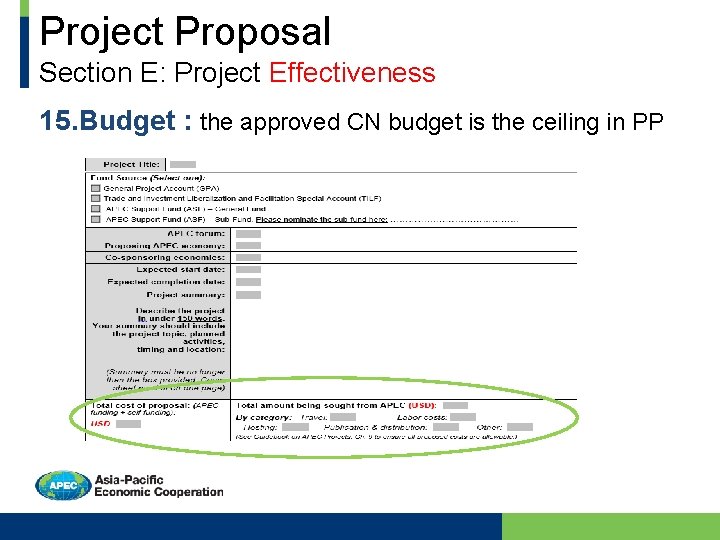
Project Proposal Section E: Project Effectiveness 15. Budget : the approved CN budget is the ceiling in PP
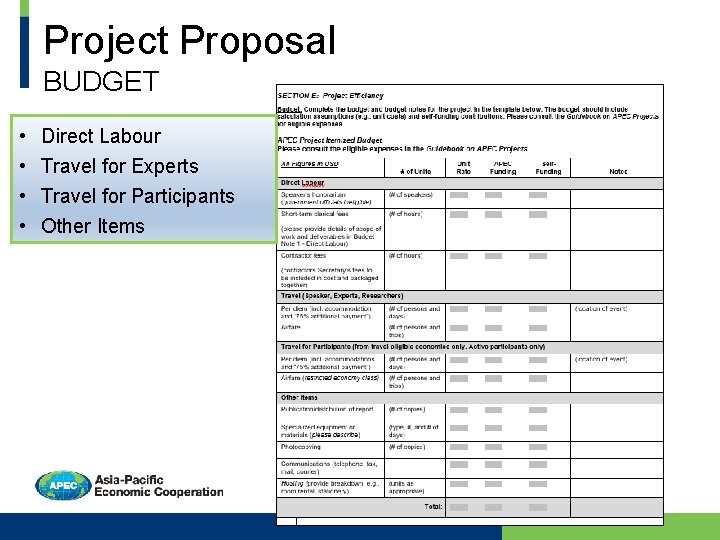
Project Proposal BUDGET • • Direct Labour Travel for Experts Travel for Participants Other Items
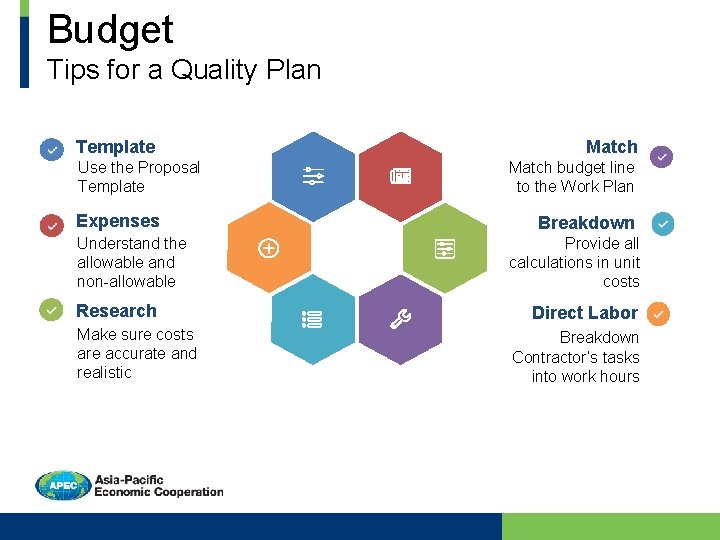
Budget Tips for a Quality Plan Template Use the Proposal Template Expenses Understand the allowable and non-allowable Research Make sure costs are accurate and realistic Match budget line to the Work Plan Breakdown Provide all calculations in unit costs Direct Labor Breakdown Contractor’s tasks into work hours
Budget Standard Procedures Costs are on a reimbursement basis (after the completion of the project), however: • Advance travel payments can be requested • Contractors are contracted by APEC, paid directly, on a milestone basis
Budget Typical Allowable Expenses The following are usual expenses that APEC funds: Labour • Honoraria up to $1500 per event for up to 6 experts per day • Translation of documents into English • Contractors: researcher, organiser, clerical • Tasks should be bundled and contracted to a single contractor unless justified • Contracts $20, 001+ have tendering requirements (takes 6 -8 weeks to finalize)
Budget Typical Allowable Expenses The following are usual expenses that APEC funds: Travel - Experts • Maximum Per Diem allowed is 100% Current UN Per Diem Rate x No. of Official Event Days + 1 Arrival Day + One-Off 75% of the UN Per Diem Rate • (E. g. 3 day event = 4. 75 days, maximum) • Maximum of 6 experts / day • Airfare: most direct economical. Business class for 12 hours or more
Budget Typical Allowable Expenses The following are usual expenses that APEC funds: Travel - Participants • Per Diem rate is normally same as Speakers/Experts rate • Up to 2 travelers from each travel-eligible economy only • Only economy class travel, most direct and economical flight • Break down each flight by participant/sector • Estimate costs through travel website (e. g. Expedia) 11 travel eligible economies: Chile, China, Indonesia, Malaysia, Mexico, PNG, Philippines, Peru, Russia, Thailand, Viet Nam
Budget Typical Allowable Expenses The following are usual expenses that APEC funds: Other • Publication/distribution: electronic is recommended • Specialised equipment • Photocopying, communications • Hosting: renting venue • No meals (exception possible if hosting package is cheaper) • No field trip costs without strong justification
Budget Typical Non-Allowable Expenses Examples: • Travel expenses for POs • Honoraria for government or international organisation officials • Simultaneous interpretation, or translation of final outputs such as reports • Meals, coffee and tea breaks • Promotional items and gifts (such as advertisements, briefcases, souvenirs, flowers)
Budget Typical Non-Allowable Expenses Examples: • Maintenance costs for websites, databases, servers, other on-line resources • Conference registration fees • Local transport costs, including for airport transfers, field trips, or sightseeing • Standard office equipment, e. g. desktop/laptop computers, printers, cameras
Project Proposals Mandatory Reporting On Progress: • Projects should be completed in 18 -21 months • Monitoring Reports are submitted annually on 1 Apr or 1 Oct • Work with your PD for programming and budget changes Upon Closing: • • A project is considered completed once all project activities and monetary disbursement have been undertaken A Completion Report must be submitted within 2 months after completing the project
Project Proposal Evaluation after Completion The Longer Term Evaluation of APEC Projects • A results oriented evaluation that collects quantitative and qualitative data on the performance of APEC projects will be completed about one year after project completion • POs and participants will be contacted by the Secretariat Why Evaluate? • To improve the design of future projects • To evaluate the successes or failures of the project • To generate knowledge or lessons learned, and share successes
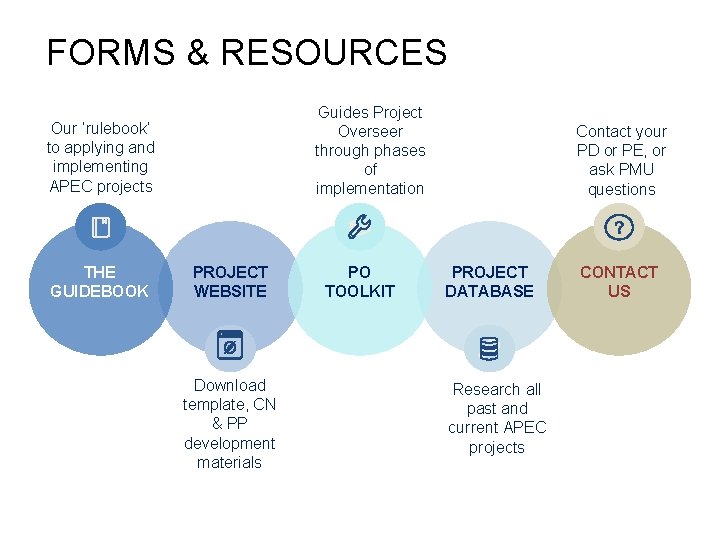
FORMS & RESOURCES Guides Project Overseer through phases of implementation Our ‘rulebook’ to applying and implementing APEC projects THE GUIDEBOOK PROJECT WEBSITE Download template, CN & PP development materials PO TOOLKIT Contact your PD or PE, or ask PMU questions PROJECT DATABASE Research all past and current APEC projects CONTACT US
Follow Us on Social Media www. apec. org www. facebook. com/APECnews @APEC www. linkedin. com/company/asia-pacificeconomic-cooperation-apec-secretariat

THANK YOU !
- Slides: 31