
Proposal of Omni RAN architecture for Data Offload
- Slides: 11
Proposal of Omni. RAN architecture for Data Offload Service through Wireless P 2 P Networks Document Number: omniran-13 -0001 -00 -0000 Date Submitted: 2013 -01 -08 Source: Hyunho Park Email: hyunhopark@etri. re. kr Hyeong-Ho Lee Email: holee@etri. re. kr (ETRI) Re: omniran-12 -0004 -02 -ecsg Base Contribution: None. Purpose: This document proposes Omni. RAN architecture for data offload Service through wireless P 2 P Networks. Notice: This document does not represent the agreed views of the IEEE 802 Omni. RAN EC Study Group. It represents only the views of the participants listed in the “Source(s)” field above. It is offered as a basis for discussion. It is not binding on the contributor(s), who reserve(s) the right to add, amend or withdraw material contained herein. Copyright Policy: The contributor is familiar with the IEEE-SA Copyright Policy <http: //standards. ieee. org/IPR/copyrightpolicy. html>. Patent Policy: The contributor is familiar with the IEEE-SA Patent Policy and Procedures: <http: //standards. ieee. org/guides/bylaws/sect 6 -7. html#6> and <http: //standards. ieee. org/guides/opman/sect 6. html#6. 3>. Further information is located at <http: //standards. ieee. org/board/pat-material. html> and <http: //standards. ieee. org/board/pat >. 1
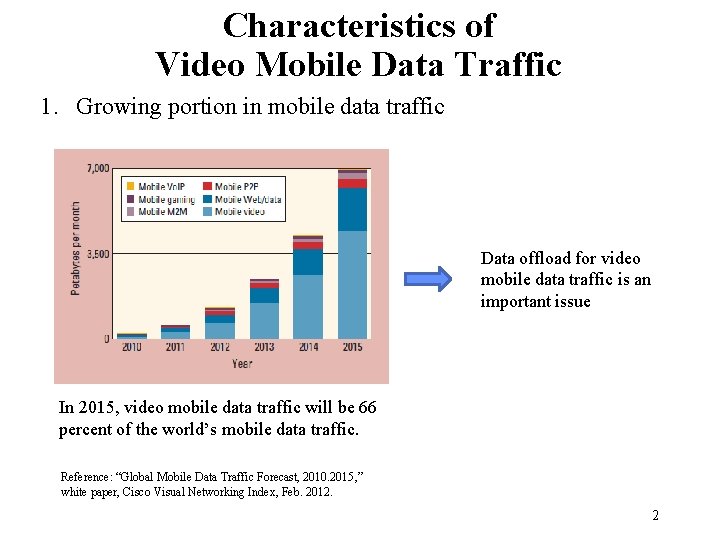
Characteristics of Video Mobile Data Traffic 1. Growing portion in mobile data traffic Data offload for video mobile data traffic is an important issue In 2015, video mobile data traffic will be 66 percent of the world’s mobile data traffic. Reference: “Global Mobile Data Traffic Forecast, 2010. 2015, ” white paper, Cisco Visual Networking Index, Feb. 2012. 2
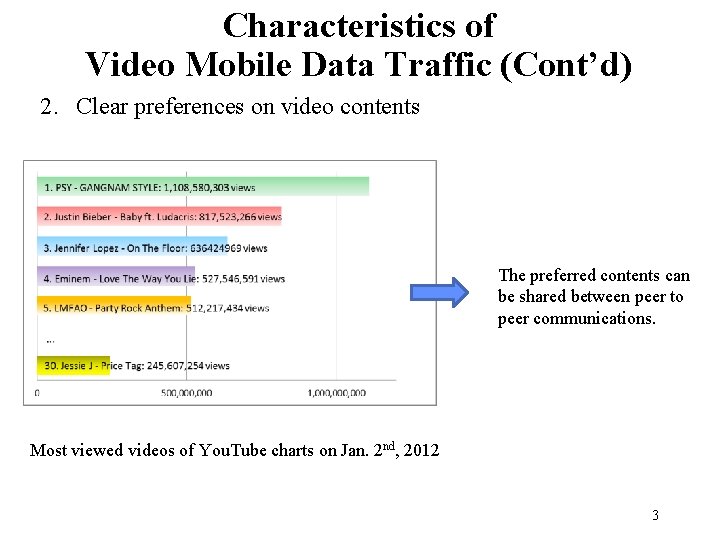
Characteristics of Video Mobile Data Traffic (Cont’d) 2. Clear preferences on video contents The preferred contents can be shared between peer to peer communications. Most viewed videos of You. Tube charts on Jan. 2 nd, 2012 3
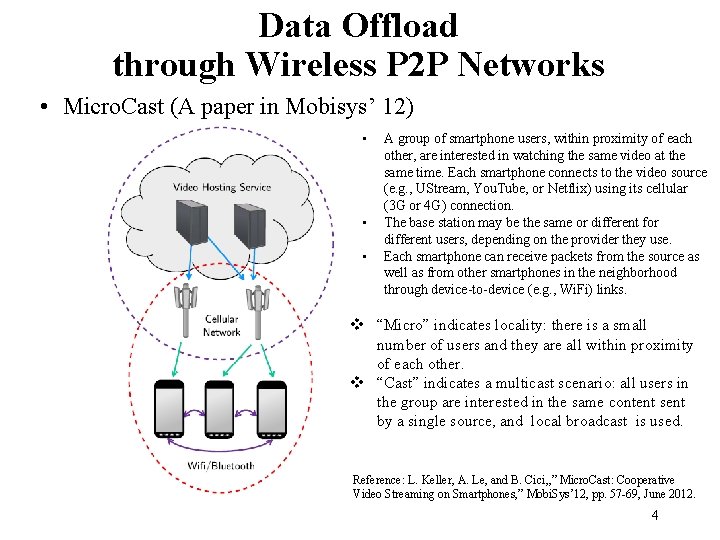
Data Offload through Wireless P 2 P Networks • Micro. Cast (A paper in Mobisys’ 12) • • • A group of smartphone users, within proximity of each other, are interested in watching the same video at the same time. Each smartphone connects to the video source (e. g. , UStream, You. Tube, or Netflix) using its cellular (3 G or 4 G) connection. The base station may be the same or different for different users, depending on the provider they use. Each smartphone can receive packets from the source as well as from other smartphones in the neighborhood through device-to-device (e. g. , Wi. Fi) links. v “Micro” indicates locality: there is a small number of users and they are all within proximity of each other. v “Cast” indicates a multicast scenario: all users in the group are interested in the same content sent by a single source, and local broadcast is used. Reference: L. Keller, A. Le, and B. Cici, , ” Micro. Cast: Cooperative Video Streaming on Smartphones, ” Mobi. Sys’ 12, pp. 57 -69, June 2012. 4
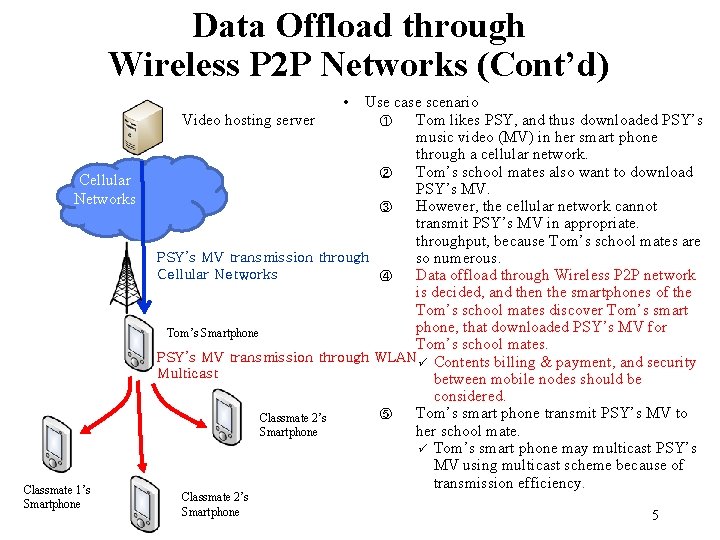
Data Offload through Wireless P 2 P Networks (Cont’d) Cellular Networks Classmate 1’s Smartphone • Use case scenario Video hosting server ① Tom likes PSY, and thus downloaded PSY’s music video (MV) in her smart phone through a cellular network. ② Tom’s school mates also want to download PSY’s MV. ③ However, the cellular network cannot transmit PSY’s MV in appropriate. throughput, because Tom’s school mates are PSY’s MV transmission through so numerous. Cellular Networks ④ Data offload through Wireless P 2 P network is decided, and then the smartphones of the Tom’s school mates discover Tom’s smart phone, that downloaded PSY’s MV for Tom’s Smartphone Tom’s school mates. PSY’s MV transmission through WLAN ü Contents billing & payment, and security Multicast between mobile nodes should be considered. ⑤ Tom’s smart phone transmit PSY’s MV to Classmate 2’s her school mate. Smartphone ü Tom’s smart phone may multicast PSY’s MV using multicast scheme because of transmission efficiency. Classmate 2’s Smartphone 5
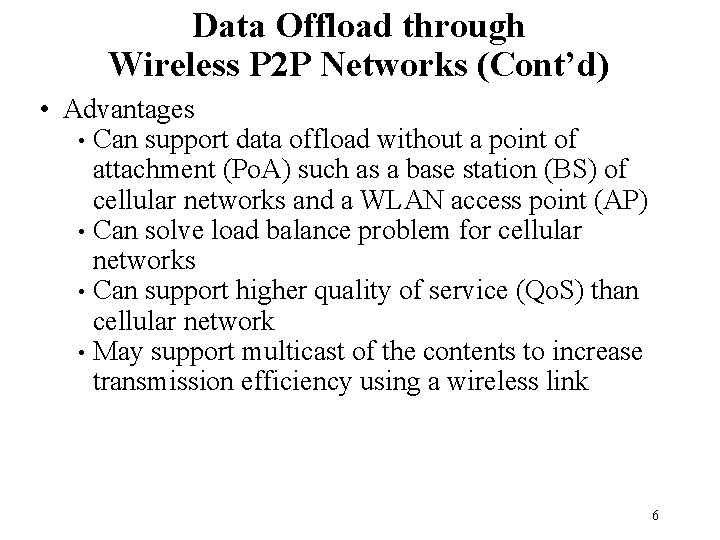
Data Offload through Wireless P 2 P Networks (Cont’d) • Advantages • Can support data offload without a point of attachment (Po. A) such as a base station (BS) of cellular networks and a WLAN access point (AP) • Can solve load balance problem for cellular networks • Can support higher quality of service (Qo. S) than cellular network • May support multicast of the contents to increase transmission efficiency using a wireless link 6
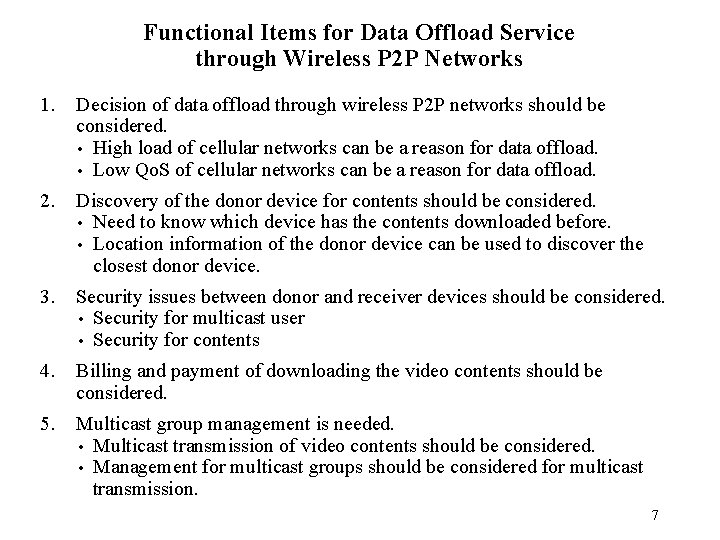
Functional Items for Data Offload Service through Wireless P 2 P Networks 1. Decision of data offload through wireless P 2 P networks should be considered. • High load of cellular networks can be a reason for data offload. • Low Qo. S of cellular networks can be a reason for data offload. 2. Discovery of the donor device for contents should be considered. • Need to know which device has the contents downloaded before. • Location information of the donor device can be used to discover the closest donor device. 3. Security issues between donor and receiver devices should be considered. • Security for multicast user • Security for contents 4. Billing and payment of downloading the video contents should be considered. 5. Multicast group management is needed. • Multicast transmission of video contents should be considered. • Management for multicast groups should be considered for multicast transmission. 7
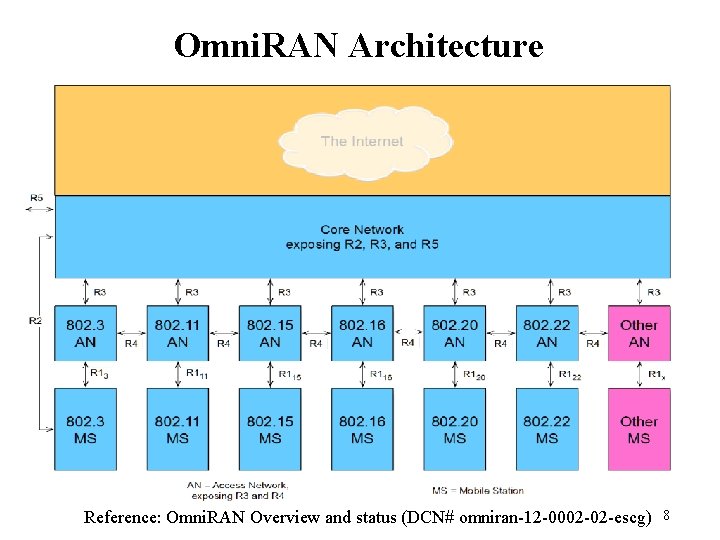
Omni. RAN Architecture Reference: Omni. RAN Overview and status (DCN# omniran-12 -0002 -02 -escg) 8
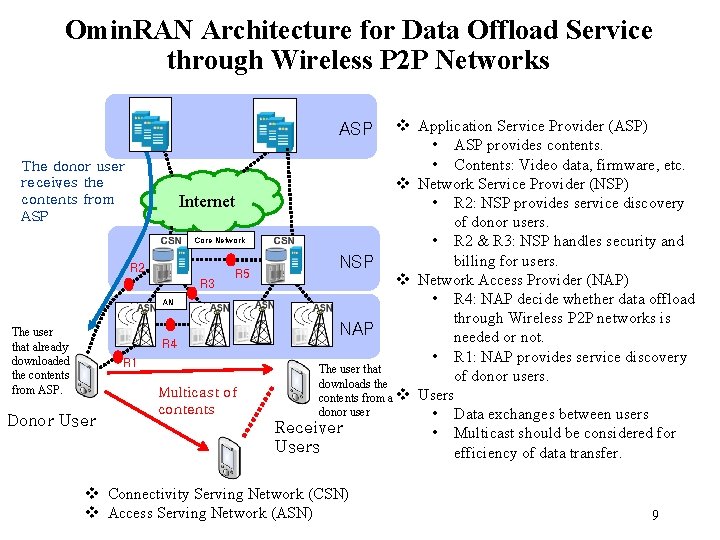
Omin. RAN Architecture for Data Offload Service through Wireless P 2 P Networks v Application Service Provider (ASP) • ASP provides contents. • Contents: Video data, firmware, etc. v Network Service Provider (NSP) • R 2: NSP provides service discovery of donor users. • R 2 & R 3: NSP handles security and billing for users. NSP v Network Access Provider (NAP) • R 4: NAP decide whether data offload through Wireless P 2 P networks is NAP needed or not. • R 1: NAP provides service discovery The user that of donor users. downloads the contents from a v Users donor user • Data exchanges between users Receiver • Multicast should be considered for Users efficiency of data transfer. ASP The donor user receives the contents from ASP Internet Core Network R 2 R 3 R 5 AN The user that already downloaded the contents from ASP. R 4 R 1 Donor User Multicast of contents v Connectivity Serving Network (CSN) v Access Serving Network (ASN) 9
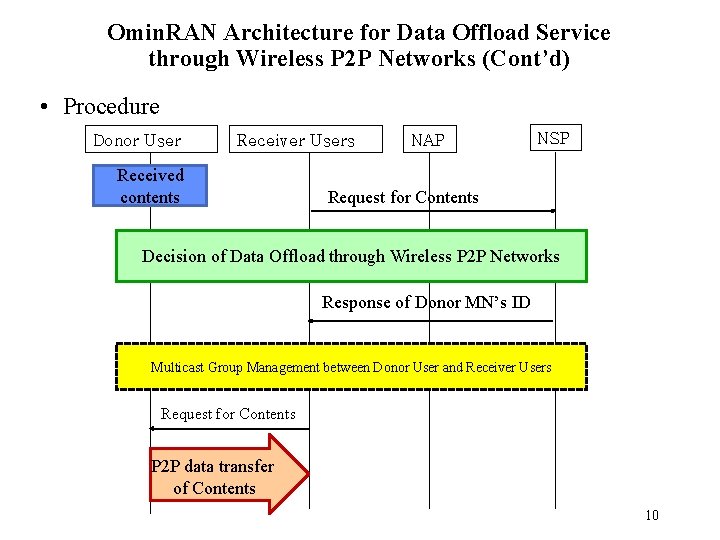
Omin. RAN Architecture for Data Offload Service through Wireless P 2 P Networks (Cont’d) • Procedure Donor User Receiver Users Received contents NAP NSP Request for Contents Decision of Data Offload through Wireless P 2 P Networks Response of Donor MN’s ID Multicast Group Management between Donor User and Receiver Users Request for Contents P 2 P data transfer of Contents 10
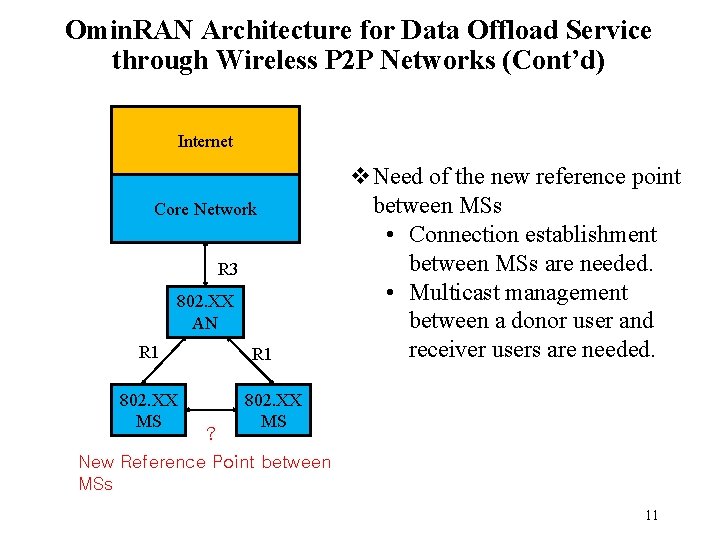
Omin. RAN Architecture for Data Offload Service through Wireless P 2 P Networks (Cont’d) Internet Core Network R 3 802. XX AN R 1 802. XX MS R 1 ? v. Need of the new reference point between MSs • Connection establishment between MSs are needed. • Multicast management between a donor user and receiver users are needed. 802. XX MS New Reference Point between MSs 11