
PROPOSAL FOR TRAINING OF BHARAT NIRMAN VOLUNTEERS BNVs
PROPOSAL FOR TRAINING OF BHARAT NIRMAN VOLUNTEERS (BNVs) AS PROFESSIONAL VOLUNTEERS NCRI INITIATIVE FOR HOLISTIC DEVELOPMENT Presented by National Council of Rural Institutes (Ministry of Human Resource Development, Government of India) #5 -10 -174, Shakar Bhavan, II Floor, Fateh Maidan Road, Hyderabad -500004, Andhra Pradesh, India, Ph: 040 - 23422102 E-mail: gsm@ncri. in website: www. ncri. in NCRI 1
Genesis of NCRI is the outcome of National Policy on Education (NPE) 1986 NPE, 1986 envisaged in accordance with Mahatma Gandhi’s revolutionary ideas on education so as to respond to the challenges associated with the transformation of rural areas. NCRI 2
About National Council of Rural Institutes : v NCRI-an autonomous organisation under the Ministry of Human Resource Development, Government Of India. v Engaged in promoting Rural Higher Education since 1995. v Catalysing rural institutes, Gandhian organizations, NGOs, universities and state government agencies and supporting various projects connected with the promotion of rural higher education. NCRI 3
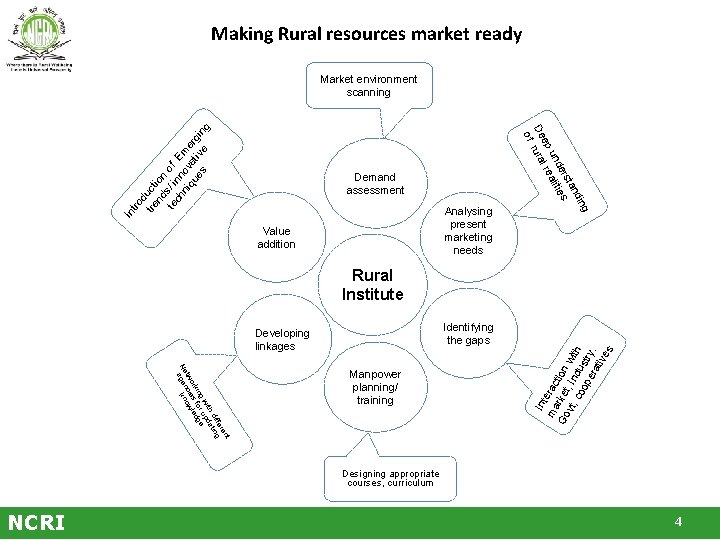
Making Rural resources market ready Demand assessment In Analysing present marketing needs Value addition g din an rst de ies un alit ep l re De rura of tro d tre uct nd ion te s/ in of ch n E ni ov me qu a es tive rgin g Market environment scanning Rural Institute t en fer dif ing th at wi upd ing for dge ork s le tw cie ow Neagen kn Manpower planning/ training Int ma erac Go rke tion vt, t, in wit co du h op str era y. tiv es Identifying the gaps Developing linkages Designing appropriate courses, curriculum NCRI 4
Bharat Nirman Volunteers (BNV) A Programme of Mo. RD, GOI � Developing development large pool of local manpower for rural �Mass based and decentralized voluntary action �Rural house holds : Target for delivery of services under rural development programmes �BNVs will assist in creation of awareness, mobalisation of community involvement with regard to welfare and development programmes Continue…. NCRI 5
Bharat Nirman Volunteers (BNV) • Volunteers will also act as agents of rural development (Item XII, page 10 of BNV document) • NCRI proposes that about 5 per cent (2 lakhs) of 40 lakh BNVs will be trained for a longer duration of 6 weeks as Professional Volunteers (PVs) • PVs to be involved in development programmes such as agriculture, community enterprises, literacy, banking, housing, livelihood promotion, etc. , NCRI 6
NCRI proposal for creation of Professional Volunteers within BNVs Six-weeks training in various professional streams. Structuring courses with on field-orientation with emphasis on practical training Expanding the scope of proposed basic training of BNVs (of 3 -5 days) Curriculum for the programmes to be designed by institutions having expertise in relevant fields. Award of certificate by IGNOU/ Universities or some other recognised educational outfit. Continue…. . NCRI 7
NCRI proposal …. �BNVs with a minimum 8/10 th/ standard (pass) will be trained as PVs as per local needs. �The proposed cadre of PVs - first of its kind in the country �Thought shift from employment to employability �Imparting professional development. skills to foster sustainable �PVs to be trained in three(3) streams: Ø Rural Development Professionals Ø Master Trainers Ø Bare-foot practitioners NCRI 8
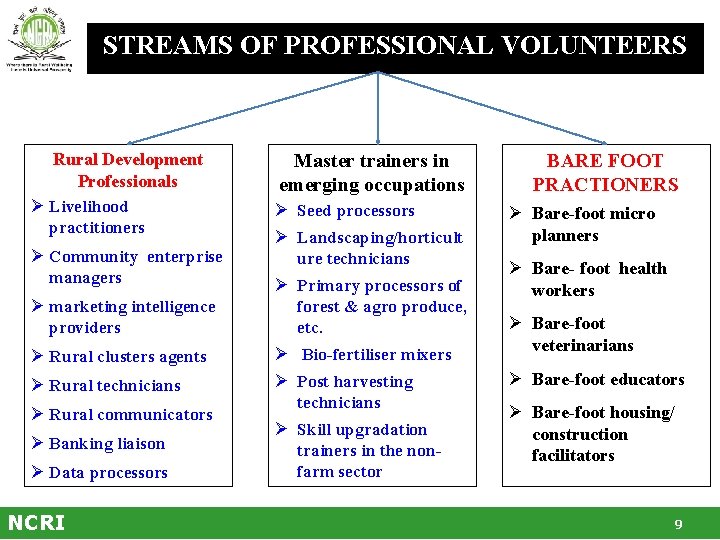
STREAMS OF PROFESSIONAL VOLUNTEERS Rural Development Professionals Ø Livelihood practitioners Ø Community enterprise managers Ø marketing intelligence providers Ø Rural clusters agents Ø Rural technicians Ø Rural communicators Ø Banking liaison Ø Data processors NCRI Master trainers in emerging occupations Ø Seed processors Ø Landscaping/horticult ure technicians Ø Primary processors of forest & agro produce, etc. Ø Bio-fertiliser mixers Ø Post harvesting technicians Ø Skill upgradation trainers in the nonfarm sector BARE FOOT PRACTIONERS Ø Bare-foot micro planners Ø Bare- foot health workers Ø Bare-foot veterinarians Ø Bare-foot educators Ø Bare-foot housing/ construction facilitators 9
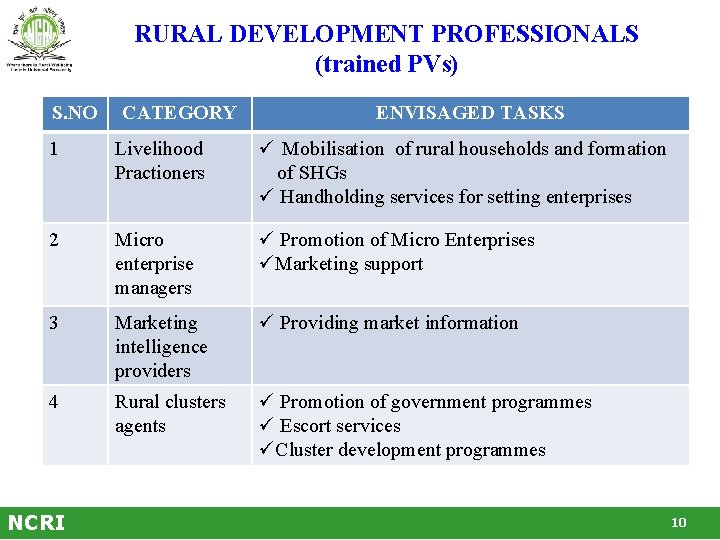
RURAL DEVELOPMENT PROFESSIONALS (trained PVs) S. NO CATEGORY ENVISAGED TASKS 1 Livelihood Practioners ü Mobilisation of rural households and formation of SHGs ü Handholding services for setting enterprises 2 Micro enterprise managers ü Promotion of Micro Enterprises üMarketing support 3 Marketing intelligence providers ü Providing market information 4 Rural clusters agents ü Promotion of government programmes ü Escort services üCluster development programmes NCRI 10
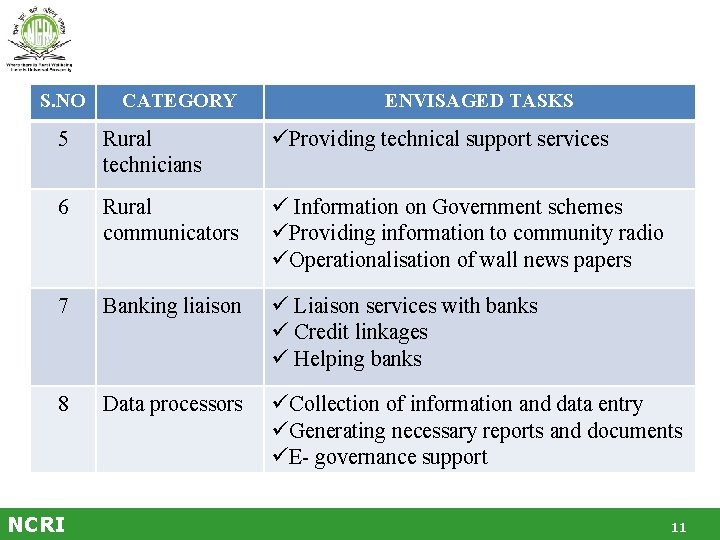
S. NO CATEGORY ENVISAGED TASKS 5 Rural technicians üProviding technical support services 6 Rural communicators ü Information on Government schemes üProviding information to community radio üOperationalisation of wall news papers 7 Banking liaison ü Liaison services with banks ü Credit linkages ü Helping banks 8 Data processors üCollection of information and data entry üGenerating necessary reports and documents üE- governance support NCRI 11
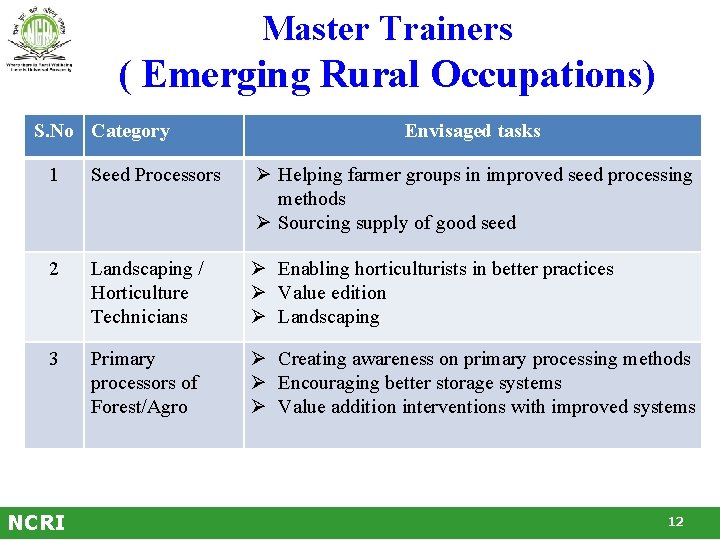
Master Trainers ( Emerging Rural Occupations) S. No Category Envisaged tasks 1 Seed Processors Ø Helping farmer groups in improved seed processing methods Ø Sourcing supply of good seed 2 Landscaping / Horticulture Technicians Ø Enabling horticulturists in better practices Ø Value edition Ø Landscaping 3 Primary processors of Forest/Agro Ø Creating awareness on primary processing methods Ø Encouraging better storage systems Ø Value addition interventions with improved systems NCRI 12
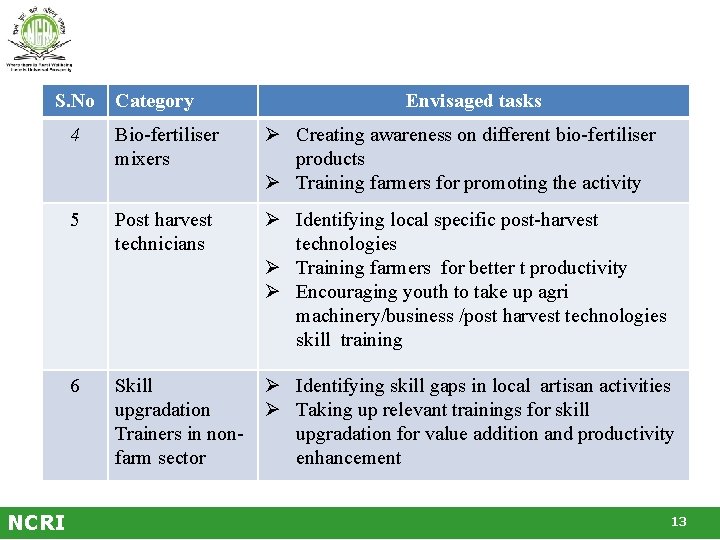
S. No Category NCRI Envisaged tasks 4 Bio-fertiliser mixers Ø Creating awareness on different bio-fertiliser products Ø Training farmers for promoting the activity 5 Post harvest technicians Ø Identifying local specific post-harvest technologies Ø Training farmers for better t productivity Ø Encouraging youth to take up agri machinery/business /post harvest technologies skill training 6 Skill upgradation Trainers in nonfarm sector Ø Identifying skill gaps in local artisan activities Ø Taking up relevant trainings for skill upgradation for value addition and productivity enhancement 13
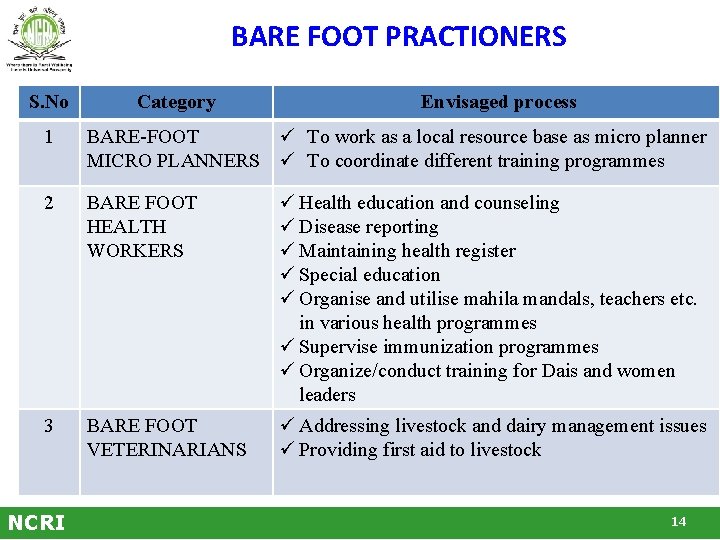
BARE FOOT PRACTIONERS S. No Category Envisaged process 1 BARE-FOOT ü To work as a local resource base as micro planner MICRO PLANNERS ü To coordinate different training programmes 2 BARE FOOT HEALTH WORKERS ü Health education and counseling ü Disease reporting ü Maintaining health register ü Special education ü Organise and utilise mahila mandals, teachers etc. in various health programmes ü Supervise immunization programmes ü Organize/conduct training for Dais and women leaders 3 BARE FOOT VETERINARIANS ü Addressing livestock and dairy management issues ü Providing first aid to livestock NCRI 14
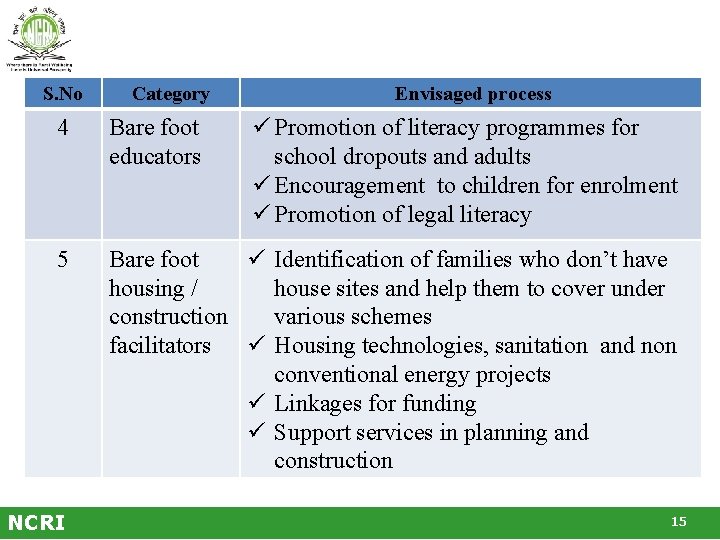
S. No Category Envisaged process ü Promotion of literacy programmes for school dropouts and adults ü Encouragement to children for enrolment ü Promotion of legal literacy 4 Bare foot educators 5 Bare foot ü Identification of families who don’t have housing / house sites and help them to cover under construction various schemes facilitators ü Housing technologies, sanitation and non conventional energy projects ü Linkages for funding ü Support services in planning and construction NCRI 15 15
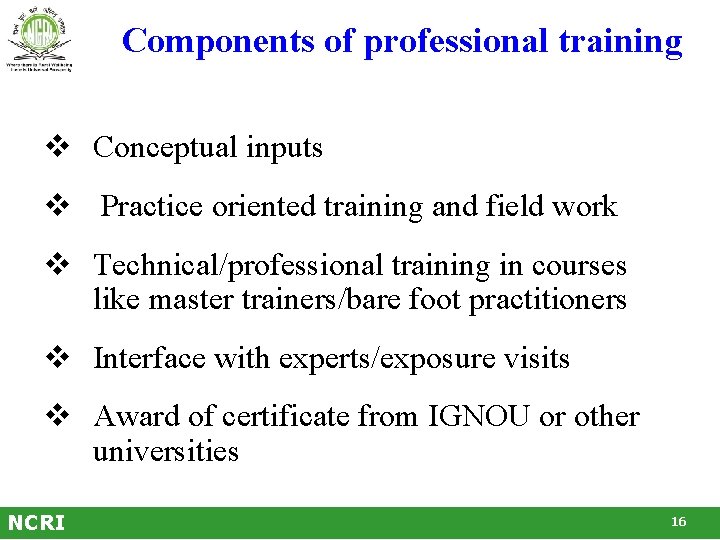
Components of professional training v Conceptual inputs v Practice oriented training and field work v Technical/professional training in courses like master trainers/bare foot practitioners v Interface with experts/exposure visits v Award of certificate from IGNOU or other universities NCRI 16 16
Advantages and Opportunities Ø Availability of Rural Institutes with a service orientation in interior and backward regions. Ø They have deep roots in rural sector Ø They posses experience in running skill-based training programmes. Ø They have adequate training infrastructure and capabilities. Ø The programme is a worthwhile investment as it affords multiple opportunities. Ø Provides potential for life-long professional volunteerism. Ø Helpful in developing multiple streams of volunteers Ø Promotes inclusiveness. NCRI 17 17
NCRI Strengths NCRI has necessary strengths to be recognised as a National Facilitating Agency (NFA) for training of Professional Volunteers, for reasons mentioned below: v Wide network with Rural Institutes in all regions of the country v Initiated several programmes through Rural Institutes v Has been focusing on Rural Higher Education to train rural development professionals v Has specialist units namely, RIF, GRTGSK, Micro-Planning, RRIC, DALC, SVCYP and The Wheel. v Collaborating with IGNOU on a 6 -12 week Internship Programme to fill the practice deficit. v Networking with knowledge-partners (Rural Institutes, Universities , TCOs, EDIs and Research Institutions, etc. , ) NCRI 18 18
Framework for proposed activities of NCRI as NFA • Selection of Rural Institutes for training purposes. • Standardising the training moludes in collaboration and networking with knowledge partners • Instituting monitoring, review and appraisal systems. NCRI 19 19
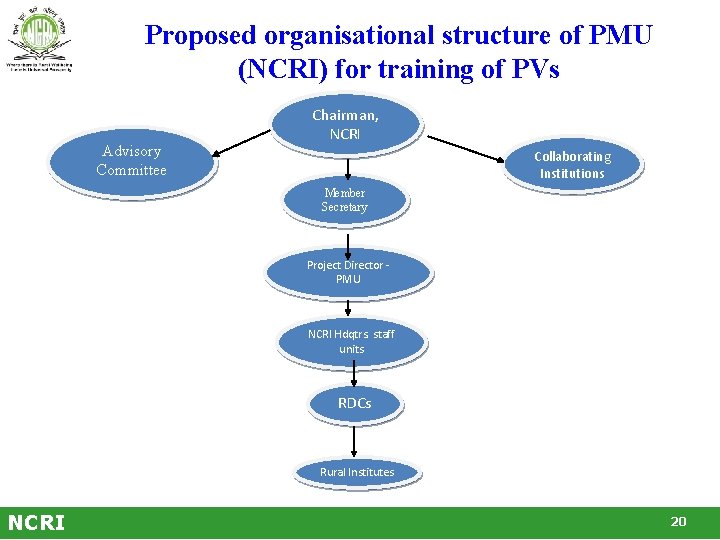
Proposed organisational structure of PMU (NCRI) for training of PVs Advisory Committee Chairman, NCRI Collaborating Institutions Member Secretary Project Director PMU NCRI Hdqtrs. staff units RDCs Rural Institutes NCRI 20 20
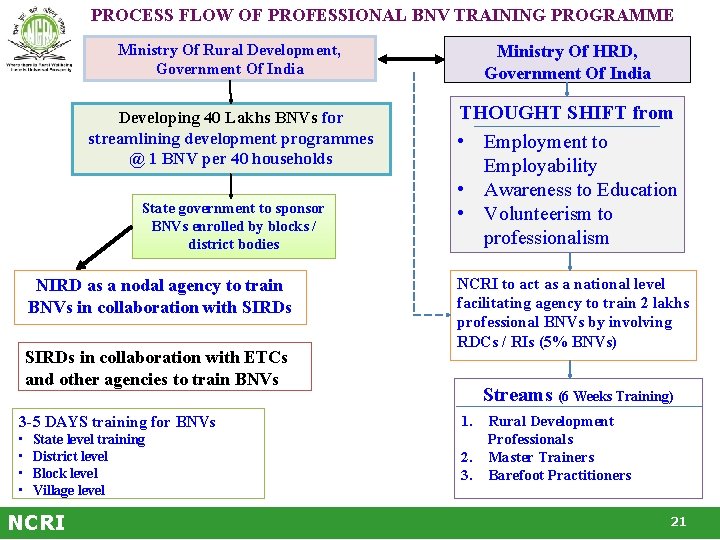
PROCESS FLOW OF PROFESSIONAL BNV TRAINING PROGRAMME Ministry Of Rural Development, Government Of India Ministry Of HRD, Government Of India Developing 40 Lakhs BNVs for streamlining development programmes @ 1 BNV per 40 households THOUGHT SHIFT from • Employment to Employability • Awareness to Education • Volunteerism to professionalism State government to sponsor BNVs enrolled by blocks / district bodies NIRD as a nodal agency to train BNVs in collaboration with SIRDs in collaboration with ETCs and other agencies to train BNVs 3 -5 DAYS training for BNVs • • State level training District level Block level Village level NCRI to act as a national level facilitating agency to train 2 lakhs professional BNVs by involving RDCs / RIs (5% BNVs) Streams (6 Weeks Training) 1. Rural Development Professionals 2. Master Trainers 3. Barefoot Practitioners 21 21

NCRI 22 22
- Slides: 22