
Proposal for PDU Structure Document Number IEEE S
Proposal for PDU Structure Document Number: IEEE S 802. 16 m-09/0605 Date Submitted: 2009 -03 -02 Source: David Johnston Intel Corporation E-mail: Venue: Vancouver, March 2008 Base Contribution: Re: 802. 16 m-08/003 r 1 Purpose: To improve the cryptographic signaling overhead in MAC PDUs. Notice: dj. johnston@intel. com This document does not represent the agreed views of the IEEE 802. 16 Working Group or any of its subgroups. It represents only the views of the participants listed in the “Source(s)” field above. It is offered as a basis for discussion. It is not binding on the contributor(s), who reserve(s) the right to add, amend or withdraw material contained herein. Release: The contributor grants a free, irrevocable license to the IEEE to incorporate material contained in this contribution, and any modifications thereof, in the creation of an IEEE Standards publication; to copyright in the IEEE’s name any IEEE Standards publication even though it may include portions of this contribution; and at the IEEE’s sole discretion to permit others to reproduce in whole or in part the resulting IEEE Standards publication. The contributor also acknowledges and accepts that this contribution may be made public by IEEE 802. 16. Patent Policy: The contributor is familiar with the IEEE-SA Patent Policy and Procedures: <http: //standards. ieee. org/guides/bylaws/sect 6 -7. html#6> and <http: //standards. ieee. org/guides/opman/sect 6. html#6. 3>. Further information is located at <http: //standards. ieee. org/board/pat-material. html> and <http: //standards. ieee. org/board/pat >.
Security Format • Requires addition of PN & ICV over protected data. • Several Options – – Multiplexed protected PDU (E. G. See 1509 r 1) Per PDU protection (16 e. ) Per SDU protection Per Burst Protection • Must cover management PDU protection • Must cover signaling PDU protection • Should be efficient
Security Format Efficiency Issues • Per PDU (16 e) – Good for packed SDUs – Bad for fragmented SDUs • Per SDU – Good for fragmented SDU – Bad for packed SDUs – Fails to protect MAC level signaling (headers & subheaders) aren’t SDUs) • Per burst – Good for big bursts – Bad for small bursts (e. g. at cell edge, where allocations are small) • We want a method that can adapt itself to these different scenarios and can protect management and signals
Adaptive Security Format • Goal – to allow both per-PDU or per-SDU encryption, as needed, while still allowing management and signaling headers to be protected • Separate PN and ICV from PDU format – Define PN signaling PDU and ICV signaling PDU. • These can be inserted in the PDU stream like any other header • Data between PN and ICV headers is protected • Signals are fixed size. Keeping overhead low – no length field. – Allow transmitter to insert them wherever it is appropriate, even across burst boundaries. • Efficient for both packed and fragmented traffic.
![PN & ICV Signaling Headers • PN Signaling Header FLOWID[3: 0] = 0011 Type[3:](http://slidetodoc.com/presentation_image_h/3035b8caecf074136732a3ed550e40b0/image-5.jpg "PN & ICV Signaling Headers • PN Signaling Header FLOWID[3: 0] = 0011 Type[3:")
PN & ICV Signaling Headers • PN Signaling Header FLOWID[3: 0] = 0011 Type[3: 0] = 0001 EKS[1: 0] PN[21: 16] 4 bytes PN[15: 8] PN[7: 0] • ICV Signaling Header FLOWID[3: 0] = 0011 Type[3: 0] = 0010 9 bytes ICV [8 Bytes] • Possibly - Combined for back to back ICV+PN FLOWID[3: 0] = 0011 Type[3: 0] = 1000 ICV [8 Bytes] PN+EKS [3 Bytes] 12 bytes
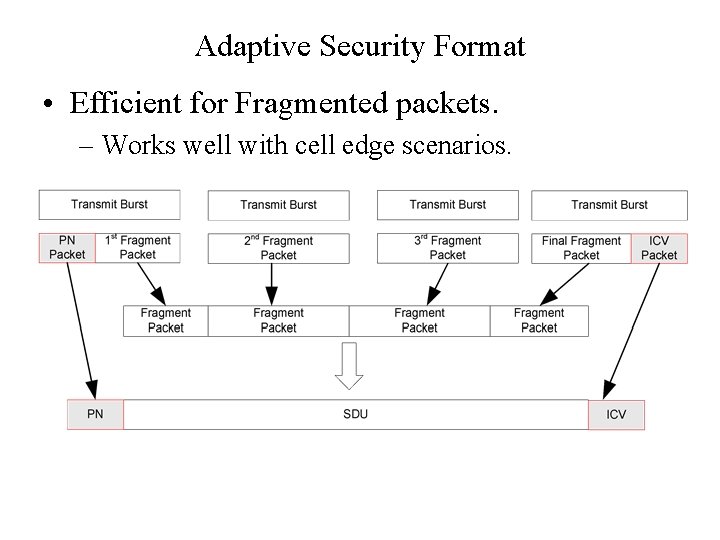
Adaptive Security Format • Efficient for Fragmented packets. – Works well with cell edge scenarios.
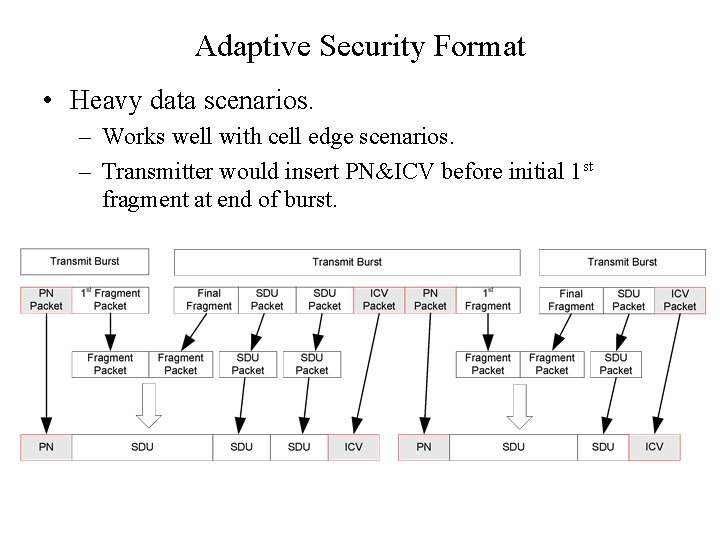
Adaptive Security Format • Heavy data scenarios. – Works well with cell edge scenarios. – Transmitter would insert PN&ICV before initial 1 st fragment at end of burst.
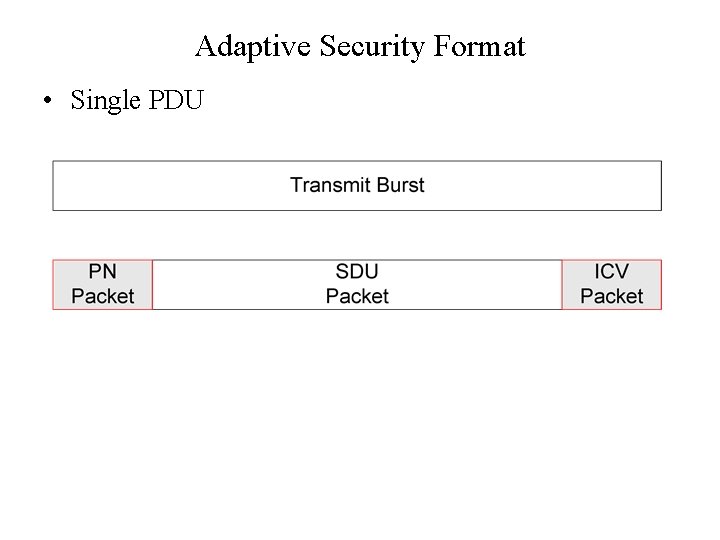
Adaptive Security Format • Single PDU
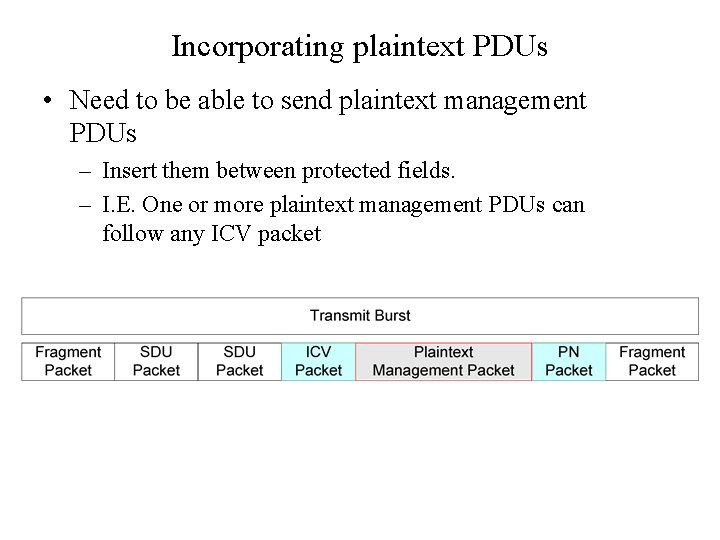
Incorporating plaintext PDUs • Need to be able to send plaintext management PDUs – Insert them between protected fields. – I. E. One or more plaintext management PDUs can follow any ICV packet
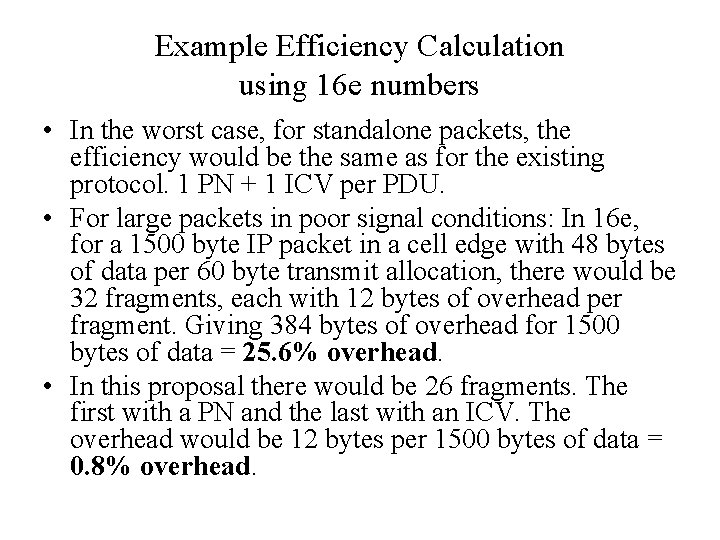
Example Efficiency Calculation using 16 e numbers • In the worst case, for standalone packets, the efficiency would be the same as for the existing protocol. 1 PN + 1 ICV per PDU. • For large packets in poor signal conditions: In 16 e, for a 1500 byte IP packet in a cell edge with 48 bytes of data per 60 byte transmit allocation, there would be 32 fragments, each with 12 bytes of overhead per fragment. Giving 384 bytes of overhead for 1500 bytes of data = 25. 6% overhead. • In this proposal there would be 26 fragments. The first with a PN and the last with an ICV. The overhead would be 12 bytes per 1500 bytes of data = 0. 8% overhead.
Complexities • When you encrypt a block of data, you must know the size in order to construct the nonce. – In 16 e, CCM encryptor/decryptor can infer length from GMH – In 16 m encrypted field size must be elsewhere to describe length of multiple PDUs over which CCM operates. E. G. in PN header. – But you don’t necessarily know the size of subsequent bursts in fragmented traffic and you don’t necessarily know what subheaders, headers or management PDUs will be inserted between fragments. So either: • Pad the DLEN field in and declare in PN – increases the tag size. • Or Use a online mode. E. G. GCM – as used in 802. 3 (with 802. 1 ae) • HARQ may reorder bursts, breaking decryption – Reordering of bursts is needed – Must have HARQ reordering SN in map, PN header or elsewhere.
SDD Changes • Define in SDD – Encryption encapsulation format • Scope of encryption encapsulation (across single or multiple bursts/PDUs) • PN Signaling Header • ICV Signaling Header • GCM Mode • Document overhead against important scenarios – – Across multiple fragments Across a packed burst Across a single PDU Indicate support for SRTP for Vo. IP in place of L 2 security encapsulation.
- Slides: 12