
PROPOSAL FOR IMPROVING PROCUREMENT EFFICIENCY IN THE SUCCESSOR

- Slides: 19
PROPOSAL FOR IMPROVING PROCUREMENT EFFICIENCY IN THE SUCCESSOR COMPANIES (GENCOS AND DISCOS) 25 th February, 2021
Content 2 Background – Power sector before now Why we are here Considerations in Public Procurement Current situation Our propositions Why engage us (What we do) Conclusion
Background 3 In 2005, the Electricity Power Sector Reform (EPSR) Act was enacted. Through the Act, the Nigerian Electricity Regulatory Commission (NERC) was established. This brought about the privatization of the Generating Companies (GENCOS) and Distribution Companies (DISCOS) while the federal government retained the control of the Transmission Company (TCN). Prior to the enactment of the EPSR Act, the Nigeria power sector was wholly owned and managed by the Federal Government of Nigeria.
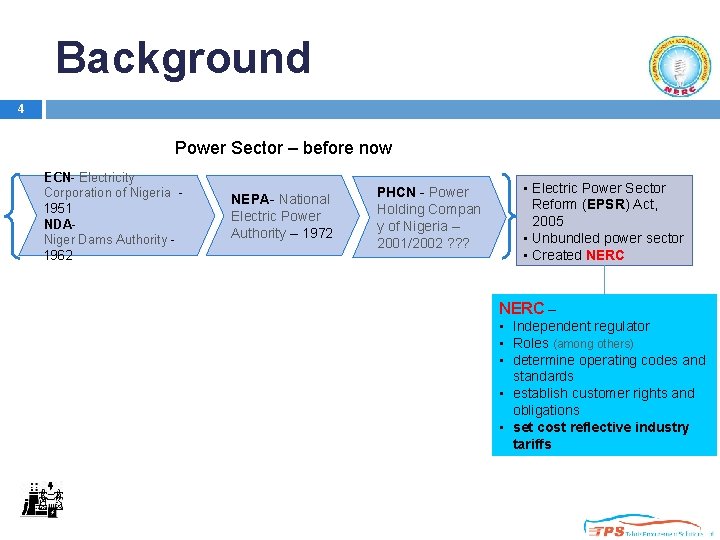
Background 4 Power Sector – before now ECN- Electricity Corporation of Nigeria 1951 NDANiger Dams Authority 1962 NEPA- National Electric Power Authority – 1972 PHCN - Power Holding Compan y of Nigeria – 2001/2002 ? ? ? • Electric Power Sector Reform (EPSR) Act, 2005 • Unbundled power sector • Created NERC – • Independent regulator • Roles (among others) • determine operating codes and standards • establish customer rights and obligations • set cost reflective industry tariffs
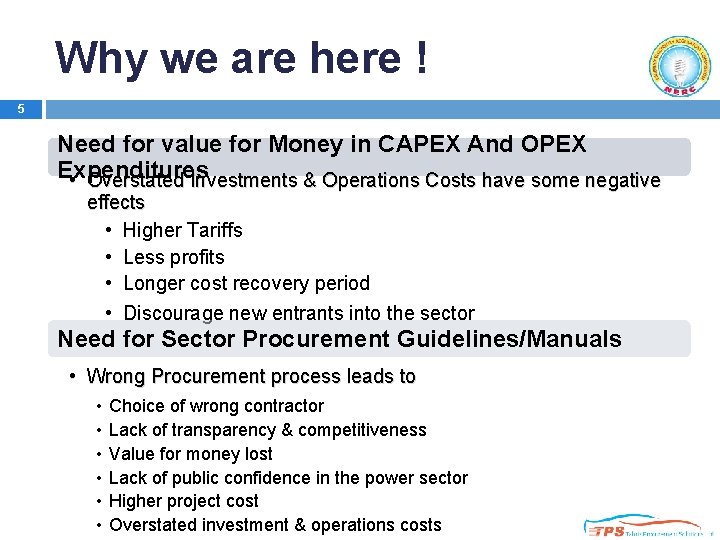
Why we are here ! 5 Need for value for Money in CAPEX And OPEX Expenditures • Overstated Investments & Operations Costs have some negative effects • Higher Tariffs • Less profits • Longer cost recovery period • Discourage new entrants into the sector Need for Sector Procurement Guidelines/Manuals • Wrong Procurement process leads to • • • Choice of wrong contractor Lack of transparency & competitiveness Value for money lost Lack of public confidence in the power sector Higher project cost Overstated investment & operations costs
Considerations in Public Procurement 6 Value for money reflecting the basic goal that every procurement system should be providing the required goods, works and services in an economic, efficient, effective and sustainable way. Transparency reflecting the basic principle of disclosure of all rules that will guide the procurement decisions and a system to monitor compliance.
Considerations in Public Procurement 7 Fairness reflecting the ambition that the public procurement process should be free from bias, ensure equal treatment to all bidders and take decisions accordingly, thus ensuring integrity. Good governance recognizing the importance of the wider governance context on the way public procurement is conducted and how procurement activities are conducted. Inside abuse needs to be guided against in the successor companies.
Current Situation 8 The Nigerian Electricity Regulatory Commission was empowered by the Act to carry out oversight function over the electricity generation, transmission and distribution companies. The Commission is to ensure an efficiently managed electricity supply industry that meets the needs of Nigerians for safe, adequate, reliable and affordable electricity
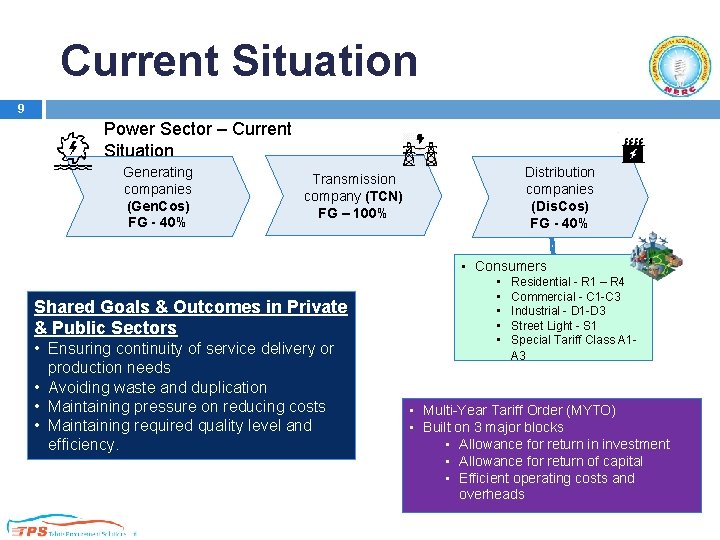
Current Situation 9 Power Sector – Current Situation Generating companies (Gen. Cos) FG - 40% Distribution companies (Dis. Cos) FG - 40% Transmission company (TCN) FG – 100% • Consumers Shared Goals & Outcomes in Private & Public Sectors • Ensuring continuity of service delivery or production needs • Avoiding waste and duplication • Maintaining pressure on reducing costs • Maintaining required quality level and efficiency. • • • Residential - R 1 – R 4 Commercial - C 1 -C 3 Industrial - D 1 -D 3 Street Light - S 1 Special Tariff Class A 1 A 3 • Multi-Year Tariff Order (MYTO) • Built on 3 major blocks • Allowance for return in investment • Allowance for return of capital • Efficient operating costs and overheads
Current Situation 10 The NERC is to ensure that prices charged by licensees are fair to customers and sufficient to allow licensees to finance their activities and have reasonable return on investment. It is envisaged that they will be incentivized to operate efficiently, thus the Multi-Year Tariff Order (MYTO) as a pricing model was designed to reward performance above certain benchmarks, reduce technical and non-technical losses.
Our Proposition 11 Successor Companies have presented Performance Implementation Plans to NERC to justify their demands for tariff review. These plans involve huge expenditures over a 5 -year period. Therefore, it is important that these figures be monitored through: • Improved procurement process in their expenditure Such that: • Value for Money is achieved • Costs are not exaggerated • Electricity market is not distorted due to wrong financial statements
Our Proposition 12 NERC needs to maintain close oversight over the expenditures of all the successor companies to ensure that the expenditures follow the best international procedures as overstated investment and operations costs would mean higher tariffs, less profits, longer cost recovery period and a distortion of the power sector market. This will discourage new entrants into the sector as well.
Our Proposition 13 Expenditur es in line with PPA 2007 Ensure that CAPEX and OPEX expenditures are market driven in line with the provisions of Public procurement Act. This will ensure that consumers are not being made to pay for overstated costs through higher tariffs
Our Proposition 14 The Public Procurement Act, 2007 as amended in 2020 (Financial Act, 2020) provides the legal and institutional framework for public procurement in Nigeria. Consequent upon this, procurement audit to ascertain weaknesses and absolute hands–on knowledge of its application in ensuring that projects are delivered on time without sacrificing the basic principles of public procurement, become essential for the regulator, NERC and for the
What we intend to do. 15 PROCUREMENT ADVISORY SERVICES: to include; The need for Tabriz Procurement Solutions Ltd • Procurement audit of successor companies • Development of sector procurement guidelines/manuals (just as corporate governance guidelines issued by NERC for successor companies) • Executive training on public procurement for NERC management • Hands-on training for procurement officials
Why engage us (What we have done!!!) 16 1. Assessed procurement capacity & produced procurement manual for Universal Basic Education Commission (UBEC) 2. Prepared bidding documents for Federal Ministry of Interior 3. Conducted procurement trainings for Nnamdi Azikwe University (NAU) 4. Reviewed contractors claim for a university from N 6, 232, 380, 469. 81 to N 3, 896, 257, 561. 15 (Saving N 2, 336, 122, 908. 66) 5. Reviewed Bauchi State Public Procurement Law. Developing their procurement manuals and regulations. 6. Reviewed contractors claim for a State from N 50, 402, 113, 003. 51 to N 44, 559, 121, 895. 21 (Saving N 5, 842, 991, 108. 30)
Why engage us (What we have done!!!) 17 7. Conducted public procurement training for Anambra State Executive Council 8. Conducted procurement training for Federal Airport Authority of Nigeria (FAAN) 9. Procurement consultant to the NASS Committees on public procurement 10. Conducted procurement conversion training for Zamfara State Government 11. Advising many MDAs on public procurement.
Conclusion 18 Effective and efficient procurement in the successor companies will achieve the shared goals of: • ensuring continuity of service delivery or production needs • avoiding waste and duplication • maintaining pressure on reducing costs and • maintaining required quality level and efficiency. Therefore developing procurement guidelines/manuals specific to the power sector will ensure that the CAPEX & OPEX expenditures are market driven in line with the provisions of the Public Procurement Act. Engaging TPS to help develop these guidelines is highly recommended. The outcome will be fairness to all parties – investors and consumers.
THANK YOU FOR YOUR ATTENTION 19