
Proposal for IEEE 802 16 m Protocol Structure
- Slides: 16
Proposal for IEEE 802. 16 m Protocol Structure Document Number: C 80216 m-08/033 Date Submitted: January 16, 2008 Source: Yih-Shen Chen Kelvin Chou Dora Chen I-Kang Fu Paul Cheng Media. Tek Inc. E-mail: yihshen. chen@mediatek. com kelvin. chou@mediatek. com dora. chen@mediatek. com ik. fu@mediatek. com paul. cheng@mediatek. com Venue: Levi, Finland Base Contribution: TGm Call for contributions on Project 802. 16 m System Description Document (SDD), IEEE 802. 16 m-07/047 Purpose: In response to the following topics specified in the SDD • Proposed 802. 16 m Protocol Architecture and main functionalities per protocol layer Notice: This document does not represent the agreed views of the IEEE 802. 16 Working Group or any of its subgroups. It represents only the views of the participants listed in the “Source(s)” field above. It is offered as a basis for discussion. It is not binding on the contributor(s), who reserve(s) the right to add, amend or withdraw material contained herein. Release: The contributor grants a free, irrevocable license to the IEEE to incorporate material contained in this contribution, and any modifications thereof, in the creation of an IEEE Standards publication; to copyright in the IEEE’s name any IEEE Standards publication even though it may include portions of this contribution; and at the IEEE’s sole discretion to permit others to reproduce in whole or in part the resulting IEEE Standards publication. The contributor also acknowledges and accepts that this contribution may be made public by IEEE 802. 16. Patent Policy: The contributor is familiar with the IEEE-SA Patent Policy and Procedures: <http: //standards. ieee. org/guides/bylaws/sect 6 -7. html#6> and <http: //standards. ieee. org/guides/opman/sect 6. html#6. 3>. Further information is located at <http: //standards. ieee. org/board/pat-material. html> and <http: //standards. ieee. org/board/pat >.
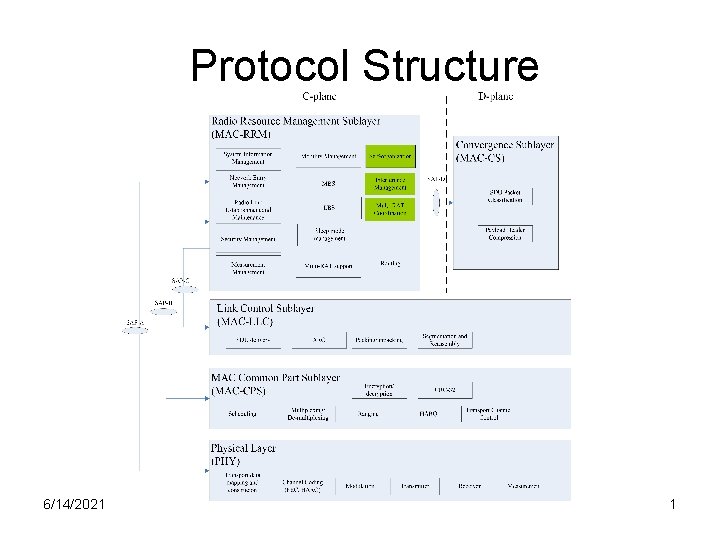
Protocol Structure 6/14/2021 1
What’s New • Enhanced system information broadcasting – Tree-like system information structure • Shorten the packet size of system information • Update the system information dynamically • Enhance the power saving – More system information • Multi-RAT, micro/macro-cells…. • Enhanced measurement report – More measurement reports should be designed • for advanced RRM (sec. 6. 4. 1, SRD) • for location-based service (sec. 6. 8, SRD) • Additional shared UL channel – Hasten the transmission of uplink short-burst data • Enhanced Handoff mechanism 6/14/2021 2
RRM Sublayer (1/6) • System Information Management – Broadcast system configuration • Basic information of a cell – BSID, cell type… • DL/UL channel descriptions • Parameters for mobility management – neighboring BS/RS information • Parameters for location management – AOA, TDOA… • Parameters for traffic control • Network Entry Management – Service capability negotiation – Terminal capability negotiation – MS registration 6/14/2021 3
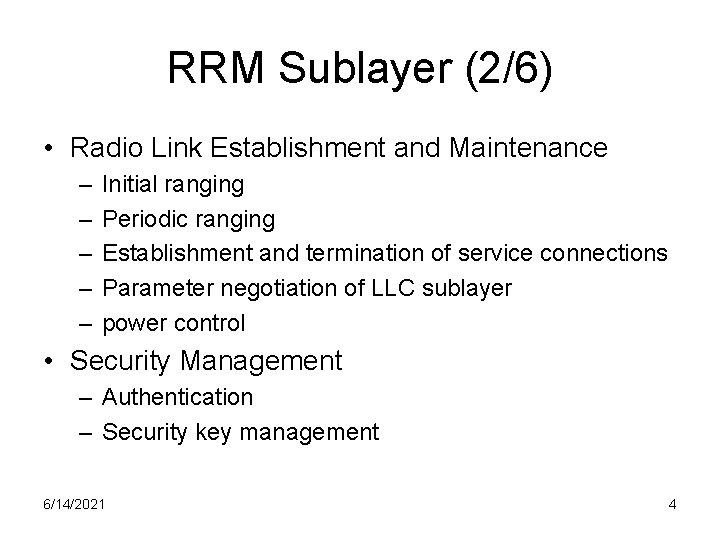
RRM Sublayer (2/6) • Radio Link Establishment and Maintenance – – – Initial ranging Periodic ranging Establishment and termination of service connections Parameter negotiation of LLC sublayer power control • Security Management – Authentication – Security key management 6/14/2021 4
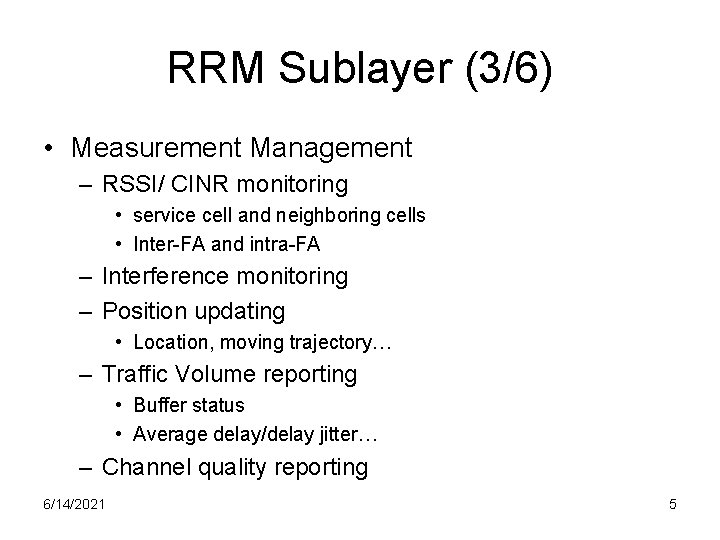
RRM Sublayer (3/6) • Measurement Management – RSSI/ CINR monitoring • service cell and neighboring cells • Inter-FA and intra-FA – Interference monitoring – Position updating • Location, moving trajectory… – Traffic Volume reporting • Buffer status • Average delay/delay jitter… – Channel quality reporting 6/14/2021 5
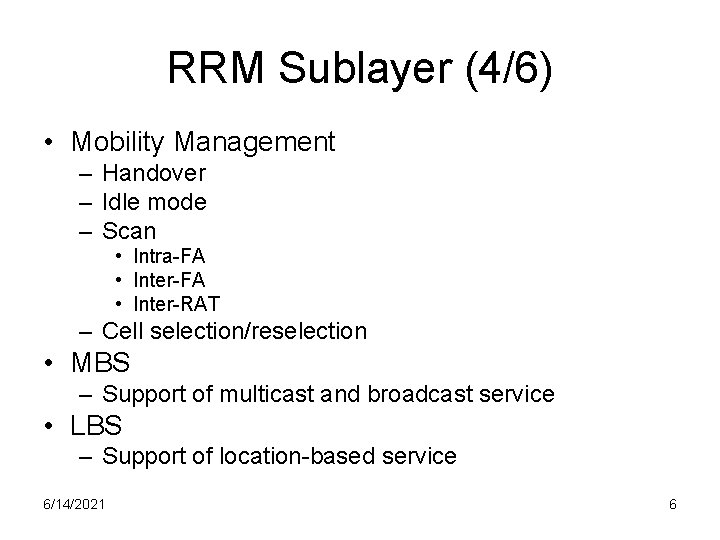
RRM Sublayer (4/6) • Mobility Management – Handover – Idle mode – Scan • Intra-FA • Inter-RAT – Cell selection/reselection • MBS – Support of multicast and broadcast service • LBS – Support of location-based service 6/14/2021 6
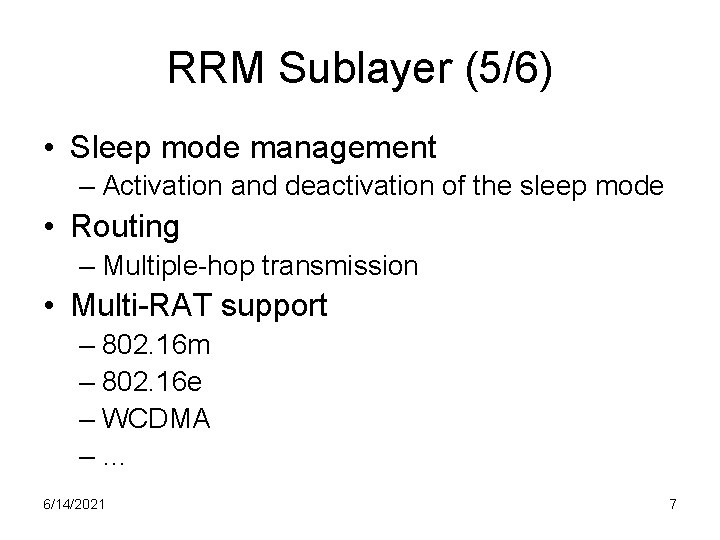
RRM Sublayer (5/6) • Sleep mode management – Activation and deactivation of the sleep mode • Routing – Multiple-hop transmission • Multi-RAT support – 802. 16 m – 802. 16 e – WCDMA –… 6/14/2021 7
RRM Sublayer (6/6) • Self-organization – Re-organize the reuse of frequency/subcarrier – Adjust cell coverage. – Purpose: load balance, flexible cell planning… • Multi-RAT coordination – Inter-RAT handover – MIH • Interference management – Mitigate the adjacent channel/co-channe interference from other RAT or BS – Manage the adjacent channel/co-channe interference from other RAT or BS 6/14/2021 8
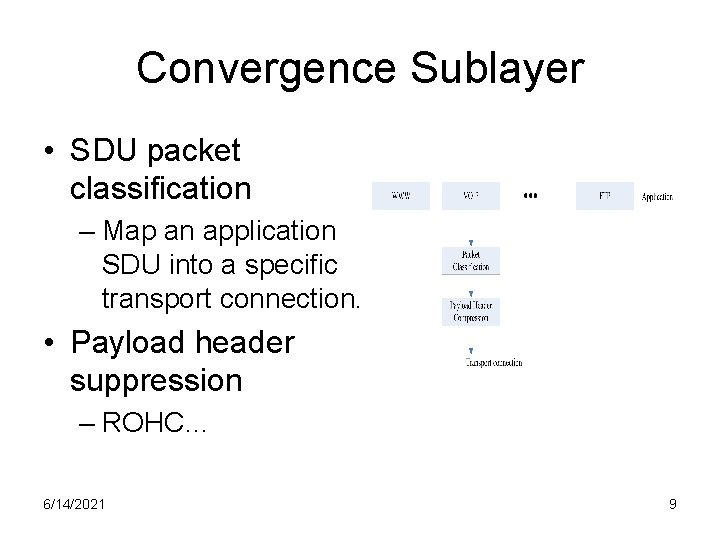
Convergence Sublayer • SDU packet classification – Map an application SDU into a specific transport connection. • Payload header suppression – ROHC… 6/14/2021 9
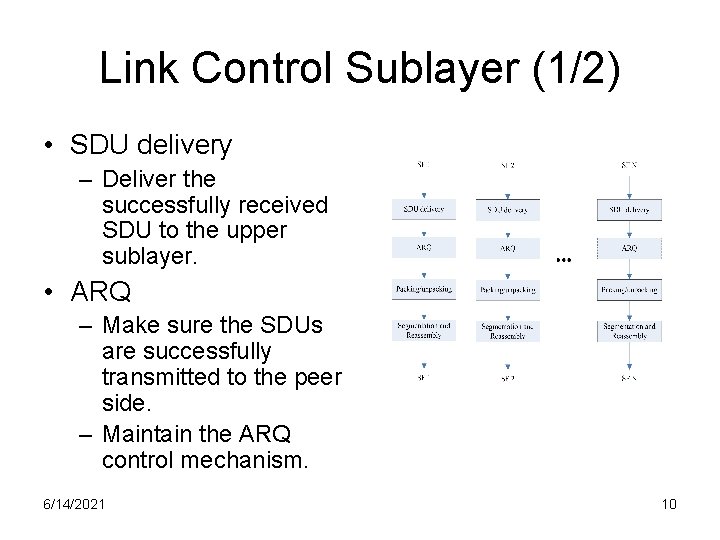
Link Control Sublayer (1/2) • SDU delivery – Deliver the successfully received SDU to the upper sublayer. • ARQ – Make sure the SDUs are successfully transmitted to the peer side. – Maintain the ARQ control mechanism. 6/14/2021 10
Link Control Sublayer (2/2) • Packing/unpacking – Concatenate small SDUs into a larger PDU. – Disassemble the received PDU into SDUs according to their original packet sizes. • Fragmentation/de-fragmentation – Fragment a large SDU into a series of smaller ones. – De-fragment the received PDUs into a complete SDU. 6/14/2021 11
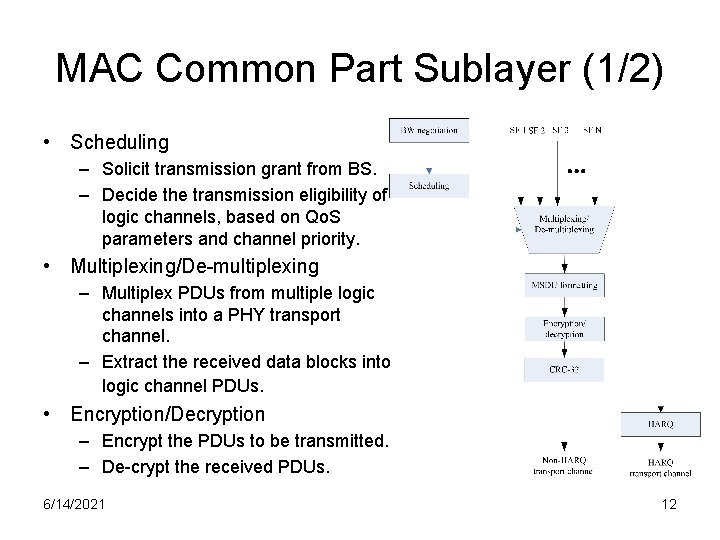
MAC Common Part Sublayer (1/2) • Scheduling – Solicit transmission grant from BS. – Decide the transmission eligibility of logic channels, based on Qo. S parameters and channel priority. • Multiplexing/De-multiplexing – Multiplex PDUs from multiple logic channels into a PHY transport channel. – Extract the received data blocks into logic channel PDUs. • Encryption/Decryption – Encrypt the PDUs to be transmitted. – De-crypt the received PDUs. 6/14/2021 12
MAC Common Part Sublayer (2/2) • Ranging – Adjust the power/time/frequency offset. • HARQ – HARQ reordering and window control. – HARQ retransmission buffering. • Transport Channel Control. – Configure the transmission parameters of PHY transport channel. 6/14/2021 13
SAPs • SAP-A – MAC-RRM PHY • Configure PHY operational parameters – PHY MAC-RRM • Report PHY measurement • SAP-B – MAC-RRM MAC-CPS • Configure the Qo. S parameters for service flows • Configure HARQ Rx/Tx parameters • Configure the encryption parameters – MAC-CPS MAC-RRM • Report the transmission statistics 6/14/2021 14
SAPs • SAP-C – MAC-RRM MAC-LLC • Configure the ARQ parameters • SAP-D – MAC-RRM MAC-CS • Configure PHS rules and header compression 6/14/2021 15