
Proposal for HTS coil inserts based on round
Proposal for HTS coil inserts based on round cables V. V. Kashikhin General MDP Meeting May 1, 2019
Introduction • Background field magnets / test facilities: – Capitalize on the use of the existing high-field magnets (i. e. the 15 T dipole and its variants); – Compatibility with VMTF (and HFVMTF in future); – Ability to test in 1. 9 – 77 K range. • HTS inserts: – Compact and efficient coil design is essential given the high cost of HTS materials; – Easy scalability of the number of layers and length and straightforward assembly with the background coils; – Focus on REBCO (i. e. CORC cables) for now to have a quick fabrication turn-around but keep Bi-2212 in mind; – Stress management is required; – Designed to operate standalone and together with the background magnets. 2 General MDP Meeting 5/1/2019
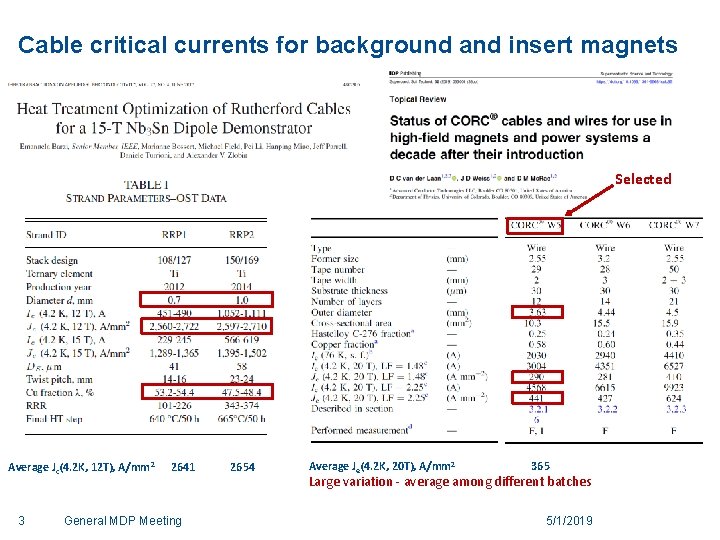
Cable critical currents for background and insert magnets Selected Average Jc(4. 2 K, 12 T), A/mm 2 3 2641 General MDP Meeting 2654 Average Je(4. 2 K, 20 T), A/mm 2 365 Large variation - average among different batches 5/1/2019
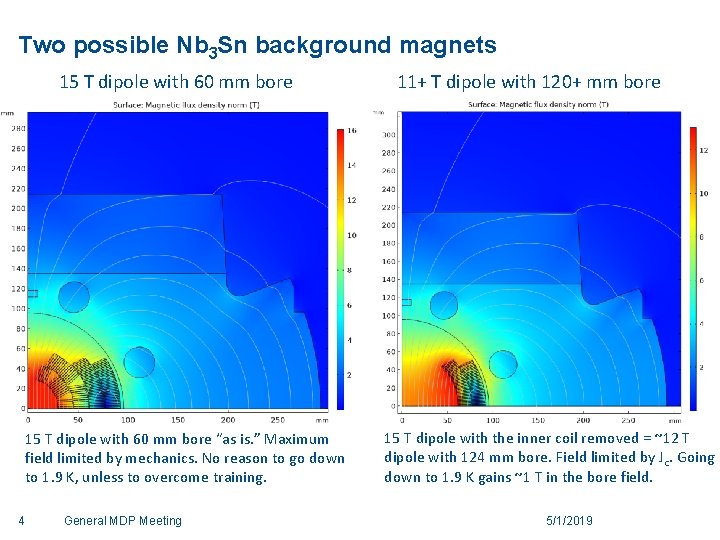
Two possible Nb 3 Sn background magnets 15 T dipole with 60 mm bore “as is. ” Maximum field limited by mechanics. No reason to go down to 1. 9 K, unless to overcome training. 4 General MDP Meeting 11+ T dipole with 120+ mm bore 15 T dipole with the inner coil removed = ~12 T dipole with 124 mm bore. Field limited by Jc. Going down to 1. 9 K gains ~1 T in the bore field. 5/1/2019
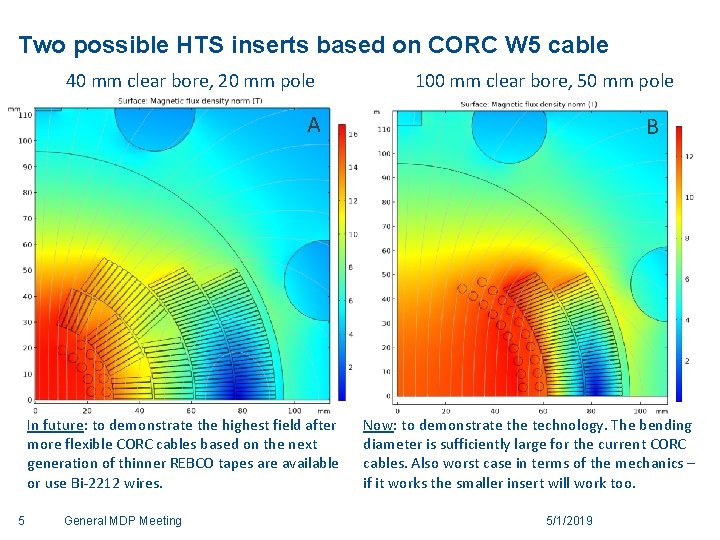
Two possible HTS inserts based on CORC W 5 cable 40 mm clear bore, 20 mm pole 100 mm clear bore, 50 mm pole A In future: to demonstrate the highest field after more flexible CORC cables based on the next generation of thinner REBCO tapes are available or use Bi-2212 wires. 5 General MDP Meeting B Now: to demonstrate the technology. The bending diameter is sufficiently large for the current CORC cables. Also worst case in terms of the mechanics – if it works the smaller insert will work too. 5/1/2019
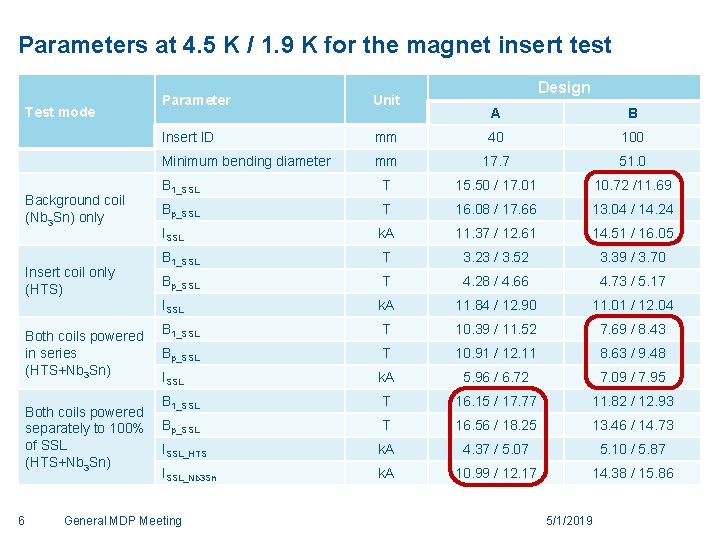
Parameters at 4. 5 K / 1. 9 K for the magnet insert test Test mode Background coil (Nb 3 Sn) only Insert coil only (HTS) Both coils powered in series (HTS+Nb 3 Sn) Both coils powered separately to 100% of SSL (HTS+Nb 3 Sn) 6 Parameter Unit Insert ID Minimum bending diameter Design A B mm 40 100 mm 17. 7 51. 0 B 1_SSL T 15. 50 / 17. 01 10. 72 /11. 69 Bp_SSL T 16. 08 / 17. 66 13. 04 / 14. 24 ISSL k. A 11. 37 / 12. 61 14. 51 / 16. 05 B 1_SSL T 3. 23 / 3. 52 3. 39 / 3. 70 Bp_SSL T 4. 28 / 4. 66 4. 73 / 5. 17 ISSL k. A 11. 84 / 12. 90 11. 01 / 12. 04 B 1_SSL T 10. 39 / 11. 52 7. 69 / 8. 43 Bp_SSL T 10. 91 / 12. 11 8. 63 / 9. 48 ISSL k. A 5. 96 / 6. 72 7. 09 / 7. 95 B 1_SSL T 16. 15 / 17. 77 11. 82 / 12. 93 Bp_SSL T 16. 56 / 18. 25 13. 46 / 14. 73 ISSL_HTS k. A 4. 37 / 5. 07 5. 10 / 5. 87 ISSL_Nb 3 Sn k. A 10. 99 / 12. 17 14. 38 / 15. 86 General MDP Meeting 5/1/2019
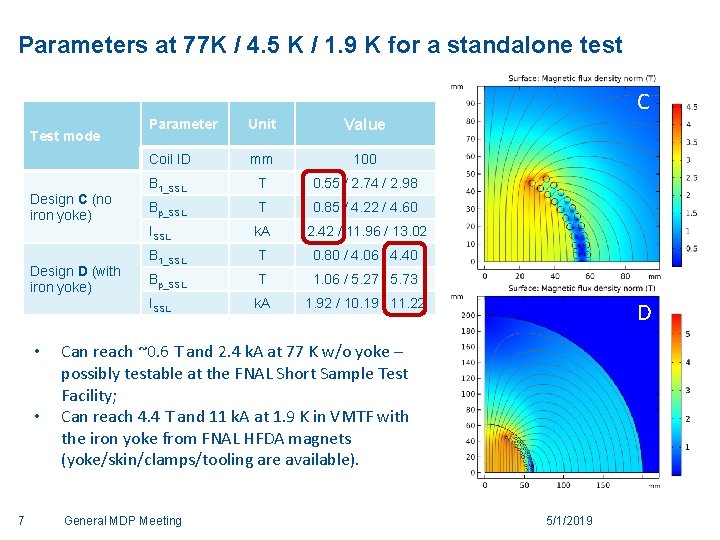
Parameters at 77 K / 4. 5 K / 1. 9 K for a standalone test C Test mode Design C (no iron yoke) Design D (with iron yoke) • • 7 Parameter Unit Value Coil ID mm 100 B 1_SSL T 0. 55 / 2. 74 / 2. 98 Bp_SSL T 0. 85 / 4. 22 / 4. 60 ISSL k. A 2. 42 / 11. 96 / 13. 02 B 1_SSL T 0. 80 / 4. 06 / 4. 40 Bp_SSL T 1. 06 / 5. 27 / 5. 73 ISSL k. A 1. 92 / 10. 19 / 11. 22 D Can reach ~0. 6 T and 2. 4 k. A at 77 K w/o yoke – possibly testable at the FNAL Short Sample Test Facility; Can reach 4. 4 T and 11 k. A at 1. 9 K in VMTF with the iron yoke from FNAL HFDA magnets (yoke/skin/clamps/tooling are available). General MDP Meeting 5/1/2019
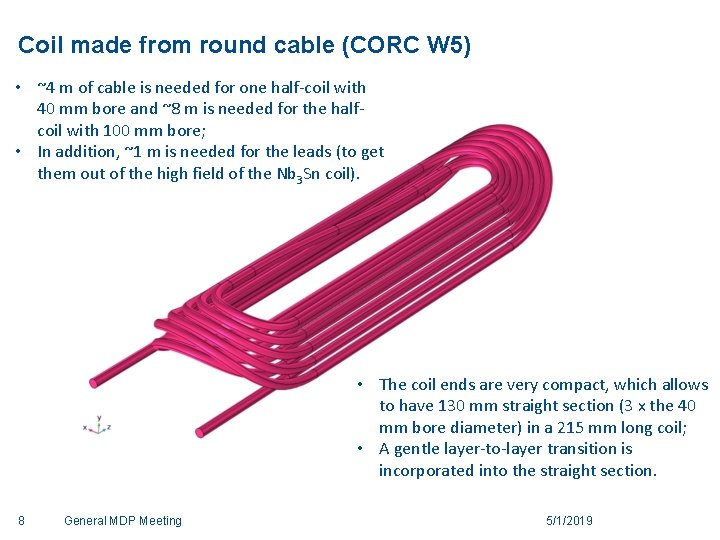
Coil made from round cable (CORC W 5) • ~4 m of cable is needed for one half-coil with 40 mm bore and ~8 m is needed for the halfcoil with 100 mm bore; • In addition, ~1 m is needed for the leads (to get them out of the high field of the Nb 3 Sn coil). • The coil ends are very compact, which allows to have 130 mm straight section (3 x the 40 mm bore diameter) in a 215 mm long coil; • A gentle layer-to-layer transition is incorporated into the straight section. 8 General MDP Meeting 5/1/2019
COMB (Conductor On Molded Barrel) support structure 9 General MDP Meeting 5/1/2019
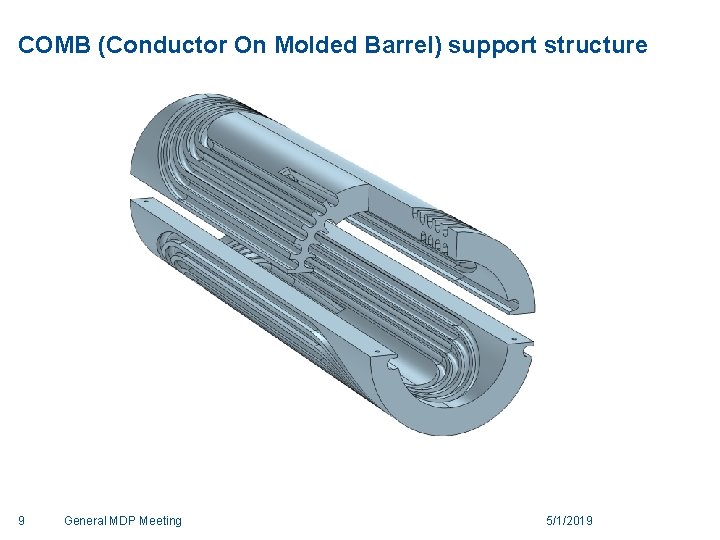
COMB technology features • Provides stress management for every turn and has features of the real accelerator magnets – i. e. open bore and a good field quality (similar to CCT); • The barrels can be fabricated as single solid pieces holding two layers of the cable. Both layers can be wound from a single piece of the cable without a splice. About ½ of the cable needs to be pulled through the transition hole prior to winding. • The structures can be handled like the regular cosine-theta half-coils (for a dipole) and assembled with additional inner or outer coils using midplane and azimuthal shims, which makes them readily scalable; • Even though, the present focus is on the dipoles, the technology is easily adoptable to any number of poles, which may be of interest to IR quadrupoles with large radiation load or stand-alone correctors operating at intermediate temperatures; • The structure has a single continuous cable channel of complicated topology spanning both inner and outer surfaces of the barrel, which is not well suited for CNC machining that could be un-manufacturable several decades ago. However, nowadays it can be readily produced by additive manufacturing using the Direct Metal Laser Sintering (DMLS) or another material deposition process – hence the word “molded” in its name; • In case of a long magnet, the central part can also be extruded or stamped to minimize fabrication time and cost and only the ends 3 D printed. 10 General MDP Meeting 5/1/2019
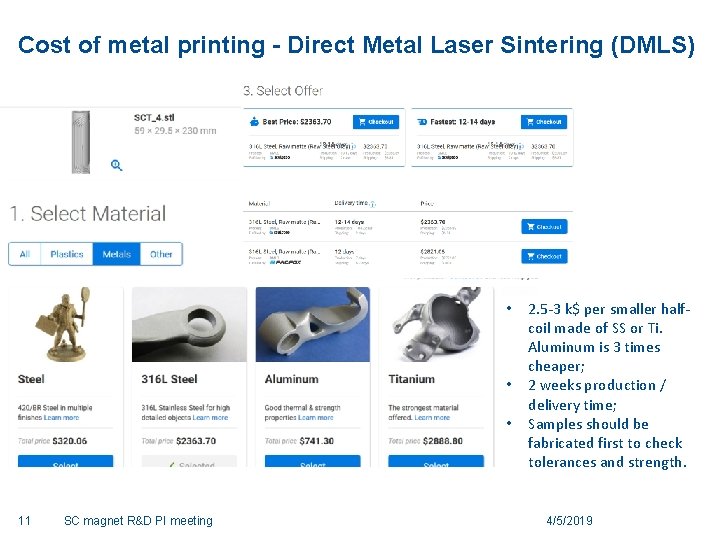
Cost of metal printing - Direct Metal Laser Sintering (DMLS) • • • 11 SC magnet R&D PI meeting 2. 5 -3 k$ per smaller halfcoil made of SS or Ti. Aluminum is 3 times cheaper; 2 weeks production / delivery time; Samples should be fabricated first to check tolerances and strength. 4/5/2019
Structural analysis: assumptions • The structural analysis was performed for the worst case in terms of the total forces and stresses in the HTS coil, which corresponds to independent powering of design “B” at 1. 9 K. • The following assumptions were used: – the gap in the iron yoke closes during the cool-down and remains closed under all conditions (i. e. the shell/clamp system is strong enough to make it happen); – there is a free sliding contact between HTS-LTS coils, LTS coil and the iron yoke as well as between cables and the pole blocks in that coil; – the coils are prestresses by means of the radial and azimuthal shims during assembly at the room temperature to the level that all conductors stay in contact with the adjacent parts under the maximum load; – the COMB structure is made of 316 L stainless steel. 12 General MDP Meeting 5/1/2019
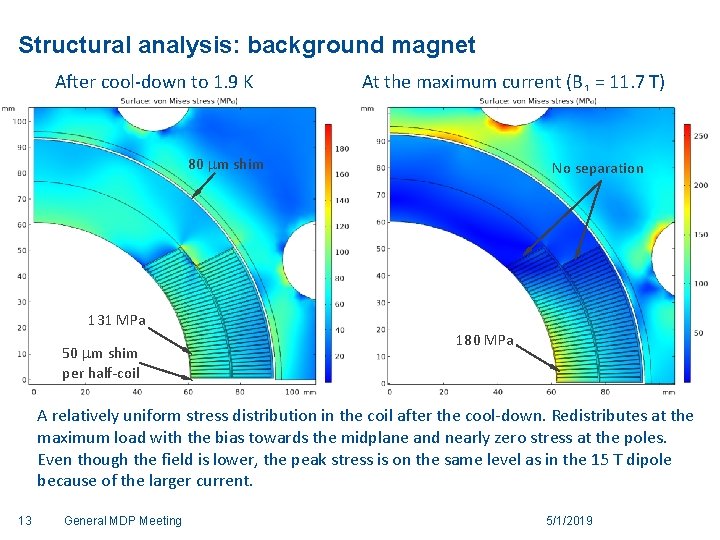
Structural analysis: background magnet After cool-down to 1. 9 K At the maximum current (B 1 = 11. 7 T) 80 mm shim No separation 131 MPa 50 mm shim per half-coil 180 MPa A relatively uniform stress distribution in the coil after the cool-down. Redistributes at the maximum load with the bias towards the midplane and nearly zero stress at the poles. Even though the field is lower, the peak stress is on the same level as in the 15 T dipole because of the larger current. 13 General MDP Meeting 5/1/2019
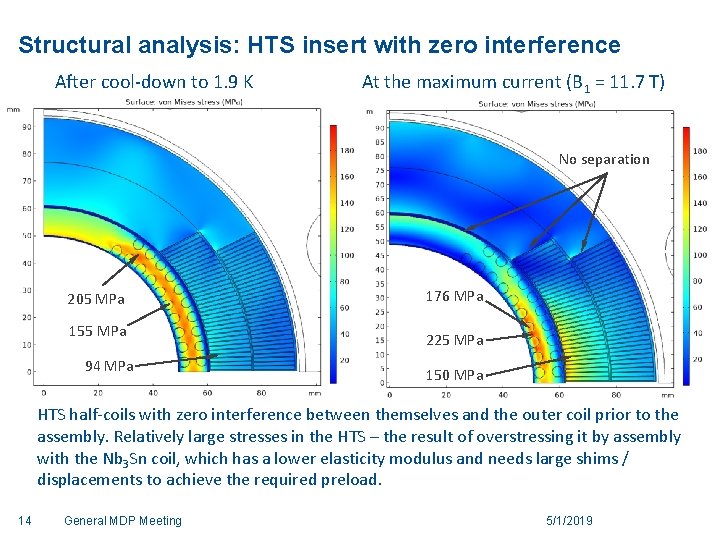
Structural analysis: HTS insert with zero interference After cool-down to 1. 9 K At the maximum current (B 1 = 11. 7 T) No separation 205 MPa 155 MPa 94 MPa 176 MPa 225 MPa 150 MPa HTS half-coils with zero interference between themselves and the outer coil prior to the assembly. Relatively large stresses in the HTS – the result of overstressing it by assembly with the Nb 3 Sn coil, which has a lower elasticity modulus and needs large shims / displacements to achieve the required preload. 14 General MDP Meeting 5/1/2019
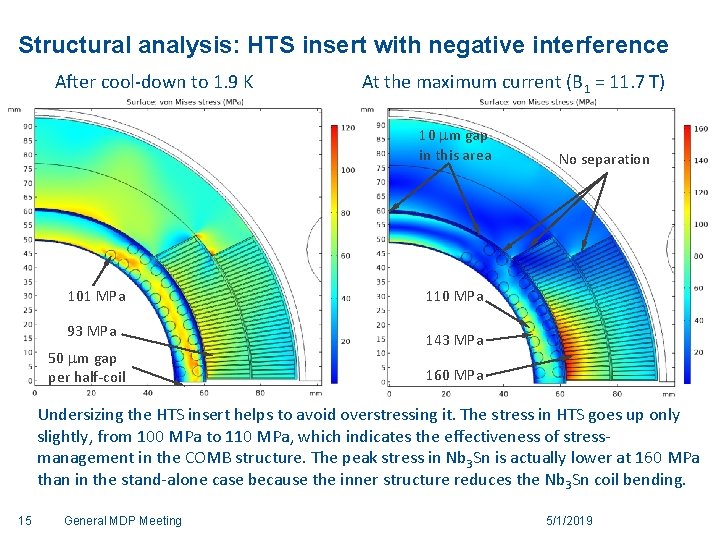
Structural analysis: HTS insert with negative interference After cool-down to 1. 9 K At the maximum current (B 1 = 11. 7 T) 10 mm gap in this area 101 MPa 93 MPa 50 mm gap per half-coil No separation 110 MPa 143 MPa 160 MPa Undersizing the HTS insert helps to avoid overstressing it. The stress in HTS goes up only slightly, from 100 MPa to 110 MPa, which indicates the effectiveness of stressmanagement in the COMB structure. The peak stress in Nb 3 Sn is actually lower at 160 MPa than in the stand-alone case because the inner structure reduces the Nb 3 Sn coil bending. 15 General MDP Meeting 5/1/2019

Summary • Two HTS coil designs based on CORC cables were considered: – 40 mm coil to explore 16+ T fields (in future); – 100 mm coil to develop the technology (now). • Offer quick turn-around and the ease of assembly. • Can be tested in various configurations: – 1. 9 K – 77 K; – Self field with or without iron yoke; – In 12 -15 T background field magnets. • The structural analysis for the worst case indicated the stresses low enough for any kind of HTS material (including Bi-2212). • The proposed COMB structure can be a useful (and a unique) technology development tool. 16 General MDP Meeting 5/1/2019
Backup slides 17 General MDP Meeting 5/1/2019
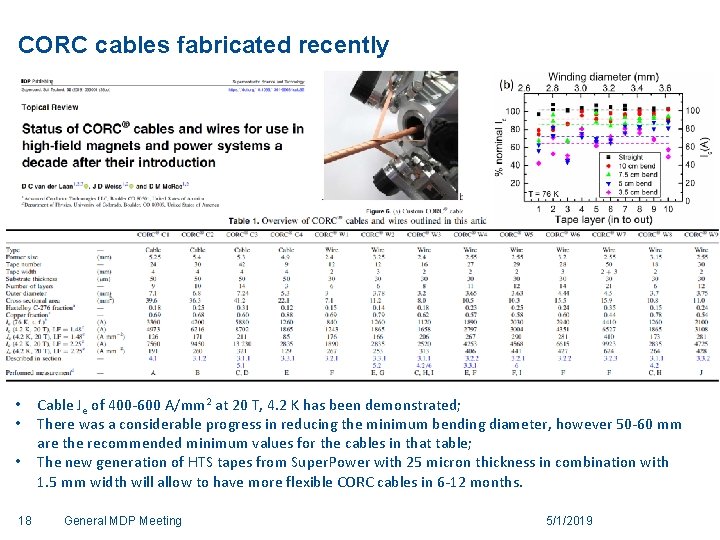
CORC cables fabricated recently • • • 18 Cable Je of 400 -600 A/mm 2 at 20 T, 4. 2 K has been demonstrated; There was a considerable progress in reducing the minimum bending diameter, however 50 -60 mm are the recommended minimum values for the cables in that table; The new generation of HTS tapes from Super. Power with 25 micron thickness in combination with 1. 5 mm width will allow to have more flexible CORC cables in 6 -12 months. General MDP Meeting 5/1/2019
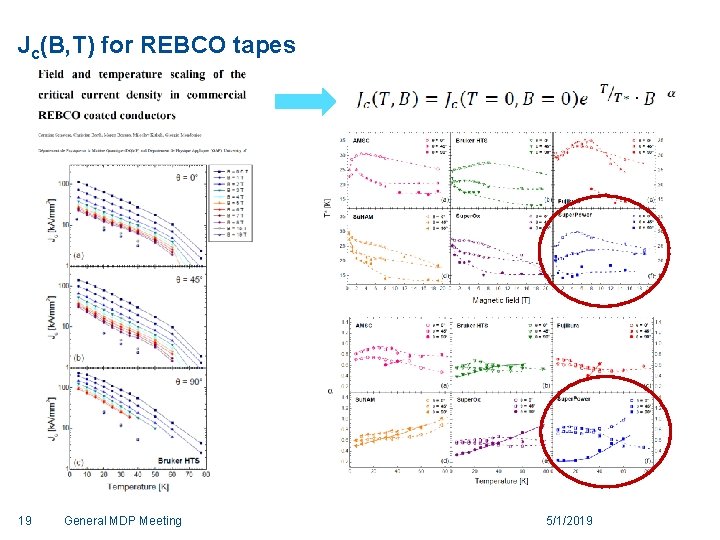
Jc(B, T) for REBCO tapes 19 General MDP Meeting 5/1/2019
- Slides: 19