
Proposal for Derogation under Paragraph 2b of Annex
Proposal for Derogation, under Paragraph 2(b) of Annex III of Nitrates Directive, from the limit of 170 kg N/ha/year from livestock manure for grassland farming in Northern Ireland Response to Questions From Member States 29 June 2007

Germany Question 1 Minimum storage capacity and exceptions from the basic rule. Response: § Minimum storage requirements are as follows: - 26 weeks for pig and poultry - 22 weeks for others § The calculation of storage requirements however, can take account of specific farming practices.
Germany Question 2 Conditions of fertiliser application near water courses Response: The Action Programme establishes the manner and method of nitrogen fertiliser application including the minimum distances from waters. eg. 20 m from lakes 10 m from any waterway (other restrictions detailed in Regulations)
Germany Question 3 Limitations of fertiliser application to ensure a balance between N requirement of the crops and N supply Response: The Action Programme limits the total nitrogen in livestock manure to 170 kg N/ha/year and limits the amount of chemical fertiliser and organic manures that may be applied to crop requirement.
Germany Question 4 By which method will the amount of N applied livestock manure be identified – legally binding values? Response: The Action Programme sets legally binding values of manure N excretion for each livestock type.
Germany Question 5 Methods of spreading liquid manure? Any obligation on derogated farms to use specific emission reducing methods? Response: The Regulations introduce an obligation on all farms to use emission reducing methods to spread slurry.
Germany Question 6 How will compliance with the measures of the Action Programme be controlled? Response: § Regular monitoring and enforcement will be carried out by the Environment and Heritage Service of the Department of the Environment. § Farms will be inspected on a risk - based assessment to ensure compliance with the Nitrates Action Programme.
Finland Comment 1 Justification of derogation on basis of denitrification capacity conflicts with serious debate on climate change. Response: § Denitrification is highlighted by Nitrates Directive as grounds for derogation. § § Majority of Northern Ireland soils have impeded drainage. Denitrification loss significantly lowers soil nitrate concentration and hence lowers nitrate loss to water. Northern Ireland is not complacent about impact of denitrification and a major research programme is in place to address this issue
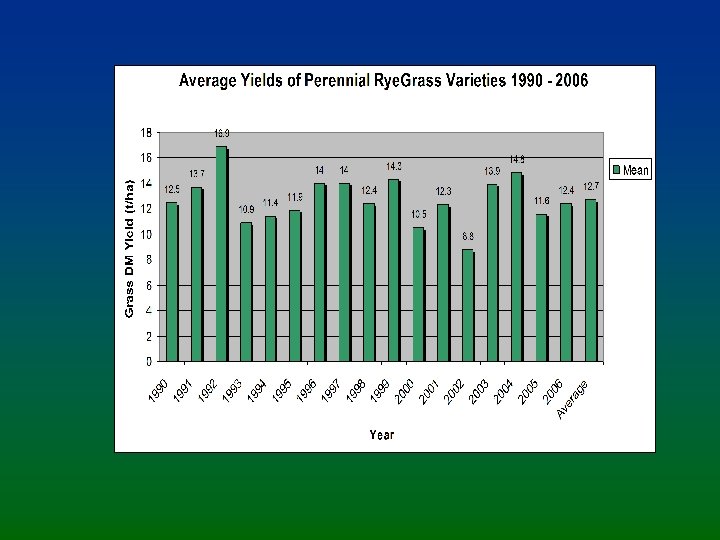
Finland Comment 2 Yield statistics do not necessarily give the correct picture on N uptake potential, especially in areas of poor growth Response: § Over 71% of Northern Ireland is classified as above average grass growth. § Grass growth classification is based on detailed knowledge of soil type and long term (30+ years) rainfall etc. § With the exception of 2002, average yields of ryegrass swards on farm have exceeded 10 t DM per ha, with average yields of new varieties from 1990 to 2006 averaging 12. 7 t DM/ha. Majority of farms seeking a derogation are grassland farms located on better quality land better grass growing areas.
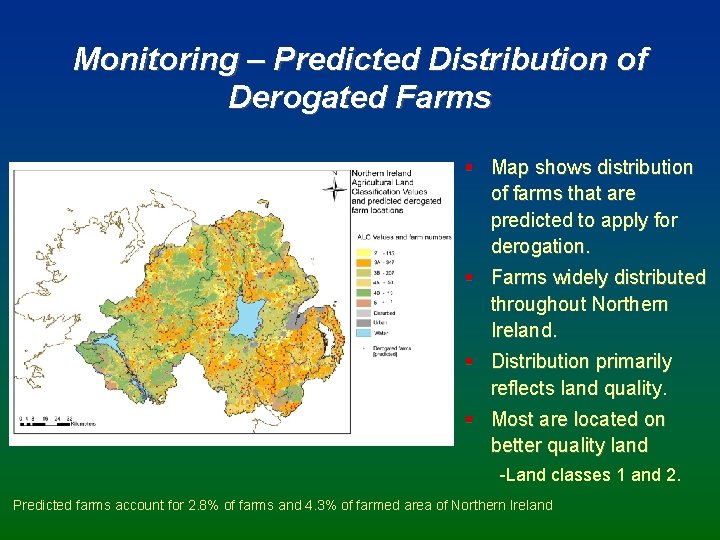
Monitoring – Predicted Distribution of Derogated Farms § Map shows distribution of farms that are predicted to apply for derogation. § Farms widely distributed throughout Northern Ireland. § Distribution primarily reflects land quality. § Most are located on better quality land -Land classes 1 and 2. Predicted farms account for 2. 8% of farms and 4. 3% of farmed area of Northern Ireland
Finland Question 1 Check values in Table 4. 5 (page 38). Does this increase the N balance for Farm C (derogated farm)? Response: § § We apologise for the typographical error in Table 4. 5. § Derogated farms with a high reliance on grass can achieve a lower N balance and a significantly lower P balance than non derogated farms. Correct data are now included – N balance data are changed, but P balance data are not affected. Introduction of P balance of 10 kg/ha on derogated farms will constrain concentrate (and hence N and P) input
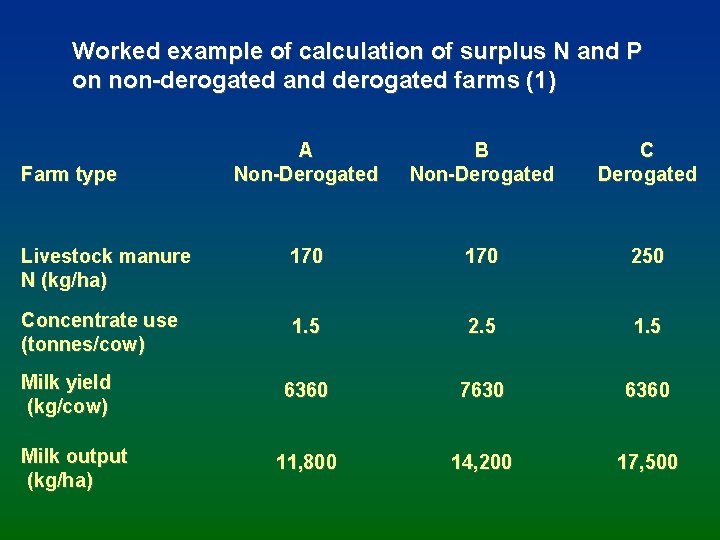
Worked example of calculation of surplus N and P on non-derogated and derogated farms (1) A Non-Derogated B Non-Derogated C Derogated Livestock manure N (kg/ha) 170 250 Concentrate use (tonnes/cow) 1. 5 2. 5 1. 5 6360 7630 6360 11, 800 14, 200 17, 500 Farm type Milk yield (kg/cow) Milk output (kg/ha)
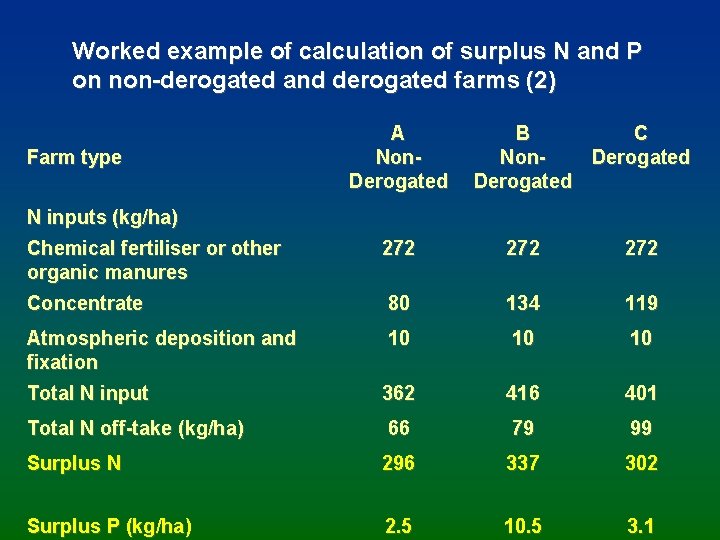
Worked example of calculation of surplus N and P on non-derogated and derogated farms (2) Farm type A Non. Derogated B C Non. Derogated N inputs (kg/ha) Chemical fertiliser or other organic manures 272 272 Concentrate 80 134 119 Atmospheric deposition and fixation 10 10 10 Total N input 362 416 401 Total N off-take (kg/ha) 66 79 99 Surplus N 296 337 302 Surplus P (kg/ha) 2. 5 10. 5 3. 1
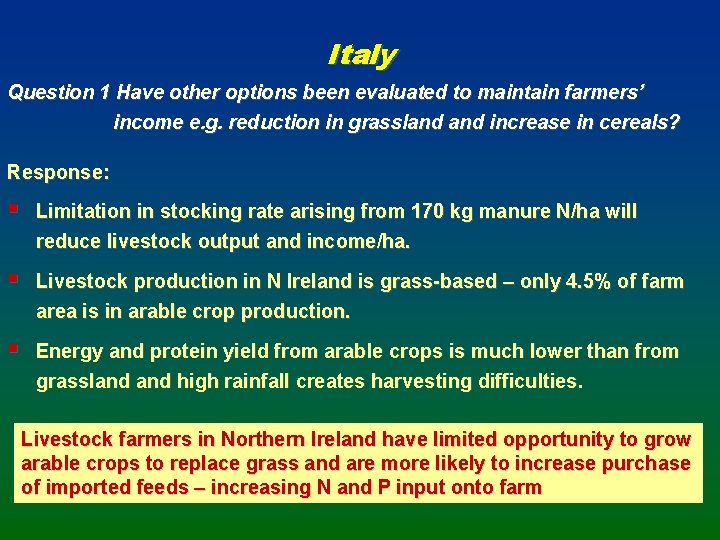
Italy Question 1 Have other options been evaluated to maintain farmers’ income e. g. reduction in grassland increase in cereals? Response: § Limitation in stocking rate arising from 170 kg manure N/ha will reduce livestock output and income/ha. § Livestock production in N Ireland is grass-based – only 4. 5% of farm area is in arable crop production. § Energy and protein yield from arable crops is much lower than from grassland high rainfall creates harvesting difficulties. Livestock farmers in Northern Ireland have limited opportunity to grow arable crops to replace grass and are more likely to increase purchase of imported feeds – increasing N and P input onto farm
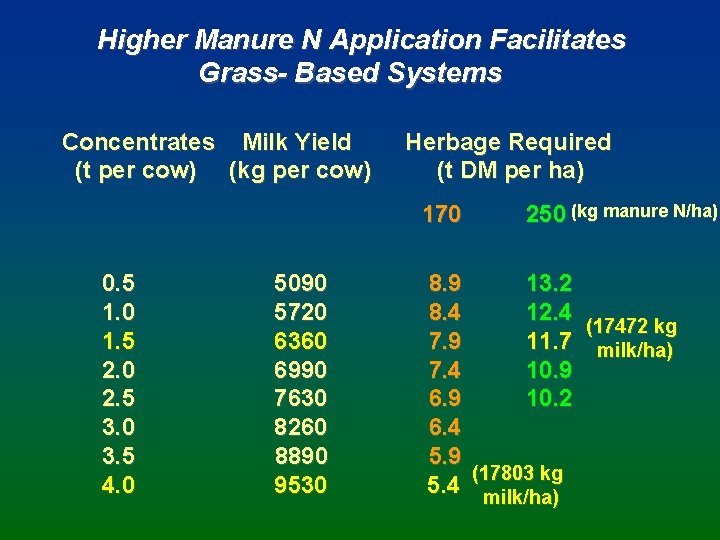
Higher Manure N Application Facilitates Grass- Based Systems Concentrates Milk Yield (t per cow) (kg per cow) Herbage Required (t DM per ha) 170 0. 5 1. 0 1. 5 2. 0 2. 5 3. 0 3. 5 4. 0 5090 5720 6360 6990 7630 8260 8890 9530 250 (kg manure N/ha) 8. 9 13. 2 8. 4 12. 4 (17472 kg 7. 9 11. 7 milk/ha) 7. 4 10. 9 6. 9 10. 2 6. 4 5. 9 (17803 kg 5. 4 milk/ha)
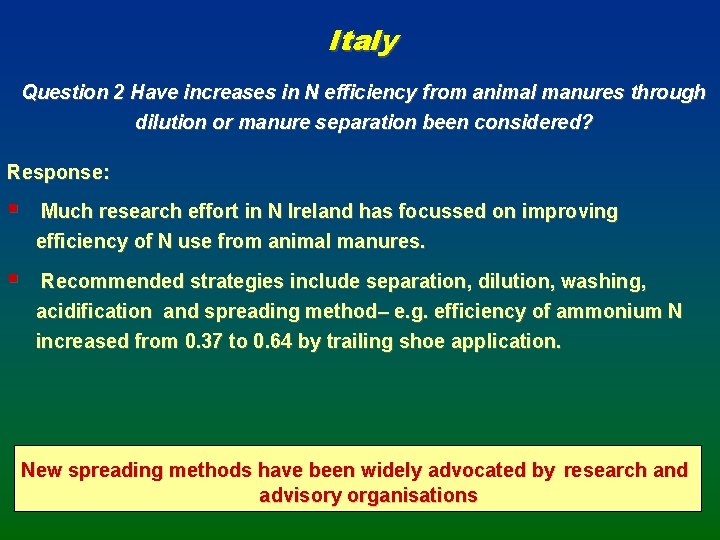
Italy Question 2 Have increases in N efficiency from animal manures through dilution or manure separation been considered? Response: § Much research effort in N Ireland has focussed on improving efficiency of N use from animal manures. § Recommended strategies include separation, dilution, washing, acidification and spreading method– e. g. efficiency of ammonium N increased from 0. 37 to 0. 64 by trailing shoe application. New spreading methods have been widely advocated by research and advisory organisations
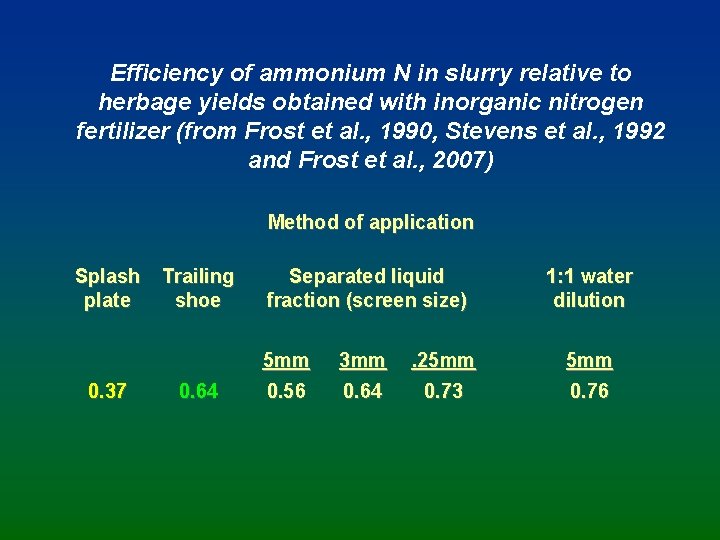
Efficiency of ammonium N in slurry relative to herbage yields obtained with inorganic nitrogen fertilizer (from Frost et al. , 1990, Stevens et al. , 1992 and Frost et al. , 2007) Method of application Splash plate 0. 37 Trailing shoe 0. 64 Separated liquid fraction (screen size) 1: 1 water dilution 5 mm 3 mm . 25 mm 0. 56 0. 64 0. 73 0. 76
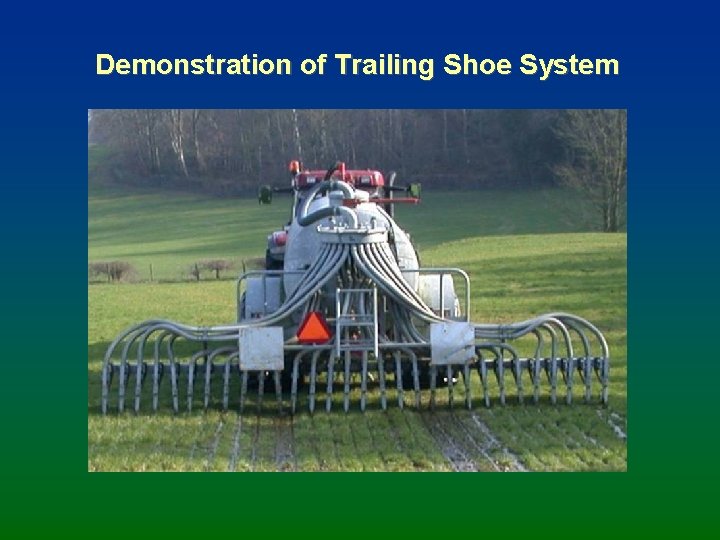
Demonstration of Trailing Shoe System
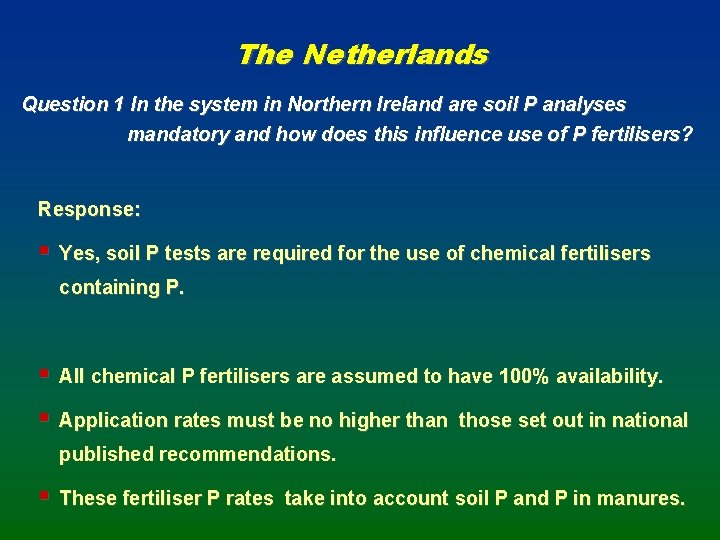
The Netherlands Question 1 In the system in Northern Ireland are soil P analyses mandatory and how does this influence use of P fertilisers? Response: § Yes, soil P tests are required for the use of chemical fertilisers containing P. § All chemical P fertilisers are assumed to have 100% availability. § Application rates must be no higher than those set out in national published recommendations. § These fertiliser P rates take into account soil P and P in manures.
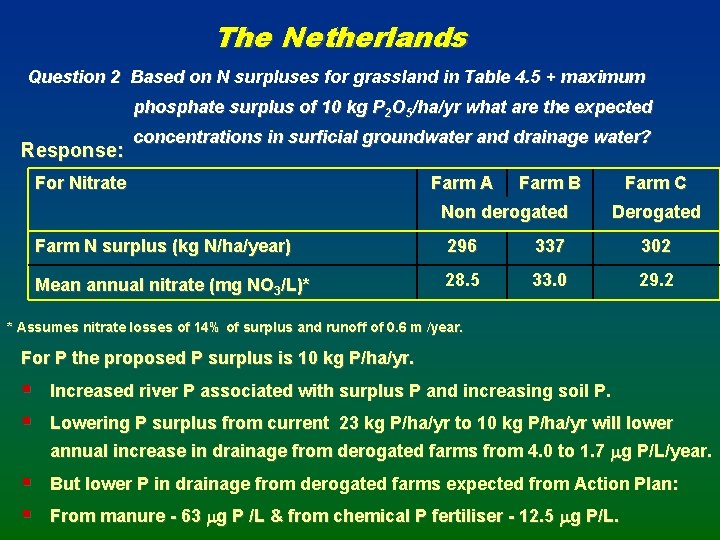
The Netherlands Question 2 Based on N surpluses for grassland in Table 4. 5 + maximum phosphate surplus of 10 kg P 2 O 5/ha/yr what are the expected Response: concentrations in surficial groundwater and drainage water? For Nitrate Farm A Farm B Non derogated Farm C Derogated Farm N surplus (kg N/ha/year) 296 337 302 Mean annual nitrate (mg NO 3/L)* 28. 5 33. 0 29. 2 * Assumes nitrate losses of 14% of surplus and runoff of 0. 6 m /year. For P the proposed P surplus is 10 kg P/ha/yr. § § Increased river P associated with surplus P and increasing soil P. Lowering P surplus from current 23 kg P/ha/yr to 10 kg P/ha/yr will lower annual increase in drainage from derogated farms from 4. 0 to 1. 7 mg P/L/year. § § But lower P in drainage from derogated farms expected from Action Plan: From manure - 63 mg P /L & from chemical P fertiliser - 12. 5 mg P/L.
The Netherlands Question 3 How do the N and P surpluses and resulting concentrations in surficial groundwater and drainage water relate to the concentrations that are expected to comply with the eutrophication surface water standards (Good Ecological Status) of the WFD? Response: Eutrophication standards for N and P concentrations have yet to be set for lakes and rivers in Northern Ireland, the UK or for the Republic of Ireland. (This is consistent with the timeline set for implementing the Water Framework Directive).
Sweden Question 1 What is the reason for assuming usage of more chemical fertilisers and higher grass production than needed on farm A and B? Did you consider other levels of fertiliser or land usage? Response: § A higher level of herbage production is produced relative to that required for Farms A and B. This reflects the lower stocking rate of Farm A and substitution of herbage by concentrates on Farm B. § If surplus grass is produced it will be conserved as silage and offered for sale. § Livestock farmers in Northern Ireland have limited opportunity to grow arable crops to replace grass and are more likely to increase purchase of imported feeds – increasing N and P input onto farm.
Belgium Question 1 What is the ratio of N 2 O to N in the denitrification process and estimated effect of derogation on this ratio? Response: § Upper and lower estimates of N 2 O emissions vary by a factor of 38 In the greenhouse gas inventory for Northern Ireland. Given this uncertainty a definitive answer cannot be given to the question. • However, evolving practices for nitrogen management on farms, including measures contained in the Nitrates Action Programme Regulations, may result in lower denitrification losses.
Summary of potential management effects on N 2 O emissions Factor influencing N 2 O emissions Apply more manure N in historic N management framework. Impact on N 20 But following likely changes in N management Winter closed period Higher soil temperature & lower soil moisture when manure is applied Less denitrification. Better manure N efficiency Less nitrate fertiliser Lower soil nitrate Less denitrification. Increased lime use = >soils at target p. H of 6. 0 Lower N 20 fraction. > band spreading to increase N efficiency lower interaction between chemical fertiliser N & slurry carbon Less denitrification & lower N 20 fraction Apply nitrate fertiliser >4 days after manure Less labile soil carbon for denitrification Lower denitrification & N 20 fraction
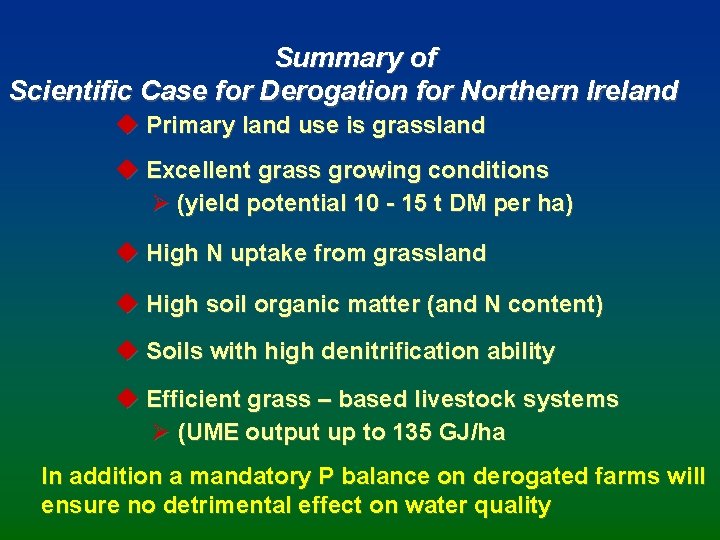
Summary of Scientific Case for Derogation for Northern Ireland u Primary land use is grassland u Excellent grass growing conditions Ø (yield potential 10 - 15 t DM per ha) u High N uptake from grassland u High soil organic matter (and N content) u Soils with high denitrification ability u Efficient grass – based livestock systems Ø (UME output up to 135 GJ/ha In addition a mandatory P balance on derogated farms will ensure no detrimental effect on water quality
- Slides: 26