
Proposal Development Support Planning Extension Proposal Development Specialists

- Slides: 15
Proposal Development Support & Planning Extension Proposal Development Specialists Alyson Straquadine & Delite Primus
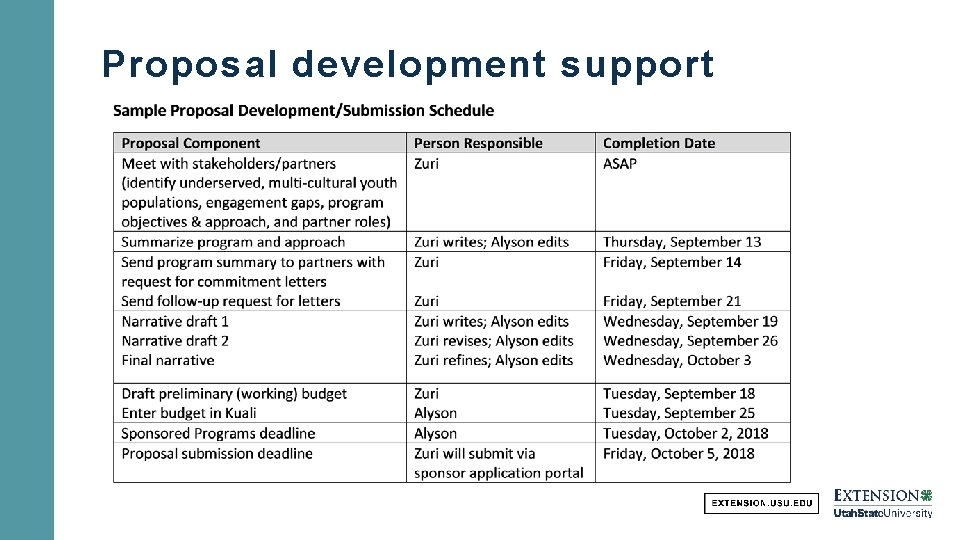
Proposal development support • Identify funding opportunities matched with faculty program goals and funding needs • Initiate decision and kick-off meetings • Help faculty decide whether to apply (i. e. evaluate projects for eligibility, match, and competitiveness) • Help identify team member roles • Create and follow a proposal development schedule
Proposal development support
Proposal development support • Assist faculty with logic model development • Build consensus among team members • Guide budget and narrative development • Ensure consistency among proposal components
Proposal development support • Assist with budget development • Consider the who, what, where, when and how of the entire project to ensure inclusion of all components in budget • Assist with Kuali budget entry • Facilitate budget review and refinements consistent with sponsor and university guidelines
Proposal development support • Encourage use of narrative organizational templates • Guide writing and ensure responsiveness to funding opportunity requirements and review criteria • Draft content for non-technical proposal components • (e. g. management plan, institutional support, budget justification) • Edit proposal narrative for organization, completeness, clarity, and grammar • Provide suggestions to help faculty explain how their projects advance funding agency goals
Proposal planning • Prioritize your program goals and funding needs • Know what you want to do before you look for funding • Better able to find well matched opportunities that facilitate your goals and advance the agency’s goals • Draft a project description that answers these questions • What are you going to do? (Project Introduction) • “The program director will use Mental Health First Aid Training curriculum and other evidence-based resources to teach local adults and youth how to recognize symptoms and help someone who is developing a mental health problem or experiencing a mental health crisis. ”
Proposal planning • Draft project description continued. . . • Why are you going to do it? (Significance) • “Mental health is a critical issue in San Juan County and Extension programming is uniquely positioned to impact community wellness. San Juan County has several characteristics that contribute to mental health challenges. ” • Explain characteristics (e. g. rural, shortage of behavioral health providers) and provide data to back up assertion • Problem recognition (Who else in the community views mental health challenges as as a problem? ) • Problem implications and urgency (What will happen to the population served if the problem isn’t addressed soon? )
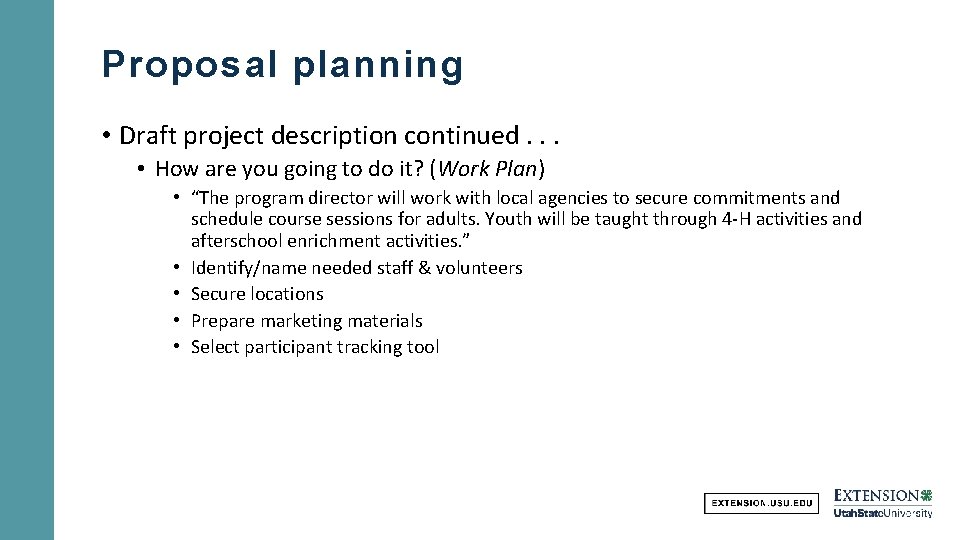
Proposal planning • Draft project description continued. . . • How are you going to do it? (Work Plan) • “The program director will work with local agencies to secure commitments and schedule course sessions for adults. Youth will be taught through 4 -H activities and afterschool enrichment activities. ” • Identify/name needed staff & volunteers • Secure locations • Prepare marketing materials • Select participant tracking tool
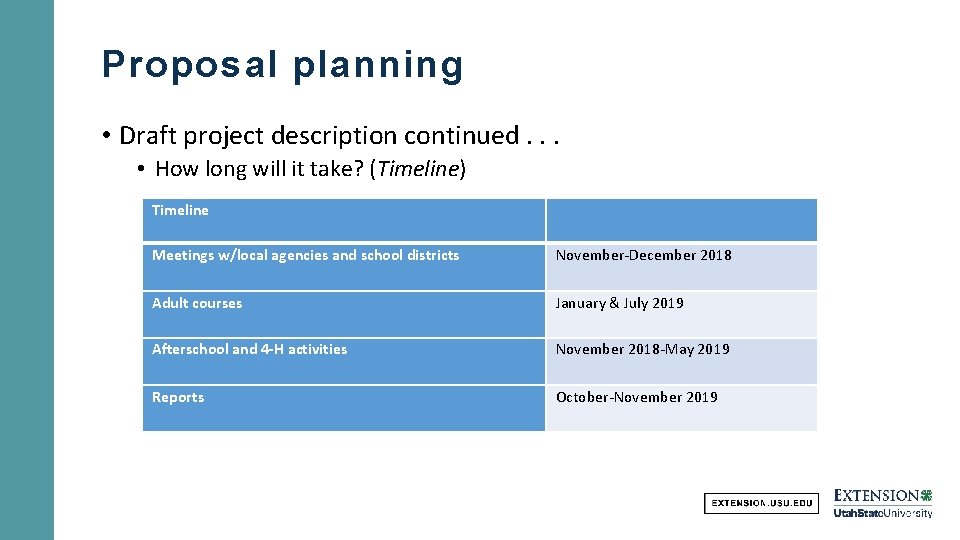
Proposal planning • Draft project description continued. . . • How long will it take? (Timeline) Timeline Meetings w/local agencies and school districts November-December 2018 Adult courses January & July 2019 Afterschool and 4 -H activities November 2018 -May 2019 Reports October-November 2019
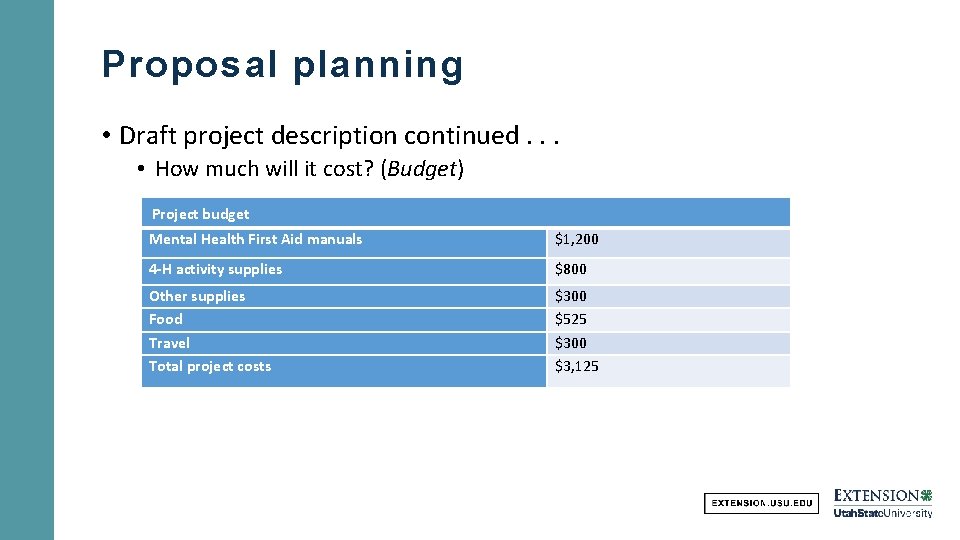
Proposal planning • Draft project description continued. . . • How much will it cost? (Budget) Project budget Mental Health First Aid manuals $1, 200 4 -H activity supplies $800 Other supplies Food Travel Total project costs $300 $525 $300 $3, 125
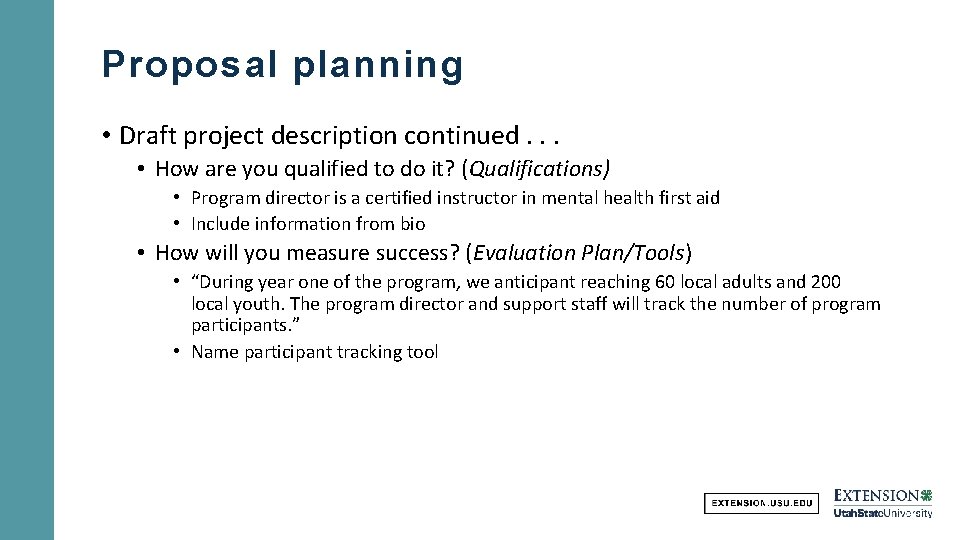
Proposal planning • Draft project description continued. . . • How are you qualified to do it? (Qualifications) • Program director is a certified instructor in mental health first aid • Include information from bio • How will you measure success? (Evaluation Plan/Tools) • “During year one of the program, we anticipant reaching 60 local adults and 200 local youth. The program director and support staff will track the number of program participants. ” • Name participant tracking tool
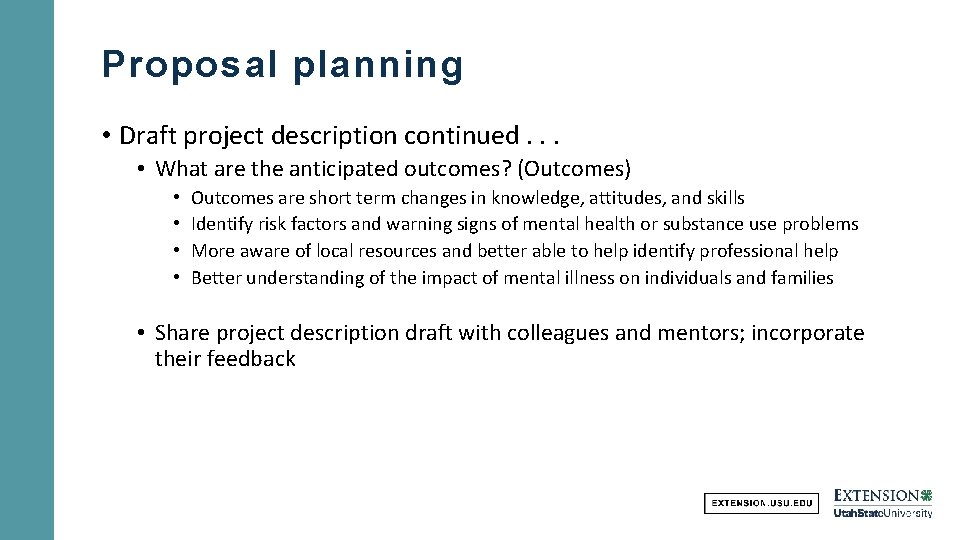
Proposal planning • Draft project description continued. . . • What are the anticipated outcomes? (Outcomes) • • Outcomes are short term changes in knowledge, attitudes, and skills Identify risk factors and warning signs of mental health or substance use problems More aware of local resources and better able to help identify professional help Better understanding of the impact of mental illness on individuals and families • Share project description draft with colleagues and mentors; incorporate their feedback
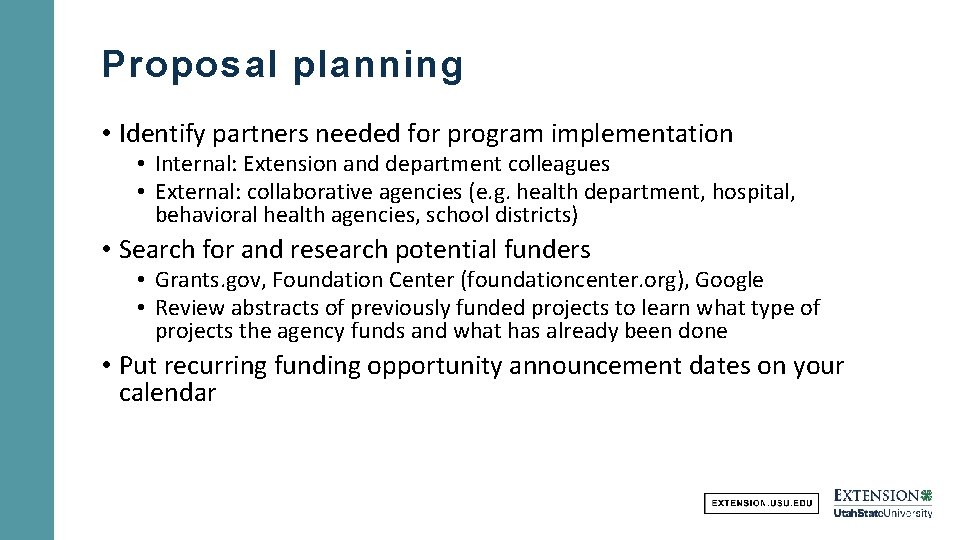
Proposal planning • Identify partners needed for program implementation • Internal: Extension and department colleagues • External: collaborative agencies (e. g. health department, hospital, behavioral health agencies, school districts) • Search for and research potential funders • Grants. gov, Foundation Center (foundationcenter. org), Google • Review abstracts of previously funded projects to learn what type of projects the agency funds and what has already been done • Put recurring funding opportunity announcement dates on your calendar
Contact us! • Alyson Straquadine • (435) 613 -5286 or (435) 553 -9332 • alyson. straquadine@usu. edu • Delite Primus • (435) 210 -1329 • delite. primus@usu. edu