
Proportional Counters Some of what you should know
- Slides: 31
Proportional Counters Some of what you should know in order to use proportional counters for Spectroscopy, Timing, Imaging and Polarimetry Keith Jahoda GSFC Laboratory for X-ray Astrophysics K. Jahoda, 6 Aug 2007 X-ray School, GWU
Why Proportional Counters? • Historical Work-horse – Sounding rockets, Uhuru, Ariel-5, HEAO-1, Einstein, EXOSAT, Ginga, RXTE … • Still attractive for – Large area – Low power • Signal processing only, no cooling requirement – Low background – Broad band-pass – Unique capabilities, even now • Polarization, like imaging, spectroscopy, and timing, will begin with proportional counters. – Calibration – Low cost – Performance can be tuned for unique projects - polarimetry K. Jahoda, 6 Aug 2007 X-ray School, GWU
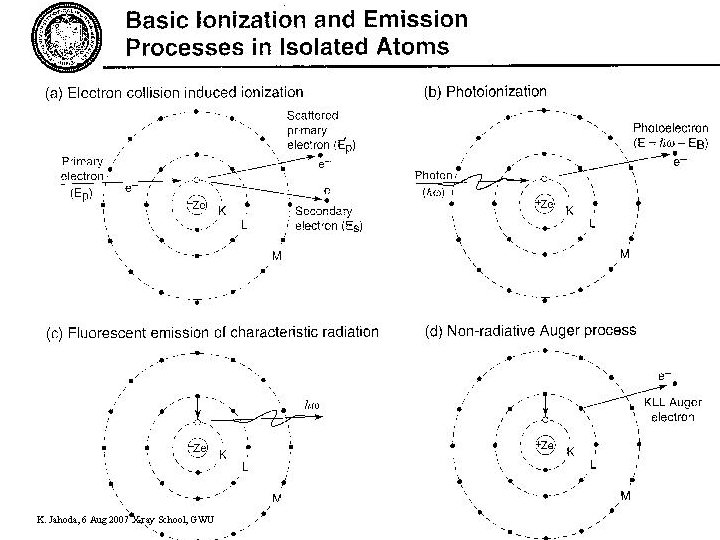
What is a Proportional Counter? • Executive Summary, (inspired by DAS) – An X-ray interacts with an atom of the prop counter gas. Photo-electric absorption is most important (or only important) mechanism below 100 ke. V – Charge is generated, proportional to the incident X-ray energy; (i. e. , electrons and positive ions separated). – The charge is multiplied in a high field region. – The charge is collected, measured, digitized, and telemetered. K. Jahoda, 6 Aug 2007 X-ray School, GWU
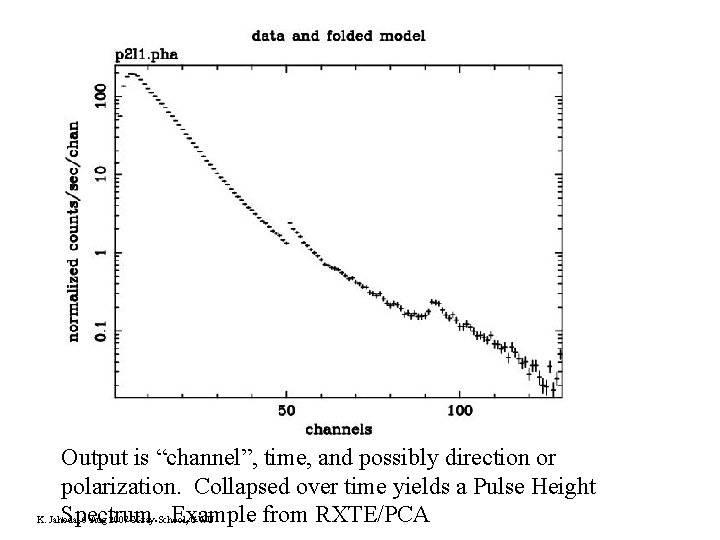
Output is “channel”, time, and possibly direction or polarization. Collapsed over time yields a Pulse Height Spectrum. Example from RXTE/PCA K. Jahoda, 6 Aug 2007 X-ray School, GWU
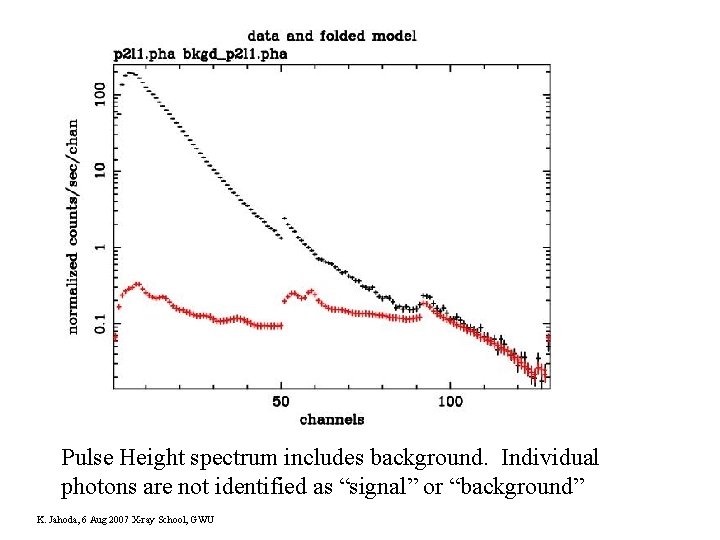
Pulse Height spectrum includes background. Individual photons are not identified as “signal” or “background” K. Jahoda, 6 Aug 2007 X-ray School, GWU
Sources of Proportional Counter Background • From sky (I. e. through collimator) • From particles – Minimum ionizing particles deposit ~ 2 ke. V/ mg per cm 2 – Electrons with 10 s of ke. V can penetrate window to deposit 1 -10 ke. V – Secondaries from spacecraft, detector itself • From photons – Forward Compton scattering of g-rays – Flouresence from collimator or other detector material – Secondaries from Spacecraft or instrument K. Jahoda, 6 Aug 2007 X-ray School, GWU
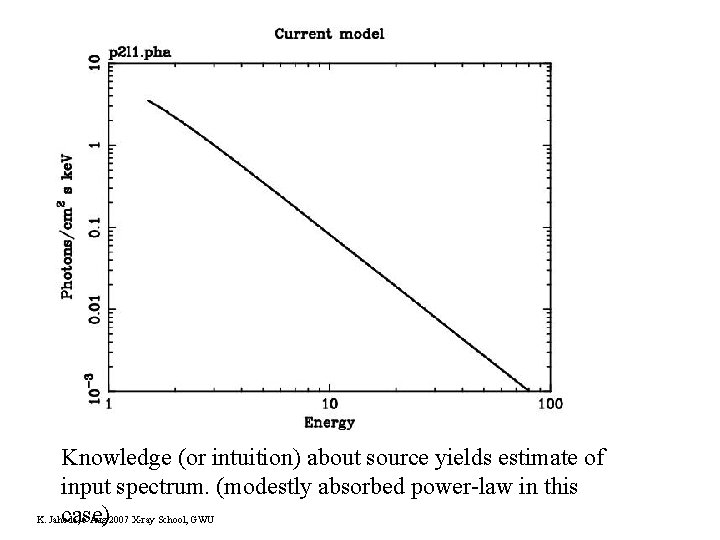
Knowledge (or intuition) about source yields estimate of input spectrum. (modestly absorbed power-law in this case) K. Jahoda, 6 Aug 2007 X-ray School, GWU
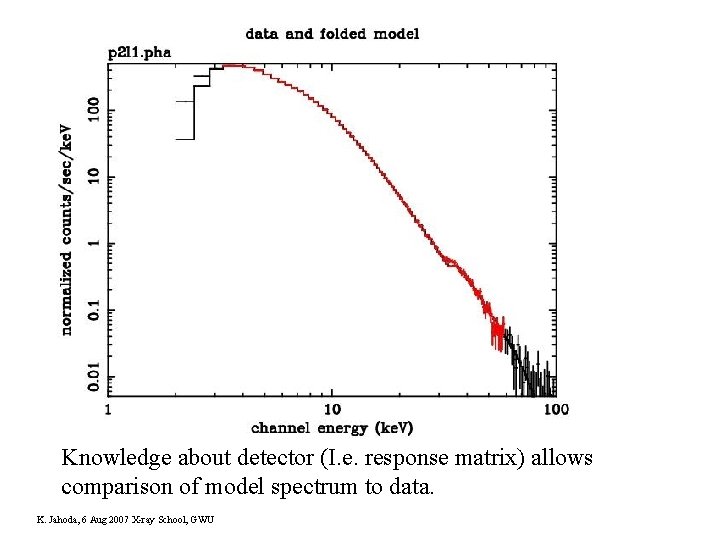
Knowledge about detector (I. e. response matrix) allows comparison of model spectrum to data. K. Jahoda, 6 Aug 2007 X-ray School, GWU
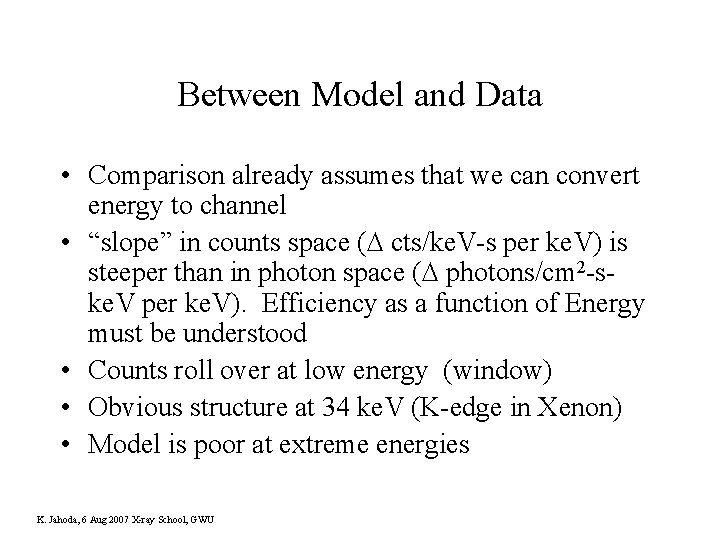
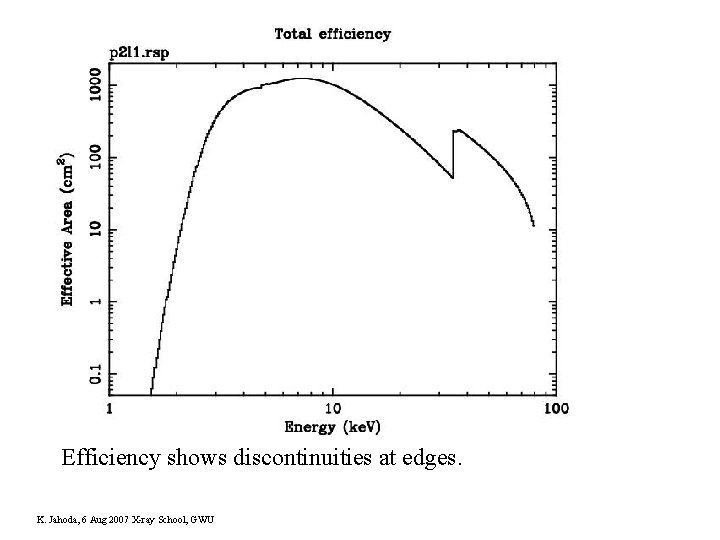
Between Model and Data • Comparison already assumes that we can convert energy to channel • “slope” in counts space (D cts/ke. V-s per ke. V) is steeper than in photon space (D photons/cm 2 -ske. V per ke. V). Efficiency as a function of Energy must be understood • Counts roll over at low energy (window) • Obvious structure at 34 ke. V (K-edge in Xenon) • Model is poor at extreme energies K. Jahoda, 6 Aug 2007 X-ray School, GWU
Efficiency shows discontinuities at edges. K. Jahoda, 6 Aug 2007 X-ray School, GWU
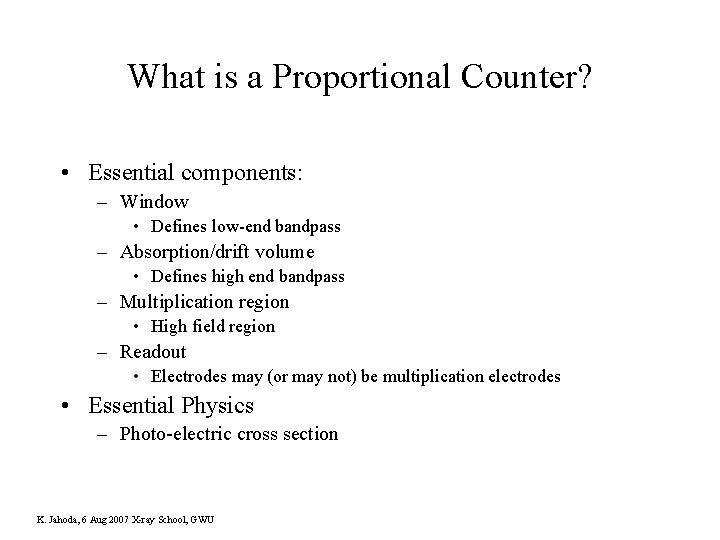
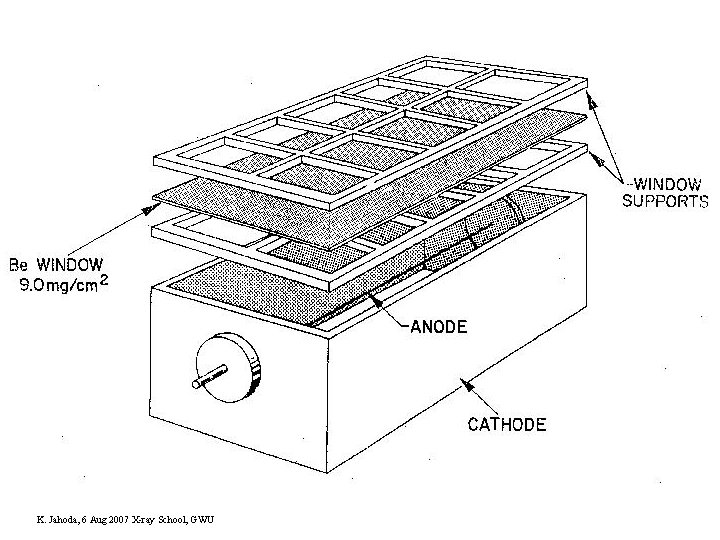
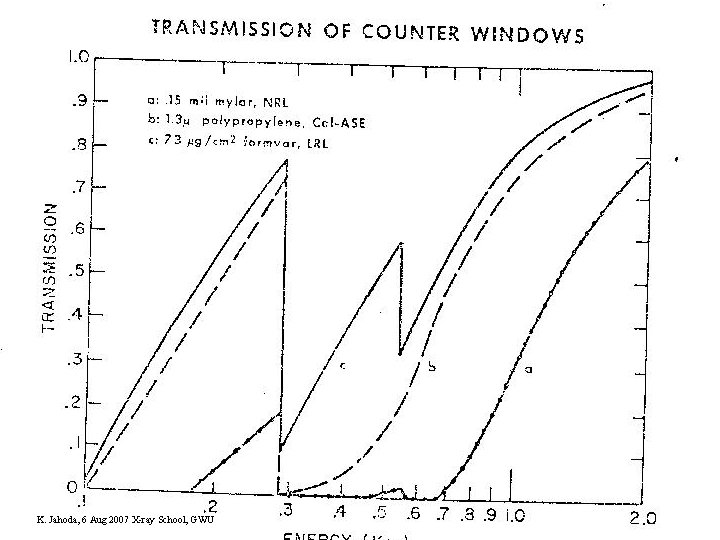
What is a Proportional Counter? • Essential components: – Window • Defines low-end bandpass – Absorption/drift volume • Defines high end bandpass – Multiplication region • High field region – Readout • Electrodes may (or may not) be multiplication electrodes • Essential Physics – Photo-electric cross section K. Jahoda, 6 Aug 2007 X-ray School, GWU
K. Jahoda, 6 Aug 2007 X-ray School, GWU
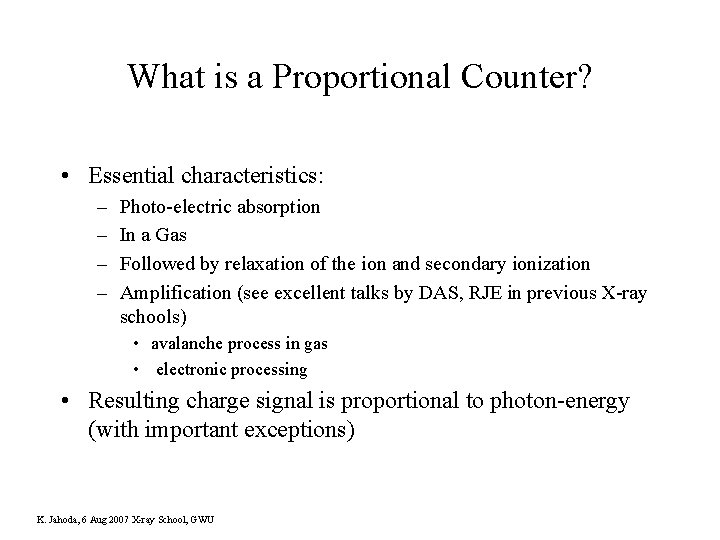
What is a Proportional Counter? • Essential characteristics: – – Photo-electric absorption In a Gas Followed by relaxation of the ion and secondary ionization Amplification (see excellent talks by DAS, RJE in previous X-ray schools) • avalanche process in gas • electronic processing • Resulting charge signal is proportional to photon-energy (with important exceptions) K. Jahoda, 6 Aug 2007 X-ray School, GWU
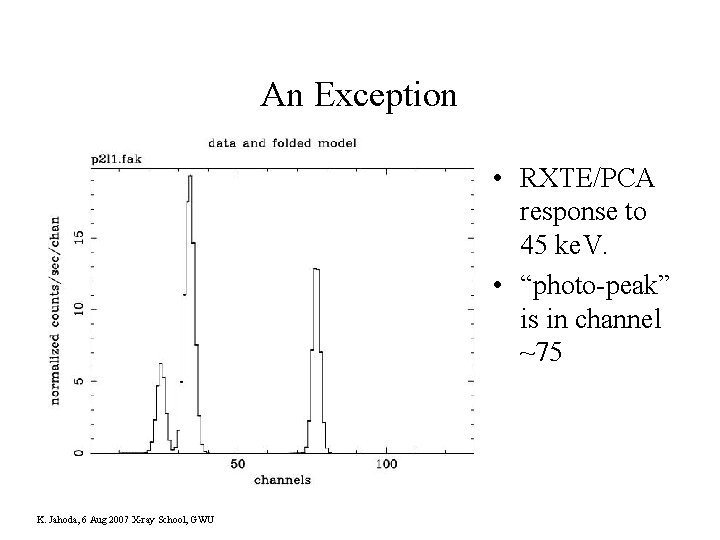
An Exception • RXTE/PCA response to 45 ke. V. • “photo-peak” is in channel ~75 K. Jahoda, 6 Aug 2007 X-ray School, GWU
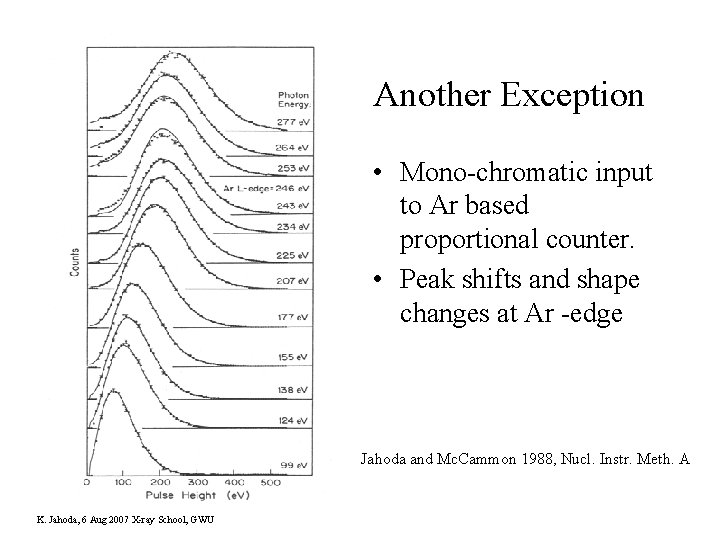
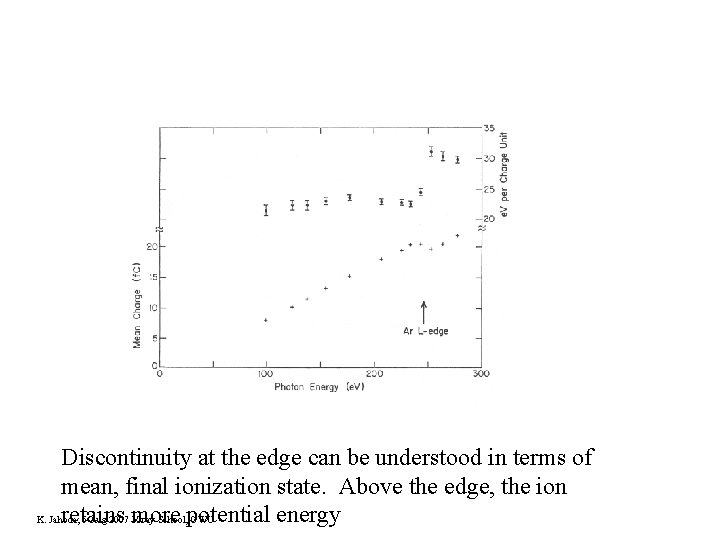
Another Exception • Mono-chromatic input to Ar based proportional counter. • Peak shifts and shape changes at Ar -edge Jahoda and Mc. Cammon 1988, Nucl. Instr. Meth. A K. Jahoda, 6 Aug 2007 X-ray School, GWU
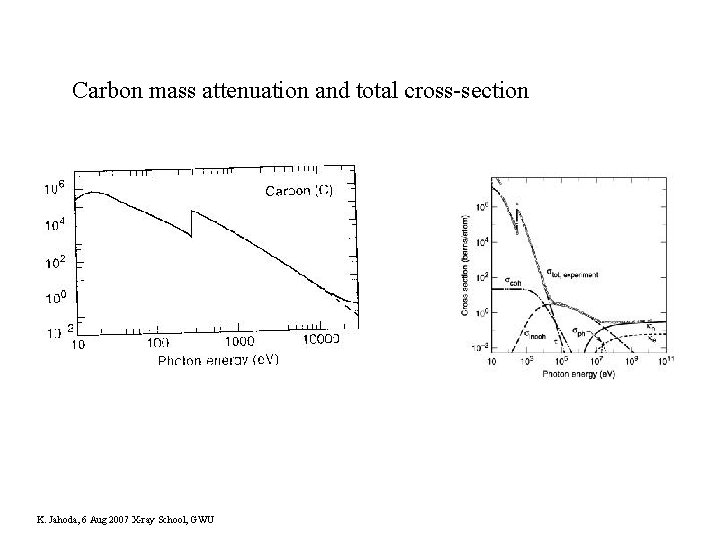
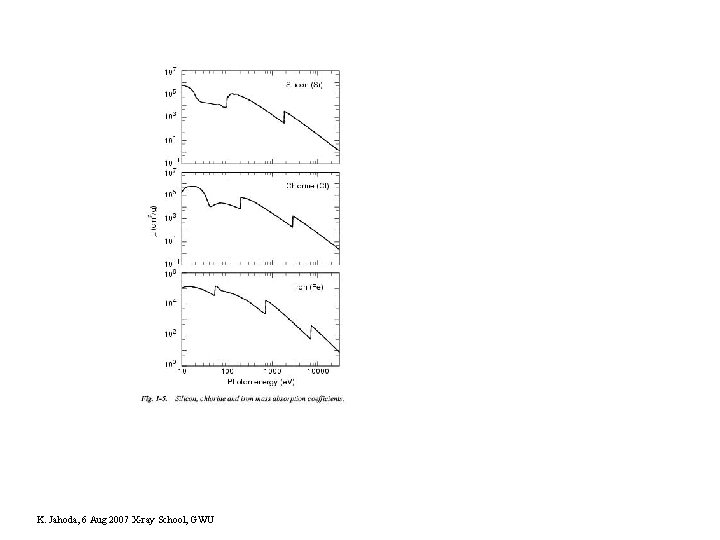
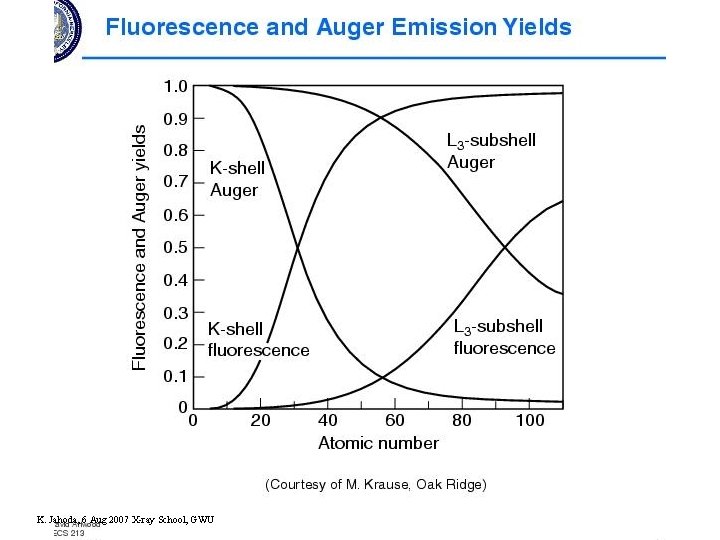
Carbon mass attenuation and total cross-section K. Jahoda, 6 Aug 2007 X-ray School, GWU
K. Jahoda, 6 Aug 2007 X-ray School, GWU
K. Jahoda, 6 Aug 2007 X-ray School, GWU
Discontinuity at the edge can be understood in terms of mean, final ionization state. Above the edge, the ion retains energy K. Jahoda, 6 Aug 2007 more X-ray School, potential GWU
K. Jahoda, 6 Aug 2007 X-ray School, GWU
K. Jahoda, 6 Aug 2007 X-ray School, GWU
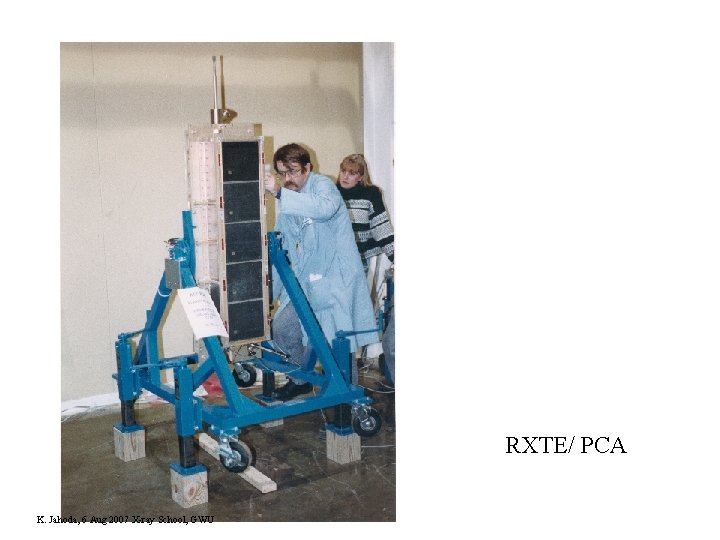
RXTE/ PCA K. Jahoda, 6 Aug 2007 X-ray School, GWU
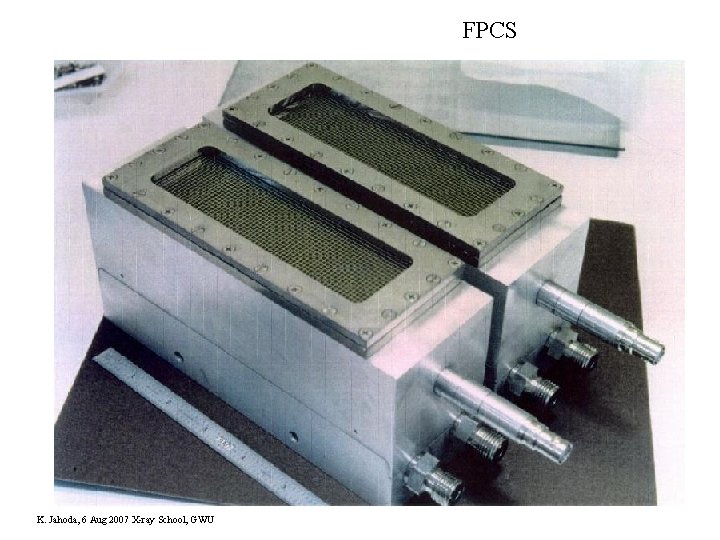
FPCS K. Jahoda, 6 Aug 2007 X-ray School, GWU
K. Jahoda, 6 Aug 2007 X-ray School, GWU
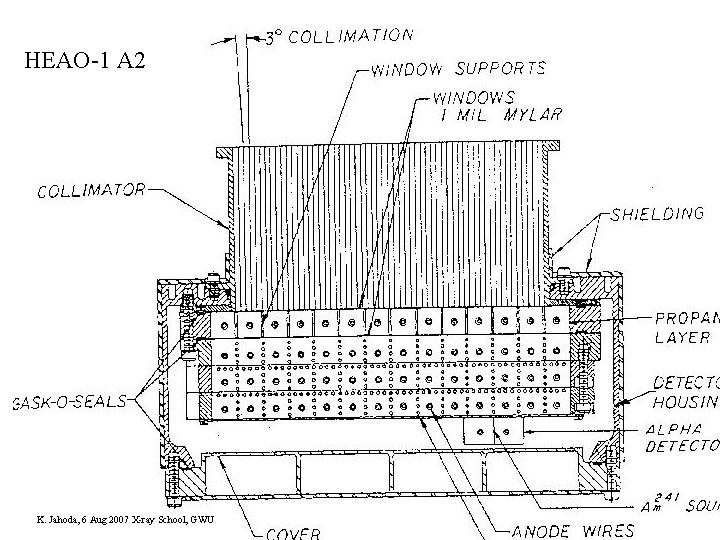
HEAO-1 A 2 K. Jahoda, 6 Aug 2007 X-ray School, GWU
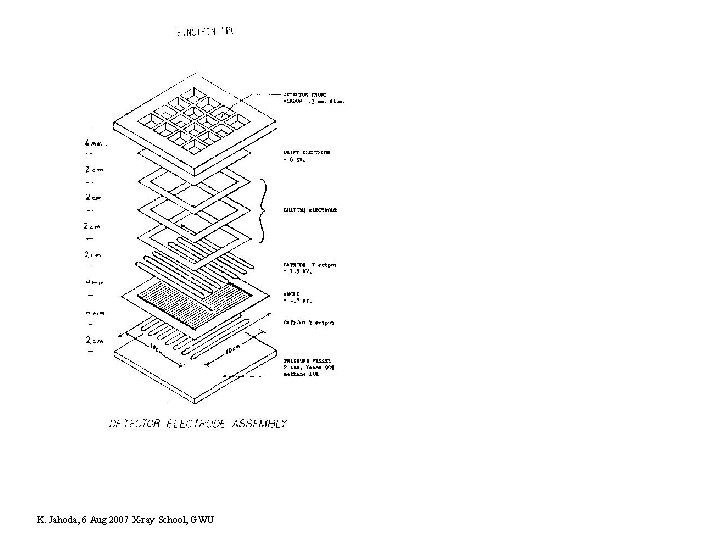
K. Jahoda, 6 Aug 2007 X-ray School, GWU
Future Uses • Polarimetry – Gas detector allows images of the individual interactions. – Range of the photo-electron can be tuned K. Jahoda, 6 Aug 2007 X-ray School, GWU
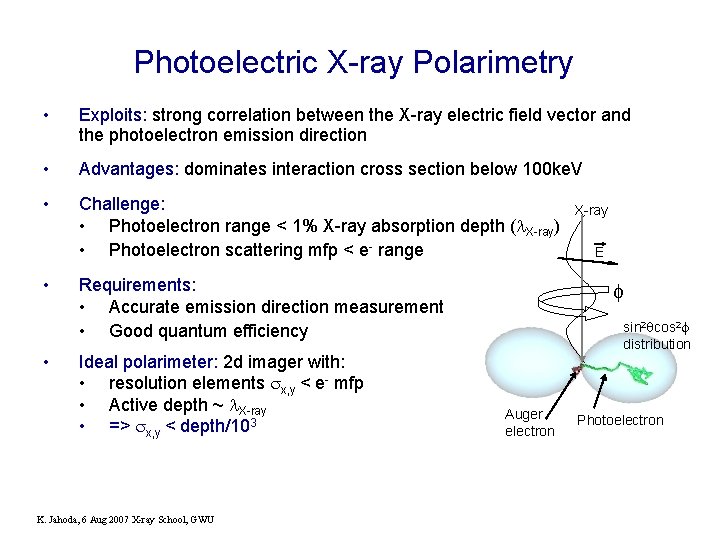
Photoelectric X-ray Polarimetry • Exploits: strong correlation between the X-ray electric field vector and the photoelectron emission direction • Advantages: dominates interaction cross section below 100 ke. V • Challenge: • Photoelectron range < 1% X-ray absorption depth (l. X-ray) • Photoelectron scattering mfp < e- range • • Requirements: • Accurate emission direction measurement • Good quantum efficiency Ideal polarimeter: 2 d imager with: • resolution elements sx, y < e- mfp • Active depth ~ l. X-ray • => sx, y < depth/103 K. Jahoda, 6 Aug 2007 X-ray School, GWU X-ray E f sin 2 qcos 2 f distribution Auger electron Photoelectron
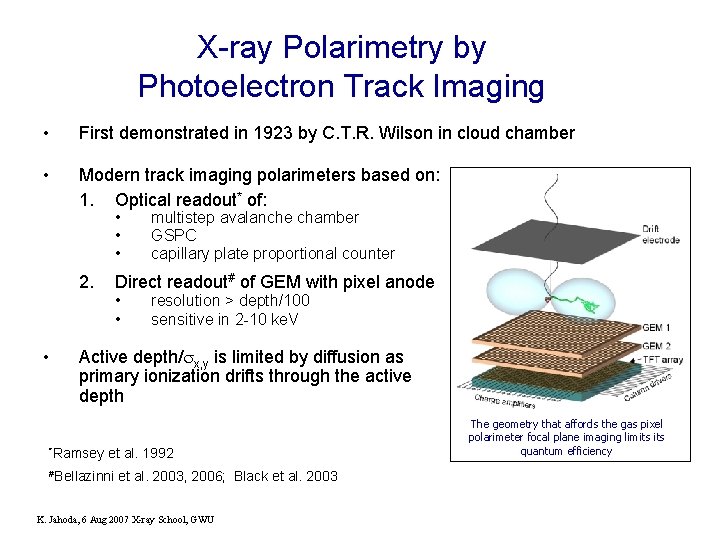
X-ray Polarimetry by Photoelectron Track Imaging • First demonstrated in 1923 by C. T. R. Wilson in cloud chamber • Modern track imaging polarimeters based on: 1. Optical readout* of: • • • 2. • multistep avalanche chamber GSPC capillary plate proportional counter Direct readout# of GEM with pixel anode • • resolution > depth/100 sensitive in 2 -10 ke. V Active depth/sx, y is limited by diffusion as primary ionization drifts through the active depth *Ramsey et al. 1992 #Bellazinni et al. 2003, 2006; Black et al. 2003 K. Jahoda, 6 Aug 2007 X-ray School, GWU The geometry that affords the gas pixel polarimeter focal plane imaging limits quantum efficiency
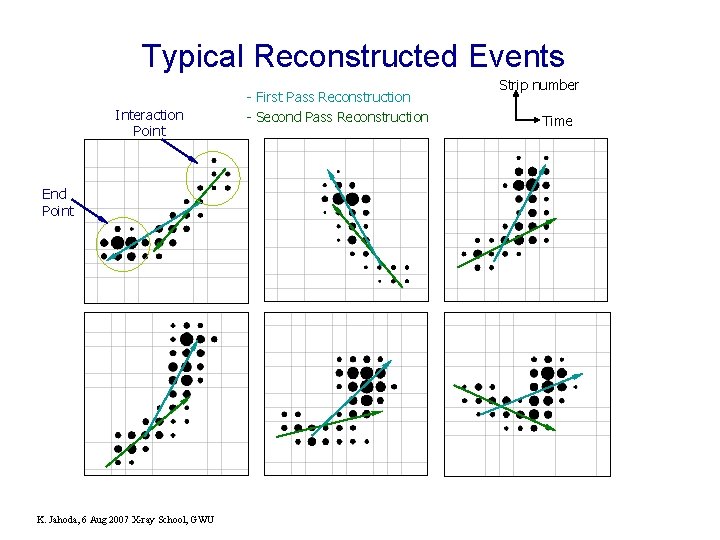
Typical Reconstructed Events Interaction Point End Point K. Jahoda, 6 Aug 2007 X-ray School, GWU - First Pass Reconstruction - Second Pass Reconstruction Strip number Time
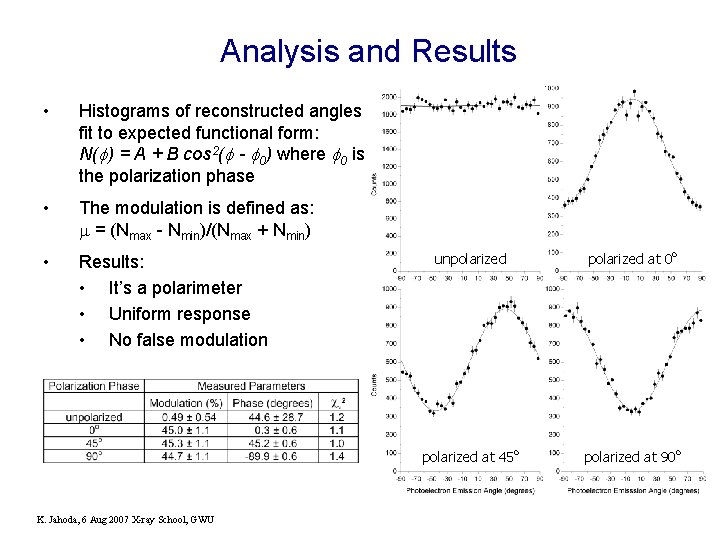
Analysis and Results • Histograms of reconstructed angles fit to expected functional form: N(f) = A + B cos 2(f - f 0) where f 0 is the polarization phase • The modulation is defined as: m = (Nmax - Nmin)/(Nmax + Nmin) • Results: • It’s a polarimeter • Uniform response • No false modulation K. Jahoda, 6 Aug 2007 X-ray School, GWU unpolarized at 0 o polarized at 45 o polarized at 90 o