
Proportion difference and confidence interval based on CMH
Proportion difference and confidence interval based on CMH test in stratified RCT with an example in pooled analysis of HIV trials Jacob Gong
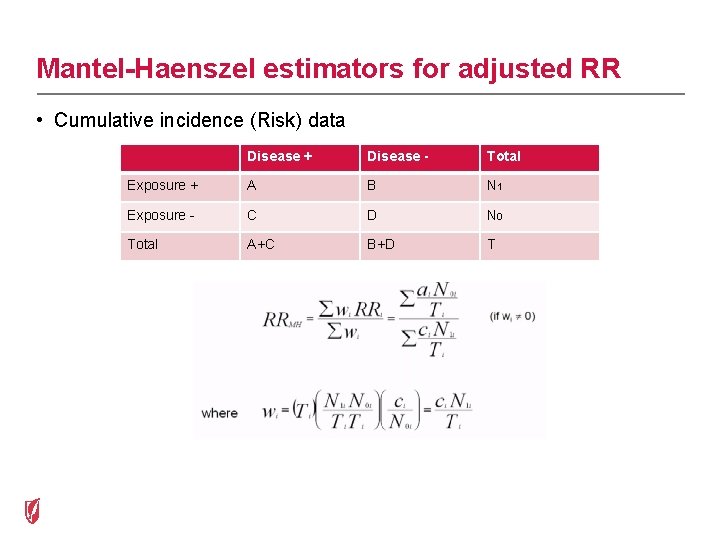
Mantel-Haenszel estimators for adjusted RR • Cumulative incidence (Risk) data Disease + Disease - Total Exposure + A B N 1 Exposure - C D N 0 Total A+C B+D T
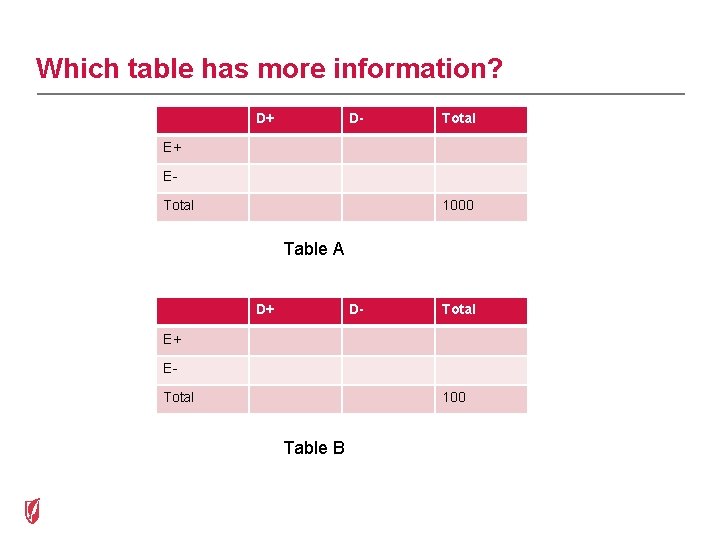
Which table has more information? D+ D- Total E+ ETotal 1000 Table A D+ D- Total E+ ETotal 100 Table B
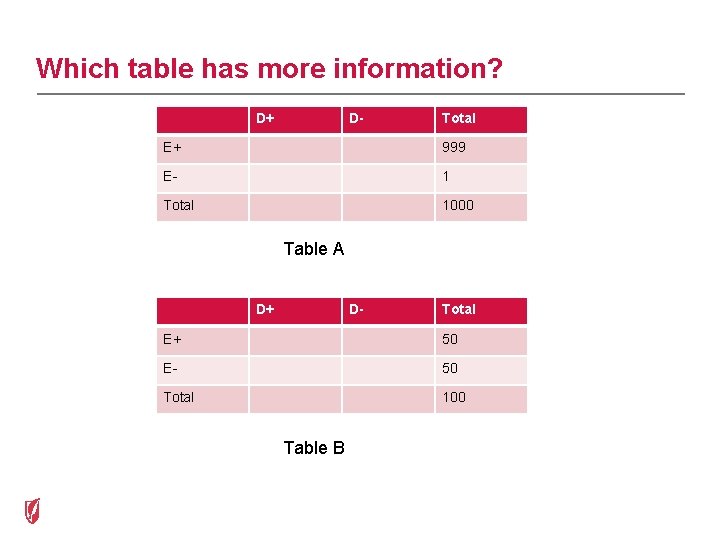
Which table has more information? D+ D- Total E+ 999 E- 1 Total 1000 Table A D+ D- Total E+ 50 E- 50 Total 100 Table B
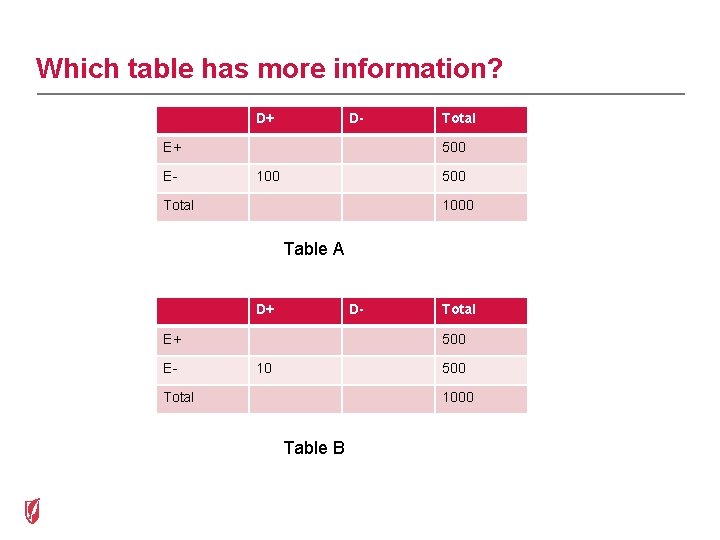
Which table has more information? D+ D- E+ E- Total 500 100 500 Total 1000 Table A D+ D- E+ E- Total 500 10 500 Total 1000 Table B

Cochran-Mantel-Haenszel Estimates - Example Age < 50 CVD Age >= 50 No CVD Total CVD No CVD Total Males 14 1502 1516 76 873 949 Females 10 1691 1701 121 2124 2245 Total 24 3193 3217 197 2997 3194 Crude RR =(90/2465)/(131/3946)=1. 10 RR age<50 =(14/1516)/(10/1701)=1. 57 RR age 50+ =(76/949)/(121/2245)=1. 49
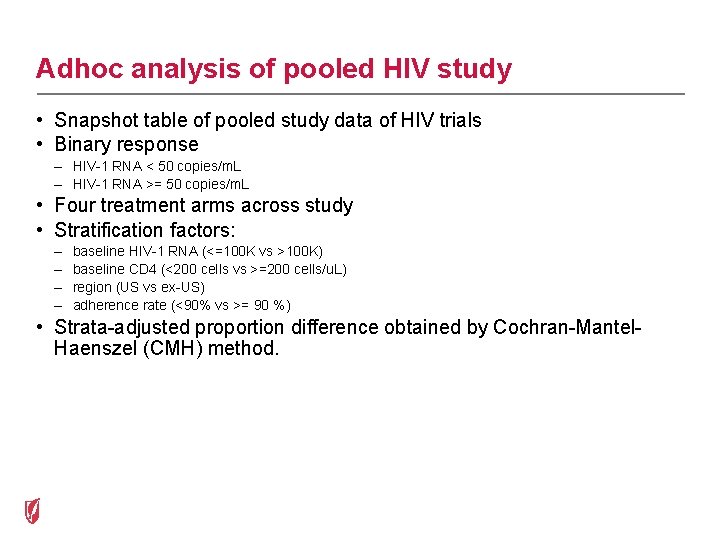
Adhoc analysis of pooled HIV study • Snapshot table of pooled study data of HIV trials • Binary response – HIV-1 RNA < 50 copies/m. L – HIV-1 RNA >= 50 copies/m. L • Four treatment arms across study • Stratification factors: – – baseline HIV-1 RNA (<=100 K vs >100 K) baseline CD 4 (<200 cells vs >=200 cells/u. L) region (US vs ex-US) adherence rate (<90% vs >= 90 %) • Strata-adjusted proportion difference obtained by Cochran-Mantel. Haenszel (CMH) method.

Treatment difference (95 CI) CMH test in SAS Response Treatment Control Total Yes X 1 j X 0 j Xj No n 1 j-x 1 j n 0 j-x 0 j Nj-Xj Total n 1 j n 0 j Nj each stratum j • No SAS option in PROC FREQ to produce strata-adjusted proportion difference from CMH method. At Gilead, we use %tabsamhp

Using 4 stratification factor • Macro produce difference in percentages between treatments but fail to produce 95%CI, p-value, why? There are many small or missing stratum
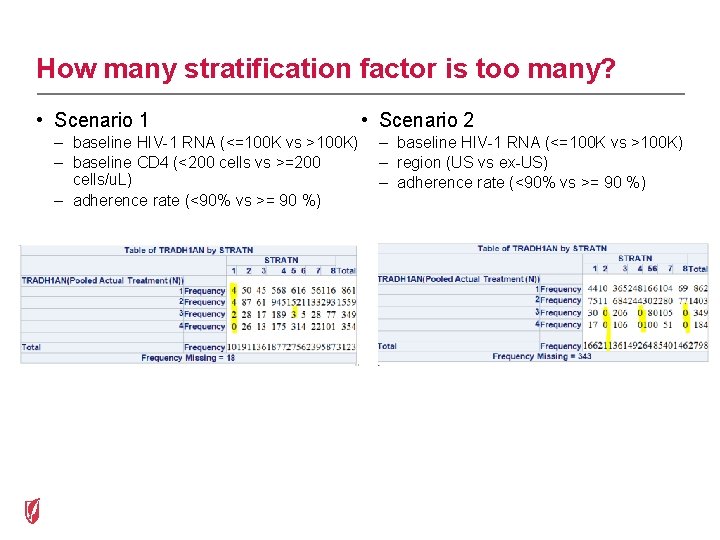
How many stratification factor is too many? • Scenario 1 – baseline HIV-1 RNA (<=100 K vs >100 K) – baseline CD 4 (<200 cells vs >=200 cells/u. L) – adherence rate (<90% vs >= 90 %) • Scenario 2 – baseline HIV-1 RNA (<=100 K vs >100 K) – region (US vs ex-US) – adherence rate (<90% vs >= 90 %)
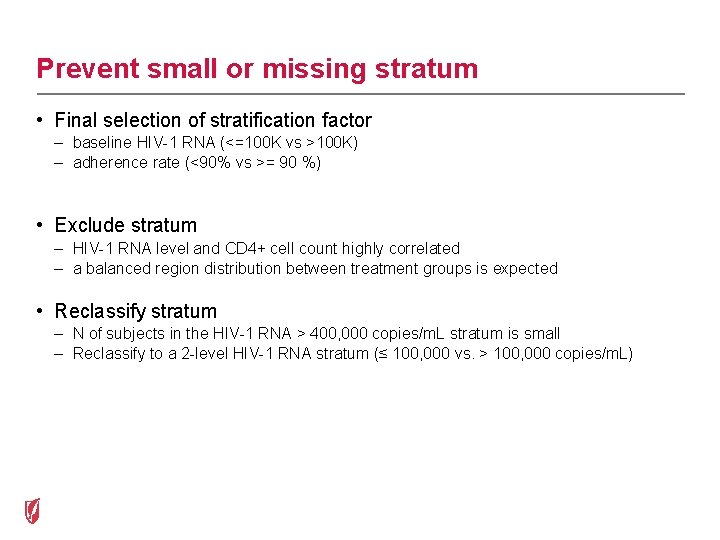
Prevent small or missing stratum • Final selection of stratification factor – baseline HIV-1 RNA (<=100 K vs >100 K) – adherence rate (<90% vs >= 90 %) • Exclude stratum – HIV-1 RNA level and CD 4+ cell count highly correlated – a balanced region distribution between treatment groups is expected • Reclassify stratum – N of subjects in the HIV-1 RNA > 400, 000 copies/m. L stratum is small – Reclassify to a 2 -level HIV-1 RNA stratum (≤ 100, 000 vs. > 100, 000 copies/m. L)
Lesson learnt • CMH test • For CMH test to be valid, the sample size should be relatively large in each stratum. • Check to make sure enough statistical power for CMH test to provide meaningful treatment difference and 95%CI • Prevent small or missing stratum – Exclude stratum – Reclassify stratum
Acknowledgement • Yu Ning, Associated Director, Statistical Programming, Gilead Science • Ting Bai, Associated Director, Statistical Programming, Gilead Science • Dayakar Gouru, Senior Statistical Programmer, Gilead Science
Reference • Confounding and Effect Measure Modification Wayne W. La. Morte, MD, Ph. D, MPH, Professor of Epidemiology, Lisa Sullivan, Ph. D, Professor of Biostatistics, Boston University School of Public Health
- Slides: 14