
Propofol Physical Chemical properties Propofol consists of phenol
- Slides: 21
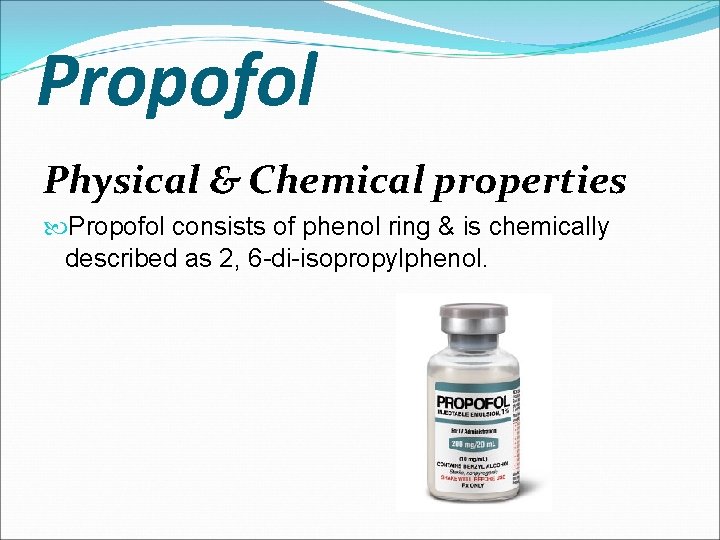
Propofol Physical & Chemical properties Propofol consists of phenol ring & is chemically described as 2, 6 -di-isopropylphenol.
The colour of solution is Milky white and is available in 1% and 2% concentration. The formulation also contains soybean oil, Egg, Lecithin & glycerol. So injection is painful. The propofol injectable emulsion is isotonic and has a p. H of 4. 5 -6. 4. It is preservative free so should be used within 6 hrs after opening the vial because there have been death reports following the use of contaminated solution of propofol ( as egg lecithin is a good media for bacterial growth ). To prevent this formulations have disodium edetate or sodium metabisulfite as antimicrobials.
Mechanism of Action Specific mechanism is unknown. But it is mainly due to GABA medaited. Anaesthetic properties It is a sedative hypnotic used in the induction and maintenance of anesthesia. Induction is achieved in one brain arm circulation time i. e. 15 seconds. Consciousness is regained after 2 -8 minutes due to redistribution. Elimination half life is 2 -4 hrs, recovery is rapid & associated with less hangover than thiopentone. It has no analgesic property. It is not a muscle relaxant. Dose : 2 mg /kg.
Metabolism It is chiefly eliminated by hepatic conjugation to inactive metabolites which are excreted by the kidney. Elimination half life is 2 -4 hrs , recovery is rapid. All metabolic products of propofol are inactive.
Systemic Effects Cardiovascular Hypotension produced is significant & it also impairs baroreceptor response to hypotension. Respiratory The first respiratory disturbance after a bolus dose of propofol is a profound fall in tidal volume leading to apnea in many patients. There has been no accompanying cough or hiccup and otherwise anesthesia is smooth. Induces broncho dilatation. During sedation, attention must be given to the cardiorespiratory effects of propofol. Hypotension, apnea, airway obstruction, and/or oxygen desaturation can occur, especially with a rapid bolus injection.
Cerebral It also has cerebral protection effect by decreasing cerebral oxygen consumption, cerebral metabolic rate and intracranial pressure. It is also a reliable amnestic agent. It can sometimes produce muscle twitching & myoclonic activity. Eye Reduces intraocular pressure. GIT It is anti-emetic Immunologic It is antipruritic.
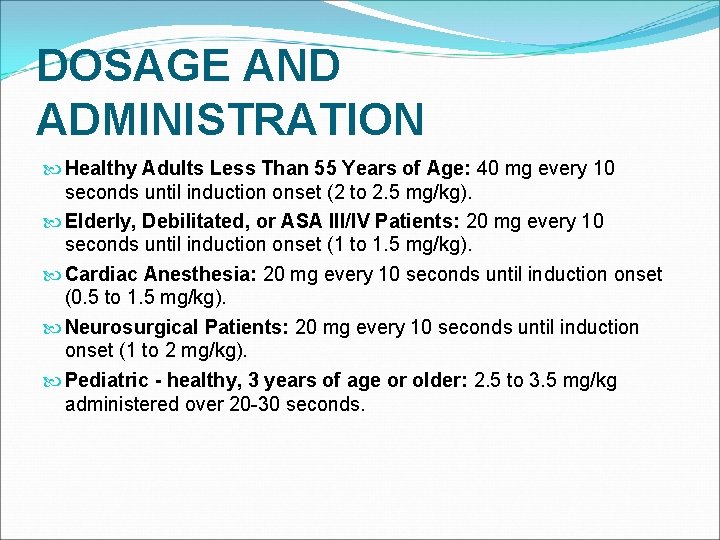
DOSAGE AND ADMINISTRATION Healthy Adults Less Than 55 Years of Age: 40 mg every 10 seconds until induction onset (2 to 2. 5 mg/kg). Elderly, Debilitated, or ASA III/IV Patients: 20 mg every 10 seconds until induction onset (1 to 1. 5 mg/kg). Cardiac Anesthesia: 20 mg every 10 seconds until induction onset (0. 5 to 1. 5 mg/kg). Neurosurgical Patients: 20 mg every 10 seconds until induction onset (1 to 2 mg/kg). Pediatric - healthy, 3 years of age or older: 2. 5 to 3. 5 mg/kg administered over 20 -30 seconds.
Indications Because of its early induction, early & smooth recovery, inactive metabolites & anti emetic effects it is, the IV agent of choice for day care surgery. Along with opioids (alfentanil or remifentanil ) it is the agent of choice for total intravenous anaesthesia (TIVA). Propofol injection can be used to produce sedation in ICU patients. Agent of choice for induction in susceptible individuals for malignant hyperthermia.
Contraindications Hypersensitivity to propofol which contains soybean oil and egg phoshpolipid Obstetrical procedures( Propofol crosses the placenta; and may be associated with neonatal depression ) Propofol is not recommended for use in nursing mothers because propofol has been reported to be excreted in human milk, and the effects of oral absorption of small amounts of propofol are still not known. Propofol is not recommended for anesthesia in children below the age of 3 years because safety and effectiveness have not been established yet.
Advantages of propofol over thiopentone Rapid and smooth recovery. Completely eliminated from body in 4 hours so patient is ambulatory early. Anti-emetic. Anti-pruritic. Bronchodilator.
Disadvantages Apnea is more profound and longer. Hypotension is more severe. Injection is painful. Solution is less stable (6 hrs). Chances of sepsis with contaminated solution is high. Myoclonic activity. Sexual fantasies and hallucination. Expensive than thiopentone. Allergic reactions in individuals who are allergic to egg lecitin. Propofol addiction has also been reported. Propofol infusion syndrome: It is very rare but is a lethal complication. Usually seen if infusion is continued for more than 48 hrs & is much more common in children.
OVERDOSAGE If accidental overdosage occurs, propofol administration should be discontinued immediately. Overdosage is likely to cause cardio-respiratory depression. Respiratory depression should be treated by artificial ventilation with oxygen. Cardiovascular depression may require repositioning of the patient by raising the patient's legs, increasing the flow rate of i. v. fluids.
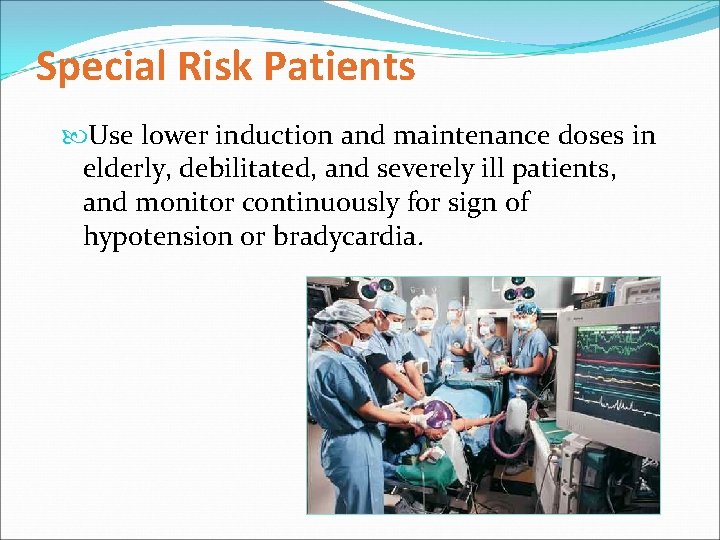
Special Risk Patients Use lower induction and maintenance doses in elderly, debilitated, and severely ill patients, and monitor continuously for sign of hypotension or bradycardia.
Etomidate is a carboxylated imidazole derivative. Etomidate has anesthetic and amnetic properties, but has no analgesic properties
Uses Etomidate is commonly used in the emergency setting as part of a rapid sequence induction to induce anesthesia or for conscious sedation. It is often used in this setting since it has a rapid onset of action and a low cardiovascular risk profile, and therefore is less likely to cause a significant drop in blood pressure than other induction agents It is the agent IV anesthetic agent of choice for aneurysm surgery & patients with cardiac disease.
Dosage The anaesthetic induction dose for adult humans is 0. 3 mg/kg intravenously, with a typical dose being 20 mg. In common with all induction agents, etomidate causes loss of consciousness after one arm-brain circulation time. At the typical dose, anesthesia is induced for about 5– 10 minutes even though the half-life of drug metabolism is approximately 75 minutes. This is because etomidate is redistributed from the plasma to other tissues.
Metabolism Etomidate is highly protein bound in blood plasma and is metabolised by hepatic and plasma esterases to inactive products with a redistribution half-life of 2– 5 minutes and an elimination half-life of 68– 75 minutes.
Actions and effects Etomidate does not cause significant cardiovascular or respiratory depression, but may cause a brief period of apnea. The decrease in cerebral blood flow produced by etomidate is approximately the same as that produced by thiopental Etomidate slightly lowers intracranial pressure and it usually causes a moderate decrease in intraocular pressure
Side effects ( disadvantages) Adrenocortical suppressioin on long term infusion. Nausea & vomiting. ( 40 %) Has very high incidence of myoclonus. High incidence of thrombophlebitis. It can cause vitamin C deficiency & platelet dysfunction. May produce pain on injection No analgesia. Hiccups are common.
Contraindications and precautions Use of etomidate is not recommended since data are insufficient to support its use in obstetrics, including cesarean section deliveries It is not known whether etomidate is distributed into breast milk. However, problems in humans have not been documented
Appropriate studies with etomidate have not been performed in children up to 10 years of age. Safety and efficacy have not been established. Elderly patients are more sensitive to the effects of etomidate than are younger patients. In addition, geriatric patients are more likely to have agerelated hepatic function impairment, which may require reduction of dosage in patients receiving etomidate