
Property Law Types of dominion over things Ulpianus

- Slides: 45
Property Law
Types of dominion over things Ulpianus: Nihil commune habet proprietas cum possessione. Possession and ownership are two different things.
Types of dominion over things • Factual dominion: possession (its variations) wielding (pure factual dominion) • Legal dominion: ownership and numerous rights in rem (easement, pledge, surface right, perpetual usufruc)
Factual dominion - possesion • corpus – physial dominion over a thing • animus – intention to retain the thing: for oneself or for someone else.
Types of possession (1) • possessio civilis – civil possession, generally given legal possession in various manners. • possessio naturalis (detentio) – natural possession (wielding), only in exceptional circumstances granted legal protection.
Types of possession (2) • possessio bonae fidei – possession in good faith, the conviction that something belongs to us. • possessio malae fidei – possession in bad faith, the conviction that somethig does not belong to us.
Types of possession (3) • possessio iusta - based on legal norms • possessio iniusta (vi, clam, precario) - not based on legal norms
Particular types of possession • possessio ad interdicta – possession protected by praetorian interdiction - condition: animus rem sibi habendi – the intention to keep the thing for oneself. • quasi possessio – possession "as if" - e. g. Possession of an interitance, as an estate is an individual non-material thing, regardless of the number of physical things and claims contained in it.
Acquiring position Rule: corpore et animo, simultaneously handing over the physical thing and having the desire to transfer possession. Exceptions (discussed on the next slides): • constitutum possessorium • traditio brevi manu
Acquiring possession II Exception (from the previous slide): • constitutum possessorium Transfer of possession on the basis of an understanding, in which the previous owner-like possessor (e. g. the owner of the thing) keeps the thing in his dominion as a dependent possessor or wielder on the basis of a legal relationship (e. g. rental contract), which the parties establish jointly.
Acquiring possession III Exception (from the previous slide): • traditio brevi manu Transfer of owner-like possession to the dependent possessor, or to the wielder, on the sole basis of a contract. For example, when the owner of a house sells it to the person currently leasing it.
Protection of possession • Interdicta retinendae possessionis Served to protect current possession which was being interrupted. • Interdicta recuperandae possessionis Served to restore possession after it was lost.
Interdicta retinendae possessionis 1. Interdictum uti possidetis – concerned real property, the rightful possessor at the moment of the interdict’s issuance was victorious. 2. Interdictum utrubi – concerned moveables, the rightful possessor with the longest period of possession over the preceding year was victorious.
Interdicta recuperandae possessionis (1) 1. Interdictum unde vi – valid for one year from dispossession by force. 2. Interdictum de vi armata – no limitation for someone dispossessed by armed force.
Interdicta recuperandae possessionis (2) 3. Interdictum de precario – could be enforced against a recalcitrant possessor who was obliged to return a thing and failed to do so. 4. Interdictum quod vi aut clam – could be enforced against the possessor of land acting in secret and with force, e. g. one who cut down a tree.
The concept of ownership • No general Roman definition • The only general description is found in Justinian’s Institutions: Plena in re potestas (Full dominion over a thing)
The concept of ownership (2) Distinguishing factors: • Protection of possession via actiones in rem. • Actiones in rem were effective erga omnes, meaning including individuals with whom the owner was not linked by any legal realtionship.
The substance of ownership (1) • Roman jurists understood the substance of the right of ownership intuitively and described it causistically. • In the Middle Ages, a general and abstract enumeration of the owner’s rights was developed.
The rights of the owner • Ius possidendi – right to possess the thing • Ius utendi – right to use thing • Ius abutendi – right to use thing up • Ius fruendi – right to derive benefits from the thing • Ius disponendi – right to dispose legally of the thing
Types of full legal dominion over things in the Roman state • Dominium ex iure Quiritium • State of res in bonis habere • Possessio et usufructus • Property of Latins • Property of peregrines
Limitations on the right of ownership in public law • Sanitary • Communication • Construction • Possibility to dispossess for the public good
Limitations on the right of ownership in private law • Law of neighbours • Limited property rights • Obligatory relationships
Joint ownership • Only in fractions - Every owner was entitled to defined, abstract fractional ownership of the entire thing, e. g. ¼. - Potential division quoad usum, meaning for use
Division of joint ownership • Actio communi dividundo – action used for establishing joint ownership. • Actio familiae erciscundae – action used in probate matters. • Joint owners could decide themselves about a division of joint ownership. • In case of a dispute, a court could decide about the division of jointly-owned property, such as parcels of land, or could order payments to the other joint owners.
Secondary acquisition of ownership • Mancipatio – formal ceremony transferring ownership before 5 witnesses and weigher (libripens). • In iure cessio – formal transfer of ownership before a civil servant. • Traditio – informal transfer of ownership in objects of lesser value. During the later imperial period (dominate) the first two forms disappeared, and the only way of transferring ownership was traditio.
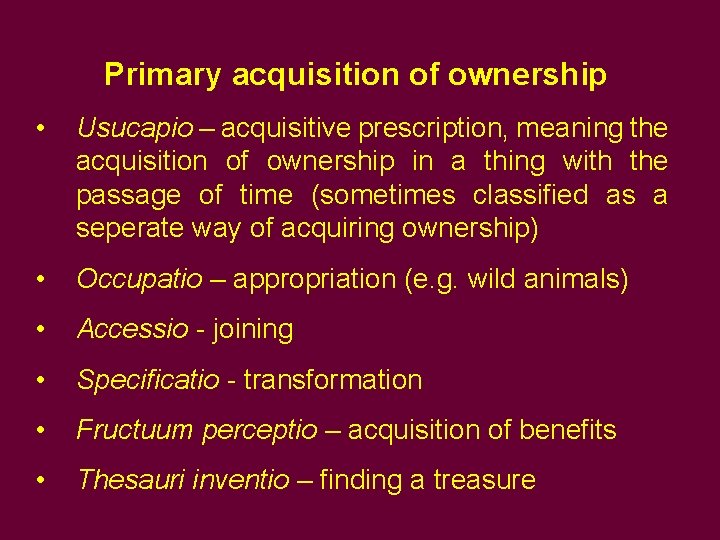
Primary acquisition of ownership • Usucapio – acquisitive prescription, meaning the acquisition of ownership in a thing with the passage of time (sometimes classified as a seperate way of acquiring ownership) • Occupatio – appropriation (e. g. wild animals) • Accessio - joining • Specificatio - transformation • Fructuum perceptio – acquisition of benefits • Thesauri inventio – finding a treasure
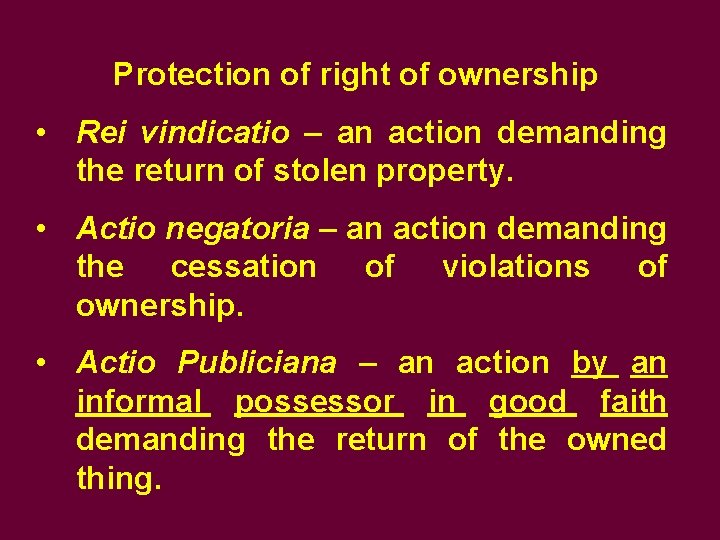
Protection of right of ownership • Rei vindicatio – an action demanding the return of stolen property. • Actio negatoria – an action demanding the cessation of violations of ownership. • Actio Publiciana – an action by an informal possessor in good faith demanding the return of the owned thing.
Rights in the property of others • Servitudes • Emphyteusis • Right of the surface (Superficies) • Pledge
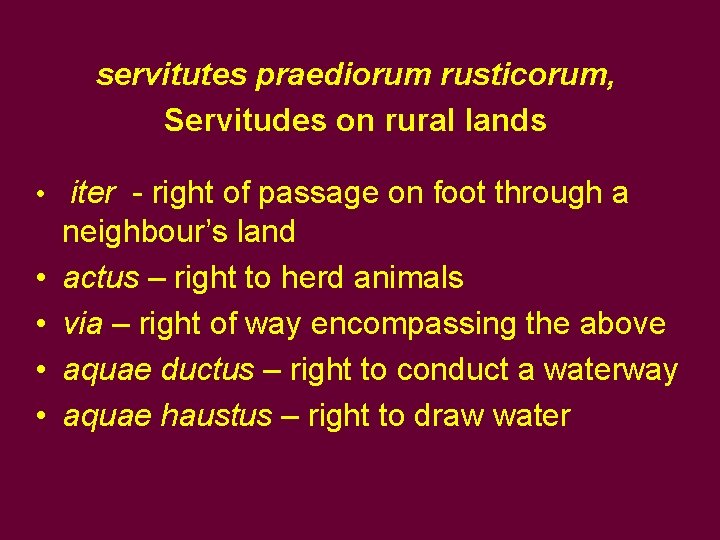
servitutes praediorum rusticorum, Servitudes on rural lands • iter - right of passage on foot through a • • neighbour’s land actus – right to herd animals via – right of way encompassing the above aquae ductus – right to conduct a waterway aquae haustus – right to draw water
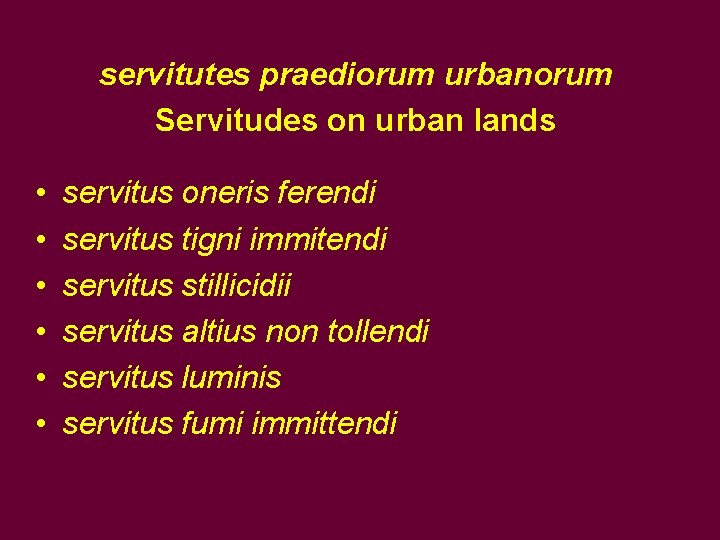
servitutes praediorum urbanorum Servitudes on urban lands • • • servitus oneris ferendi servitus tigni immitendi servitus stillicidii servitus altius non tollendi servitus luminis servitus fumi immittendi
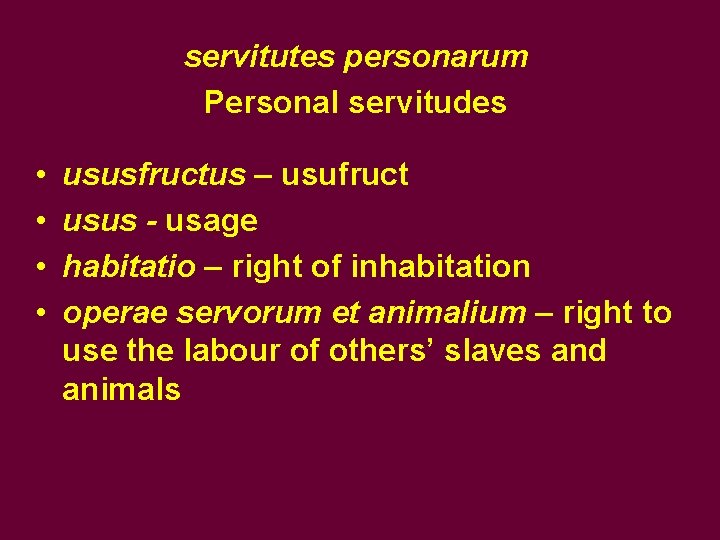
servitutes personarum Personal servitudes • • ususfructus – usufruct usus - usage habitatio – right of inhabitation operae servorum et animalium – right to use the labour of others’ slaves and animals
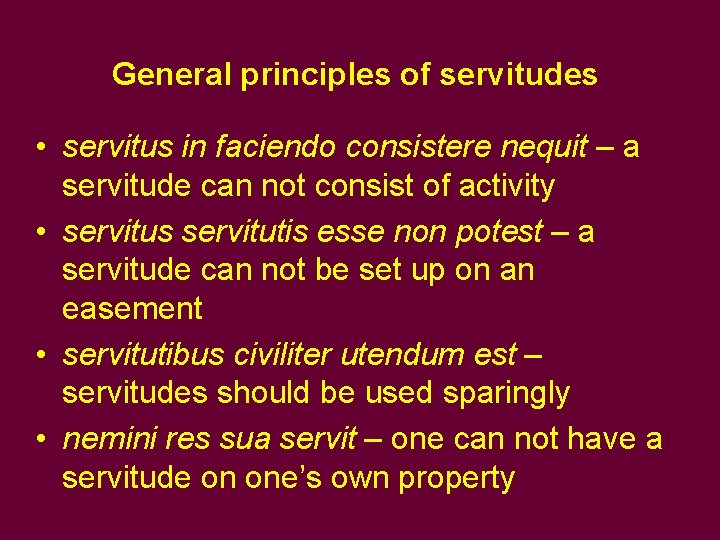
General principles of servitudes • servitus in faciendo consistere nequit – a servitude can not consist of activity • servitus servitutis esse non potest – a servitude can not be set up on an easement • servitutibus civiliter utendum est – servitudes should be used sparingly • nemini res sua servit – one can not have a servitude on one’s own property
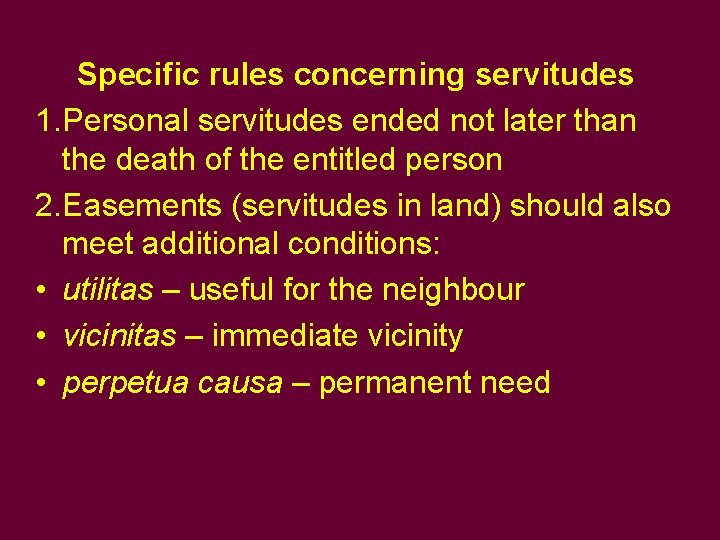
Specific rules concerning servitudes 1. Personal servitudes ended not later than the death of the entitled person 2. Easements (servitudes in land) should also meet additional conditions: • utilitas – useful for the neighbour • vicinitas – immediate vicinity • perpetua causa – permanent need
Perpetual leasehold - origins 1. Ius in agro vectigali – Roman leasehold of public lands 2. Emphyteusis – from the Hellenic law, resulting from private law actions such as contract, testament 3. Emperor Zenon in 480 decided about the seperateness of institutional emphyteusis from other property rights and obligations
Perpetual leasehold – establishment Two possibilities 1. Contractus emphyteuticarius – a special emphyteutical contract 2. Testamentum - testament
Perpetual leasehold – rights of the leaseholder 1. To collect benefits at the moment of seperation from the superior thing 2. Possibility to decide independently about changes in crop types 3. Use of actions designed to protect possession 4. Right to dispose of leasehold
Permanent leasehold – duties of the leaseholder 1. Annual rent paid to owner 2. Payment of all taxes burdening the land 3. Maintaining land in good condition 4. Informing owner of intention to dispose of leasehold 5. Payment of laudemium upon effective disposal of leasehold
Permanent leasehold – expieration 1. Destruction of land 2. Convergence of leasehold with ownership (e. g. Owner exercises right of pre-emption) 3. Removal of leaseholder (e. g. for failure to pay rent for three successive years)
Superficies • This right did not infringe the principle superficies solo cedit (what is permanently connected to the ground belongs to the owner of the ground) • Protected through a special (interdictum de superficiebus) interdict • Only in Justinian law was the superficiary granted actiones in rem
Pledge – essence • Real securrity for a debt • Accessorial • Secured only a specified receivable (exception: pignus Gordianum)
Pledge – historical development • Fiducia – fiduciary pledge, associated with transfer of pledged item to the creditor • Pignus – pledge in which the creditor only wields the pledged item; presently available in pawn shops • Hypotheca – contractual pledge, the item remained in the dominion of the debtor
Fiducia • Fiduciary contract transfering ownership of a thing • In archaic law there was no civil protection for a fiduciary debtor • In later law, the debtor was granted a seperate right of action, actio fiduciae directa
Pignus • This form of pledge appeared at the beginning of the republic • Consisted in the pledgee being the wielder of the item • The property right arose out of a contract with the same name
Additional covenants which could be concluded in the case of a pledge • Lex commissoria, forfeiture clause – the object of the pledge became the property of the creditor in the event of failure to pay the debt • Pactum de vendendo – a contract for sale of the item by the lender if the debtor failed to pay the debt, but settlement was required • Antichresis – a contract on collecting
Hypotheca • Origins in the 2 nd century BC • Milestone at the turn of the 2 nd and 1 st centuries BC when praetor Salvianus introduced a special possession interdict, interdictum Salvianum • In the mid-1 st century the praetor Servius introduced a separate actio in rem, called actio Serviana • In the Roman Empire there was no special land register, only Egypt had a proper land register.