
Property dualism and mental causation Michael Lacewing enquiriesalevelphilosophy
- Slides: 12
Property dualism and mental causation Michael Lacewing enquiries@alevelphilosophy. co. uk
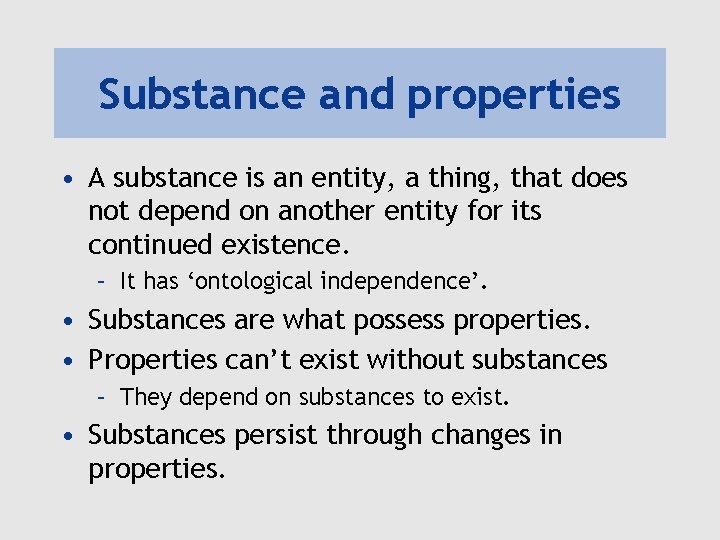
Substance and properties • A substance is an entity, a thing, that does not depend on another entity for its continued existence. – It has ‘ontological independence’. • Substances are what possess properties. • Properties can’t exist without substances – They depend on substances to exist. • Substances persist through changes in properties.
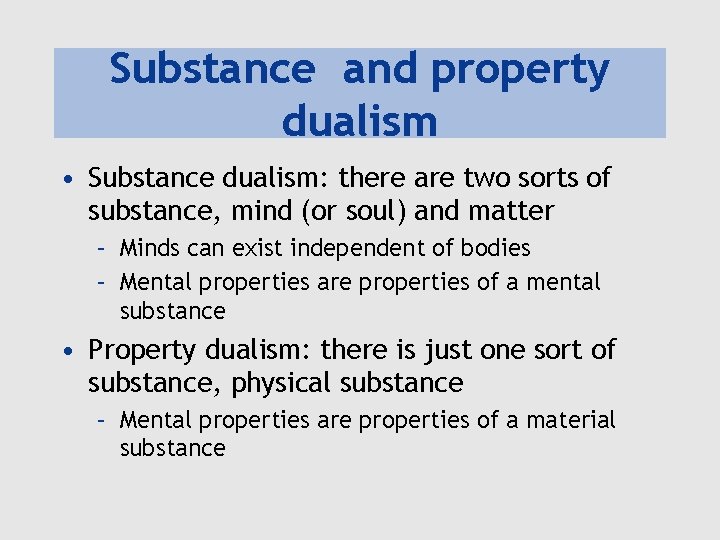
Substance and property dualism • Substance dualism: there are two sorts of substance, mind (or soul) and matter – Minds can exist independent of bodies – Mental properties are properties of a mental substance • Property dualism: there is just one sort of substance, physical substance – Mental properties are properties of a material substance
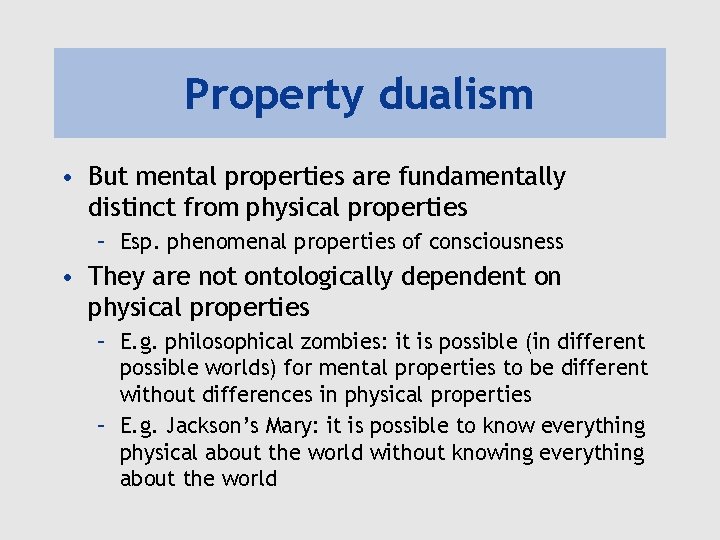
Property dualism • But mental properties are fundamentally distinct from physical properties – Esp. phenomenal properties of consciousness • They are not ontologically dependent on physical properties – E. g. philosophical zombies: it is possible (in different possible worlds) for mental properties to be different without differences in physical properties – E. g. Jackson’s Mary: it is possible to know everything physical about the world without knowing everything about the world
Mental causation • Do mental properties have ‘causal powers’? – E. g. Do thoughts cause bodily movements and other thoughts? • Property dualism doesn’t face the problem of substance dualism, because mental properties are properties of physical substance • But how do thoughts etc. cause physical effects? – This is no objection: any fundamental causal relationship can’t be further explained
Property dualism and science • Obj: if mental properties cause physical effects, this is incompatible with science – We don’t have good evidence of this – Some interpretations of quantum mechanics support the idea that consciousness has effects
Epiphenomenalism • But it is appealing to think that every physical event has a sufficient physical cause – This is compatible with property dualism if mental properties make no causal difference to the world – epiphenomenalism • The claim is very counterintuitive
Epiphenomenalism • Reply: it seems like mental states (e. g. pain) cause physical effects (e. g. crying) because a brain process causes both – So the mental state is correlated with the effect, but doesn’t cause it • Obj: how and why would epiphenomenal properties evolve? – Reply: they are by-products of traits (brain processes) that make a difference to survival
Introspection • I know I am in pain, because my belief that I am in pain is caused by my pain – If epiphenomenalism is true, my pain causes nothing • I will believe that I am in pain if my brain processes are the same, even if I am not in pain – So if epiphenomenalism is true, my belief is unreliable, and not knowledge
Reply • Knowledge doesn’t require direct causation – Suppose the brain state that causes pain also causes the belief that I am in pain – Then I wouldn’t (normally) have the belief without the pain – so my belief is reliable – So I know when I’m in pain
Free will and responsibility • Epiphenomenalism threatens to undermine choice and responsibility for our actions – My choice is simply an effect of brain processes – how is this my choice? • Choice is not mere consciousness of choosing – Choice is the brain state that causes my awareness of choosing and my awareness • Other physicalist theories will have to agree that there is a physical component to choice
Compatibilism • Free will is not opposed to physical causation – To have free will is for one’s choices to cause one’s actions – To choose to act is to act voluntarily – When you don’t act voluntarily, you are forced to act – But your brain is not ‘forcing you’ to act – it is you choosing to act