
Property Covered Home owners policy offers property protection
- Slides: 18
Property Covered • Home owner’s policy offers property protection under Section I for: • Dwelling unit • Accompanying structures- (garage) • Personal property of home owners and their families • Common exclusions are business inventory, animals, motorized vehicles such as autos, motorcycles, golf carts or snowmobiles. PFIN 6 | CH 10 1
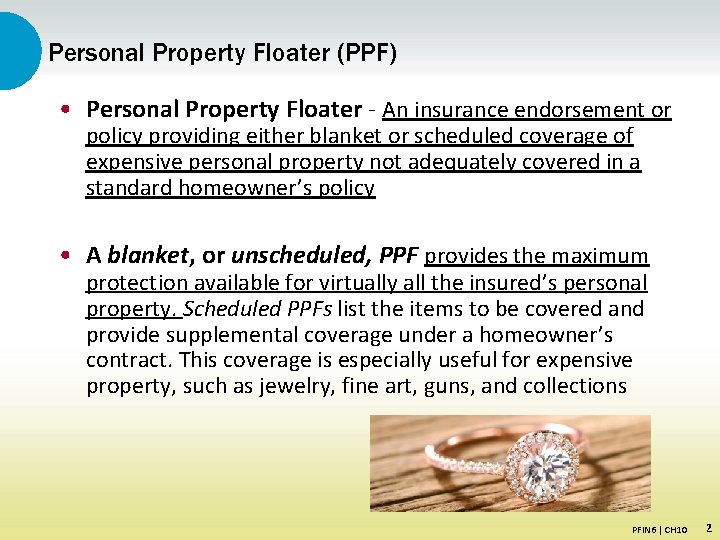
Personal Property Floater (PPF) • Personal Property Floater - An insurance endorsement or policy providing either blanket or scheduled coverage of expensive personal property not adequately covered in a standard homeowner’s policy • A blanket, or unscheduled, PPF provides the maximum protection available for virtually all the insured’s personal property. Scheduled PPFs list the items to be covered and provide supplemental coverage under a homeowner’s contract. This coverage is especially useful for expensive property, such as jewelry, fine art, guns, and collections PFIN 6 | CH 10 2
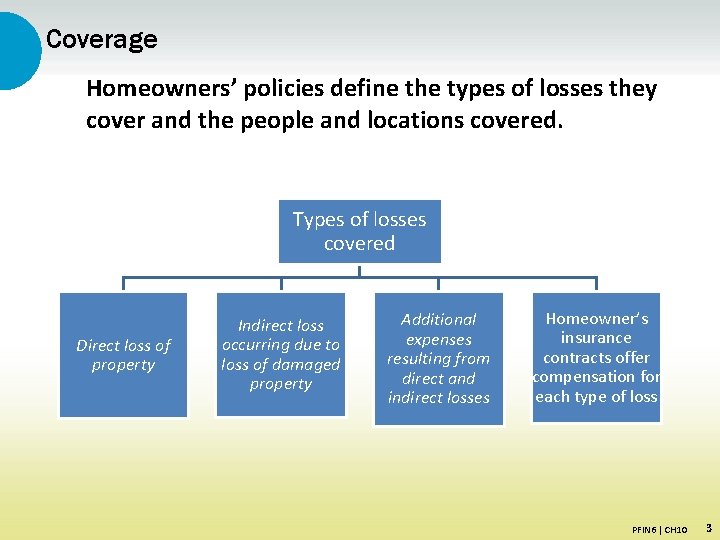
Coverage Homeowners’ policies define the types of losses they cover and the people and locations covered. Types of losses covered Direct loss of property Indirect loss occurring due to loss of damaged property Additional expenses resulting from direct and indirect losses Homeowner’s insurance contracts offer compensation for each type of loss PFIN 6 | CH 10 3
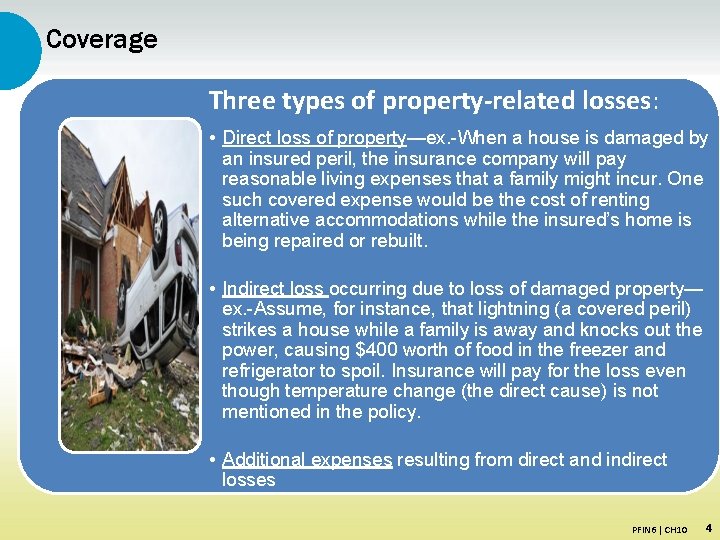
Coverage Three types of property-related losses: • Direct loss of property—ex. -When a house is damaged by an insured peril, the insurance company will pay reasonable living expenses that a family might incur. One such covered expense would be the cost of renting alternative accommodations while the insured’s home is being repaired or rebuilt. • Indirect loss occurring due to loss of damaged property— ex. -Assume, for instance, that lightning (a covered peril) strikes a house while a family is away and knocks out the power, causing $400 worth of food in the freezer and refrigerator to spoil. Insurance will pay for the loss even though temperature change (the direct cause) is not mentioned in the policy. • Additional expenses resulting from direct and indirect losses PFIN 6 | CH 10 4
Coverage • Section I • Damage of the house by an insured peril leads to the insurer paying reasonable living expenses • Section II • Home owner’s policy covers: • Cost of defending the insured • Reasonable expenses incurred by an insured in helping the insurance company’s defense • Payment of court costs PFIN 6 | CH 10 5
Coverage • Persons covered • Persons named in the policy and members of their families residing in the house • Guests of the insured with limited coverage • Locations covered • Extended worldwide when off premises temporarily PFIN 6 | CH 10 6
Factors Influencing Insurance Payment Amount for a Loss • Replacement cost • Policy limits • Deductibles PFIN 6 | CH 10 7
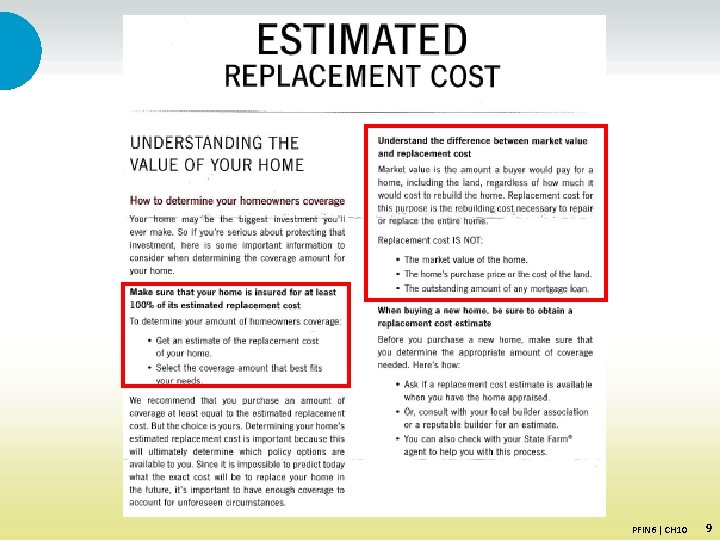
Factors Influencing Insurance Payment Amount for a Loss Replacement cost is normally paid for dwelling unit. Replacement cost is the amount necessary to repair, rebuild, or replace an asset at today’s prices (depreciation is not considered). Full replacement-cost basis will be paid only if homeowner keeps their homes insured for at least 80 percent of the amount that it would cost to build them today. In periods of inflation, homeowners must either increase their coverage limits on the dwelling unit every year or take a chance on falling below the 80 percent requirement. Personal property in house is typically covered for the actual cash value, replacement cost less depreciation PFIN 6 | CH 10 8
PFIN 6 | CH 10 9
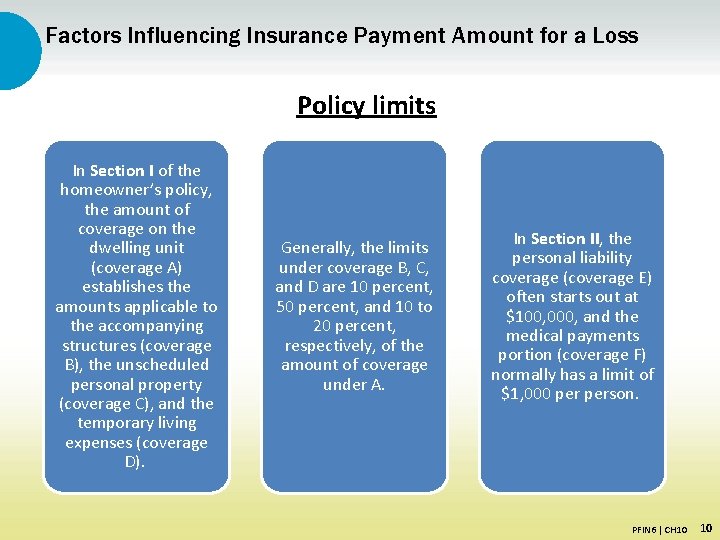
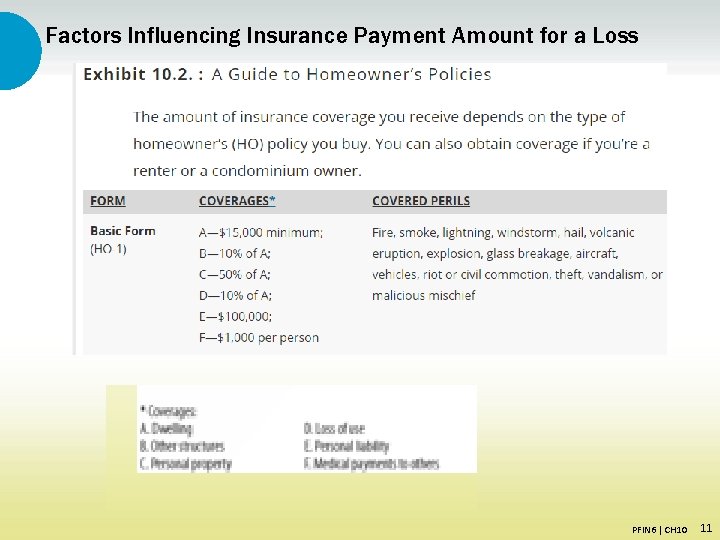
Factors Influencing Insurance Payment Amount for a Loss Policy limits In Section I of the homeowner’s policy, the amount of coverage on the dwelling unit (coverage A) establishes the amounts applicable to the accompanying structures (coverage B), the unscheduled personal property (coverage C), and the temporary living expenses (coverage D). Generally, the limits under coverage B, C, and D are 10 percent, 50 percent, and 10 to 20 percent, respectively, of the amount of coverage under A. In Section II, the personal liability coverage (coverage E) often starts out at $100, 000, and the medical payments portion (coverage F) normally has a limit of $1, 000 person. PFIN 6 | CH 10 10
Factors Influencing Insurance Payment Amount for a Loss PFIN 6 | CH 10 11
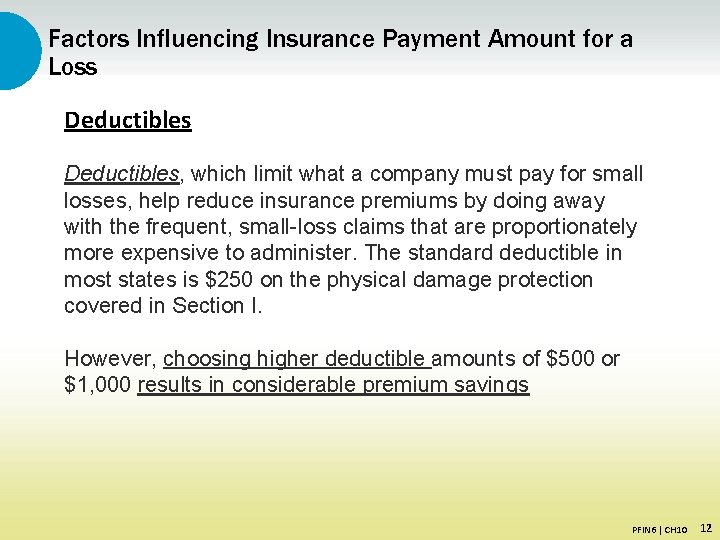
Factors Influencing Insurance Payment Amount for a Loss Deductibles, which limit what a company must pay for small losses, help reduce insurance premiums by doing away with the frequent, small-loss claims that are proportionately more expensive to administer. The standard deductible in most states is $250 on the physical damage protection covered in Section I. However, choosing higher deductible amounts of $500 or $1, 000 results in considerable premium savings PFIN 6 | CH 10 12
Personal Automobile Policy (PAP) The personal automobile policy (PAP) is a comprehensive automobile insurance policy designed to be easily understood by the “typical” insurance purchaser. Made up of six parts, the policy’s first four parts identify the coverage provided: • Part A: Liability coverage • Part B: Medical payments coverage • Part C: Uninsured motorists coverage • Part D: Coverage for damage to your vehicle Part E pertains to your duties and responsibilities if you’re involved in an accident, and Part F defines basic provisions of the policy, including the policy coverage period and the right of termination. PFIN 6 | CH 10 13
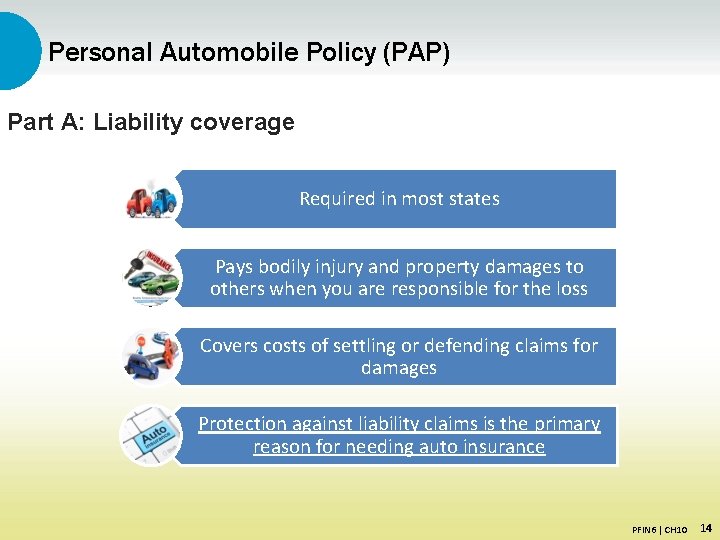
Personal Automobile Policy (PAP) Part A: Liability coverage Required in most states Pays bodily injury and property damages to others when you are responsible for the loss Covers costs of settling or defending claims for damages Protection against liability claims is the primary reason for needing auto insurance PFIN 6 | CH 10 14
Personal Automobile Policy (PAP) Part A: Who and What is Covered Insured Person: The named insured Family members Any person using covered auto Any person or organization responsible for insured’s actions Covered Auto Listed on declaration page Acquired during policy period Any vehicle temporary used while auto is being repaired PFIN 6 | CH 10 15
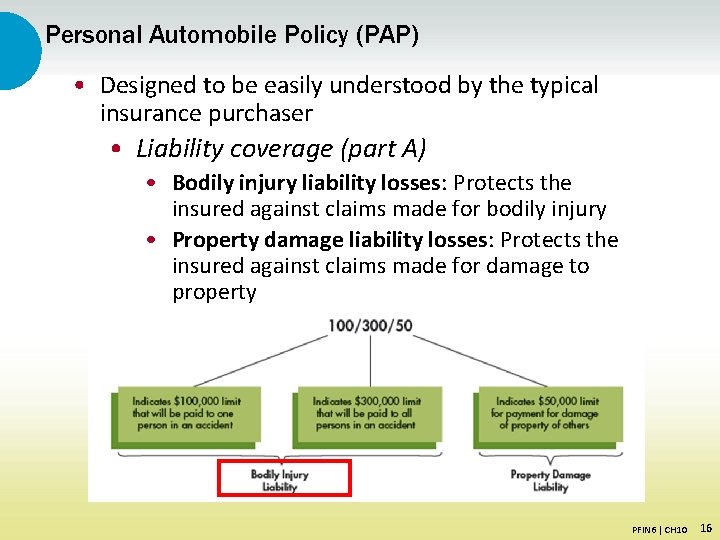
Personal Automobile Policy (PAP) • Designed to be easily understood by the typical insurance purchaser • Liability coverage (part A) • Bodily injury liability losses: Protects the insured against claims made for bodily injury • Property damage liability losses: Protects the insured against claims made for damage to property PFIN 6 | CH 10 16
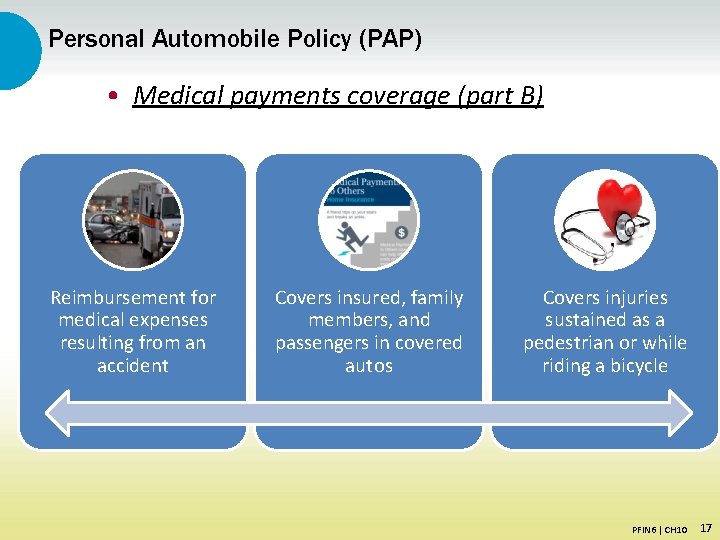
Personal Automobile Policy (PAP) • Medical payments coverage (part B) Reimbursement for medical expenses resulting from an accident Covers insured, family members, and passengers in covered autos Covers injuries sustained as a pedestrian or while riding a bicycle PFIN 6 | CH 10 17
Personal Automobile Policy (PAP) • Medical payments coverage (part B)-Coverage under an automobile medical payments insurance policy applies to the named insured and to family members who are injured while occupying an automobile (whether owned by the named insured or not) or when struck by an automobile or trailer of any type. Part B also applies to any other person occupying a covered automobile. • Uninsured motorists coverage (part C): Serves the victims of accidents injured by uninsured, underinsured, or hit-and-run motorists • Underinsured motorists coverage: Covers damages in accidents involving liable underinsured motorist PFIN 6 | CH 10 18