
Properties of Waves Wave is the motion of
- Slides: 17
Properties of Waves
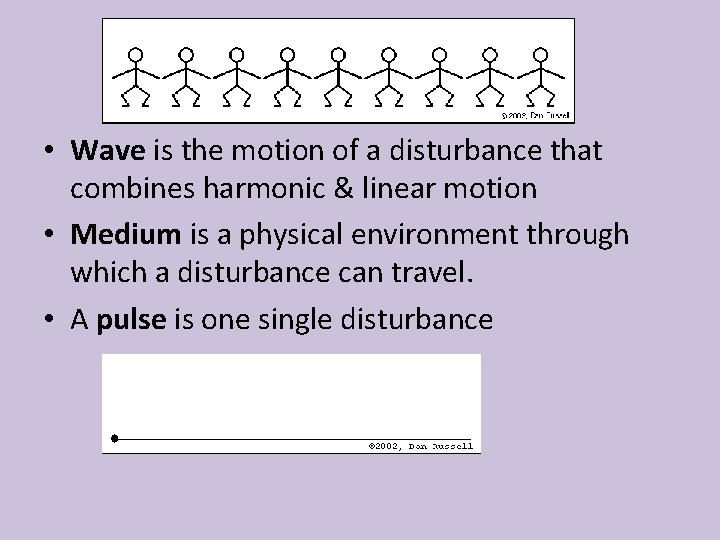
• Wave is the motion of a disturbance that combines harmonic & linear motion • Medium is a physical environment through which a disturbance can travel. • A pulse is one single disturbance
• Mechanical Waves are waves that require a medium through which to travel. • Electromagnetic Waves such as visible light do not require a medium.
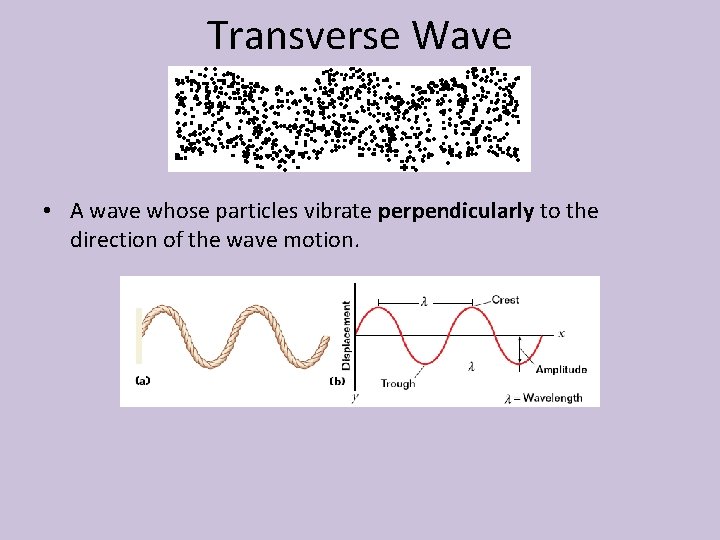
Transverse Wave • A wave whose particles vibrate perpendicularly to the direction of the wave motion.
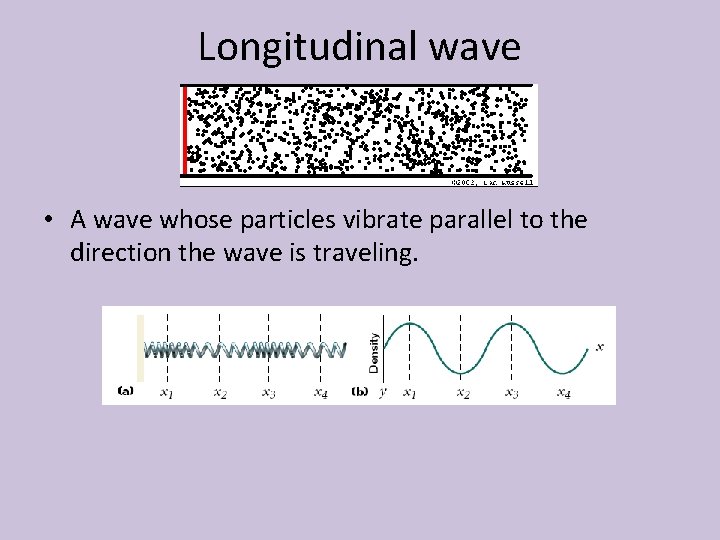
Longitudinal wave • A wave whose particles vibrate parallel to the direction the wave is traveling.
Period, Frequency, and Wave Speed • The frequency of a wave describes the number of waves that pass a given point in a unit of time. • The period of a wave describes the time it takes for a complete wavelength to pass a given point. • The period of a wave is inversely related to its frequency.
Period, Frequency, and Wave Speed, continued • The speed of a mechanical wave is constant for any given medium. • The speed of a wave is given by the following equation: v = fl wave speed = frequency wavelength • This equation applies to both mechanical and electromagnetic waves.
Practice: Wave Speed • A piano emits frequencies that range from a low of about 28. Hz to a high of about 4200. Hz. Find the range of wavelengths in air attained by this instrument when the speed of sound in air is 340. m/s.
Waves and Energy Transfer • Waves transfer energy by the vibration of matter. • The rate at which a wave transfers energy depends on the amplitude. – The greater the amplitude, the more energy a wave carries in a given time interval. – For a mechanical wave, the energy transferred is proportional to the square of the wave’s amplitude. • The amplitude of a wave gradually diminishes over time as its energy is dissipated.
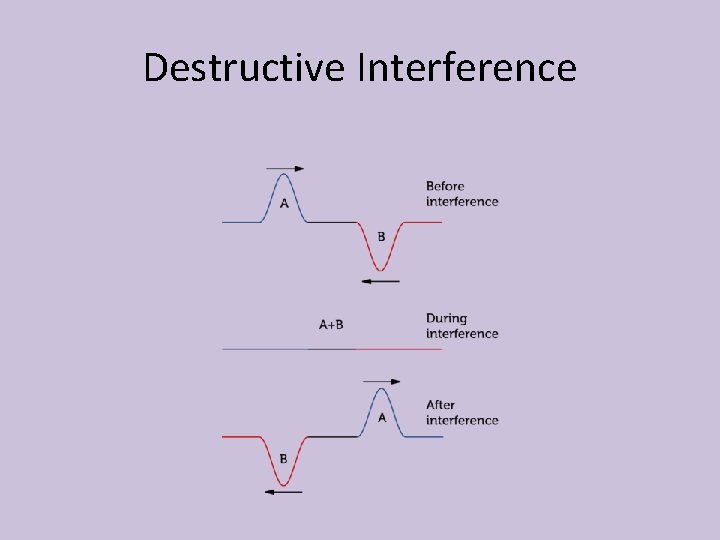
Wave Interference • Two different material objects can never occupy the same space at the same time. • Because mechanical waves are not matter but rather are displacements of matter, two waves can occupy the same space at the same time. • The combination of two overlapping waves is called superposition.
superposition
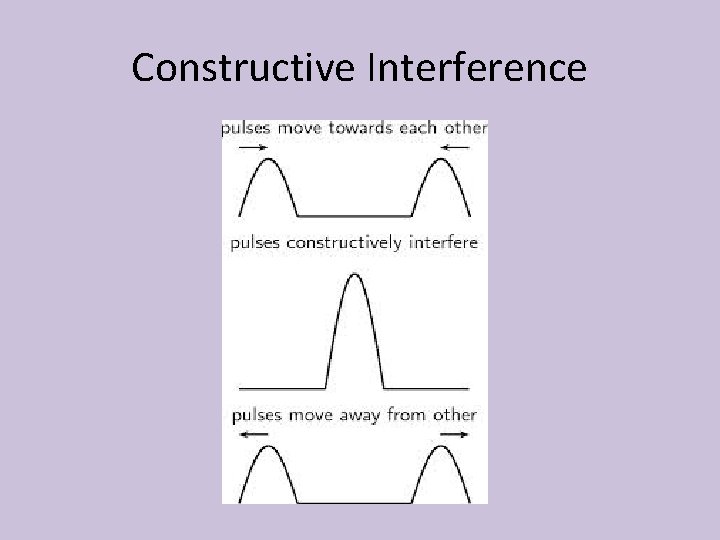
Constructive Interference
Destructive Interference
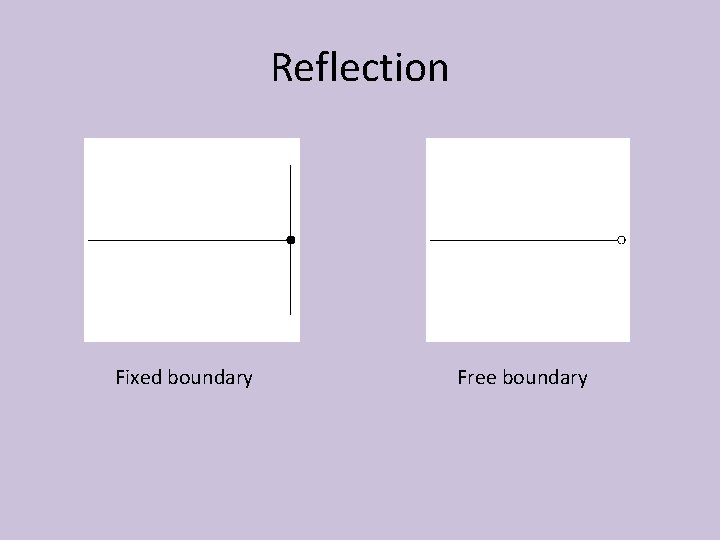
Reflection Fixed boundary Free boundary
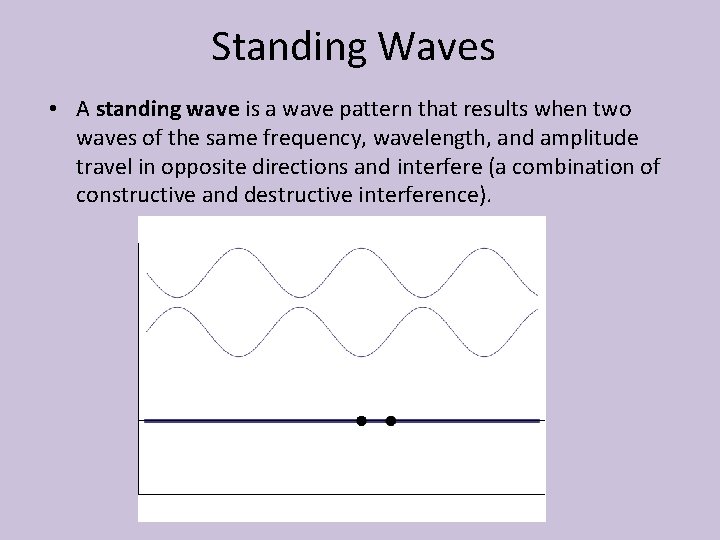
Standing Waves • A standing wave is a wave pattern that results when two waves of the same frequency, wavelength, and amplitude travel in opposite directions and interfere (a combination of constructive and destructive interference).
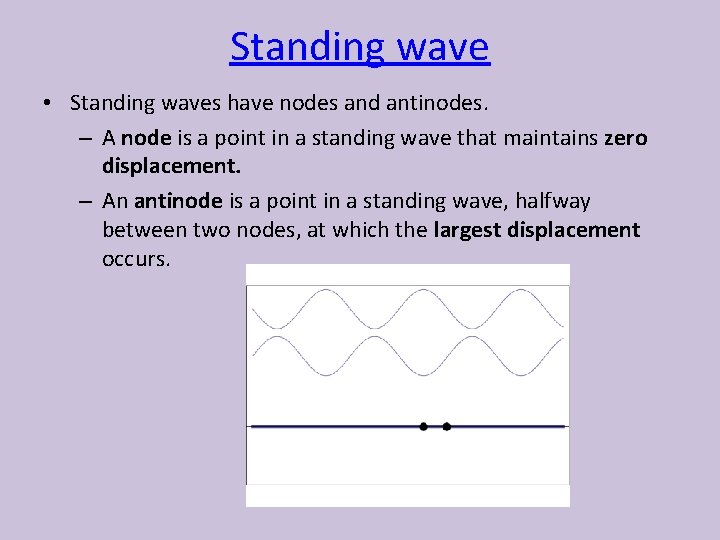
Standing wave • Standing waves have nodes and antinodes. – A node is a point in a standing wave that maintains zero displacement. – An antinode is a point in a standing wave, halfway between two nodes, at which the largest displacement occurs.
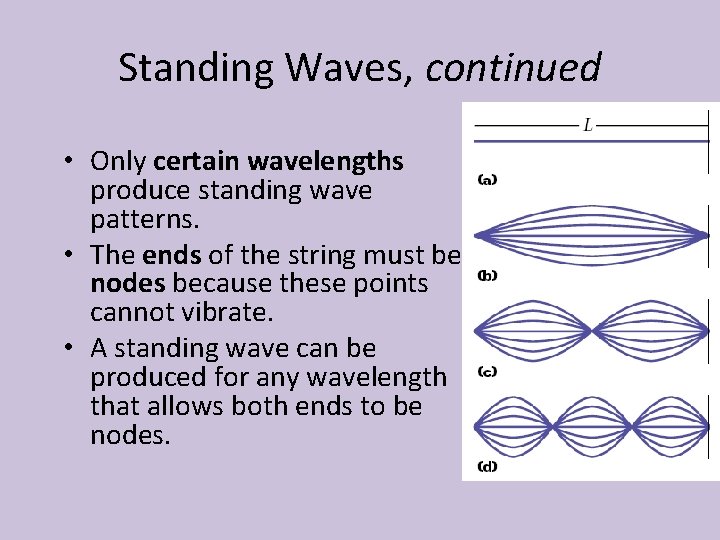
Standing Waves, continued • Only certain wavelengths produce standing wave patterns. • The ends of the string must be nodes because these points cannot vibrate. • A standing wave can be produced for any wavelength that allows both ends to be nodes.