
Properties of Waves Physical Science 20 Ms Hayduk



- Slides: 74
Properties of Waves Physical Science 20 – Ms. Hayduk
Wave Terminology
What is a Wave? Occurs when there is a movement of energy without movement of matter Mechanical wave: disturbance that travels through a medium (a substance)
Wave Movement Due to interaction of particles in a medium Temporary displacement – particles return to original position after energy is transferred Categories of wave movement: transverse, longitudinal, surface
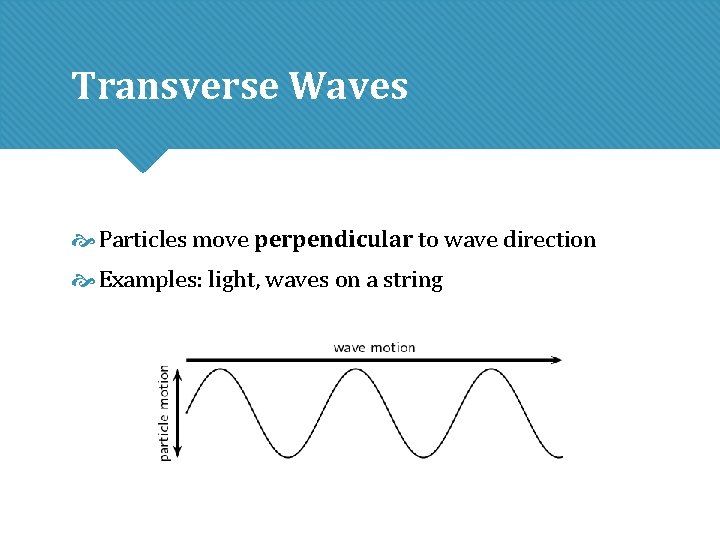
Transverse Waves Particles move perpendicular to wave direction Examples: light, waves on a string
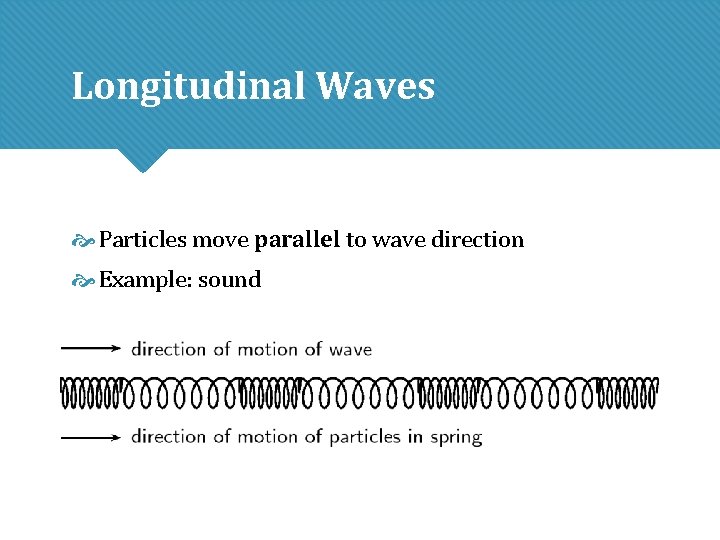
Longitudinal Waves Particles move parallel to wave direction Example: sound
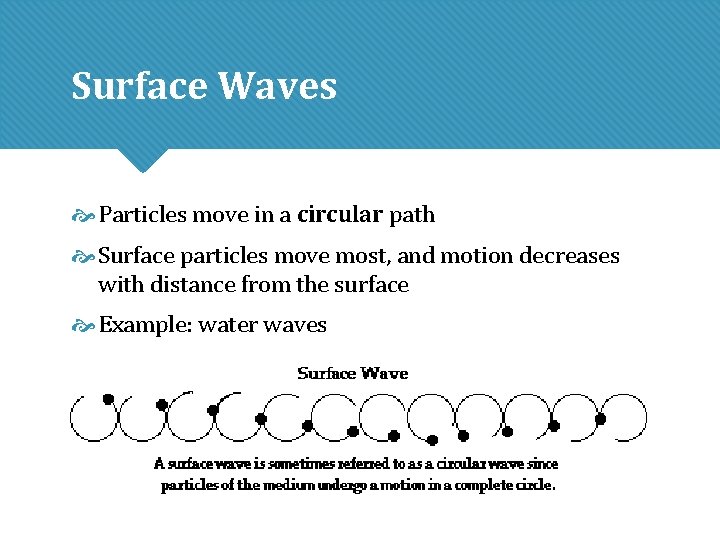
Surface Waves Particles move in a circular path Surface particles move most, and motion decreases with distance from the surface Example: water waves
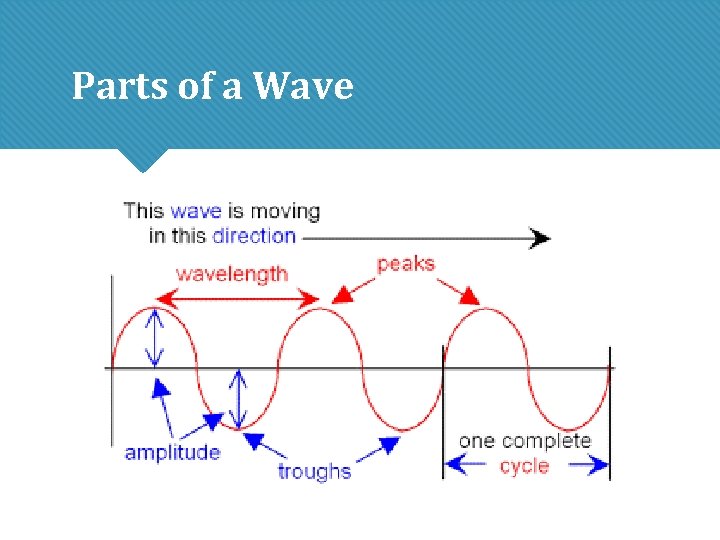
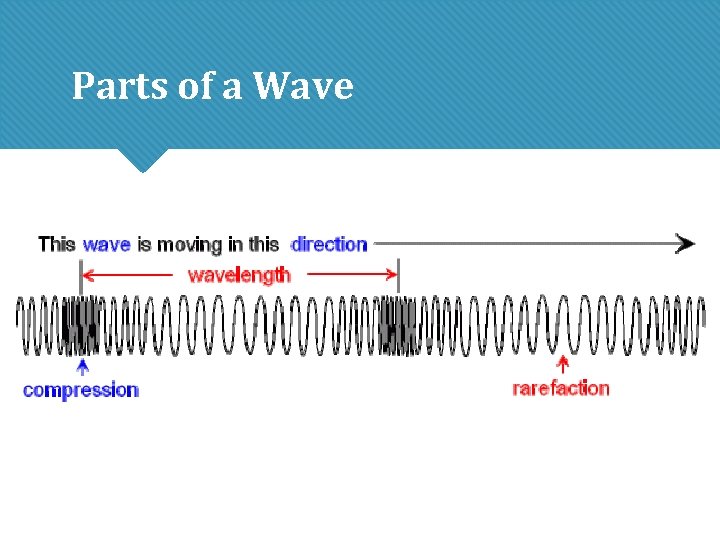
Parts of a Wave
Parts of a Wave
The Wave Equation
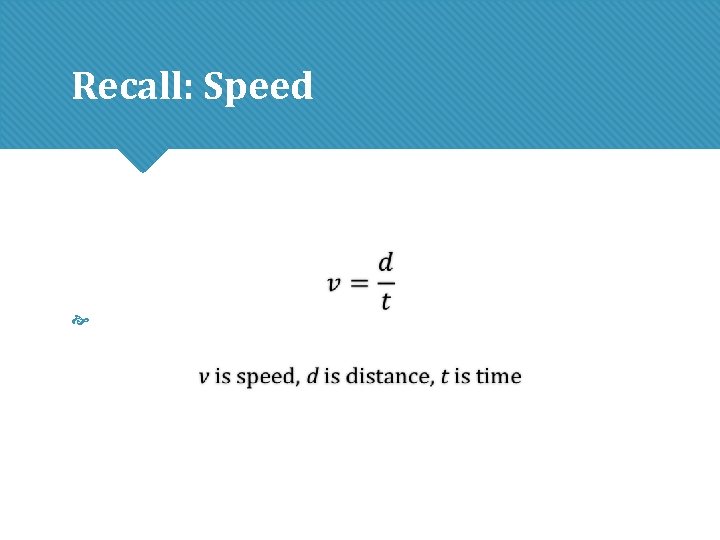
Recall: Speed
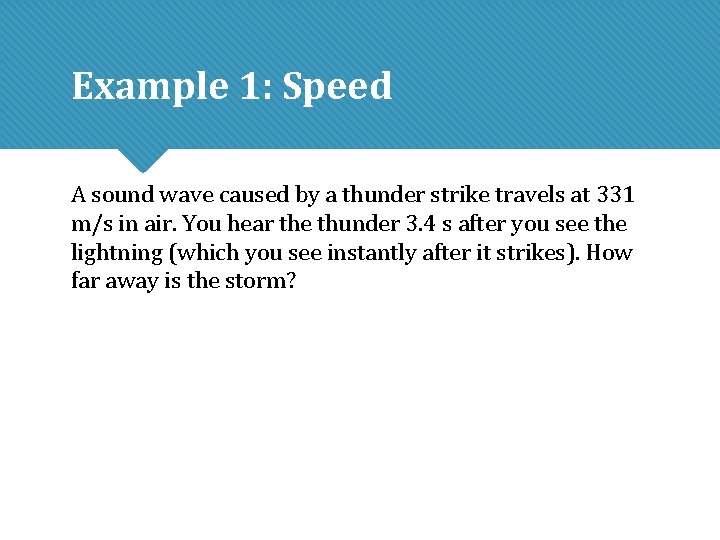
Example 1: Speed A sound wave caused by a thunder strike travels at 331 m/s in air. You hear the thunder 3. 4 s after you see the lightning (which you see instantly after it strikes). How far away is the storm?
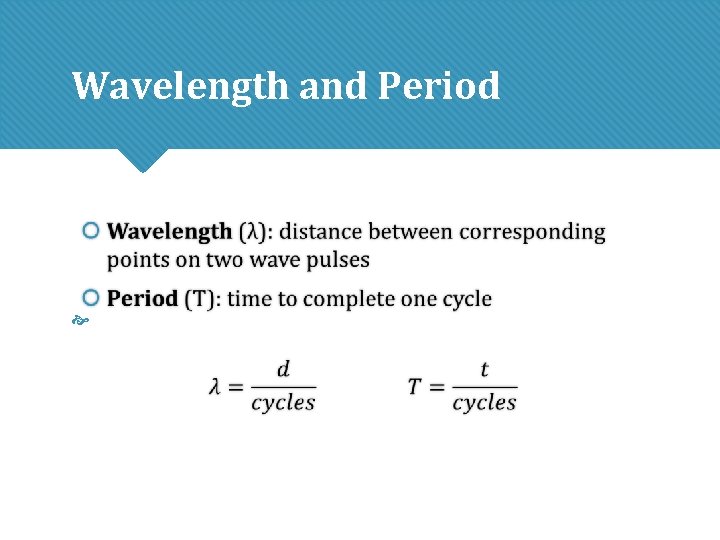
Wavelength and Period
Example 2: Wavelength A student counts six full wave cycles in a square tank full of water. The tank is 43 cm long. What is the wavelength of the water waves?
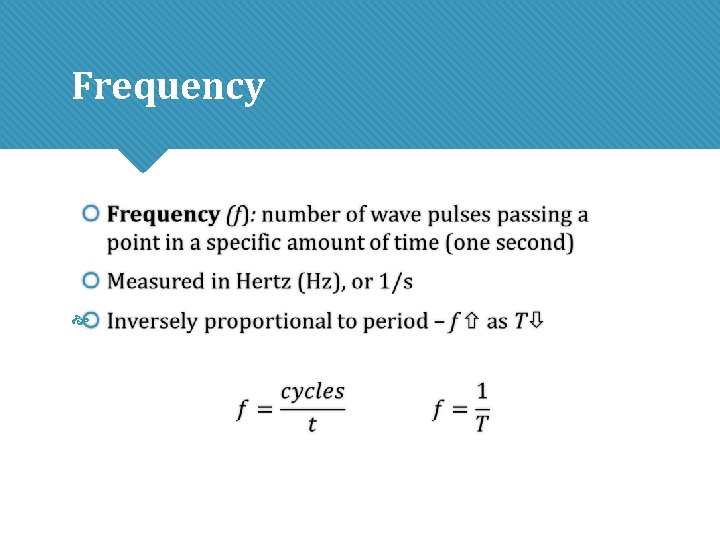
Frequency
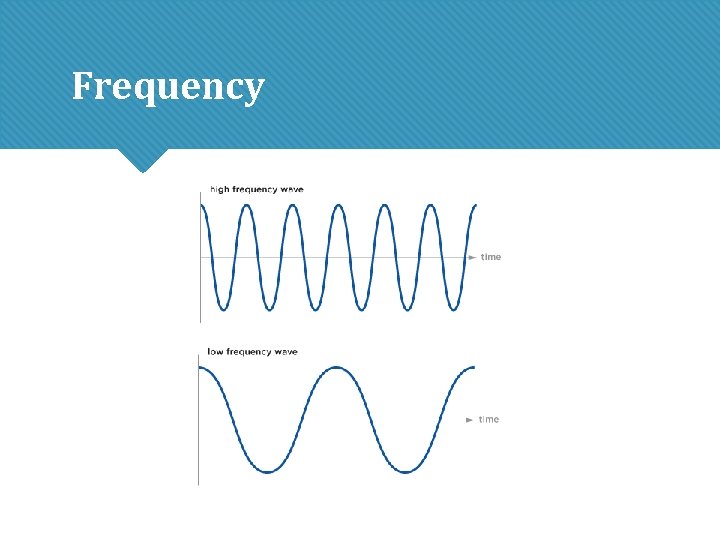
Frequency
Example 3: Period & Frequency A boat bobs up and down 18 times in 52 seconds. What is the period of the waves? What is the frequency?
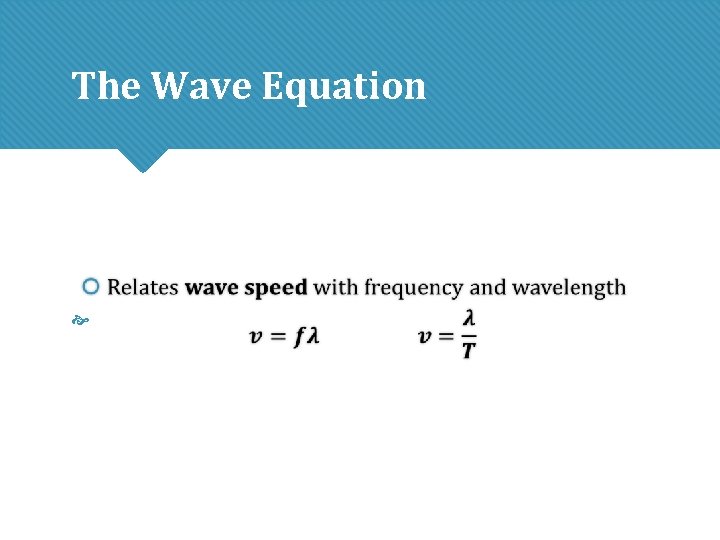
The Wave Equation
Example 4: Wave Equation A harp string produces a sound wave with a wavelength of 1. 50 m and a frequency of 220. 0 Hz. What is the speed of the wave?
Example 5: Wave Equation A buoy in the ocean bobs up and down. The wave crests are 2. 35 m apart. The buoy reaches it maximum height every 1. 21 s. What is the speed of the waves?
General Wave Behaviour
General Rules of Waves Speed depends ONLY on medium Frequency depends ONLY on rate at which wave is generated; not affected by change in medium Amplitude is independent of other factors; shows how much energy wave is transmitting
Definitions Boundary behaviour: how waves react when it changes medium (at an interface) 1 D waves: travel in only one direction (e. g. along a string) 2 D waves: travel in two directions, along a surface (e. g. water waves)
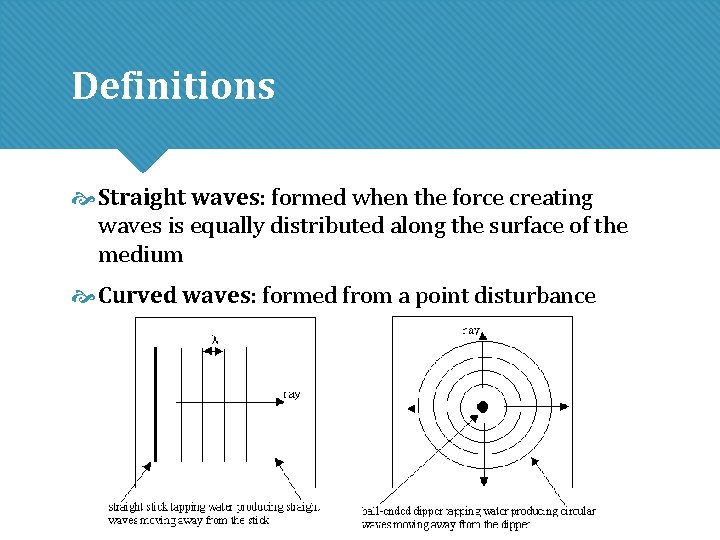
Definitions Straight waves: formed when the force creating waves is equally distributed along the surface of the medium Curved waves: formed from a point disturbance
One-Dimensional Waves
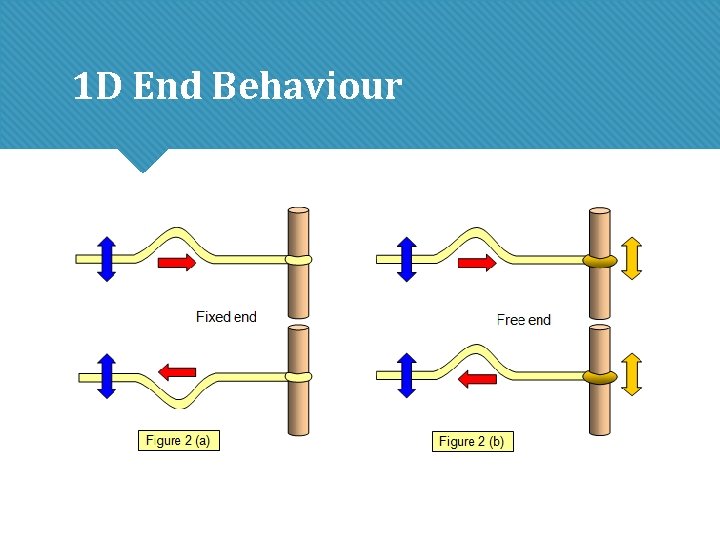
1 D End Behaviour Fixed-end reflection: end of medium is held steady, so particles cannot freely move Energy is divided as it hits the end – some reflects back and some is transmitted to the object holding the end Reflected pulse is inverted Free-end reflection: end of medium is not fixed in place, meaning minimal interaction between media Reflected pulse is on the same side as the incident pulse
1 D End Behaviour
1 D End Behaviour Reflected pulse will always have: Same speed Same wavelength Smaller amplitude (lower energy)
Change in Density of Medium Waves travel faster if there is: Greater tension in the string/spring Less density/thinner string/spring At interface: Some energy is reflected into original medium, at the same speed and wavelength Wavelength and wave speed will be different for refracted wave
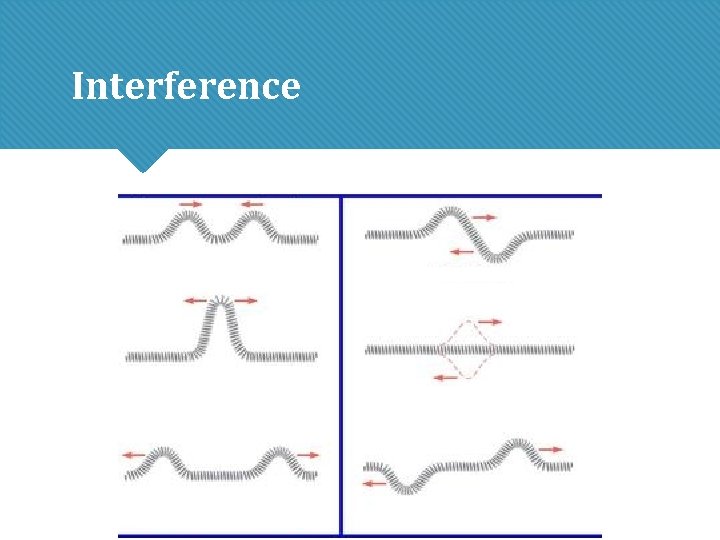
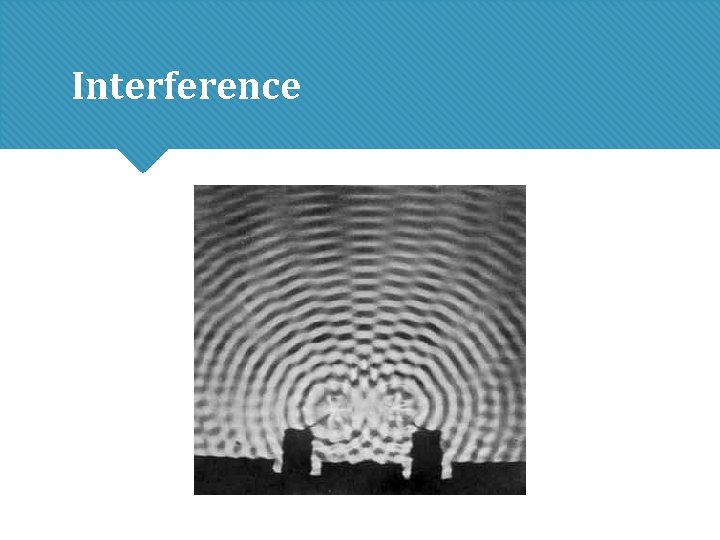
Interference Interference: effect that occurs when two waves meet within the same medium Medium takes on the net effect of the amplitude of the individual waves Constructive interference: waves with same displacement direction add to make a larger pulse Destructive interference: waves with opposite displacement direction subtract to make smaller pulse
Interference
Two-Dimensional Waves
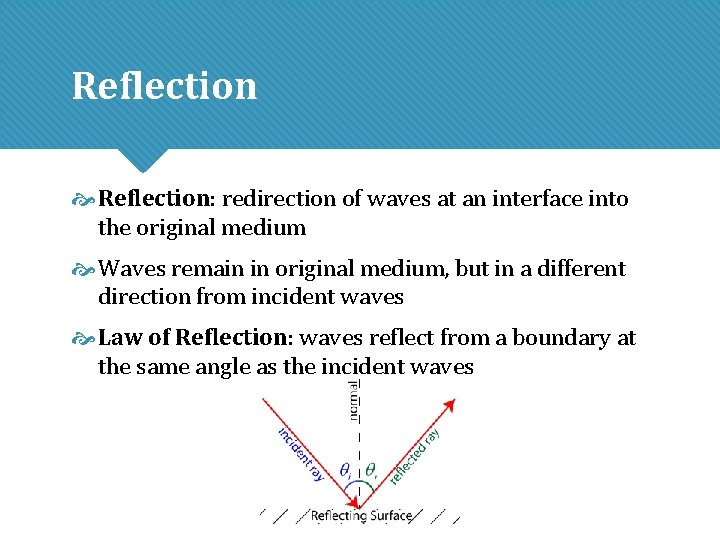
Reflection Reflection: redirection of waves at an interface into the original medium Waves remain in original medium, but in a different direction from incident waves Law of Reflection: waves reflect from a boundary at the same angle as the incident waves
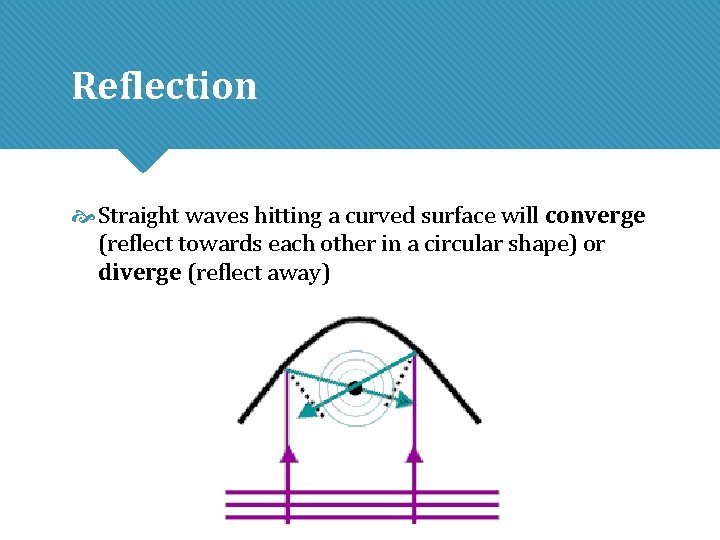
Reflection Straight waves hitting a curved surface will converge (reflect towards each other in a circular shape) or diverge (reflect away)
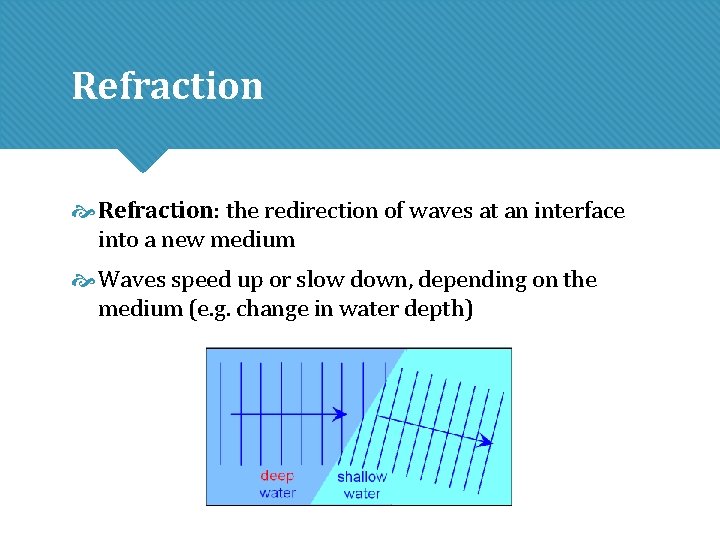
Refraction Refraction: the redirection of waves at an interface into a new medium Waves speed up or slow down, depending on the medium (e. g. change in water depth)
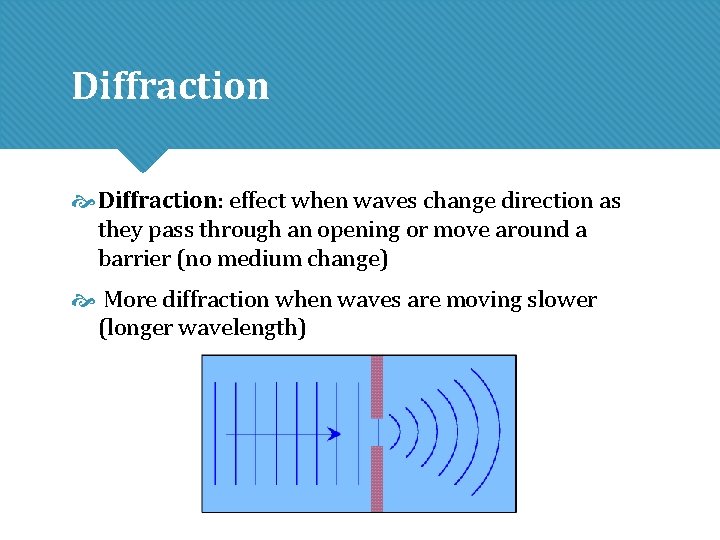
Diffraction Diffraction: effect when waves change direction as they pass through an opening or move around a barrier (no medium change) More diffraction when waves are moving slower (longer wavelength)
Interference
Sound Waves
Basics of Sound Mechanical wave originating from a vibrating object (e. g. vocal cords, guitar string), longitudinal Human ears can hear between 20 Hz and 20 000 Hz Above is ultrasound, below is infrasound Pitch is another way of saying frequency
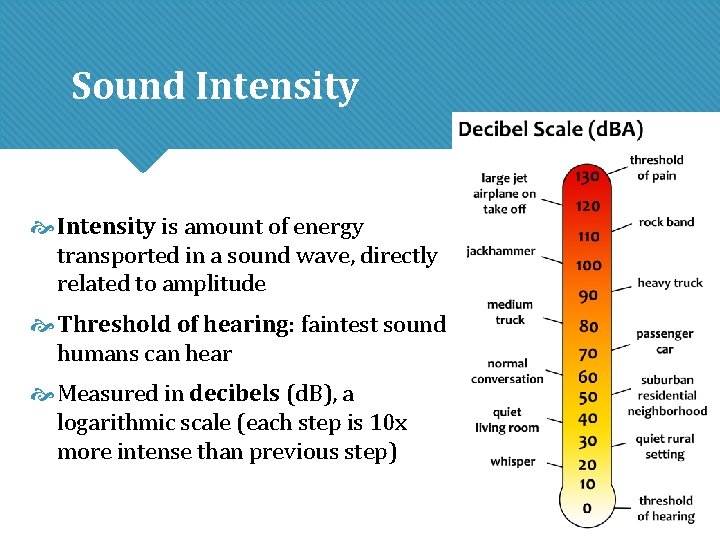
Sound Intensity is amount of energy transported in a sound wave, directly related to amplitude Threshold of hearing: faintest sound humans can hear Measured in decibels (d. B), a logarithmic scale (each step is 10 x more intense than previous step)
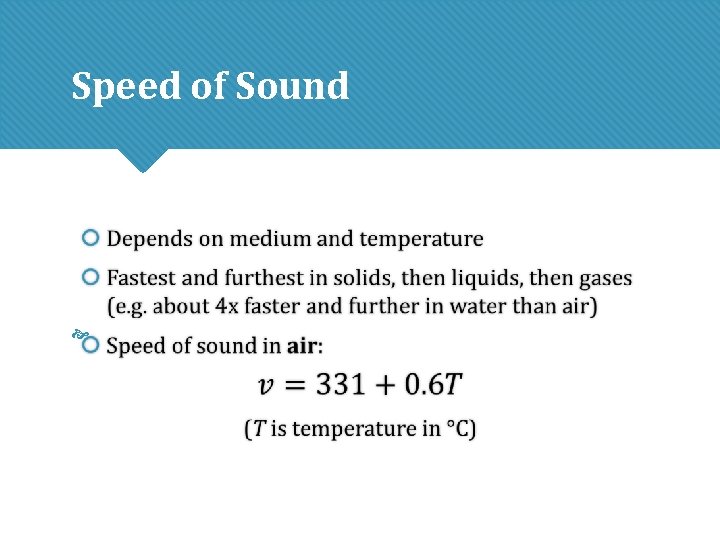
Speed of Sound
Example 1: Speed of Sound Determine the speed of sound if the temperature is 4. 0°C.
Example 2: Speed of Sound You do some calculations and determine the speed of sound to be 365 m/s. What is the air temperature?
Example 3: Speed of Sound The temperature outside on a warm summer evening is 28°C. You see a flash of lightning, then thunder rumbles 4. 0 seconds later. How far away is the storm?
Echoes Echo: reflection of a sound wave Can determine speed of sound using distance to boundary (and back) and time between sound and echo
Example 4: Echoes The air temperature is 5°C. You stand 100 m from a wall and clap your hands 10 times. You clap every time you hear the echo of the previous clap. It takes 6. 1 s from the first clap to the echo of the last clap. a. What is the speed of sound based on the echo? b. What is the speed of sound based on air temperature? c. Why might these values be different?
Light and Optics
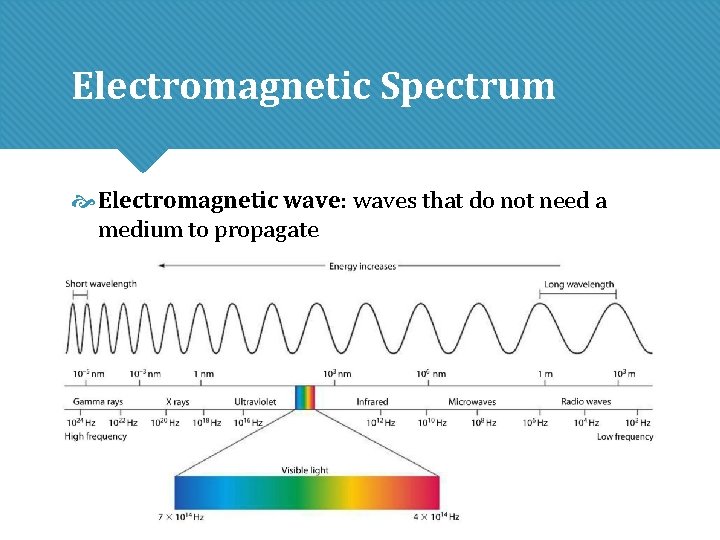
Electromagnetic Spectrum Electromagnetic wave: waves that do not need a medium to propagate
Light Travels in straight lines only (linear propagation), because it moves so fast Speed of light in a vacuum, c, is 3. 00 × 108 m/s
Reflection of Light
Reflection of Light Recall: Law of Reflection angle of incidence = angle of reflection Reflection is more complex with curved surfaces (concave and convex mirrors) Ray diagram: a method for determining path of light and resulting images as it reflects or refracts through an object or medium
Image Characteristics Object: the physical, tangible item that is being viewed Image: reflected or refracted version of the object Location: where the image is located relative to the object Orientation: upright (same as object) or inverted (upside down) Size: smaller, magnified or equal size Type: real (can be projected on a screen) or virtual (only visible inside the mirror)
Plane Mirrors
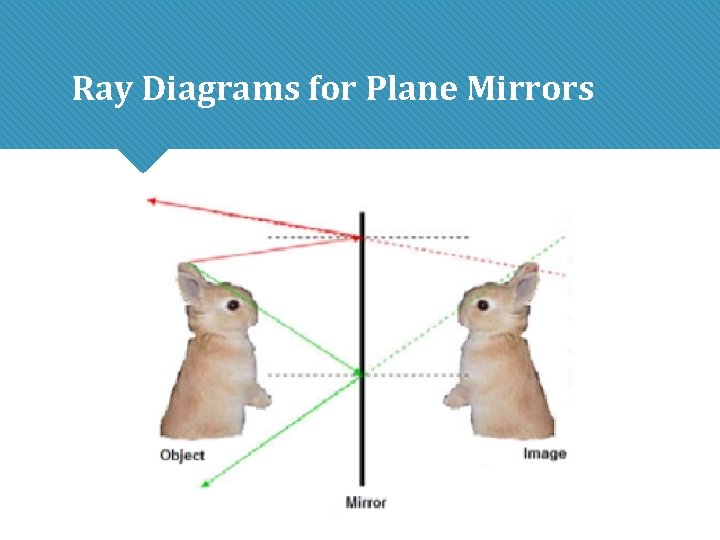
Ray Diagrams for Plane Mirrors Used to determine image location USE A RULER (and a protractor, when needed) Rules: Two rays from each “corner” of the image Law of Reflection Extend rays behind the mirror to find the image
Ray Diagrams for Plane Mirrors
Curved Mirrors
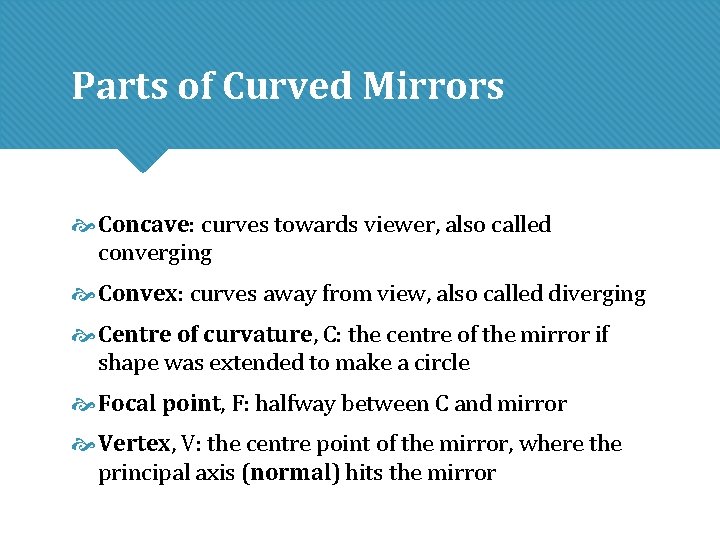
Parts of Curved Mirrors Concave: curves towards viewer, also called converging Convex: curves away from view, also called diverging Centre of curvature, C: the centre of the mirror if shape was extended to make a circle Focal point, F: halfway between C and mirror Vertex, V: the centre point of the mirror, where the principal axis (normal) hits the mirror
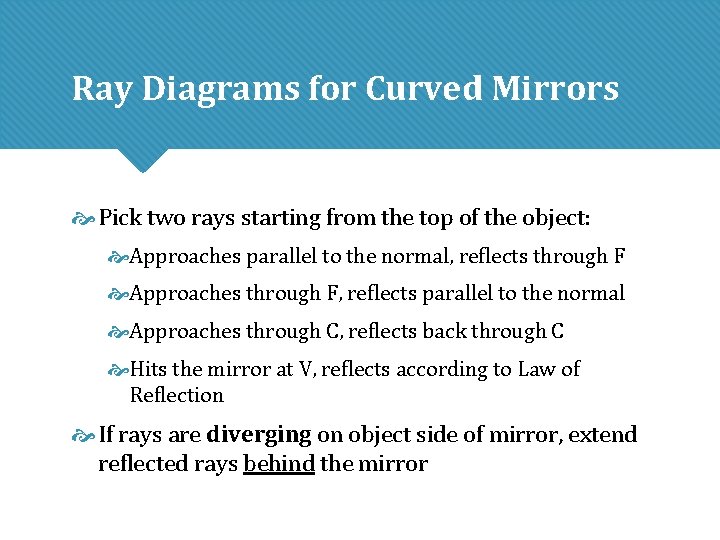
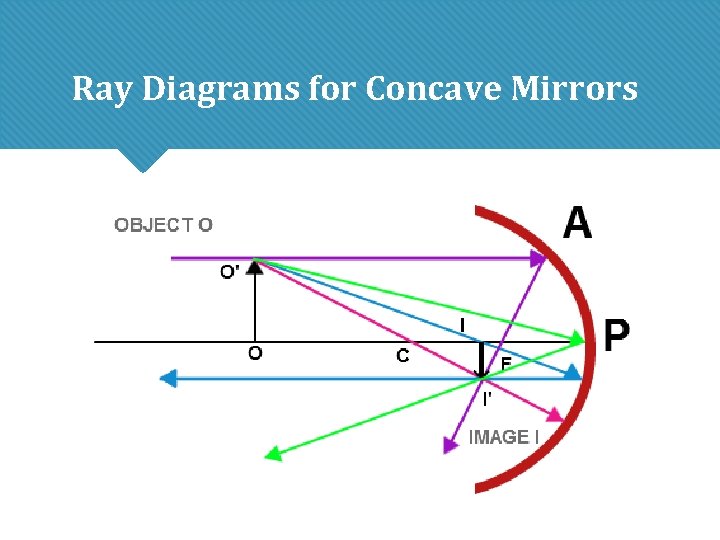
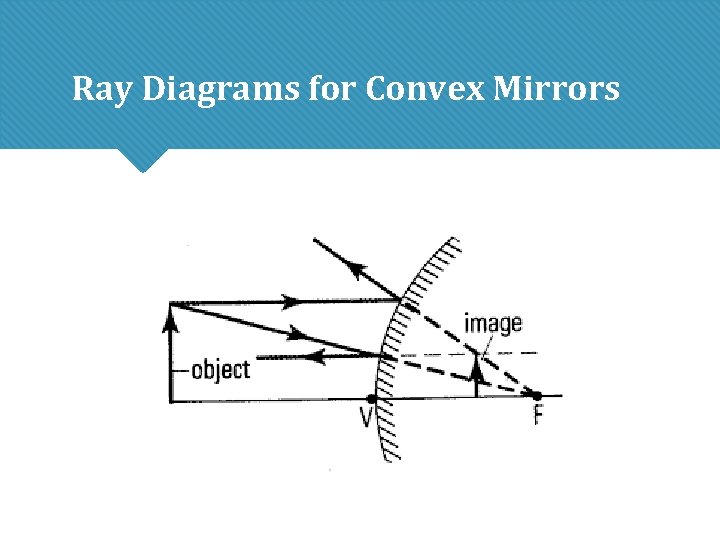
Ray Diagrams for Curved Mirrors Pick two rays starting from the top of the object: Approaches parallel to the normal, reflects through F Approaches through F, reflects parallel to the normal Approaches through C, reflects back through C Hits the mirror at V, reflects according to Law of Reflection If rays are diverging on object side of mirror, extend reflected rays behind the mirror
Ray Diagrams for Concave Mirrors
Ray Diagrams for Convex Mirrors
Refraction of Light
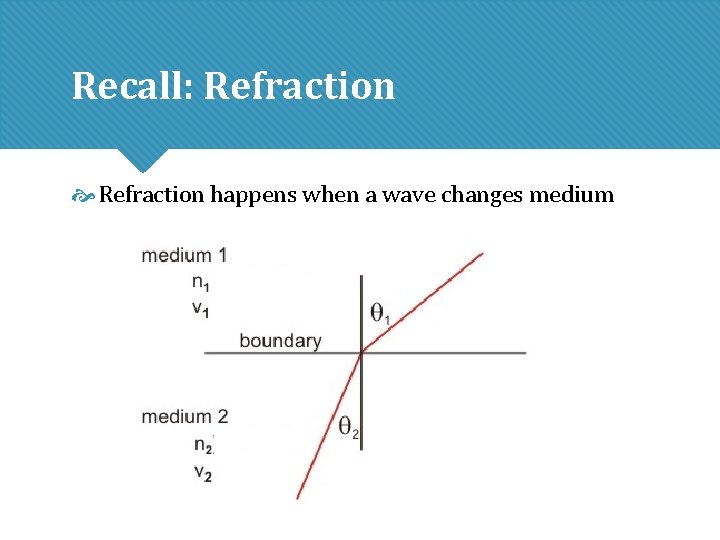
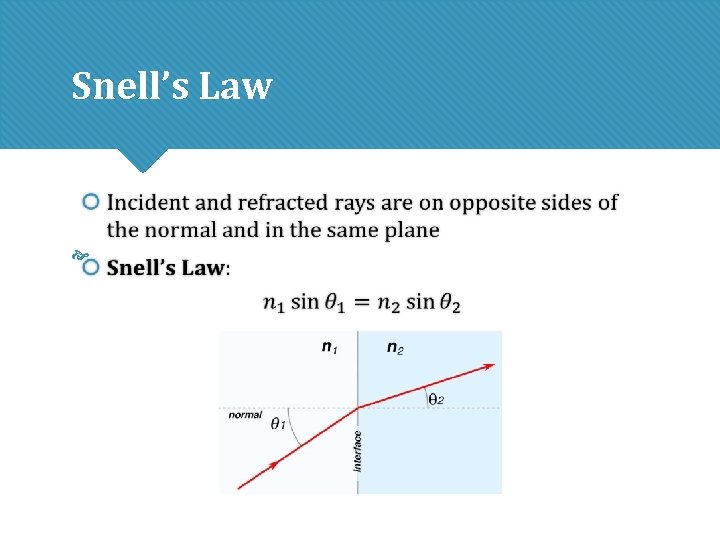
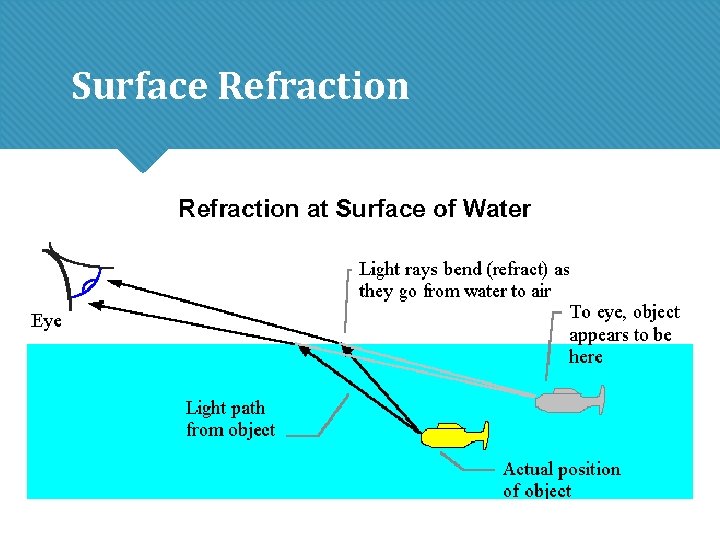
Recall: Refraction happens when a wave changes medium
Refractive Index Refractive index, n: ratio between speed of light in a substance and speed of light in a vacuum (c) No units Higher value → light moves slower → light bends more
Snell’s Law
Example: Snell’s Law Light travels from glass into water. The angle of incidence in the crown glass is 40. 0°. What is the angle of refraction?
Surface Refraction
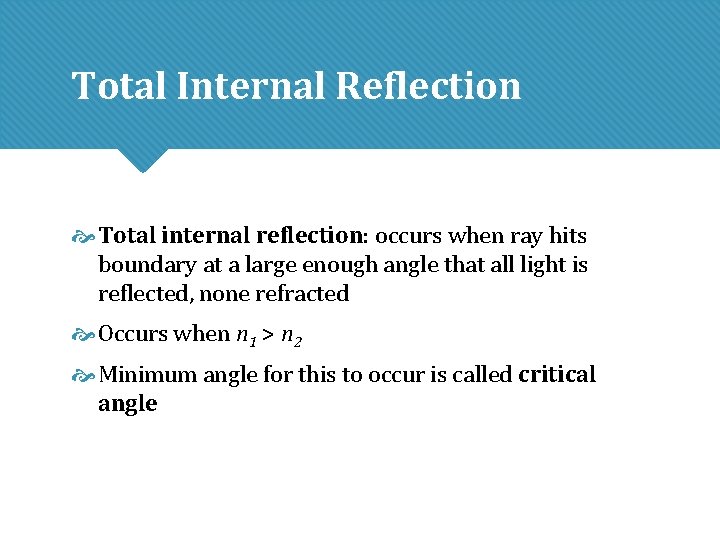
Total Internal Reflection Total internal reflection: occurs when ray hits boundary at a large enough angle that all light is reflected, none refracted Occurs when n 1 > n 2 Minimum angle for this to occur is called critical angle
Refraction in Lenses
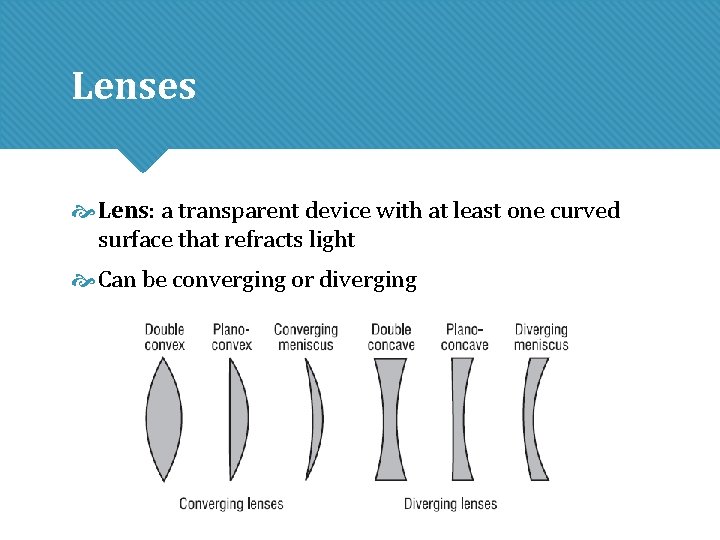
Lenses Lens: a transparent device with at least one curved surface that refracts light Can be converging or diverging
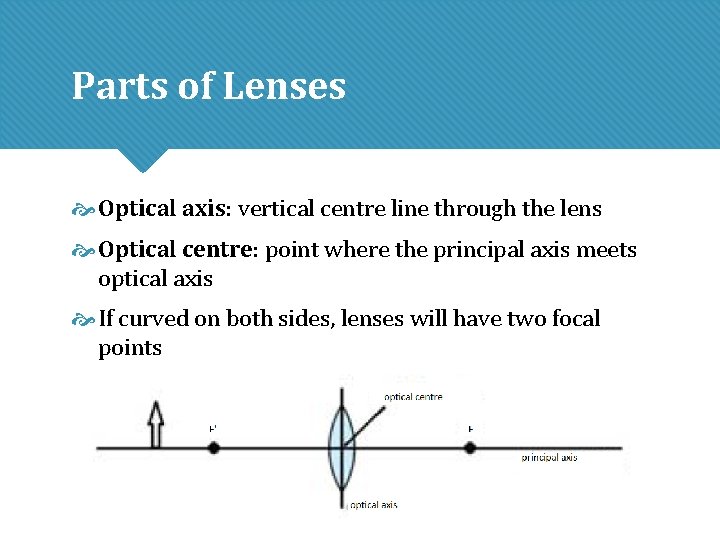
Parts of Lenses Optical axis: vertical centre line through the lens Optical centre: point where the principal axis meets optical axis If curved on both sides, lenses will have two focal points
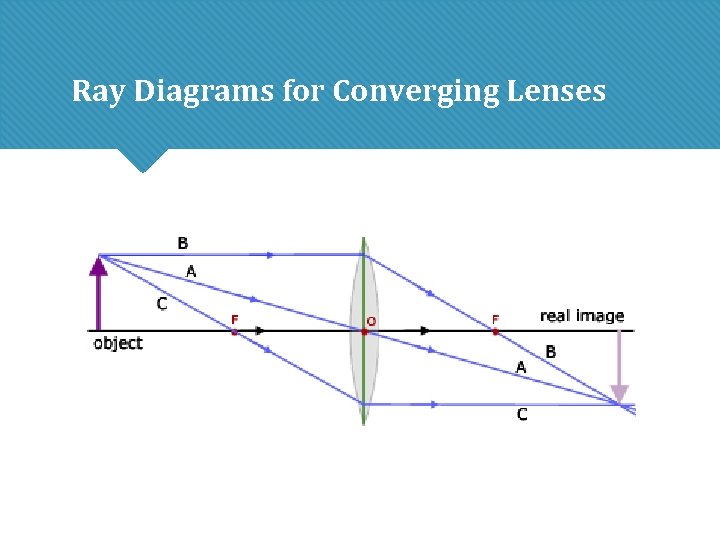
Ray Diagrams for Converging Lenses Pick two rays starting from the top of the object: Approaches OA parallel to normal, refracts through F on opposite side Approaches OA through F on object side, refracts parallel to normal Passes through optical centre If refracted rays are diverging, extend them on object side of lens
Ray Diagrams for Converging Lenses
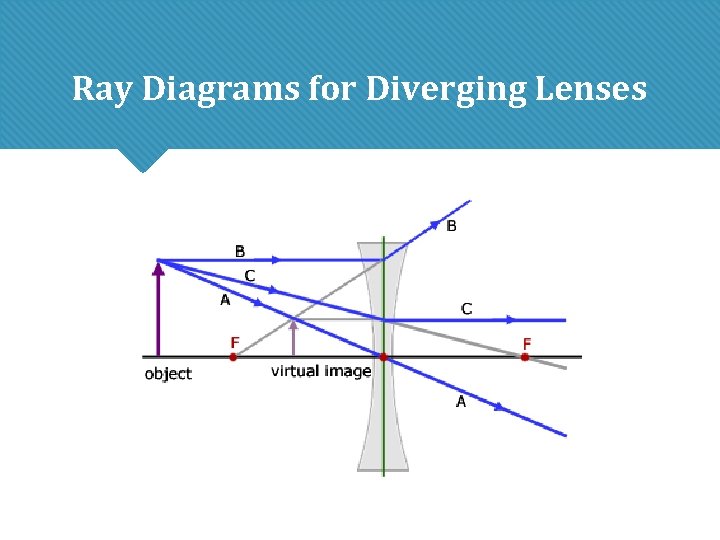
Ray Diagrams for Diverging Lenses Pick two rays starting from the top of the object: Approaches OA parallel to normal, refracts through F on object side Approaches OA toward F on opposite side, refracts parallel to normal Passes through optical centre All rays will diverge, extend all refracted rays on both sides of lens
Ray Diagrams for Diverging Lenses