
PROPERTIES OF THE ION DISTRIBUTION FUNCTION WITH VELOCITY
PROPERTIES OF THE ION DISTRIBUTION FUNCTION WITH VELOCITY SPACE HOLES A. Sadovski Space Research Institute (IKI), Moscow, Russia
Abstract The general stability properties of ion distributions with velocity space holes of the type expected in the vicinity of the field reversal region in the Earth’s magnetotail is investigated. It is shown that such distributions are unstable to electromagnetic waves exitation with wave vector directed along the Sun-Earth line. The growth rate of the excited waves is strongly depended on ion hole parameters and electron and ion temperatures.
• Study of particle dynamics in the Earth’s magnetotail has shown that some ions with large pitch angle are preferentially accelerated out of neutral sheet and form beams. As a result a peculiar type of nongyrotropic ion distribution with velocity space hole is formed. • The unique feature of such distribution is that the space hole is centered on 90º pitch angle and ion distribution is not symmetrical about magnetic field direction. • Ion distributions with empty region in velocity space represent a source of free energy for excitation as plasma waves as electromagnetic waves and may have a pronounced effect on physical processes in the neutral sheet. • The investigation of general stability properties of the nongyrotropic ion distributions in relation to electrostatic wave excitation was performed (Burinskaya and Indenbom, 2000). It was shown that when a velocity space hole is narrow enough in θ-direction, waves are excited with maximum growth rate in the direction of the magnetic field. The real frequency of these waves is vanishingly small. • We perform the investigation of stability properties of such ion distribution in the relation to electromagnetic waves.
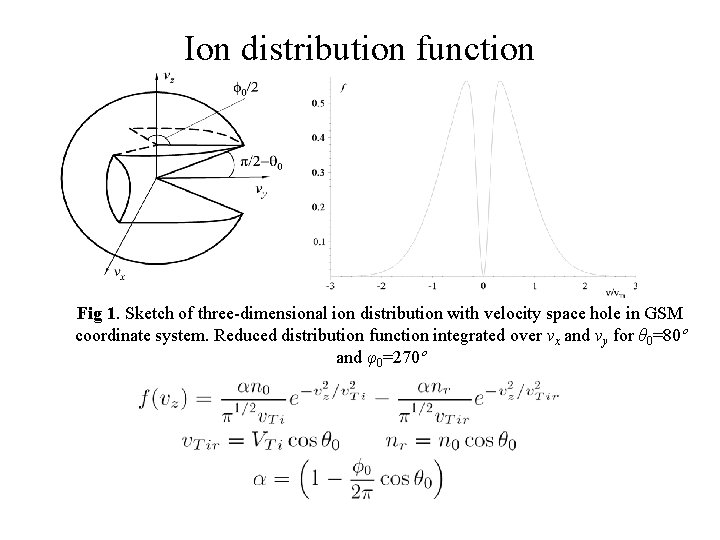
Ion distribution function Fig 1. Sketch of three-dimensional ion distribution with velocity space hole in GSM coordinate system. Reduced distribution function integrated over vx and vy for θ 0=80º and φ0=270º

Basic assumptions • The ions are unmagnetized and have distribution shown on Fig. 1. • Electrons are treated fully magnetized and have Maxwellian distribution. • For the sake of simplicity we investigate only waves in the direction of the uniform magnetic field, so

Dispersion equation (parallel propagation) Hear the next approximations were used. Z is the usual plasma dispersion function

Solution of the dispersion equation Real part of the frequency
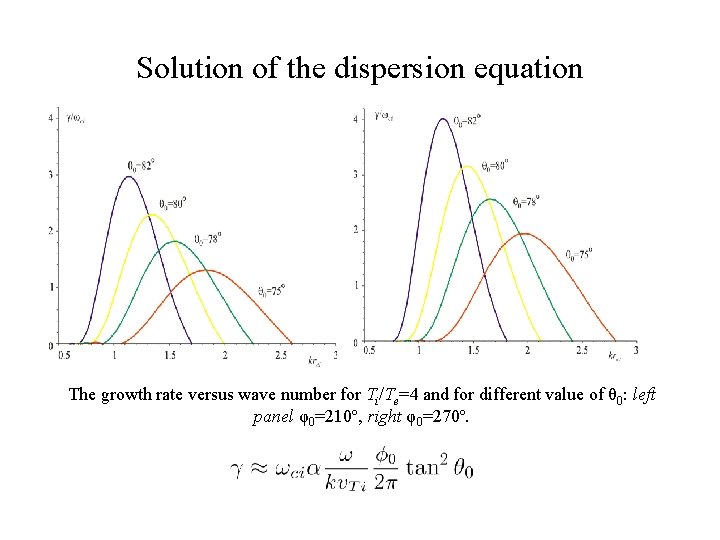
Solution of the dispersion equation The growth rate versus wave number for Ti/Te=4 and for different value of θ 0: left panel φ0=210º, right φ0=270º.
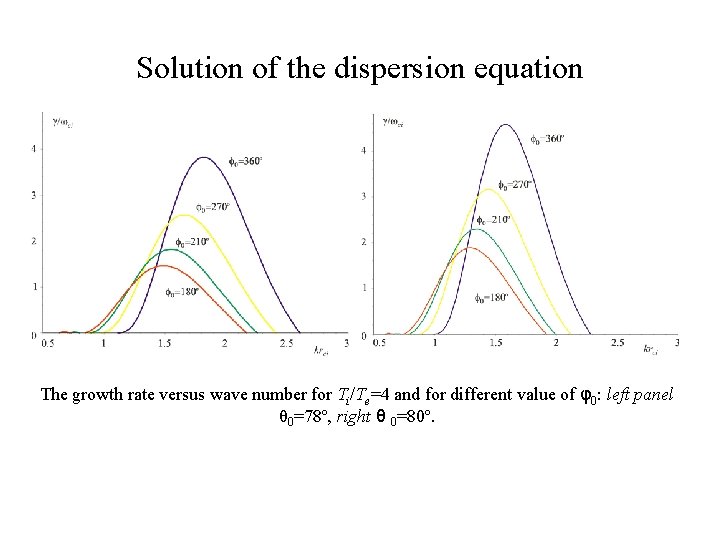
Solution of the dispersion equation The growth rate versus wave number for Ti/Te=4 and for different value of φ0: left panel θ 0=78º, right θ 0=80º.
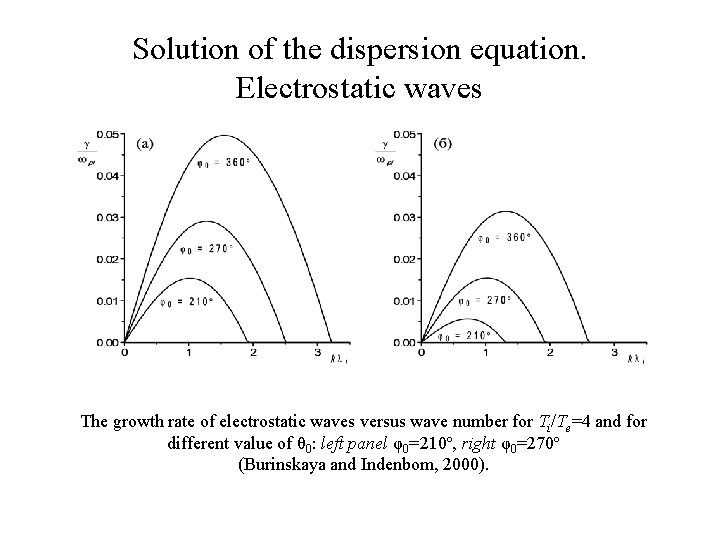
Solution of the dispersion equation. Electrostatic waves The growth rate of electrostatic waves versus wave number for Ti/Te=4 and for different value of θ 0: left panel φ0=210º, right φ0=270º (Burinskaya and Indenbom, 2000).
• The stability of the nongyrotropic ion distribution was investigated in relation to the electromagnetic waves. • The investigation was done for the variable parameters of the region with reduced ion population. • The obtained results show that the plasma with maxwellian electrons and ions with distribution shown in Fig. 1 is unstable to the electromagnetic waves perturbation for different hole parameters.
- Slides: 11