
Properties of Sound Sound is A pressure disturbance

Properties of Sound • Sound is • A pressure disturbance (alternating areas of high and low pressure) produced by a vibrating object • A sound wave • Moves outward in all directions • Is illustrated as an S-shaped curve or sine wave

Air pressure Wavelength Area of high pressure (compressed molecules) Area of low pressure (rarefaction) Crest Trough Distance Amplitude A struck tuning fork alternately compresses and rarefies the air molecules around it, creating alternate zones of high and low pressure. (b) Sound waves radiate outward in all directions. Figure 15. 29
Properties of Sound Waves • Frequency • The number of waves that pass a given point in a given time • Wavelength • The distance between two consecutive crests • Amplitude • The height of the crests
Properties of Sound • Pitch • Perception of different frequencies • Normal range is from 20– 20, 000 Hz • The higher the frequency, the higher the pitch • Loudness • Subjective interpretation of sound intensity • Normal range is 0– 120 decibels (d. B)

Pressure High frequency (short wavelength) = high pitch Low frequency (long wavelength) = low pitch Time (s) (a) Frequency is perceived as pitch. Pressure High amplitude = loud Low amplitude = soft Time (s) (b) Amplitude (size or intensity) is perceived as loudness. Figure 15. 30

Transmission of Sound to the Internal Ear • Sound waves vibrate the tympanic membrane • Ossicles vibrate and amplify the pressure at the oval window • Pressure waves move through perilymph of the scala vestibuli

Transmission of Sound to the Internal Ear • Waves with frequencies below the threshold of hearing travel through the helicotrema and scali tympani to the round window • Sounds in the hearing range go through the cochlear duct, vibrating the basilar membrane at a specific location, according to the frequency of the sound

Auditory ossicles Malleus Incus Stapes Cochlear nerve Scala vestibuli Oval window Helicotrema 2 3 Scala tympani Cochlear duct Basilar membrane 1 Tympanic Round membrane window (a) Route of sound waves through the ear 1 Sound waves vibrate the tympanic membrane. 2 Auditory ossicles vibrate. Pressure is amplified. 3 Pressure waves created by the stapes pushing on the oval window move through fluid in the scala vestibuli. Sounds with frequencies below hearing travel through the helicotrema and do not excite hair cells. Sounds in the hearing range go through the cochlear duct, vibrating the basilar membrane and deflecting hairs on inner hair cells. Figure 15. 31 a
Resonance of the Basilar Membrane • Fibers that span the width of the basilar membrane are short and stiff near oval window, and resonate in response to highfrequency pressure waves. • Longer fibers near the apex resonate with lower-frequency pressure waves
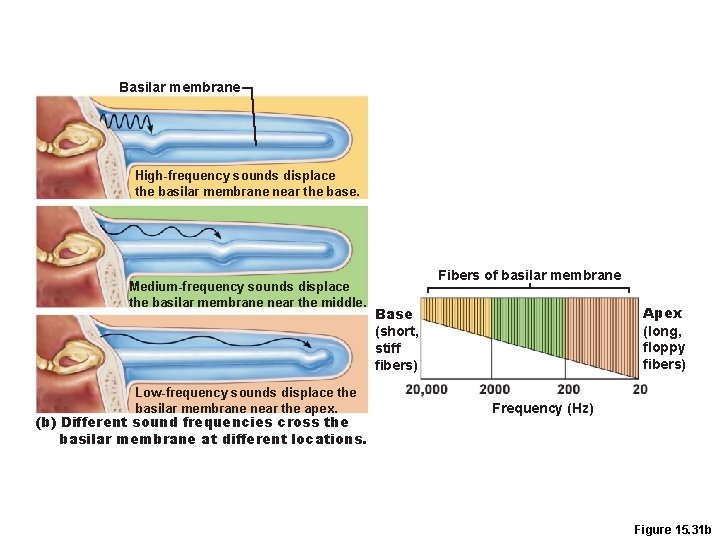
Basilar membrane High-frequency sounds displace the basilar membrane near the base. Medium-frequency sounds displace the basilar membrane near the middle. Low-frequency sounds displace the basilar membrane near the apex. (b) Different sound frequencies cross the basilar membrane at different locations. Fibers of basilar membrane Apex (long, floppy fibers) Base (short, stiff fibers) Frequency (Hz) Figure 15. 31 b
Excitation of Hair Cells in the Spiral Organ • Cells of the spiral organ • Supporting cells • Cochlear hair cells • One row of inner hair cells • Three rows of outer hair cells • Afferent fibers of the cochlear nerve coil about the bases of hair cells
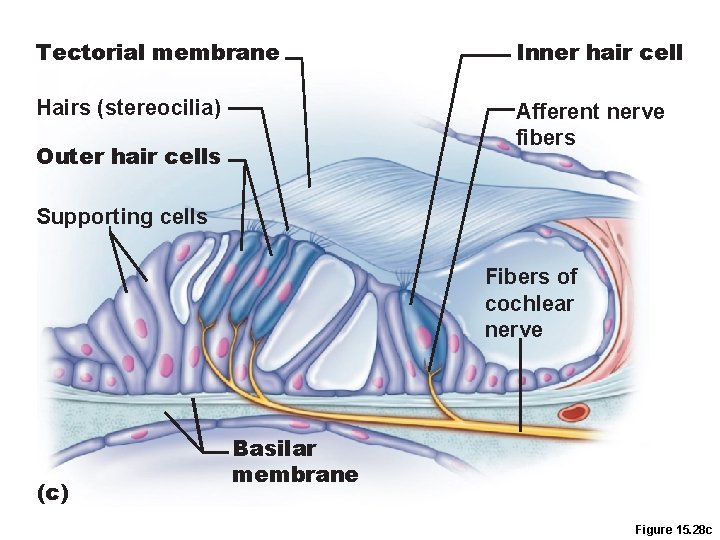
Tectorial membrane Inner hair cell Hairs (stereocilia) Afferent nerve fibers Outer hair cells Supporting cells Fibers of cochlear nerve (c) Basilar membrane Figure 15. 28 c
Excitation of Hair Cells in the Spiral Organ • The stereocilia • Protrude into the endolymph • Enmeshed in the gel-like tectorial membrane • Bending stereocilia • Opens mechanically gated ion channels • Inward K+ and Ca 2+ current causes a graded potential and the release of neurotransmitter glutamate • Cochlear fibers transmit impulses to the brain
Auditory Pathways to the Brain • Impulses from the cochlea pass via the spiral ganglion to the cochlear nuclei of the medulla • From there, impulses are sent to the • Superior olivary nucleus • Inferior colliculus (auditory reflex center) • From there, impulses pass to the auditory cortex via the thalamus • Auditory pathways decussate so that both cortices receive input from both ears
Auditory Processing • Impulses from specific hair cells are interpreted as specific pitches • Loudness is detected by increased numbers of action potentials that result when the hair cells experience larger deflections • Localization of sound depends on relative intensity and relative timing of sound waves reaching both ears
Homeostatic Imbalances of Hearing • Conduction deafness • Blocked sound conduction to the fluids of the internal ear • Can result from impacted earwax, perforated eardrum, or otosclerosis of the ossicles • Sensorineural deafness • Damage to the neural structures at any point from the cochlear hair cells to the auditory cortical cells
Homeostatic Imbalances of Hearing • Tinnitus: ringing or clicking sound in the ears in the absence of auditory stimuli • Due to cochlear nerve degeneration, inflammation of middle or internal ears, side effects of aspirin • Meniere’s syndrome: labyrinth disorder that affects the cochlea and the semicircular canals • Causes vertigo, nausea, and vomiting
Equilibrium and Orientation • Vestibular apparatus consists of the equilibrium receptors in the semicircular canals and vestibule • Vestibular receptors monitor static equilibrium • Semicircular canal receptors monitor dynamic equilibrium
Maculae • Sensory receptors for static equilibrium • One in each saccule wall and one in each utricle wall • Monitor the position of the head in space, necessary for control of posture • Respond to linear acceleration forces, but not rotation • Contain supporting cells and hair cells • Stereocilia and kinocilia are embedded in the otolithic membrane studded with otoliths (tiny Ca. CO 3 stones)
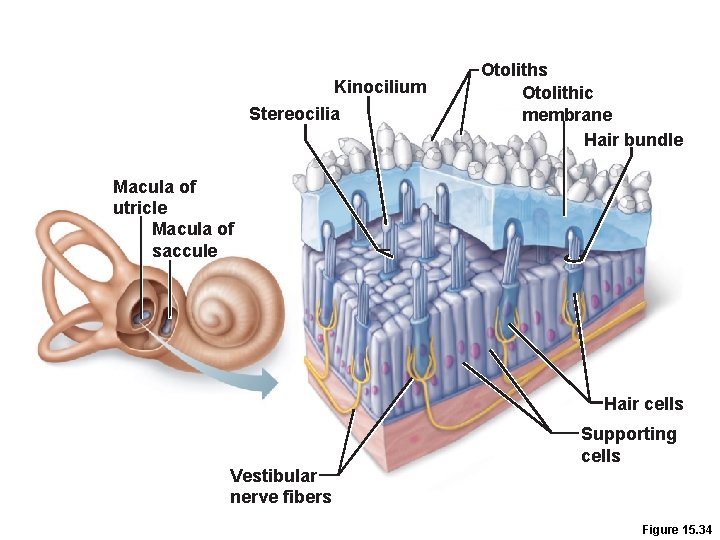
Kinocilium Stereocilia Otoliths Otolithic membrane Hair bundle Macula of utricle Macula of saccule Hair cells Vestibular nerve fibers Supporting cells Figure 15. 34
Maculae • Maculae in the utricle respond to horizontal movements and tilting the head side to side • Maculae in the saccule respond to vertical movements
Activating Maculae Receptors • Bending of hairs in the direction of the kinocilia • Depolarizes hair cells • Increases the amount of neurotransmitter release and increases the frequency of action potentials generated in the vestibular nerve
Activating Maculae Receptors • Bending in the opposite direction • Hyperpolarizes vestibular nerve fibers • Reduces the rate of impulse generation • Thus the brain is informed of the changing position of the head
- Slides: 23