
Properties of Solutions Classification of Matter Solutions are


- Slides: 37
Properties of Solutions
Classification of Matter Solutions are homogeneous mixtures
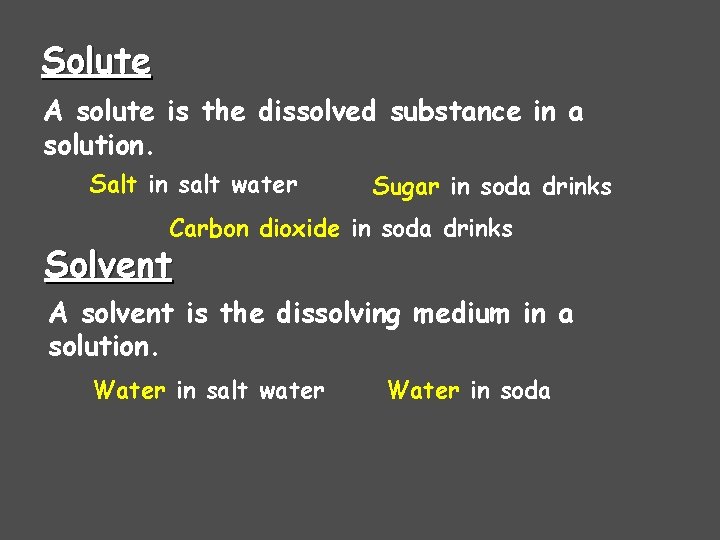
Solute A solute is the dissolved substance in a solution. Salt in salt water Sugar in soda drinks Carbon dioxide in soda drinks Solvent A solvent is the dissolving medium in a solution. Water in salt water Water in soda
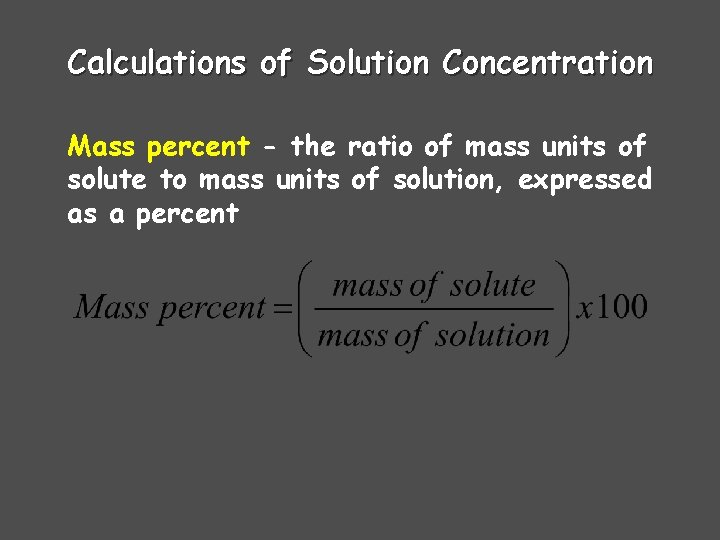
Calculations of Solution Concentration Mass percent - the ratio of mass units of solute to mass units of solution, expressed as a percent
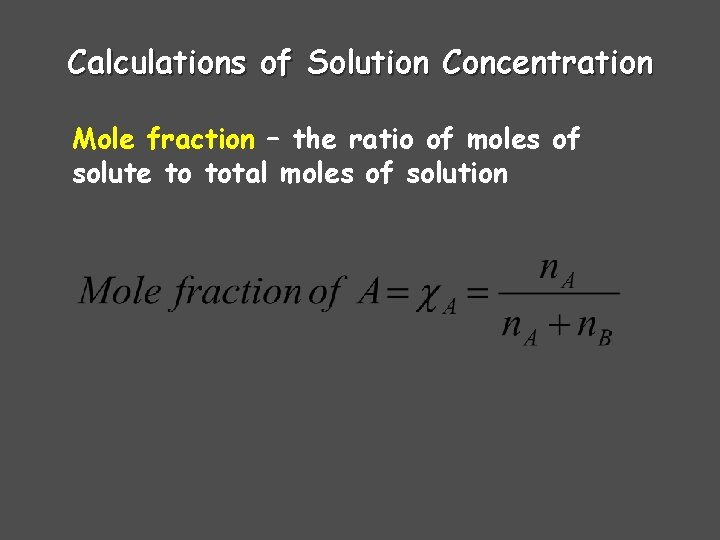
Calculations of Solution Concentration Mole fraction – the ratio of moles of solute to total moles of solution
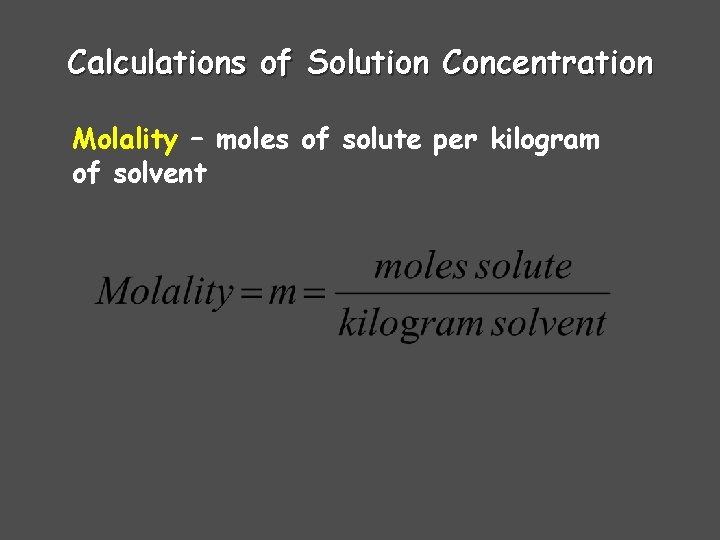
Calculations of Solution Concentration Molality – moles of solute per kilogram of solvent
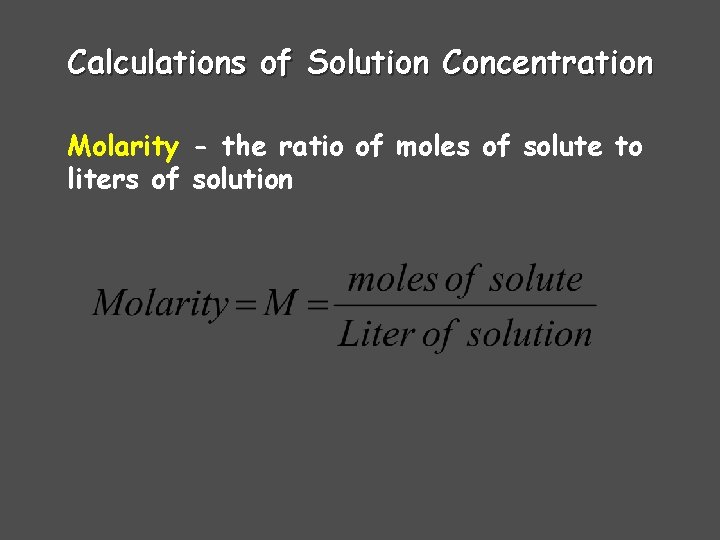
Calculations of Solution Concentration Molarity - the ratio of moles of solute to liters of solution
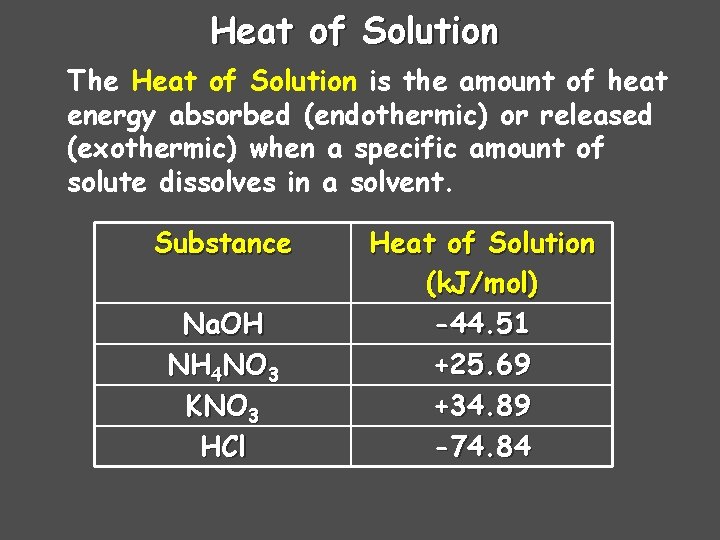
Heat of Solution The Heat of Solution is the amount of heat energy absorbed (endothermic) or released (exothermic) when a specific amount of solute dissolves in a solvent. Substance Na. OH NH 4 NO 3 KNO 3 HCl Heat of Solution (k. J/mol) -44. 51 +25. 69 +34. 89 -74. 84
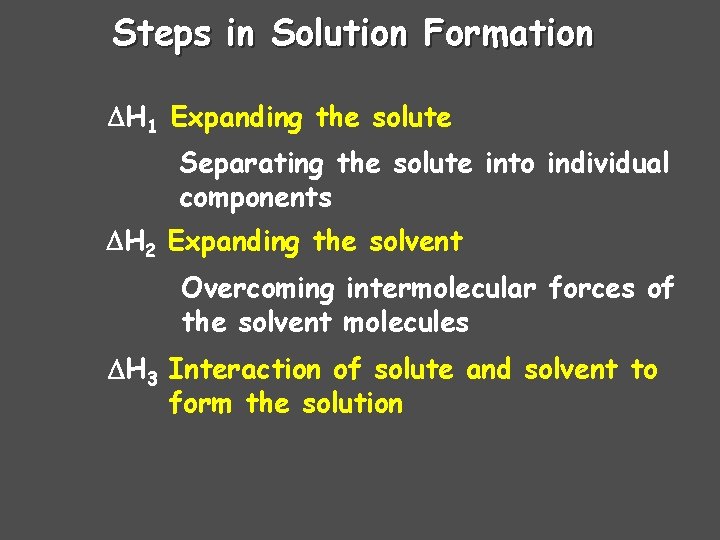
Steps in Solution Formation H 1 Expanding the solute Separating the solute into individual components H 2 Expanding the solvent Overcoming intermolecular forces of the solvent molecules H 3 Interaction of solute and solvent to form the solution
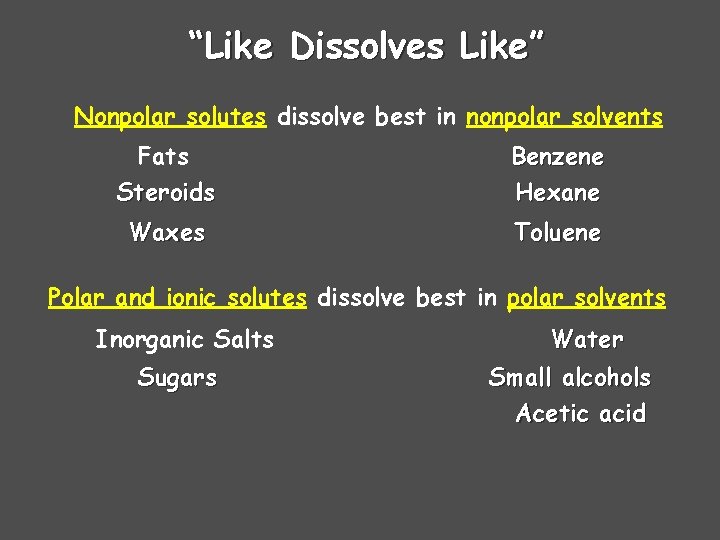
“Like Dissolves Like” Nonpolar solutes dissolve best in nonpolar solvents Fats Steroids Benzene Hexane Waxes Toluene Polar and ionic solutes dissolve best in polar solvents Inorganic Salts Sugars Water Small alcohols Acetic acid
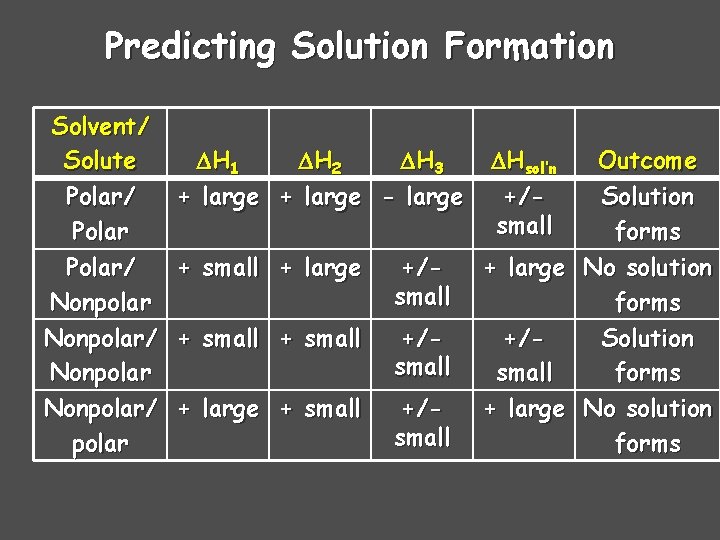
Predicting Solution Formation Solvent/ Solute Polar/ Nonpolar/ polar H 1 H 2 H 3 + large - large + small + large +/small +/small + large + small +/small Hsol’n +/small Outcome Solution forms + large No solution forms +/Solution small forms + large No solution forms
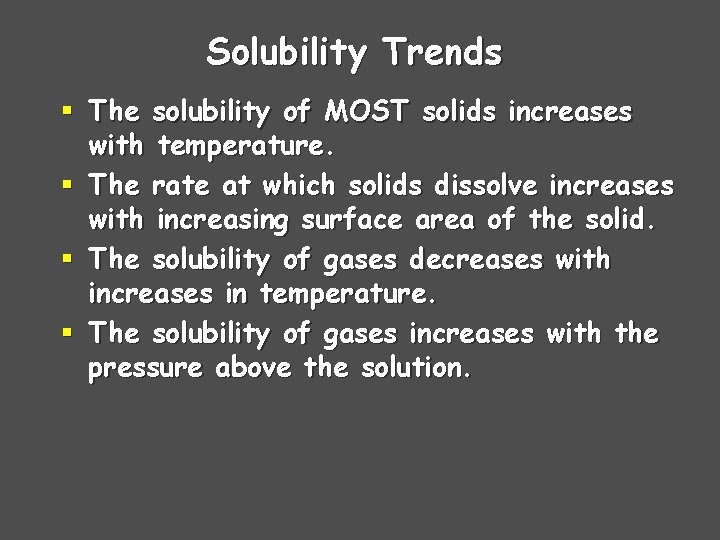
Solubility Trends § The solubility of MOST solids increases with temperature. § The rate at which solids dissolve increases with increasing surface area of the solid. § The solubility of gases decreases with increases in temperature. § The solubility of gases increases with the pressure above the solution.
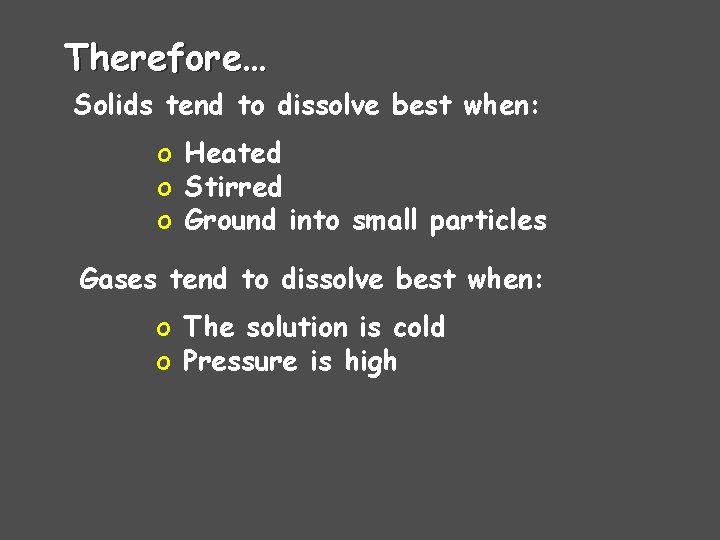
Therefore… Solids tend to dissolve best when: o Heated o Stirred o Ground into small particles Gases tend to dissolve best when: o The solution is cold o Pressure is high
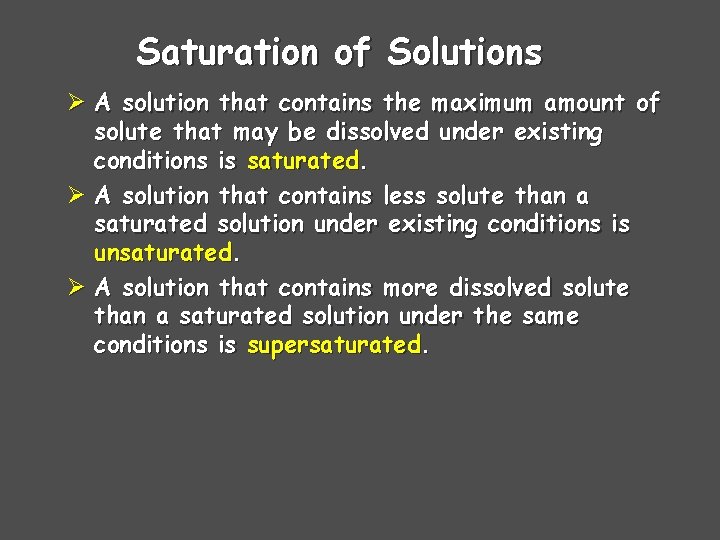
Saturation of Solutions Ø A solution that contains the maximum amount of solute that may be dissolved under existing conditions is saturated. Ø A solution that contains less solute than a saturated solution under existing conditions is unsaturated. Ø A solution that contains more dissolved solute than a saturated solution under the same conditions is supersaturated.
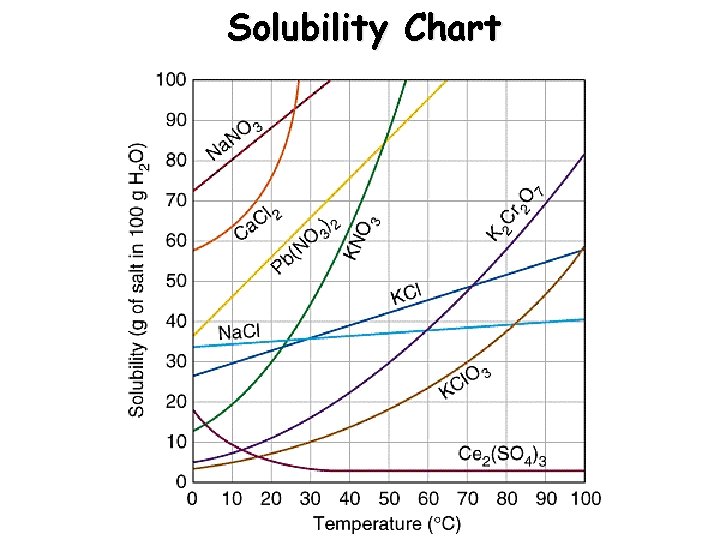
Solubility Chart
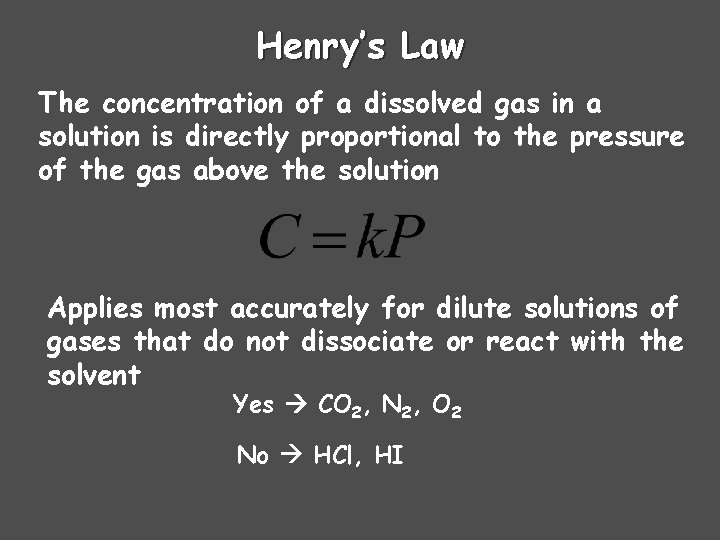
Henry’s Law The concentration of a dissolved gas in a solution is directly proportional to the pressure of the gas above the solution Applies most accurately for dilute solutions of gases that do not dissociate or react with the solvent Yes CO 2, N 2, O 2 No HCl, HI
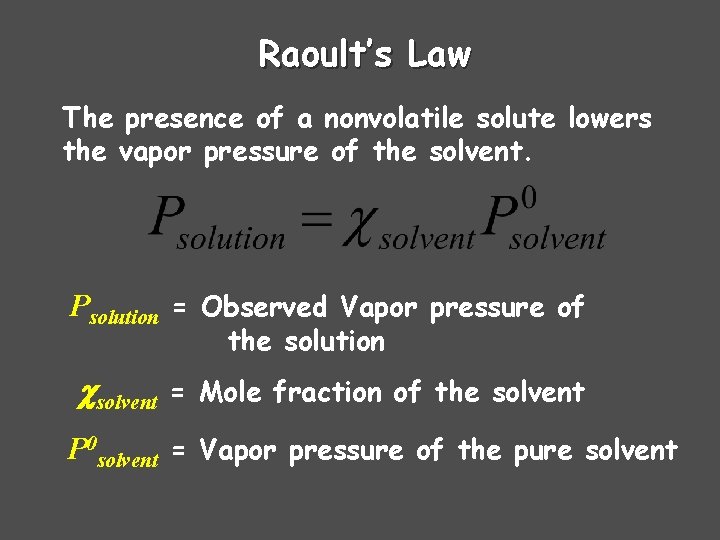
Raoult’s Law The presence of a nonvolatile solute lowers the vapor pressure of the solvent. Psolution = Observed Vapor pressure of the solution solvent = Mole fraction of the solvent P 0 solvent = Vapor pressure of the pure solvent
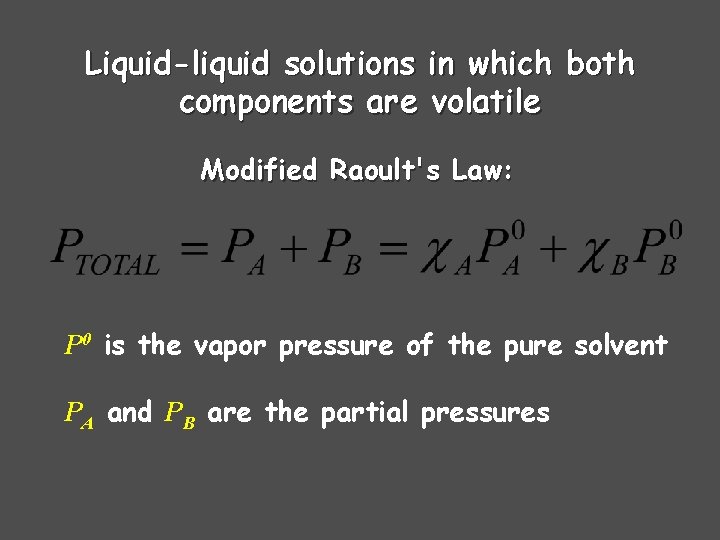
Liquid-liquid solutions in which both components are volatile Modified Raoult's Law: P 0 is the vapor pressure of the pure solvent PA and PB are the partial pressures
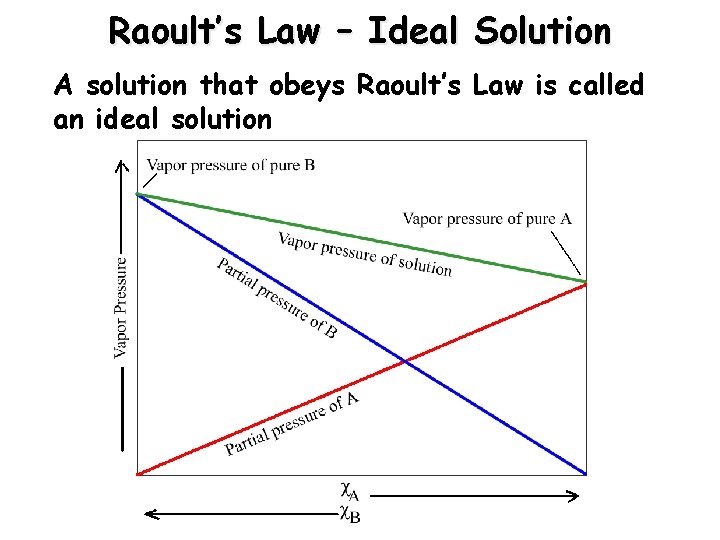
Raoult’s Law – Ideal Solution A solution that obeys Raoult’s Law is called an ideal solution
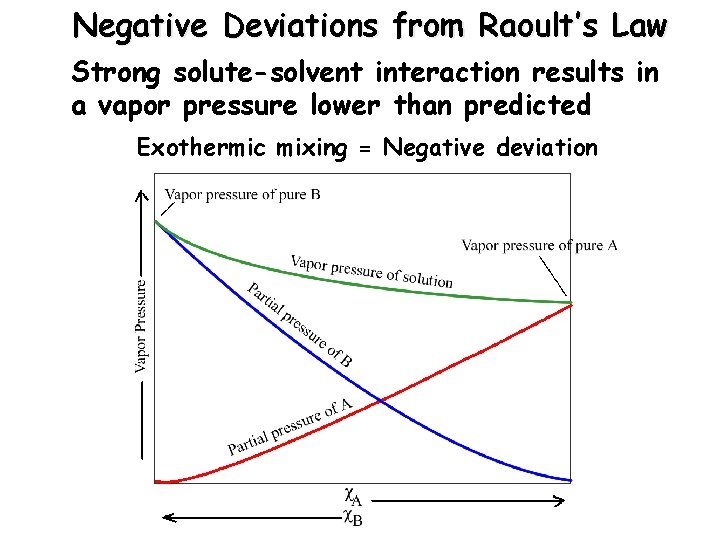
Negative Deviations from Raoult’s Law Strong solute-solvent interaction results in a vapor pressure lower than predicted Exothermic mixing = Negative deviation
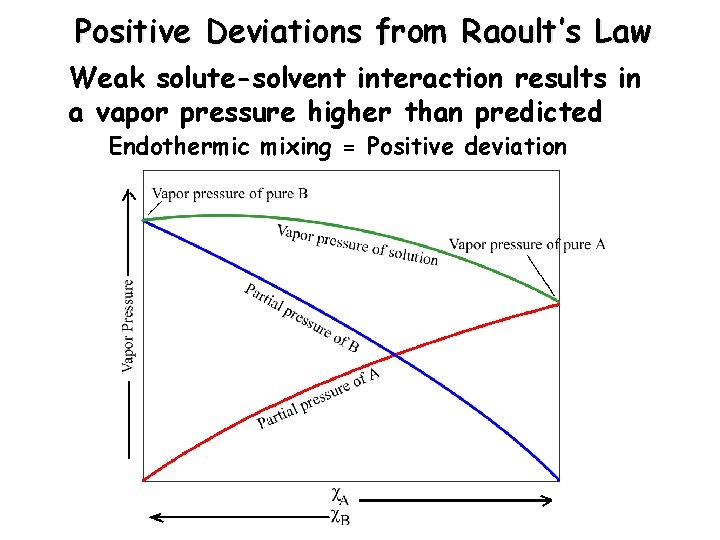
Positive Deviations from Raoult’s Law Weak solute-solvent interaction results in a vapor pressure higher than predicted Endothermic mixing = Positive deviation
Definition of Electrolytes and Nonelectrolytes An electrolyte is: A substance whose aqueous solution conducts an electric current. A nonelectrolyte is: A substance whose aqueous solution does not conduct an electric current. Try to classify the following substances as electrolytes or nonelectrolytes…
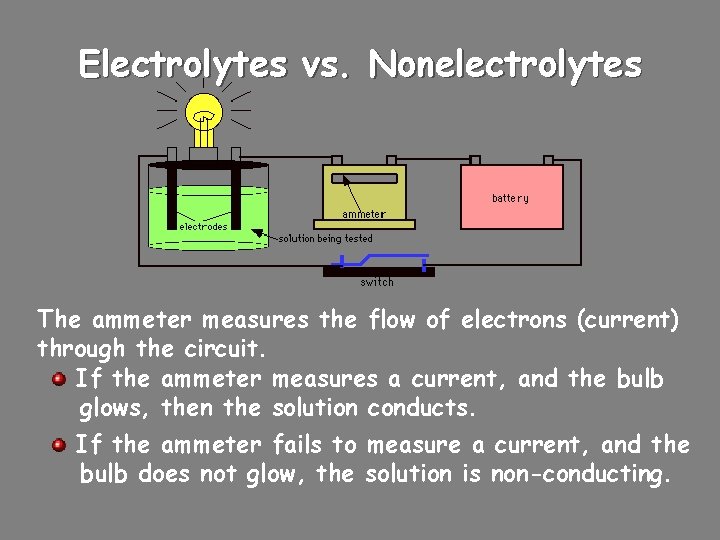
Electrolytes vs. Nonelectrolytes The ammeter measures the flow of electrons (current) through the circuit. If the ammeter measures a current, and the bulb glows, then the solution conducts. If the ammeter fails to measure a current, and the bulb does not glow, the solution is non-conducting.
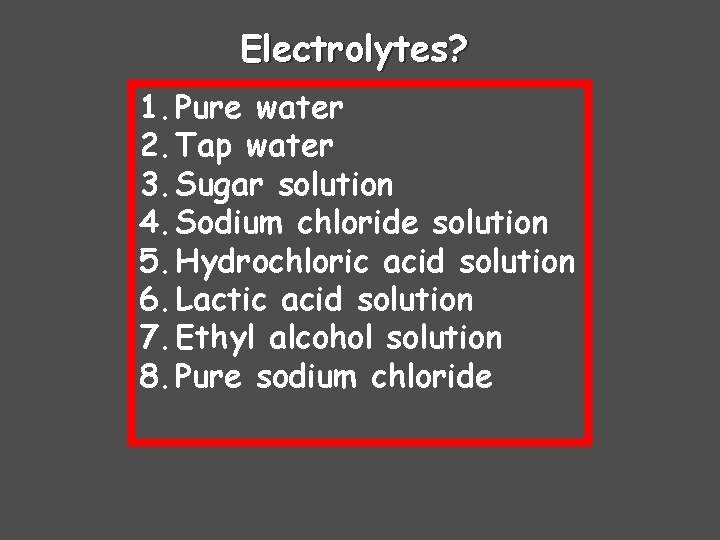
Electrolytes? 1. Pure water 2. Tap water 3. Sugar solution 4. Sodium chloride solution 5. Hydrochloric acid solution 6. Lactic acid solution 7. Ethyl alcohol solution 8. Pure sodium chloride
Answers to Electrolytes ELECTROLYTES: NONELECTROLYTES: Tap water (weak) Pure water Na. Cl solution Sugar solution HCl solution Ethanol solution Lactate solution (weak) Pure Na. Cl
Colligative Properties Colligative properties are those that depend on the concentration of particles in a solution, not upon the identity of those properties. q Boiling Point Elevation q Freezing Point Depression q Osmotic Pressure
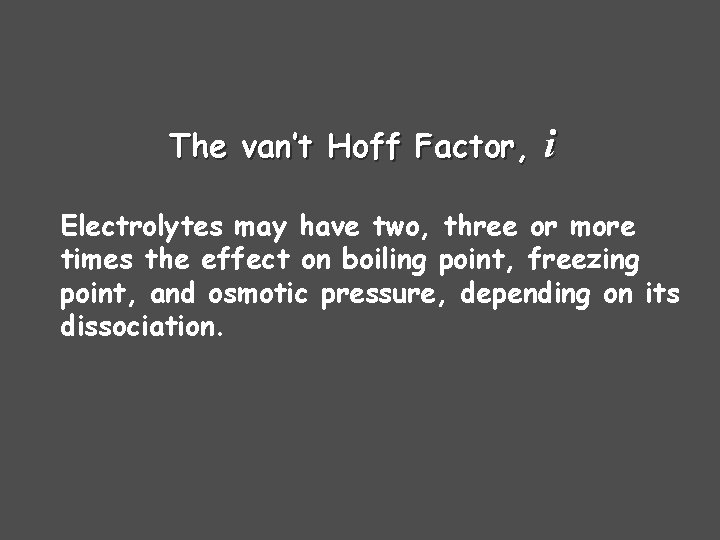
The van’t Hoff Factor, i Electrolytes may have two, three or more times the effect on boiling point, freezing point, and osmotic pressure, depending on its dissociation.
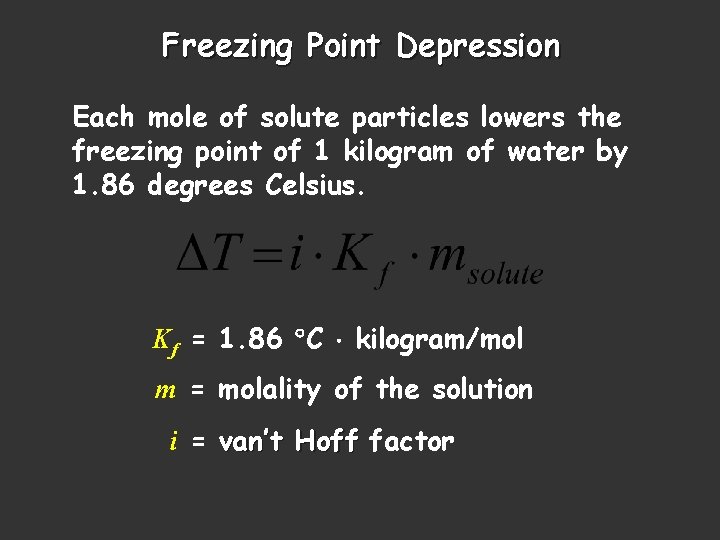
Freezing Point Depression Each mole of solute particles lowers the freezing point of 1 kilogram of water by 1. 86 degrees Celsius. Kf = 1. 86 C kilogram/mol m = molality of the solution i = van’t Hoff factor
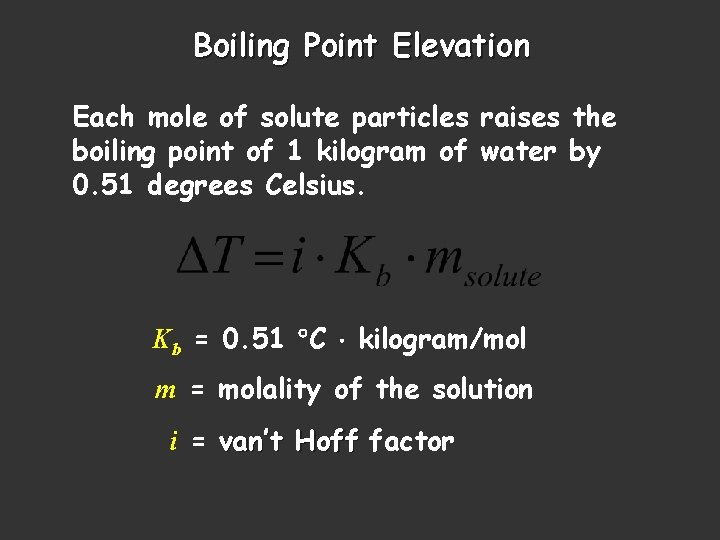
Boiling Point Elevation Each mole of solute particles raises the boiling point of 1 kilogram of water by 0. 51 degrees Celsius. Kb = 0. 51 C kilogram/mol m = molality of the solution i = van’t Hoff factor
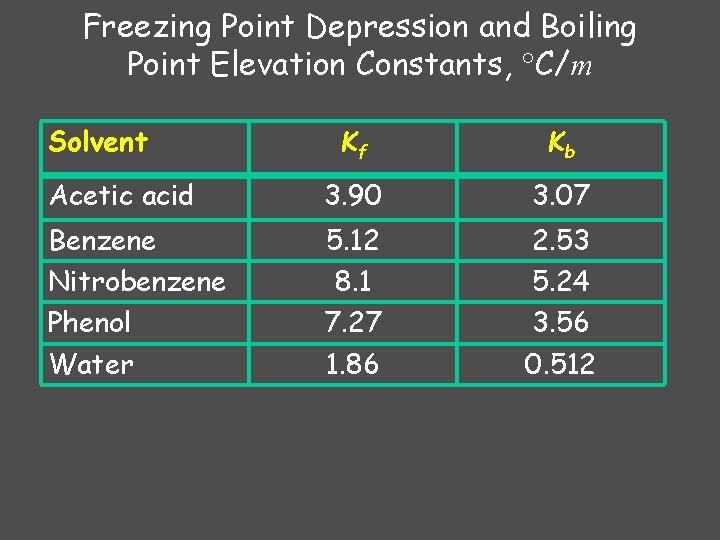
Freezing Point Depression and Boiling Point Elevation Constants, C/m Solvent Kf Kb Acetic acid 3. 90 3. 07 Benzene Nitrobenzene Phenol 5. 12 8. 1 7. 27 2. 53 5. 24 3. 56 Water 1. 86 0. 512
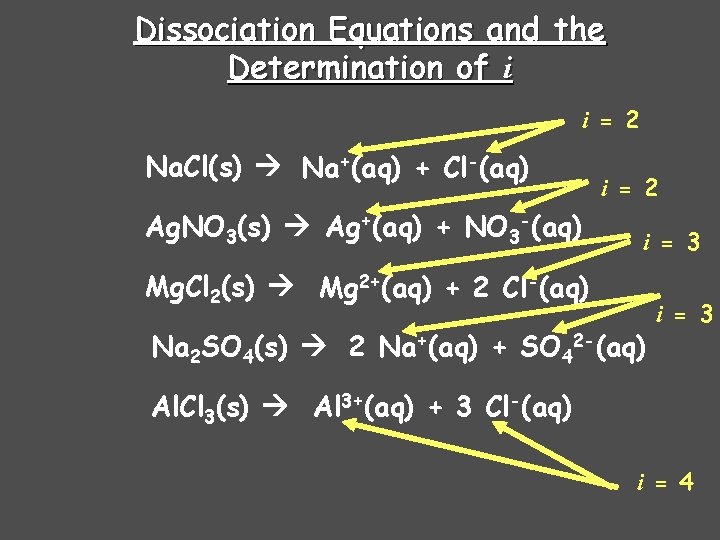
Dissociation Equations and the Determination of i i = 2 Na. Cl(s) Na+(aq) + Cl-(aq) Ag. NO 3(s) Ag+(aq) + NO 3 -(aq) i = 2 i = 3 Mg. Cl 2(s) Mg 2+(aq) + 2 Cl-(aq) Na 2 SO 4(s) 2 Na+(aq) + SO 42 -(aq) i = 3 Al. Cl 3(s) Al 3+(aq) + 3 Cl-(aq) i = 4
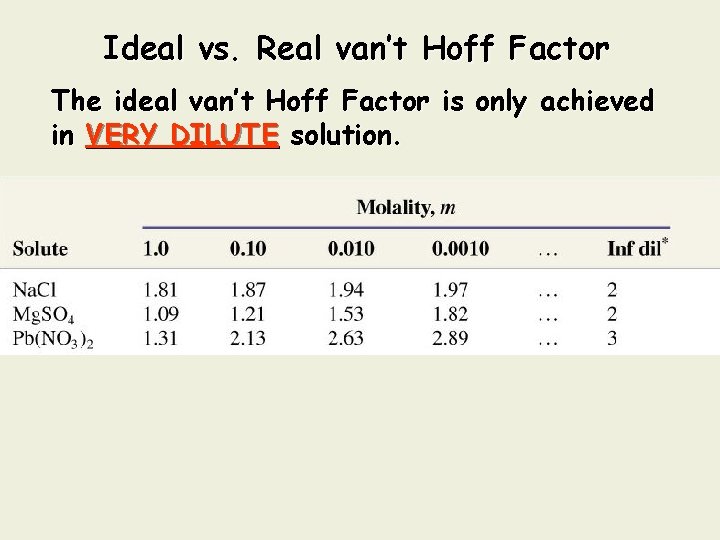
Ideal vs. Real van’t Hoff Factor The ideal van’t Hoff Factor is only achieved in VERY DILUTE solution.
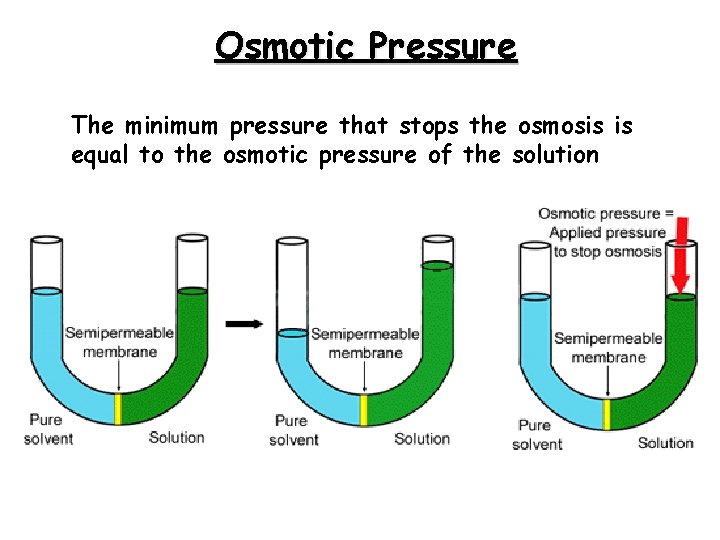
Osmotic Pressure The minimum pressure that stops the osmosis is equal to the osmotic pressure of the solution
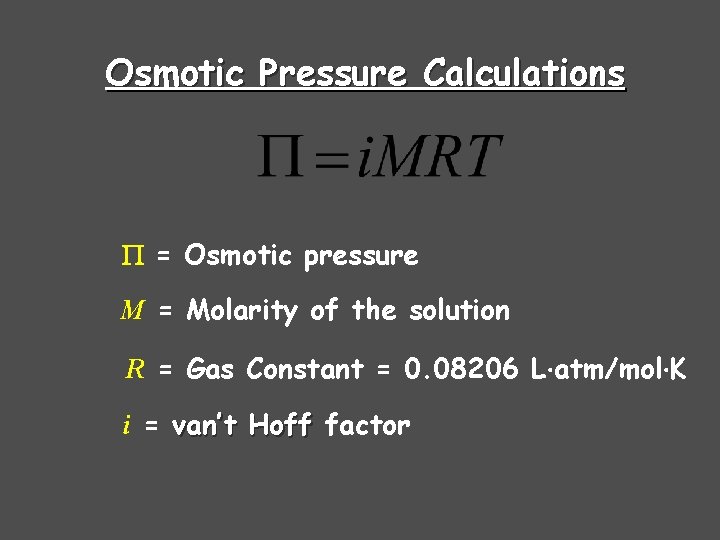
Osmotic Pressure Calculations = Osmotic pressure M = Molarity of the solution R = Gas Constant = 0. 08206 L atm/mol K i = van’t Hoff factor
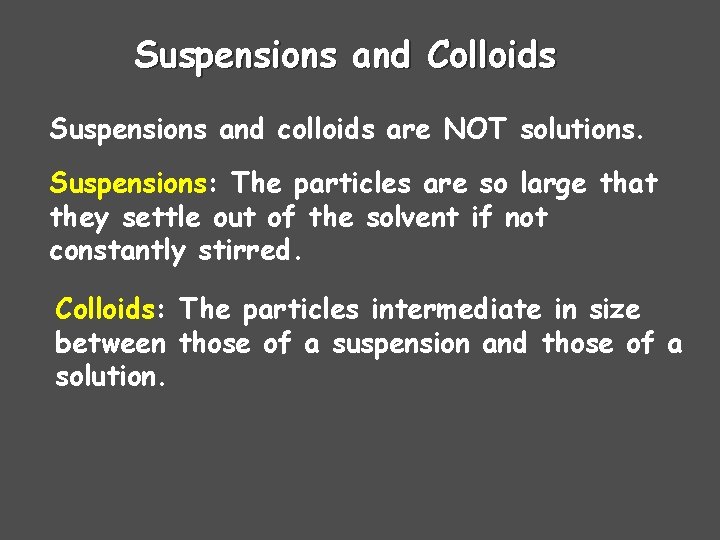
Suspensions and Colloids Suspensions and colloids are NOT solutions. Suspensions: The particles are so large that they settle out of the solvent if not constantly stirred. Colloids: The particles intermediate in size between those of a suspension and those of a solution.
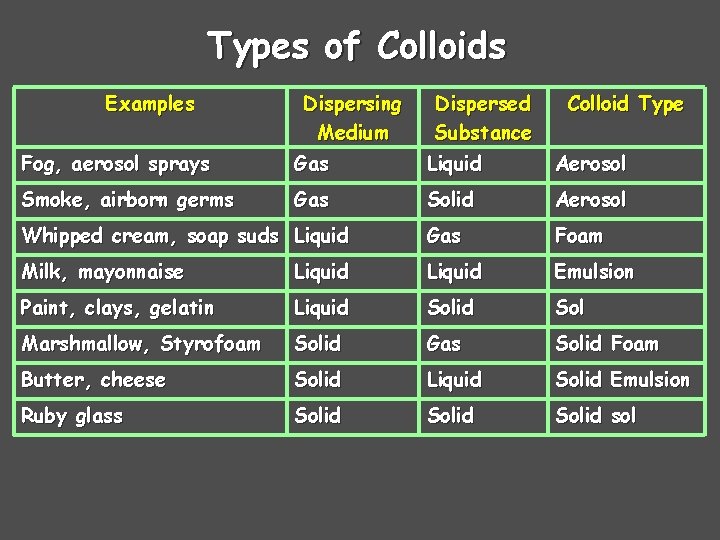
Types of Colloids Examples Dispersing Medium Dispersed Substance Colloid Type Fog, aerosol sprays Gas Liquid Aerosol Smoke, airborn germs Gas Solid Aerosol Whipped cream, soap suds Liquid Gas Foam Milk, mayonnaise Liquid Emulsion Paint, clays, gelatin Liquid Sol Marshmallow, Styrofoam Solid Gas Solid Foam Butter, cheese Solid Liquid Solid Emulsion Ruby glass Solid sol
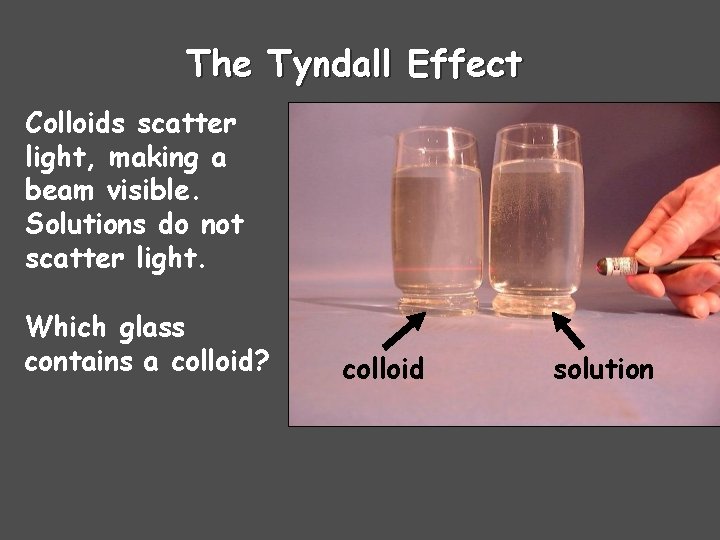
The Tyndall Effect Colloids scatter light, making a beam visible. Solutions do not scatter light. Which glass contains a colloid? colloid solution