
Properties of Solutions Chapter 11 Composition of Solutions

- Slides: 23
Properties of Solutions Chapter 11
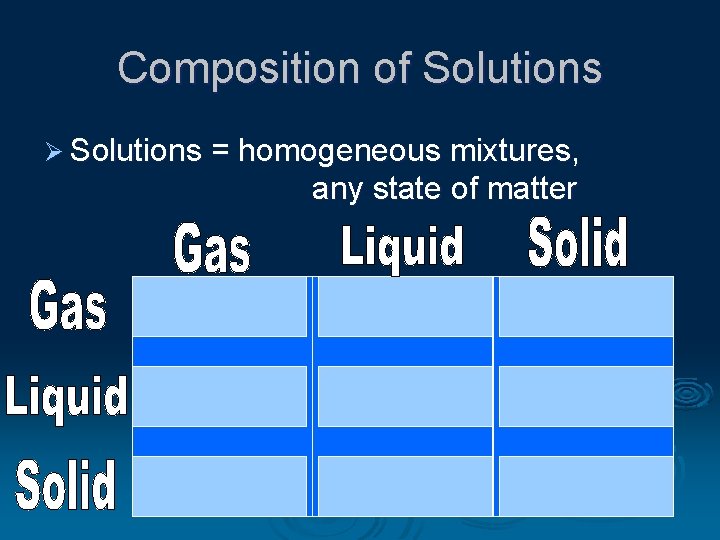
Composition of Solutions Ø Solutions = homogeneous mixtures, any state of matter
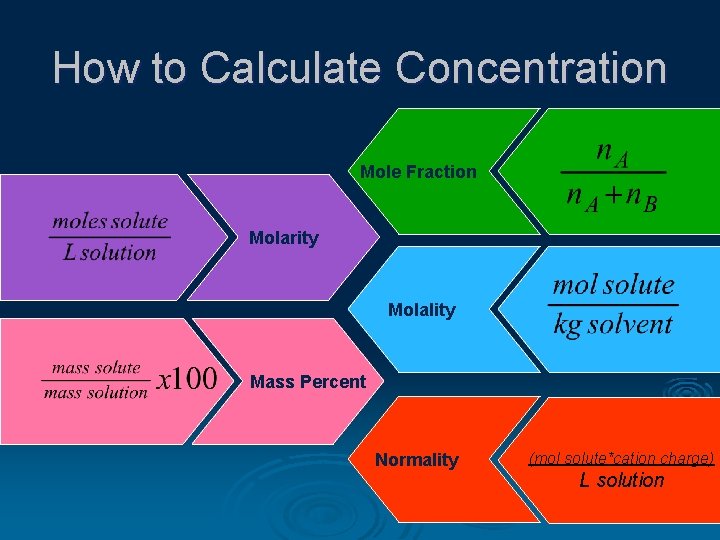
How to Calculate Concentration Mole Fraction Molarity Molality Mass Percent Normality (mol solute*cation charge) L solution
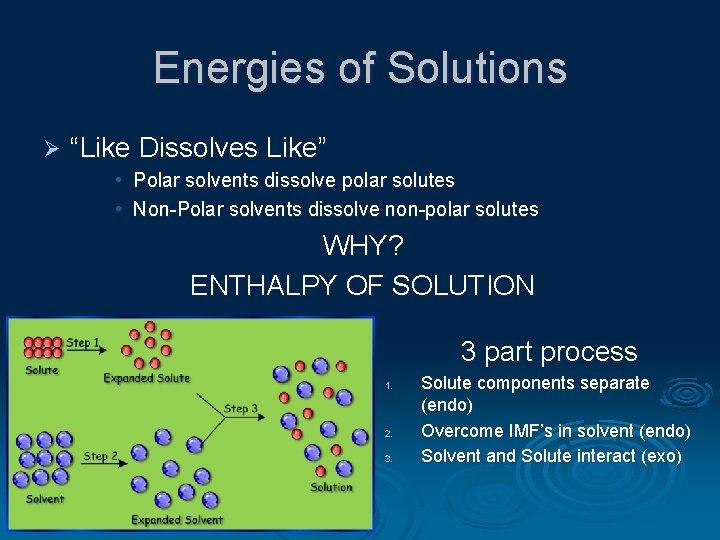
Energies of Solutions Ø “Like Dissolves Like” • Polar solvents dissolve polar solutes • Non-Polar solvents dissolve non-polar solutes WHY? ENTHALPY OF SOLUTION 3 part process Ø 1. 2. 3. Solute components separate (endo) Overcome IMF’s in solvent (endo) Solvent and Solute interact (exo)
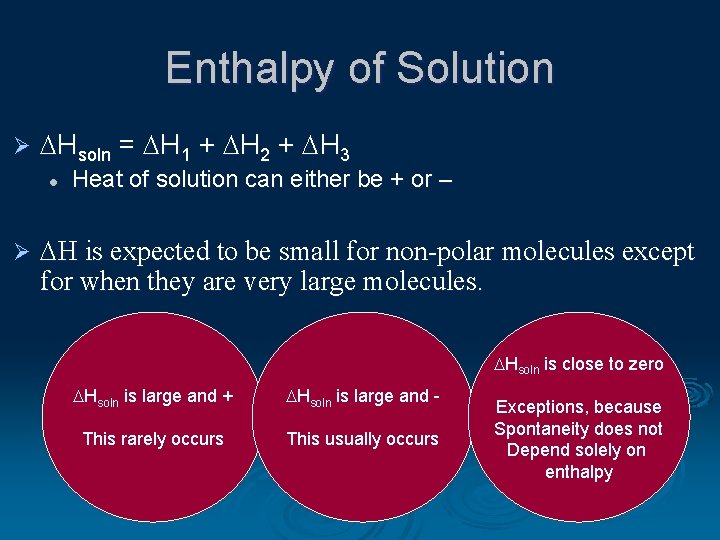
Enthalpy of Solution Ø DHsoln = DH 1 + DH 2 + DH 3 l Ø Heat of solution can either be + or – DH is expected to be small for non-polar molecules except for when they are very large molecules. DHsoln is close to zero DHsoln is large and + DHsoln is large and - This rarely occurs This usually occurs Exceptions, because Spontaneity does not Depend solely on enthalpy
Try Me! Ø Decide whether liquid hexane (C 6 H 14) or liquid methanol (CH 3 OH) is more appropriate solvent for substances, grease (C 20 H 42) and potassium iodide (KI).
Factors Affecting Solubility Ø Structure---Polarity l l Ø Pressure---works only on gases l l Ø Non polar are hydrophobic Polar are hydrophillic Some are a combo with different ends. Vitamin C and scurvy C = k. P (Henry’s Law) [gas] a Pvapor Temperature---not always a direct relationship l l Gas in water; as T increases, solubility decreases See solubility curves for individual compound reactions to temperature.
Colligative Properties Ø A property of a solution that depends only on the number, and not on the identity of the solute particles present. l l Vapor Pressure Boiling Point Elevation Freezing Point Depression Osmotic Pressure
Vapor Pressure Ø Non-volatile Solute added to solvent l l Reduces the tendency of the solvent molecules to escape (evaporate) Equilibrium pressure of the solvent is higher than equilibrium pressure of solution. More of the solvent (pure) has to evaporate to be at equilibrium than is the case in a beaker full of solution.
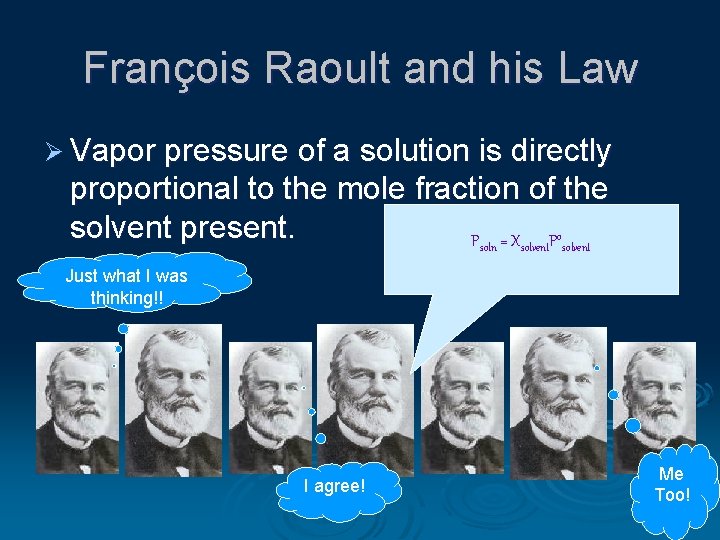
François Raoult and his Law Ø Vapor pressure of a solution is directly proportional to the mole fraction of the solvent present. Psoln = Xsolvent. Posolvent Just what I was thinking!! I agree! Me Too!
Try Me! Ø Calculate the expected vapor pressure at 25 o. C for a solution prepared by dissolving 85. 58 g of table sugar (sucrose molar mass = 342. 3 g/mol) in 320. 5 cm 3 of water. The vapor pressure of water is 23. 76 torr at this temperature.
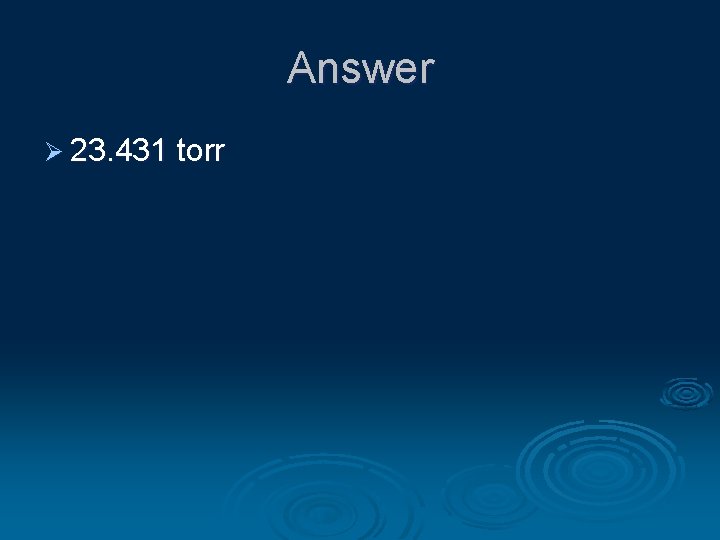
Answer Ø 23. 431 torr
More solute, lower vapor pressure Ø Predict the vapor pressure of a solution prepared by mixing 35. 0 g solid Na 2 SO 4 with 175 g water at 25 o. C. The vapor pressure of water is still 23. 76 torr.
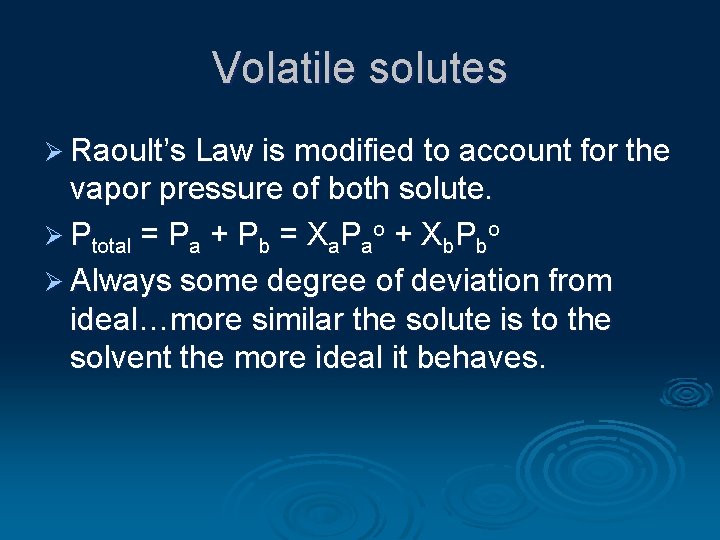
Volatile solutes Ø Raoult’s Law is modified to account for the vapor pressure of both solute. Ø Ptotal = Pa + Pb = Xa. Pao + Xb. Pbo Ø Always some degree of deviation from ideal…more similar the solute is to the solvent the more ideal it behaves.
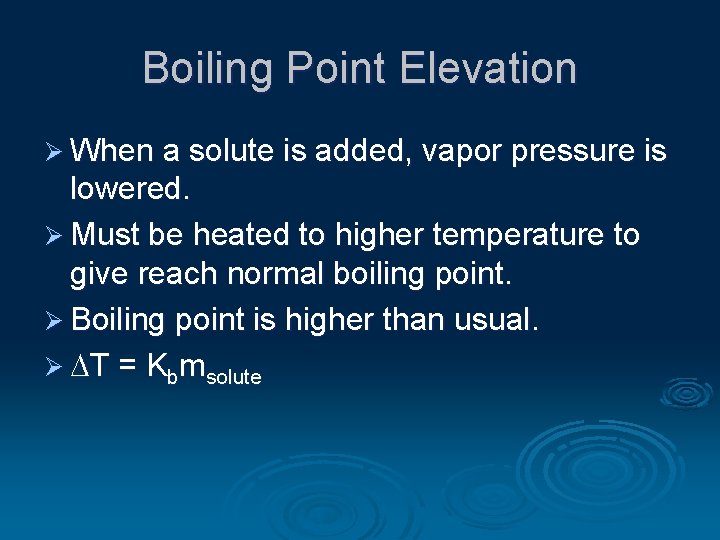
Boiling Point Elevation Ø When a solute is added, vapor pressure is lowered. Ø Must be heated to higher temperature to give reach normal boiling point. Ø Boiling point is higher than usual. Ø DT = Kbmsolute
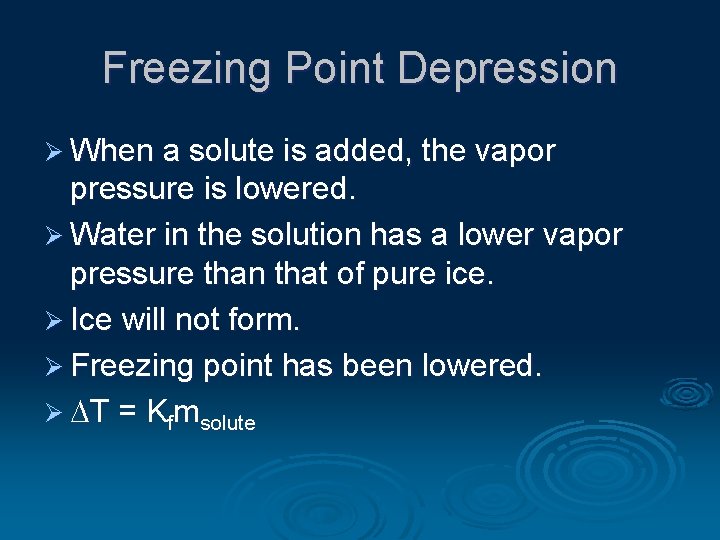
Freezing Point Depression Ø When a solute is added, the vapor pressure is lowered. Ø Water in the solution has a lower vapor pressure than that of pure ice. Ø Ice will not form. Ø Freezing point has been lowered. Ø DT = Kfmsolute
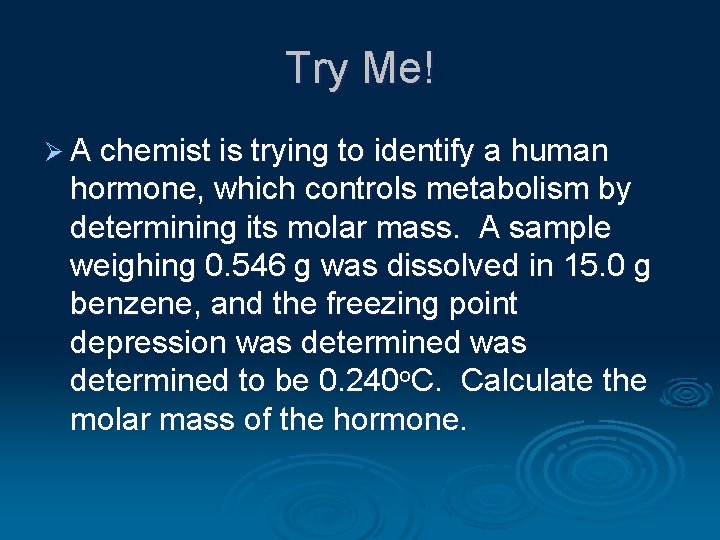
Try Me! Ø A chemist is trying to identify a human hormone, which controls metabolism by determining its molar mass. A sample weighing 0. 546 g was dissolved in 15. 0 g benzene, and the freezing point depression was determined to be 0. 240 o. C. Calculate the molar mass of the hormone.
Osmotic Pressure Ø Solvent, but not solute can pass through a semi-permeable membrane via osmosis. Ø When pure solvent and solution volumes are stabilized (the system is at equilibrium) there is a greater pressure on the solution side. Ø The difference in pressure is the Osmotic Pressure.
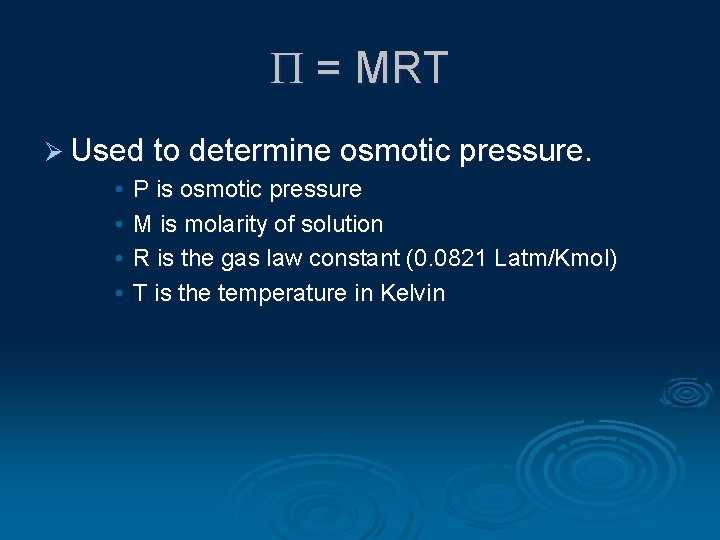
P = MRT Ø Used to determine osmotic pressure. • • P is osmotic pressure M is molarity of solution R is the gas law constant (0. 0821 Latm/Kmol) T is the temperature in Kelvin
Colligative Properties of Electrolyte Solutions Ø The type of solute DOES matter sometimes Ø Only in ability to dissociate Ø Compare: 0. 1 m glucose to 0. 1 m Na. Cl
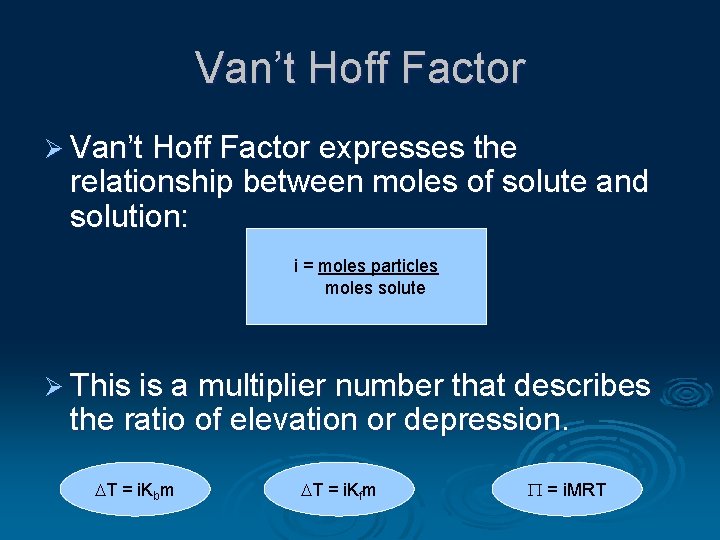
Van’t Hoff Factor Ø Van’t Hoff Factor expresses the relationship between moles of solute and solution: i = moles particles moles solute Ø This is a multiplier number that describes the ratio of elevation or depression. DT = i. Kbm DT = i. Kfm P = i. MRT
Ion Pairing Ø Van’t Hoff factor is fallible. Ø Ion Pairing: at a certain instant, some ions may not be dissociated, and thus count as a single particle. Ø Still use equations, but keep in mind that there can be some deviation.
Colloids Ø Suspension of tiny particles in a medium caused by electrostatic repulsion. Ø Tyndall Effect: Scattering of light effect by suspended particles.