
Properties of Shape To be able to identify

Properties of Shape To be able to identify equilateral, isosceles, rightangled and scalene triangles
To be able to identify equilateral, isosceles, right-angled and scalene triangles Success criteria: ü I can measure side lengths of various triangles to identify and name equilateral, isosceles, right-angled and scalene triangles ü I can explain my reasoning when measuring side lengths of various triangles to identify and name equilateral, isosceles, right-angled and scalene triangles
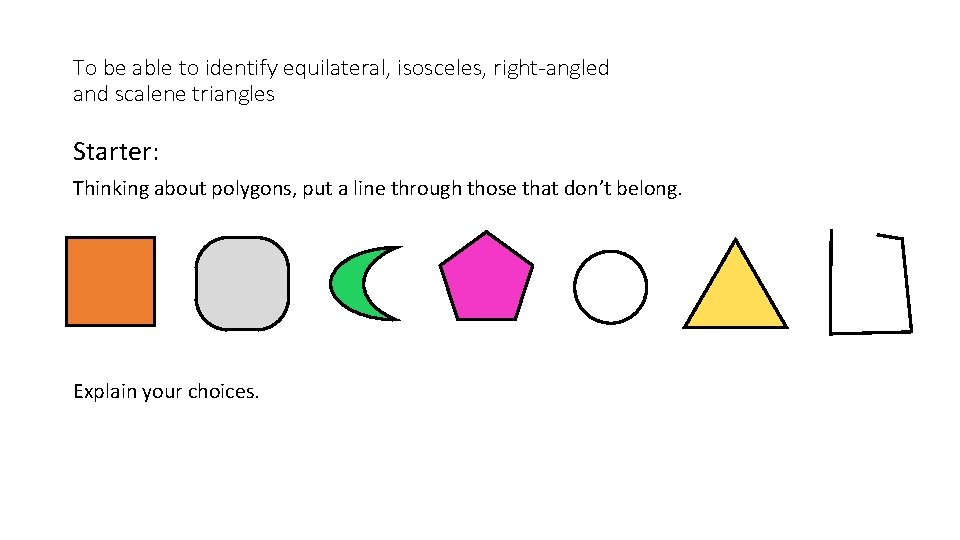
To be able to identify equilateral, isosceles, right-angled and scalene triangles Starter: Thinking about polygons, put a line through those that don’t belong. Explain your choices.
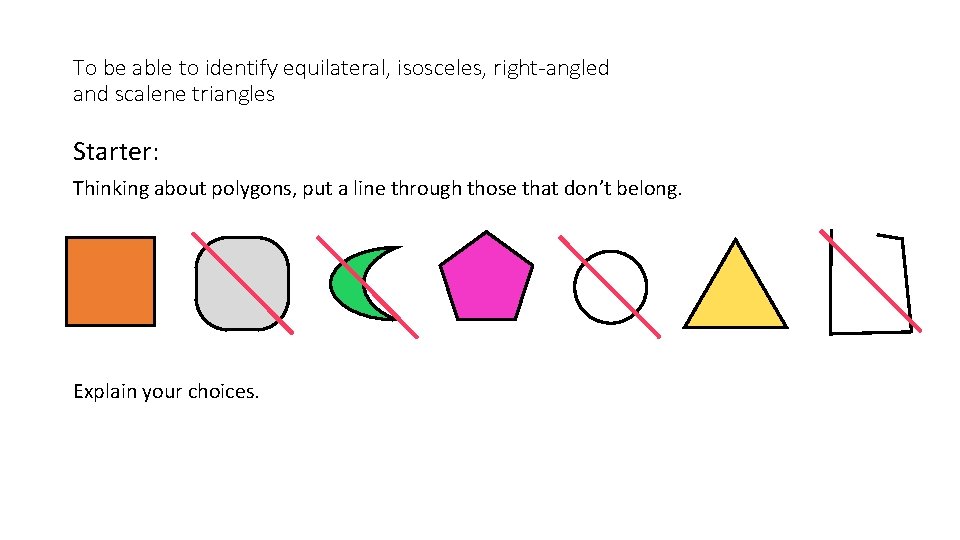
To be able to identify equilateral, isosceles, right-angled and scalene triangles Starter: Thinking about polygons, put a line through those that don’t belong. Explain your choices.
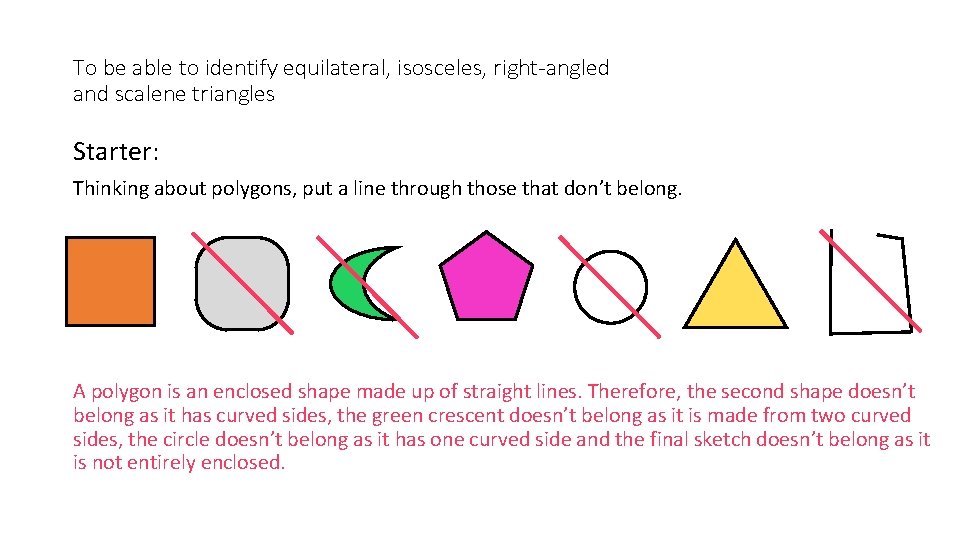
To be able to identify equilateral, isosceles, right-angled and scalene triangles Starter: Thinking about polygons, put a line through those that don’t belong. A polygon is an enclosed shape made up of straight lines. Therefore, the second shape doesn’t belong as it has curved sides, the green crescent doesn’t belong as it is made from two curved sides, the circle doesn’t belong as it has one curved side and the final sketch doesn’t belong as it is not entirely enclosed.
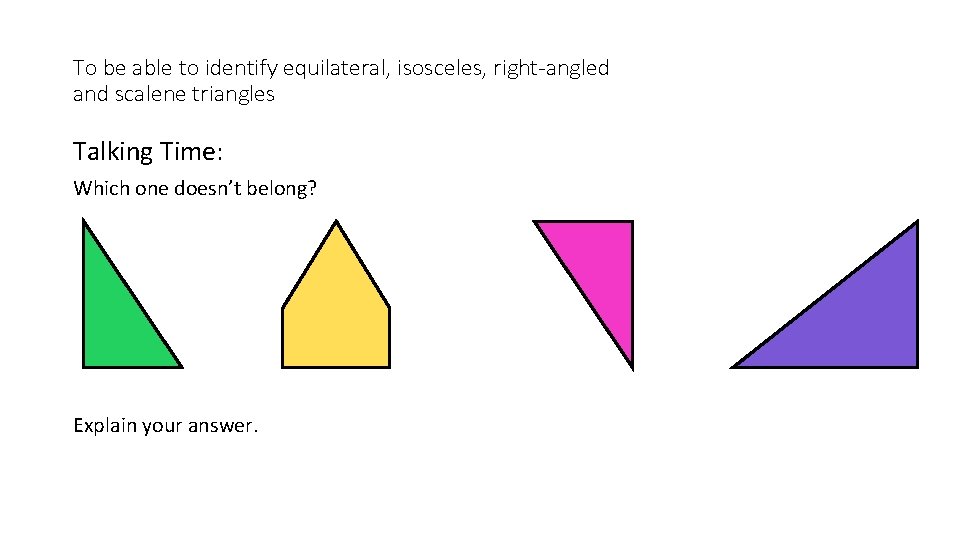
To be able to identify equilateral, isosceles, right-angled and scalene triangles Talking Time: Which one doesn’t belong? Explain your answer.
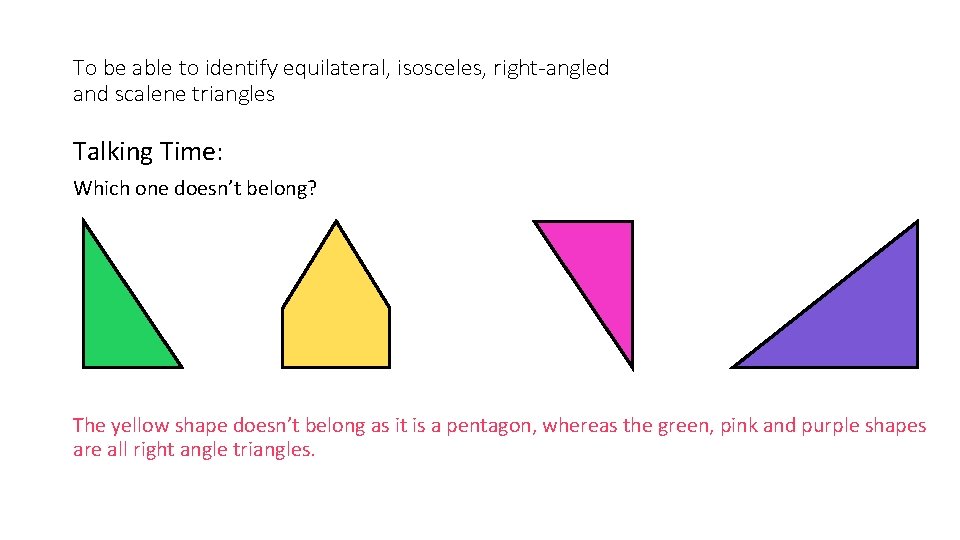
To be able to identify equilateral, isosceles, right-angled and scalene triangles Talking Time: Which one doesn’t belong? The yellow shape doesn’t belong as it is a pentagon, whereas the green, pink and purple shapes are all right angle triangles.
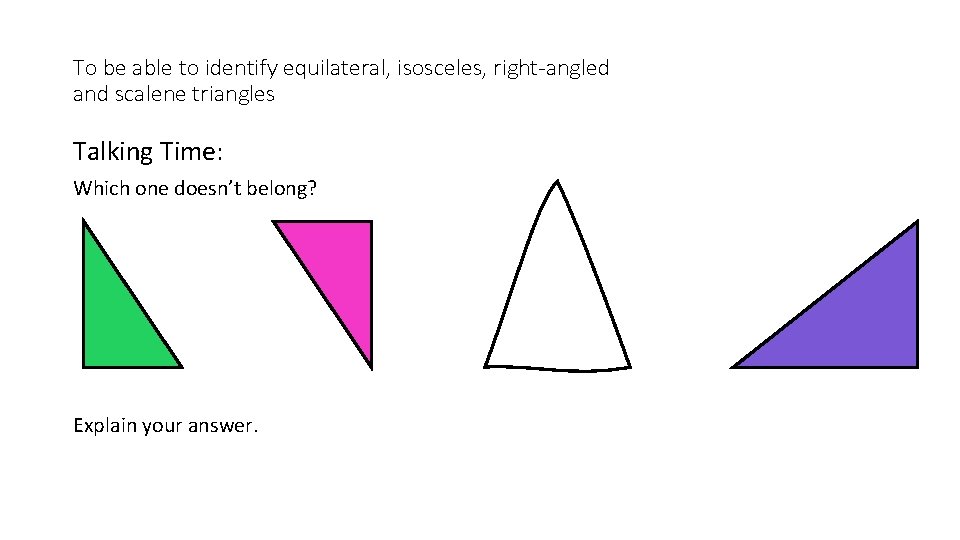
To be able to identify equilateral, isosceles, right-angled and scalene triangles Talking Time: Which one doesn’t belong? Explain your answer.
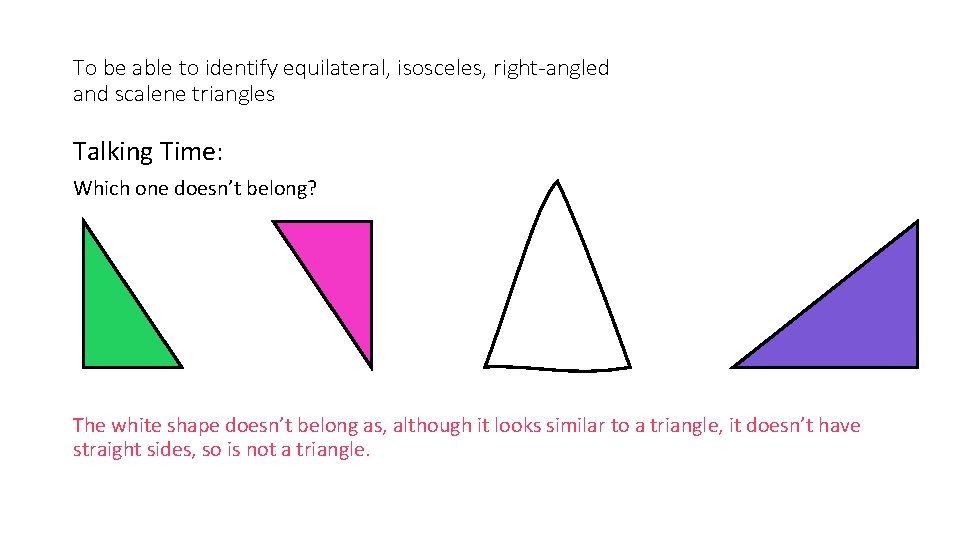
To be able to identify equilateral, isosceles, right-angled and scalene triangles Talking Time: Which one doesn’t belong? The white shape doesn’t belong as, although it looks similar to a triangle, it doesn’t have straight sides, so is not a triangle.
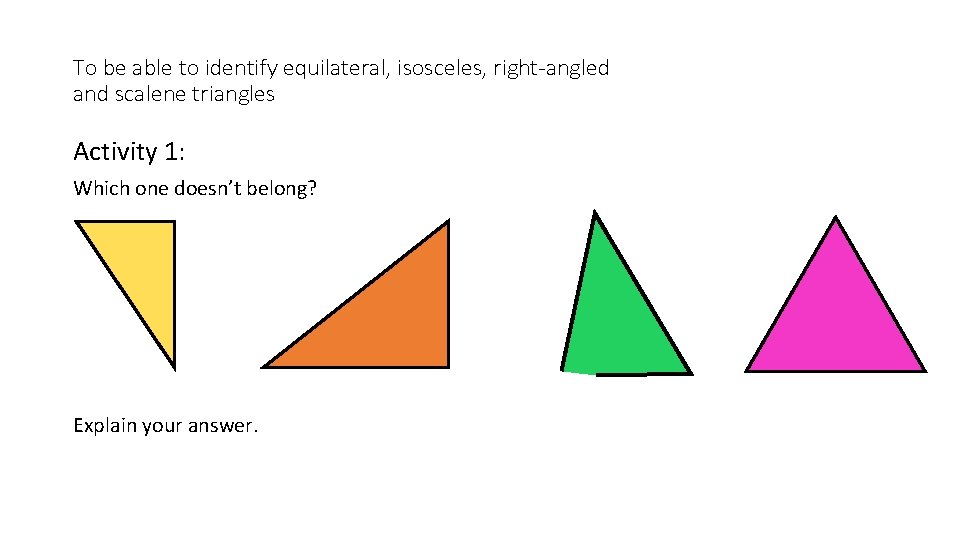
To be able to identify equilateral, isosceles, right-angled and scalene triangles Activity 1: Which one doesn’t belong? Explain your answer.
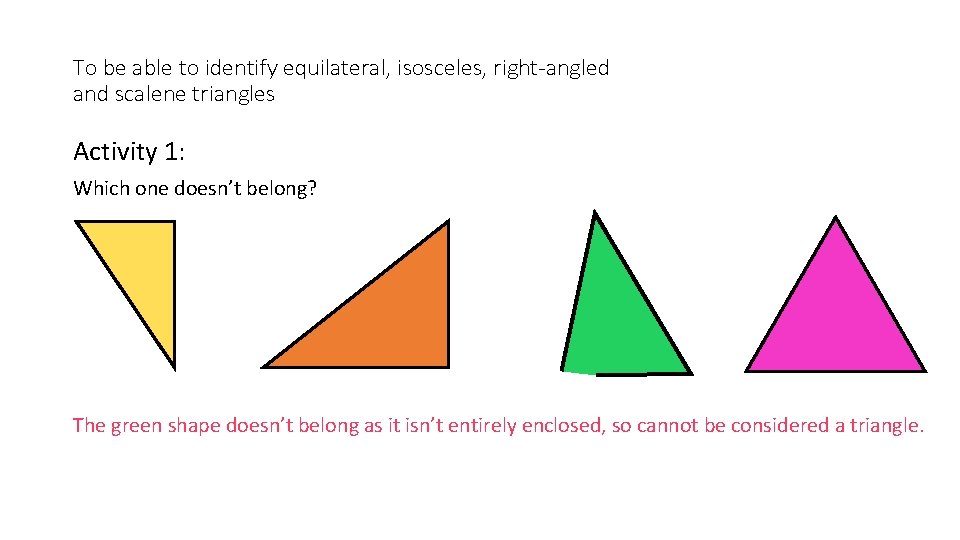
To be able to identify equilateral, isosceles, right-angled and scalene triangles Activity 1: Which one doesn’t belong? The green shape doesn’t belong as it isn’t entirely enclosed, so cannot be considered a triangle.
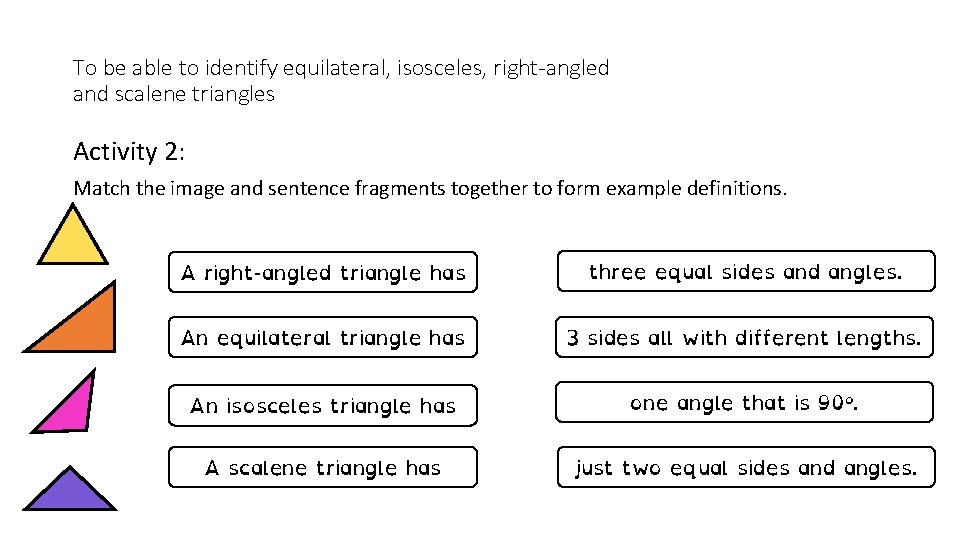
To be able to identify equilateral, isosceles, right-angled and scalene triangles Activity 2: Match the image and sentence fragments together to form example definitions. A right-angled triangle has three equal sides and angles. An equilateral triangle has 3 sides all with different lengths. An isosceles triangle has one angle that is 90 o. A scalene triangle has just two equal sides and angles.

To be able to identify equilateral, isosceles, right-angled and scalene triangles Activity 2: Match the image and sentence fragments together to form example definitions. A right-angled triangle has three equal sides and angles. An equilateral triangle has 3 sides all with different lengths. An isosceles triangle has one angle that is 90 o. A scalene triangle has just two equal sides and angles.
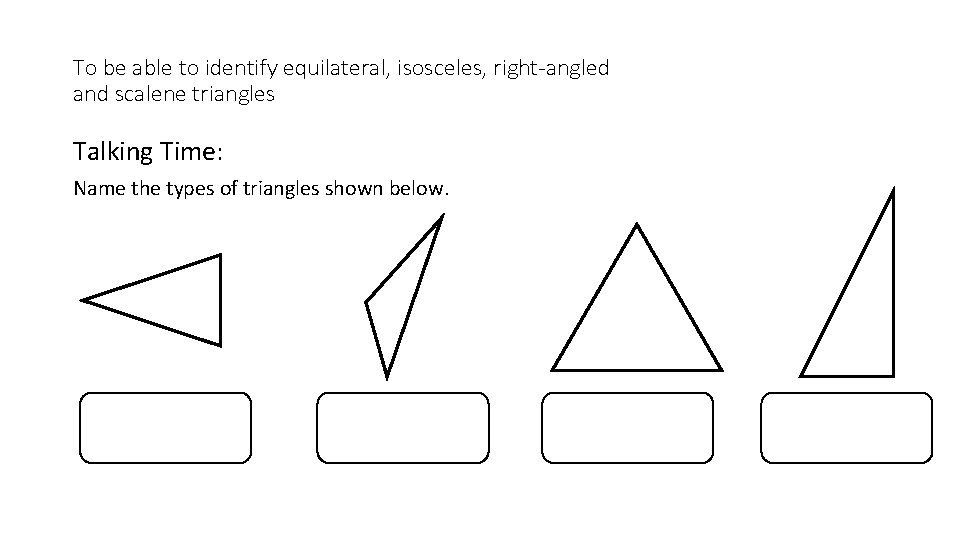
To be able to identify equilateral, isosceles, right-angled and scalene triangles Talking Time: Name the types of triangles shown below. right-angled triangle equilateral triangle scalene triangle
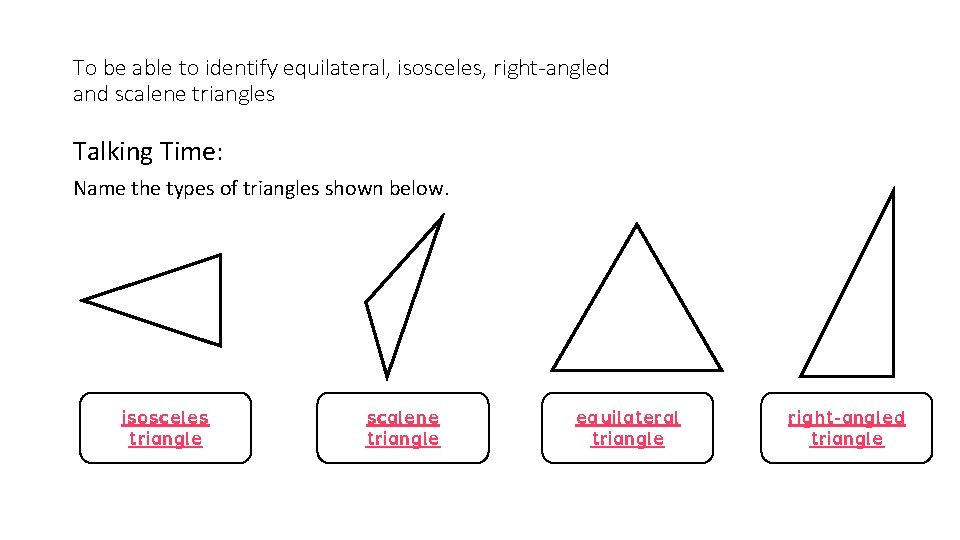
To be able to identify equilateral, isosceles, right-angled and scalene triangles Talking Time: Name the types of triangles shown below. isosceles right-angled triangle scalene equilateral triangle equilateral scalene triangle right-angled scalene triangle
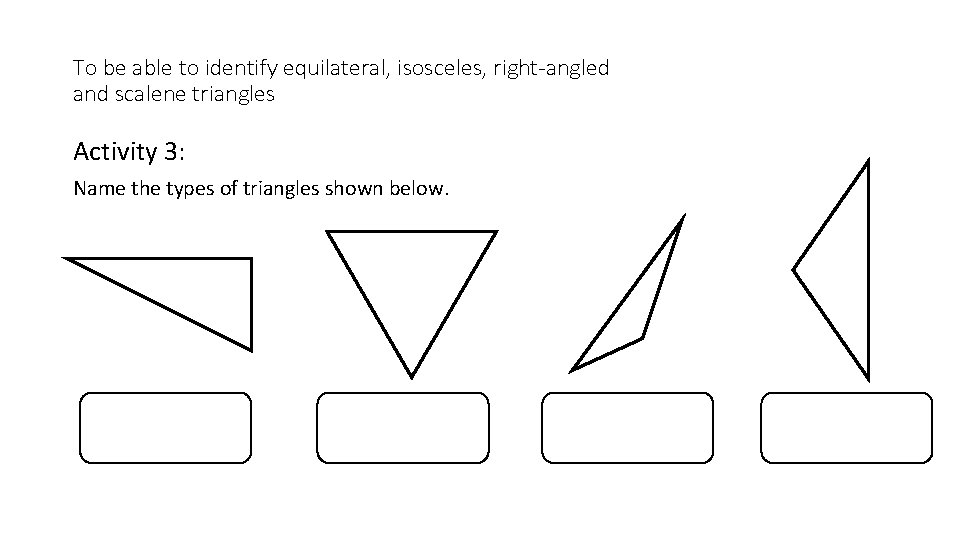
To be able to identify equilateral, isosceles, right-angled and scalene triangles Activity 3: Name the types of triangles shown below. right-angled triangle equilateral triangle scalene triangle
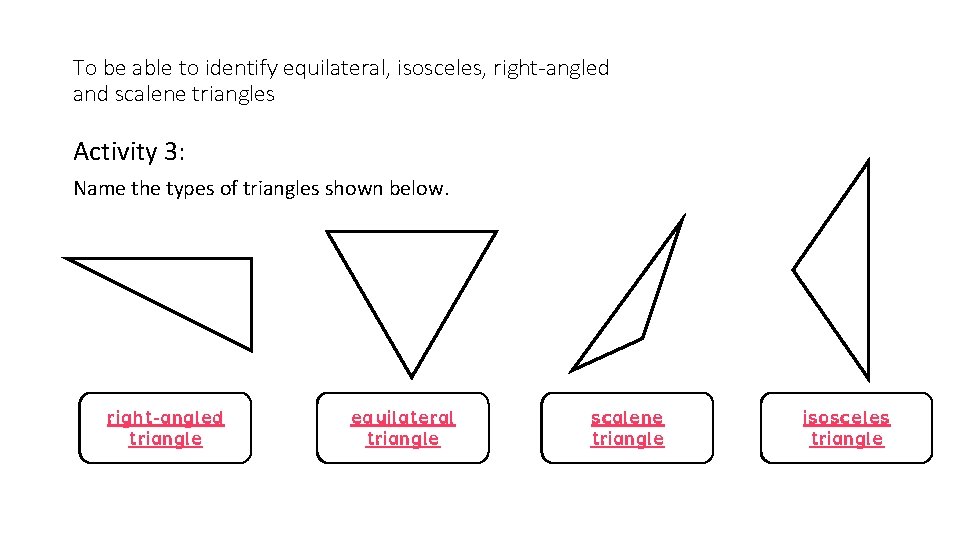
To be able to identify equilateral, isosceles, right-angled and scalene triangles Activity 3: Name the types of triangles shown below. right-angled triangle equilateral triangle scalene triangle isosceles scalene triangle
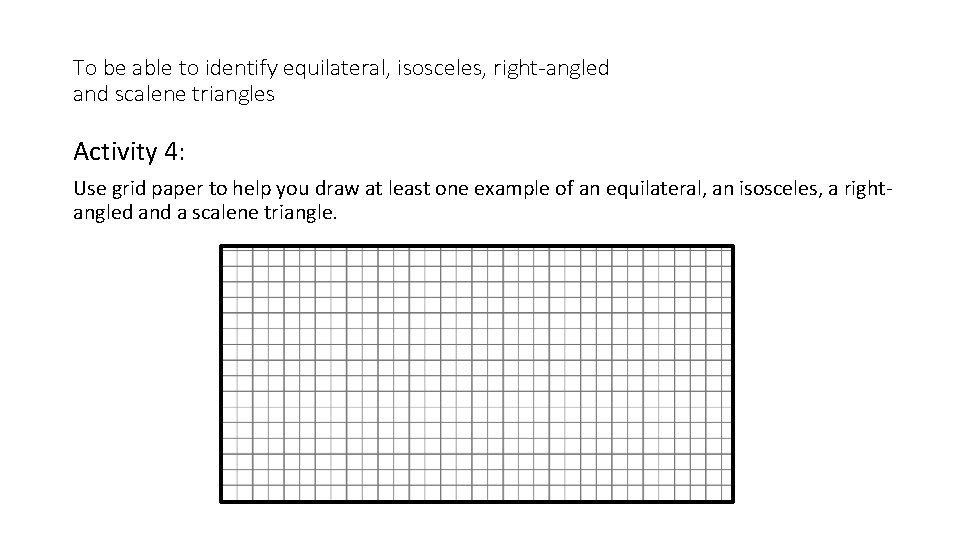
To be able to identify equilateral, isosceles, right-angled and scalene triangles Activity 4: Use grid paper to help you draw at least one example of an equilateral, an isosceles, a rightangled and a scalene triangle.
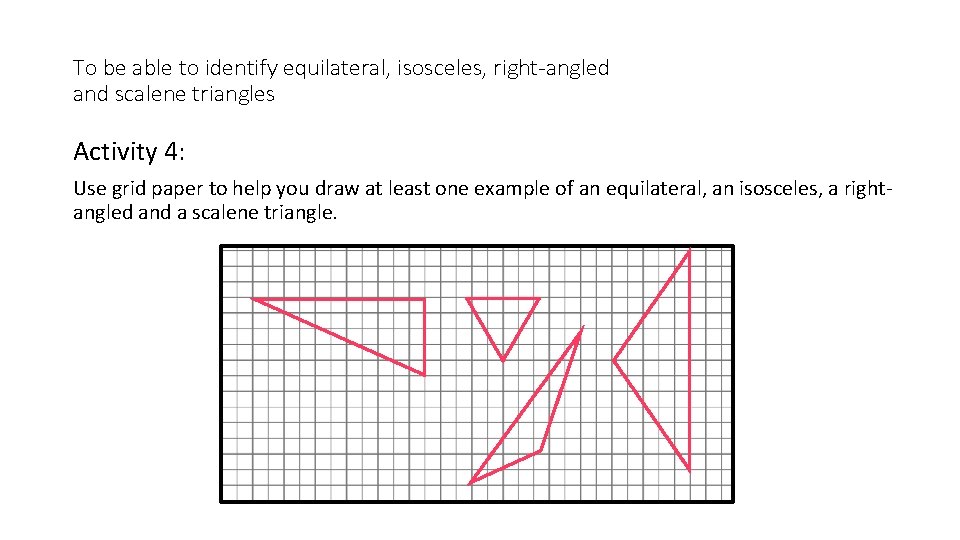
To be able to identify equilateral, isosceles, right-angled and scalene triangles Activity 4: Use grid paper to help you draw at least one example of an equilateral, an isosceles, a rightangled and a scalene triangle.
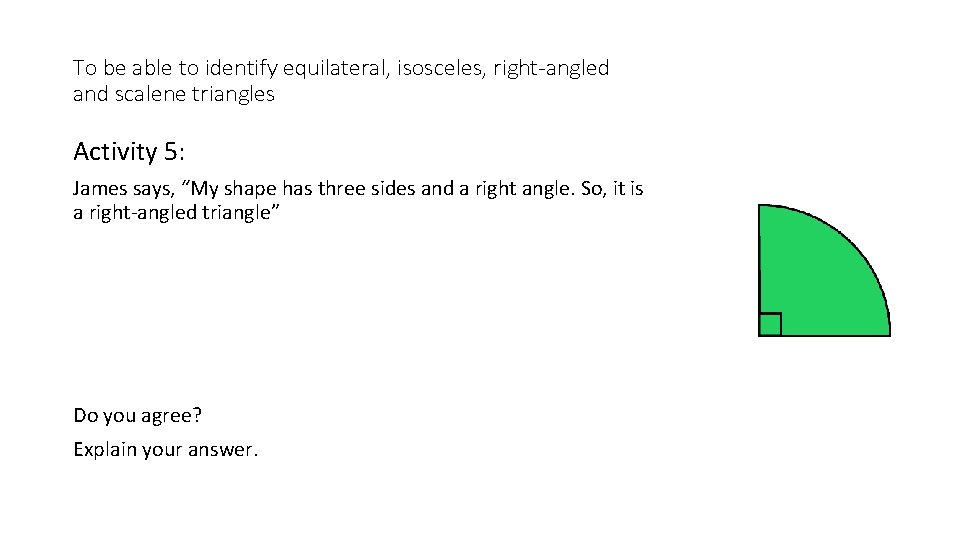
To be able to identify equilateral, isosceles, right-angled and scalene triangles Activity 5: James says, “My shape has three sides and a right angle. So, it is a right-angled triangle” Do you agree? Explain your answer.
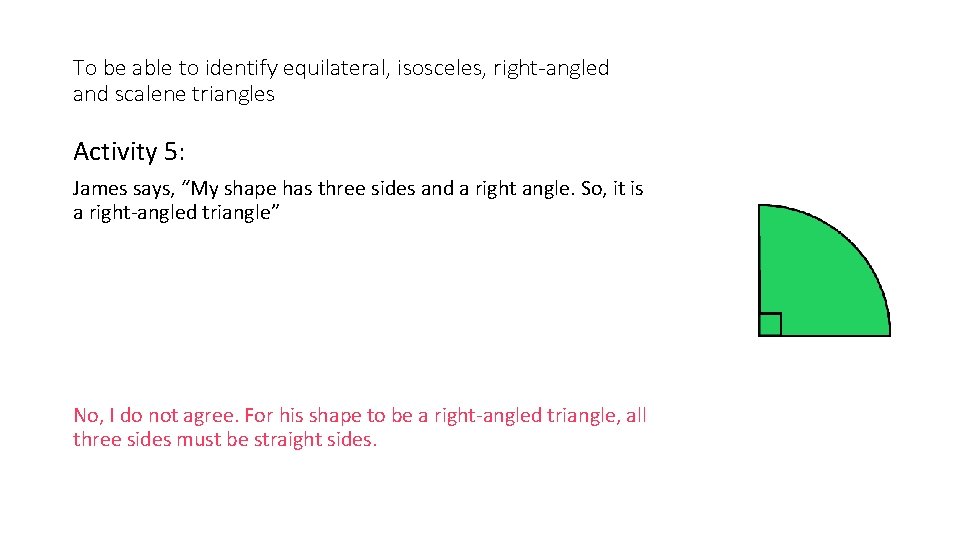
To be able to identify equilateral, isosceles, right-angled and scalene triangles Activity 5: James says, “My shape has three sides and a right angle. So, it is a right-angled triangle” No, I do not agree. For his shape to be a right-angled triangle, all three sides must be straight sides.
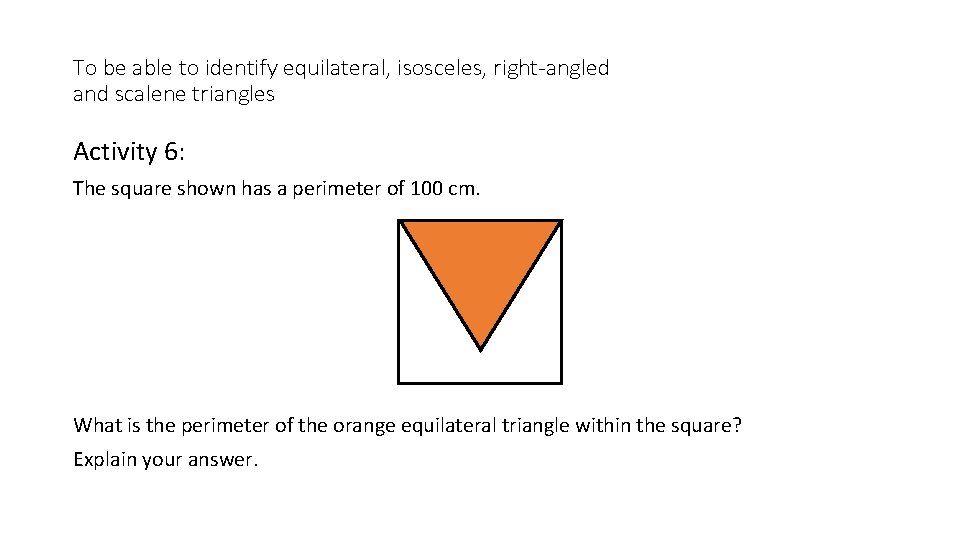
To be able to identify equilateral, isosceles, right-angled and scalene triangles Activity 6: The square shown has a perimeter of 100 cm. What is the perimeter of the orange equilateral triangle within the square? Explain your answer.
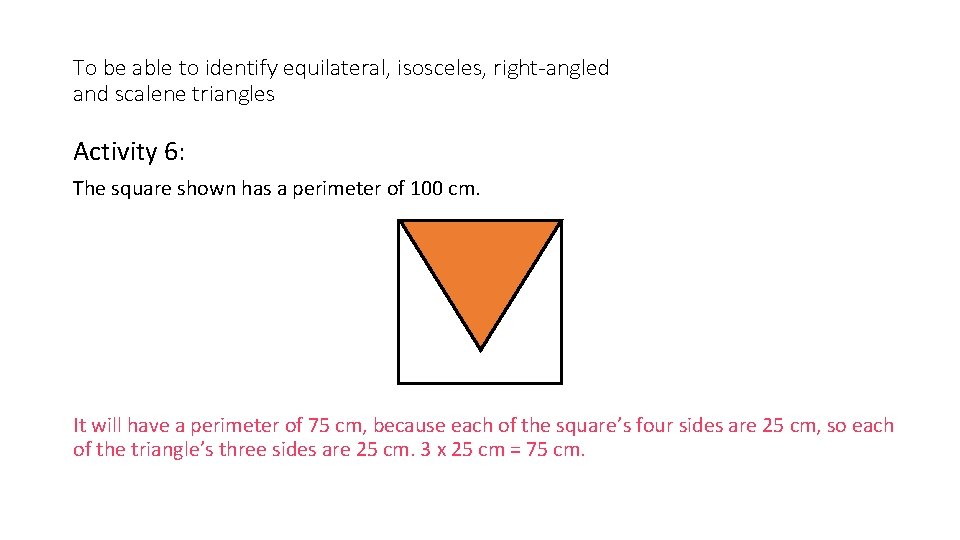
To be able to identify equilateral, isosceles, right-angled and scalene triangles Activity 6: The square shown has a perimeter of 100 cm. It will have a perimeter of 75 cm, because each of the square’s four sides are 25 cm, so each of the triangle’s three sides are 25 cm. 3 x 25 cm = 75 cm.
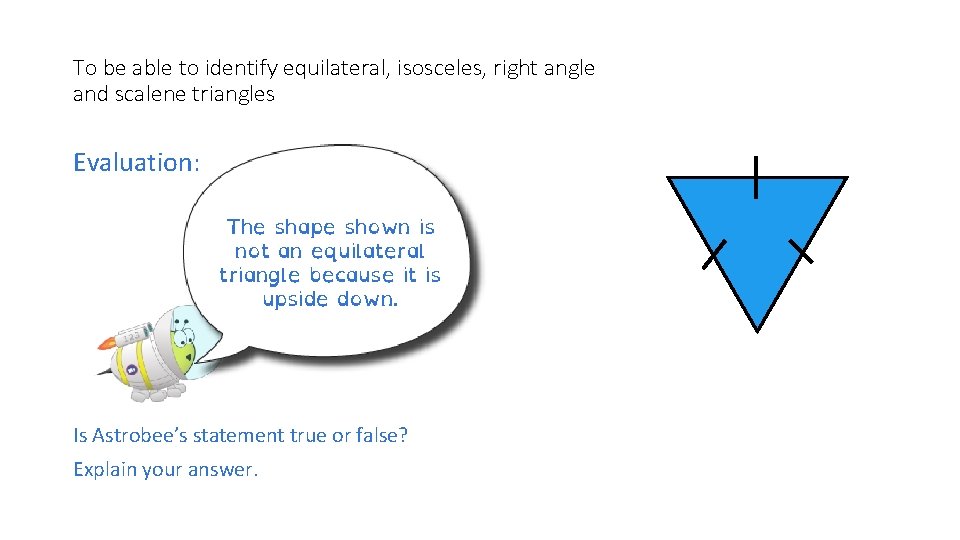
To be able to identify equilateral, isosceles, right angle and scalene triangles Evaluation: The shape shown is not an equilateral triangle because it is upside down. Is Astrobee’s statement true or false? Explain your answer.
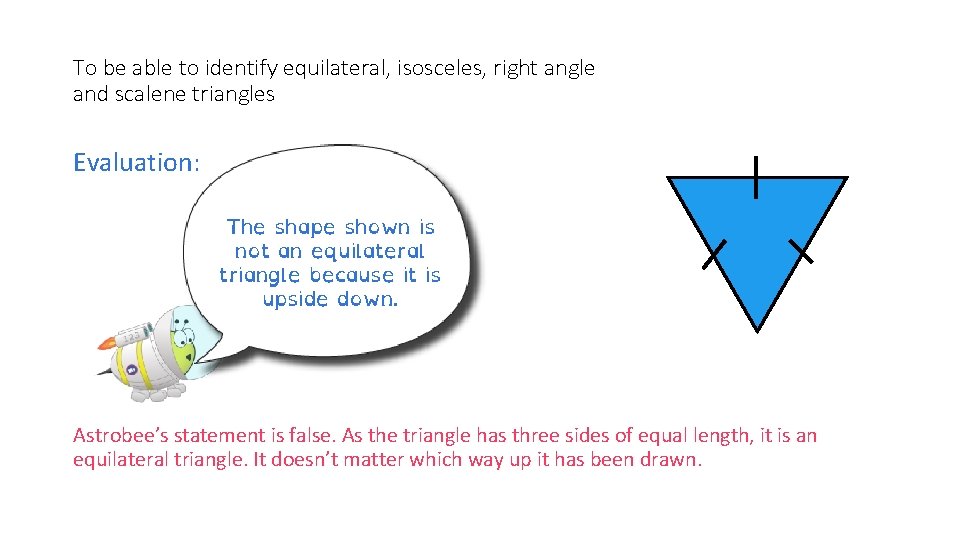
To be able to identify equilateral, isosceles, right angle and scalene triangles Evaluation: The shape shown is not an equilateral triangle because it is upside down. Astrobee’s statement is false. As the triangle has three sides of equal length, it is an equilateral triangle. It doesn’t matter which way up it has been drawn.
- Slides: 25