
Properties of Proteins A Solubility Soluble in water
Properties of Proteins: A. Solubility: - Soluble in water and insoluble in fat solvents except globulins, glutelins, gliadins which are soluble in dilute acids and alkalies. - Globulins are insoluble in water but dilute salt solutions make it soluble in Water (Salting in). - Gliadins are soluble in 70 -80% alcohol. - Scleroproteins are insoluble in most solvents. B. Amphoteric properties: Proteins are amphoteric because they are formed of amphoteric amino acids. Each one has its own I. E. P at which it carries equal + ve and – ve charges. At the acid side of the I. E. P, they carry predominantly positive charge. At the alkaline side it is predominantly – ve charge. At I. E. P the proteins can be precipitated. C. Colloidal properties: Due to their large M. W, they form emulsoid colloidal solutions in water
D. Precipitation of proteins: 1. Alcohol and acetone: They produce dehydration and denaturation. 2. Concentrated salt solution (salting out): e. g. -Albumin: It is precipitated by full saturation with ammonium sulfate. (NH 4)2 SO 4 -Globulins: It is precipitated by half saturation with ammonium sulfate (NH 4)2 SO 4 or full saturation with Na. Cl or Mg. SO 4. 3. At the I. E. P. : adjust p. H to I. E. P Suspensoid metaproteins. Precipitation. e. g. Caseinogen and 4. Salts of heavy metals: like silver, mercury and lead. 5. Alkaloidal reagents: as picric and tannic acids. The precipitation occurs on the acid side of the I. E. P. forming protein salts. e. g. Protein picrate
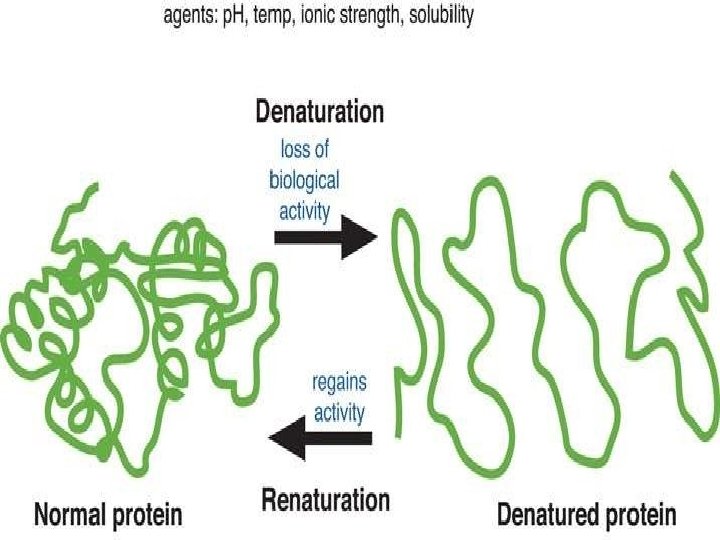
E. Denaturation: It is defined as destruction of the organization of the protein molecule (2 ry, 3 ry, and 4 ry structures). So, the polypeptide chain becomes unfolded and irregularly arranged. Causes: 1. Physical agents: as heat, UV rays, X ray, high pressure and strong shaking. 2. Chemical causes: as alcohol, strong acids and alkalies. Changes due to denaturation: I. Physical changes: increase viscosity, decrease solubility and failure of crystallization. II. Chemical changes: Exposure of many chemical groups that where hidden in the natural state e. g. SH of cysteine and OH of serine. III. Biological changes: increase in the digestibility, loss of enzymatic, hormonal and antigenic properties.
Isolation, purification and fractionation of proteins: 1. Ultracentrifugation: It is used to separate mixture of proteins having different molecular weights. 2. - Chemical precipitation: Albumin is precipitated by fully saturated ammonium sulfate solution. Globulin is precipitated by 1/2 saturated ammonium sulfate solution. Fibrinogen is precipitated by 1/4 saturated ammonium sulfate solution. 3. Chromatography: It is separation of mixture into its components by partition between two phases: one stationary and the other is mobile. According to the type of chromatographic techniques, it is used for separation and purification of proteins (including enzymes, receptors, glycoproteins and lipoproteins).
4. Electrophoresis: Separation of protein mixture on the basis of size, shape, weight and binding affinities. Proteins move in an electric field as they electrically charged. The migration rate depends on molecular weight and net charge molecules with –ve charge will migrate to anode. Molecules with +ve charge will migrate to cathode. Molecules at I. E. P will not move. (Why? ) In plasma protein electrophoresis, albumin will be the fastest in migration, followed by α 1 globulin (and α 2 globulins), ᵦ -globulin, fibrinogen and lastly ᵧ - globulin, which have the highest molecular weight 5. Dialysis is one of the most commonly used techniques to separate sample components based on selective diffusion across a porous membrane
• Sickle-cell anemia Glutamate → valine HB A → HB S • Alzheimer Disease (AD) Plaques (insoluble fibrous proteins), tangles (hyperphosphorylated mis folded Tau proteins) in the gray matter of the brain. • Bovine spongiform encephalopathy (mad cow disease) Infection by a misfolded protein called a prion.

- Slides: 8