
PROPERTIES OF NERVE FIBRES IMPORTANT PROPERTIES Excitability Conductivity
PROPERTIES OF NERVE FIBRES
IMPORTANT PROPERTIES � Excitability � Conductivity � Unfatigability � Refractive period � All or none response � Summation � Accommodation

� Excitability: › nerve fibres are highly excitable tissue › respond to various stimuli › Capable of generating electrical impulse � Conductivity: › action potential is generated in the nerve fibre, which is propagated along its entire length to the axon terminal.
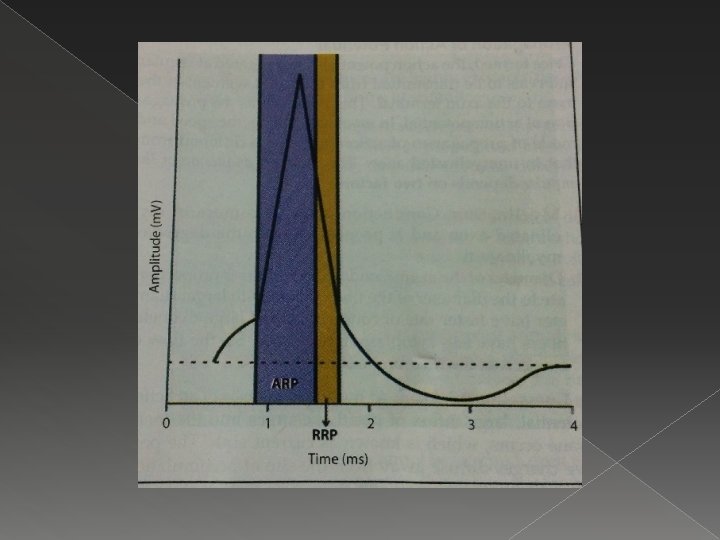
� Refractive period: � during action potential the excitability of a nerve become reduced � i. e a new impulse cannot be generated during a AP � Types: › a. Absolute refractory period (ARP) › b. Relative refractory period( RRP) � Note : - once initiated moving impulse wont depolarize the area behind it

Action Potential
� Unfatiguability : › Nerve fibres can not be fatigued even when they are stimulated continuously. � All or none response: › Either all of the action potential is seen or none at all › If a stimulus of threshold strength is applied AP will be generated › Further increase in strength of stimulus or duration has no effect on amplitude of AP › But can affect frequency
� Summation: › Application of a sub threshold stimulus does not evoke an action potential. However if sub threshold stimuli are applied in rapid succession they are added and they produce an action potential. � Accommodation: › Application of continuous stimuli may decrease the excitability of nerve fibre.
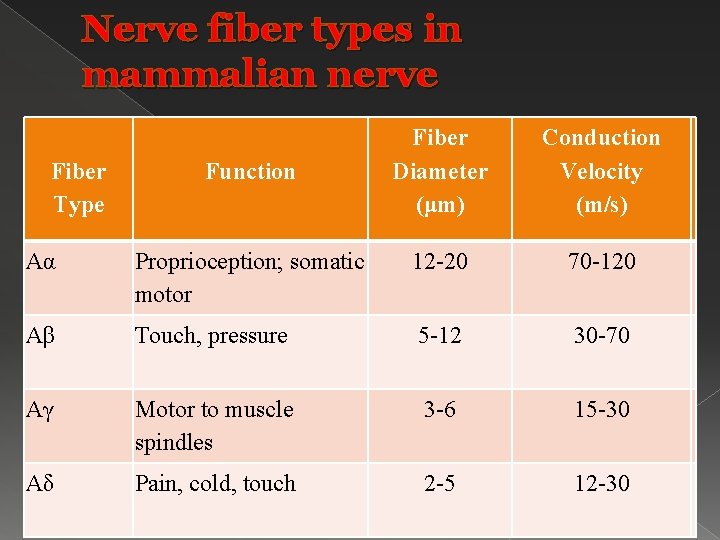
Nerve fiber types in mammalian nerve � Fiber Type Function Fiber Diameter (μm) Conduction Velocity (m/s) Aα Proprioception; somatic motor 12 -20 70 -120 Aβ Touch, pressure 5 -12 30 -70 Aγ Motor to muscle spindles 3 -6 15 -30 Aδ Pain, cold, touch 2 -5 12 -30
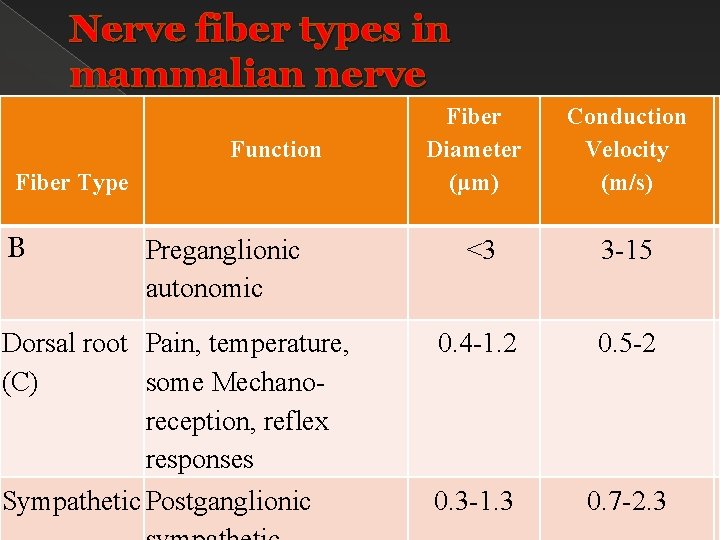
Nerve fiber types in mammalian nerve Function Fiber Type B Preganglionic autonomic Dorsal root Pain, temperature, (C) some Mechanoreception, reflex responses Sympathetic Postganglionic Fiber Diameter (μm) Conduction Velocity (m/s) <3 3 -15 0. 4 -1. 2 0. 5 -2 0. 3 -1. 3 0. 7 -2. 3
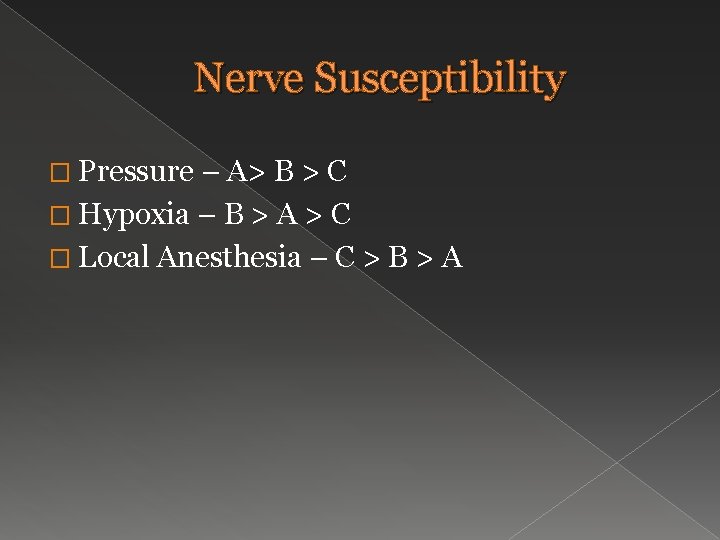
Nerve Susceptibility � Pressure – A> B > C � Hypoxia – B > A > C � Local Anesthesia – C > B > A

Saltatory Conduction

Conduction Of Nerve Impulse � Orthodromic � Antidromic � Axoplasmic Transport › Fast antegrade – 400 mm/day (kinesin) › Fast retrograde – 200 mm/day (dynein) › Slow antegrade
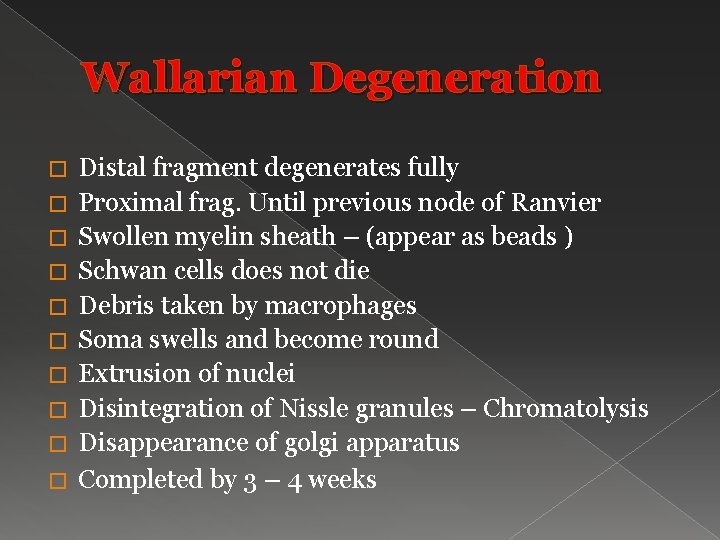
Wallarian Degeneration � � � � � Distal fragment degenerates fully Proximal frag. Until previous node of Ranvier Swollen myelin sheath – (appear as beads ) Schwan cells does not die Debris taken by macrophages Soma swells and become round Extrusion of nuclei Disintegration of Nissle granules – Chromatolysis Disappearance of golgi apparatus Completed by 3 – 4 weeks

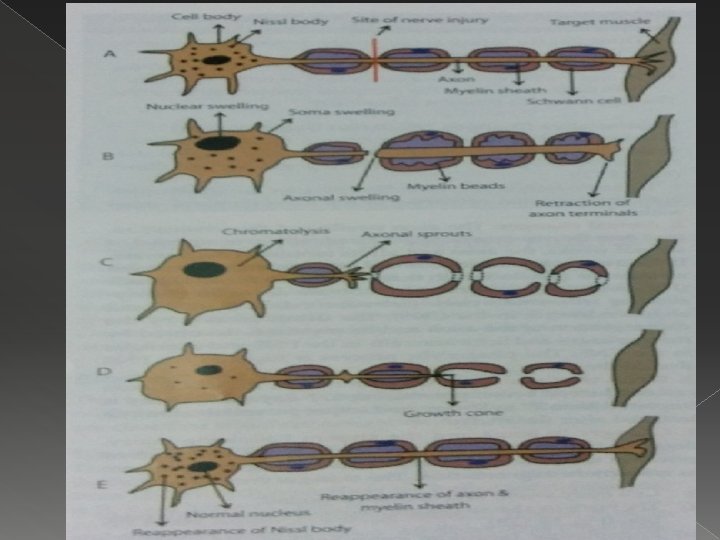
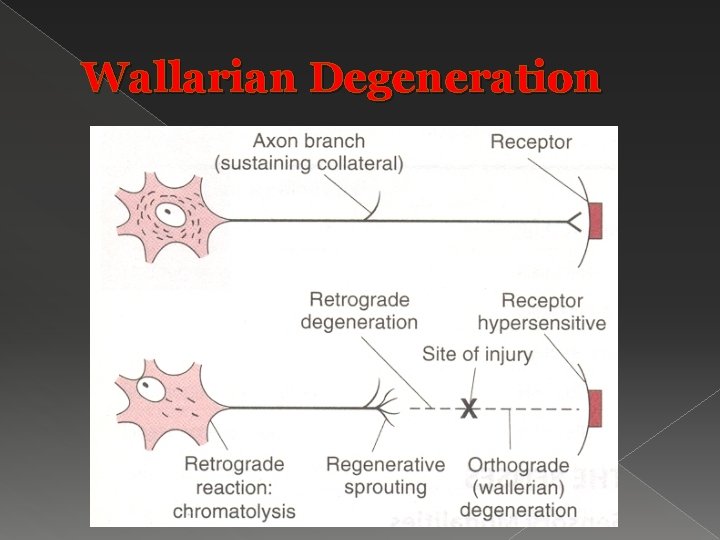
Wallarian Degeneration
Regeneration � Soma tries to repair by synthesizing new protein (axonal reaction) � Chromatolysis reversible � Axonal sprouts may form � Axonal cone (growth 1 -4 mm/day) � Schwan cells myelinate new axon � Nucleus occupy center , RER , GA reappears � Denervation hypersensitivity seen in target organ

- Slides: 19