
Properties of Matter What are three states of
- Slides: 35
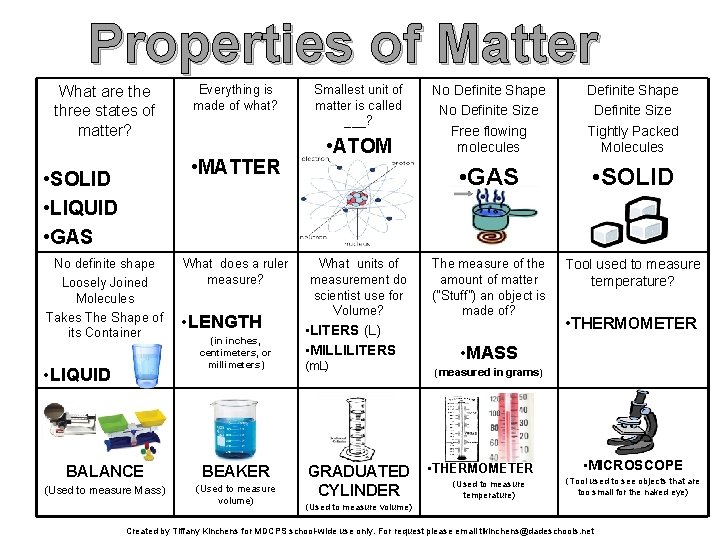
Properties of Matter What are three states of matter? Everything is made of what? • MATTER • SOLID • LIQUID • GAS No definite shape Loosely Joined Molecules Takes The Shape of its Container • LIQUID What does a ruler measure? • LENGTH (in inches, centimeters, or millimeters) BALANCE BEAKER (Used to measure Mass) (Used to measure volume) Smallest unit of matter is called ___? • ATOM What units of measurement do scientist use for Volume? • LITERS (L) • MILLILITERS (m. L) GRADUATED CYLINDER No Definite Shape No Definite Size Free flowing molecules Definite Shape Definite Size Tightly Packed Molecules • GAS • SOLID The measure of the amount of matter (“Stuff”) an object is made of? Tool used to measure temperature? • THERMOMETER • MASS (measured in grams) • THERMOMETER (Used to measure temperature) • MICROSCOPE (Tool used to see objects that are too small for the naked eye) (Used to measure volume) Created by Tiffany Kinchens for MDCPS school-wide use only. For request please email tlkinchens@dadeschools. net
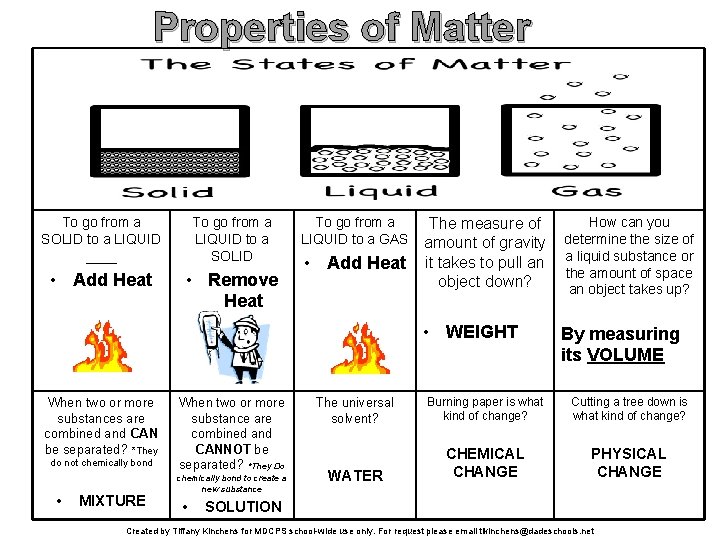
Properties of Matter To go from a SOLID to a LIQUID ____ To go from a LIQUID to a SOLID • Add Heat • Remove Heat When two or more substances are combined and CAN be separated? *They do not chemically bond • MIXTURE When two or more substance are combined and CANNOT be separated? *They Do chemically bond to create a new substance • To go from a LIQUID to a GAS • Add Heat The measure of amount of gravity it takes to pull an object down? How can you determine the size of a liquid substance or the amount of space an object takes up? • WEIGHT By measuring its VOLUME The universal solvent? Burning paper is what kind of change? Cutting a tree down is what kind of change? WATER CHEMICAL CHANGE PHYSICAL CHANGE SOLUTION Created by Tiffany Kinchens for MDCPS school-wide use only. For request please email tlkinchens@dadeschools. net
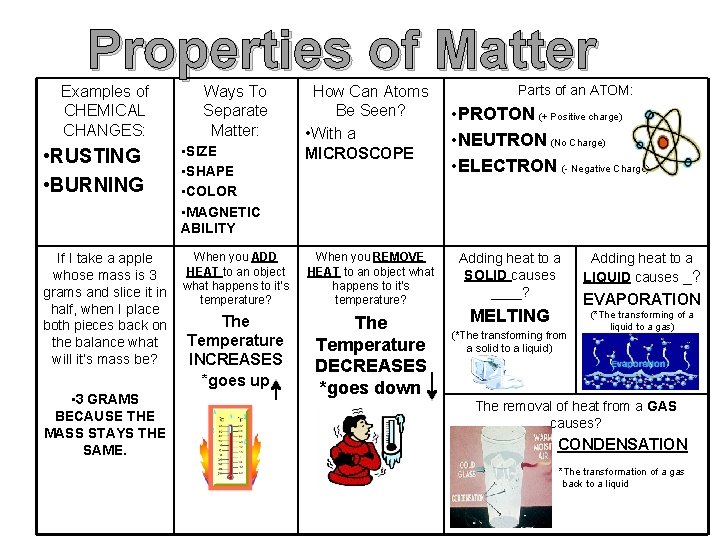
Properties of Matter Examples of CHEMICAL CHANGES: Ways To Separate Matter: How Can Atoms Be Seen? • With a MICROSCOPE • RUSTING • BURNING • SIZE • SHAPE • COLOR • MAGNETIC ABILITY If I take a apple whose mass is 3 grams and slice it in half, when I place both pieces back on the balance what will it’s mass be? When you ADD HEAT to an object what happens to it’s temperature? When you REMOVE HEAT to an object what happens to it’s temperature? The Temperature INCREASES *goes up The Temperature DECREASES *goes down • 3 GRAMS BECAUSE THE MASS STAYS THE SAME. Parts of an ATOM: • PROTON (+ Positive charge) • NEUTRON (No Charge) • ELECTRON (- Negative Charge) Adding heat to a SOLID causes ____? Adding heat to a LIQUID causes _? MELTING (*The transforming of a liquid to a gas) (*The transforming from a solid to a liquid) EVAPORATION The removal of heat from a GAS causes? CONDENSATION ) *The transformation of a gas back to a liquid
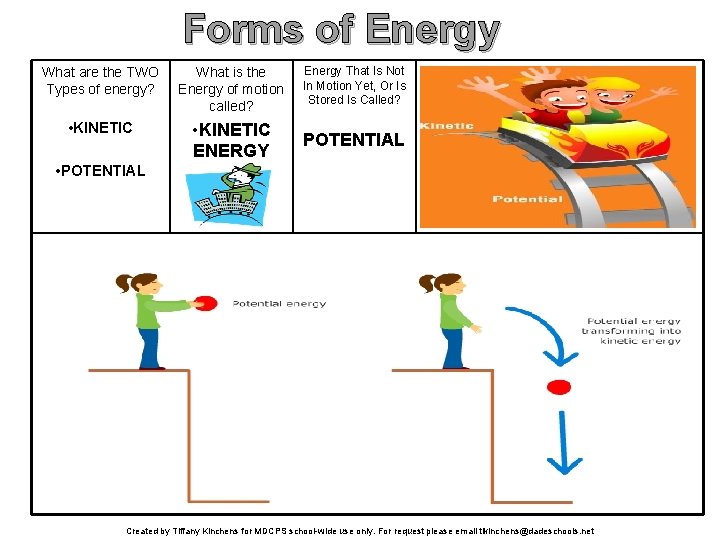
Forms of Energy What are the TWO Types of energy? What is the Energy of motion called? Energy That Is Not In Motion Yet, Or Is Stored Is Called? • KINETIC ENERGY POTENTIAL • POTENTIAL Created by Tiffany Kinchens for MDCPS school-wide use only. For request please email tlkinchens@dadeschools. net
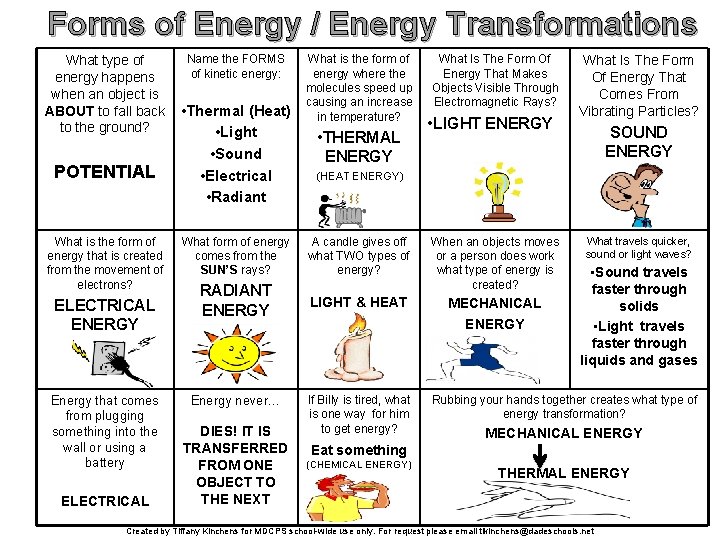
Forms of Energy / Energy Transformations What type of energy happens when an object is ABOUT to fall back to the ground? POTENTIAL What is the form of energy that is created from the movement of electrons? ELECTRICAL ENERGY Energy that comes from plugging something into the wall or using a battery ELECTRICAL Name the FORMS of kinetic energy: • Thermal (Heat) • Light • Sound • Electrical • Radiant What is the form of energy where the molecules speed up causing an increase in temperature? • THERMAL ENERGY What Is The Form Of Energy That Makes Objects Visible Through Electromagnetic Rays? • LIGHT ENERGY A candle gives off what TWO types of energy? RADIANT ENERGY When an objects moves or a person does work what type of energy is created? LIGHT & HEAT MECHANICAL ENERGY DIES! IT IS TRANSFERRED FROM ONE OBJECT TO THE NEXT SOUND ENERGY (HEAT ENERGY) What form of energy comes from the SUN’S rays? Energy never… What Is The Form Of Energy That Comes From Vibrating Particles? If Billy is tired, what is one way for him to get energy? What travels quicker, sound or light waves? • Sound travels faster through solids • Light travels faster through liquids and gases Rubbing your hands together creates what type of energy transformation? MECHANICAL ENERGY Eat something (CHEMICAL ENERGY) THERMAL ENERGY Created by Tiffany Kinchens for MDCPS school-wide use only. For request please email tlkinchens@dadeschools. net
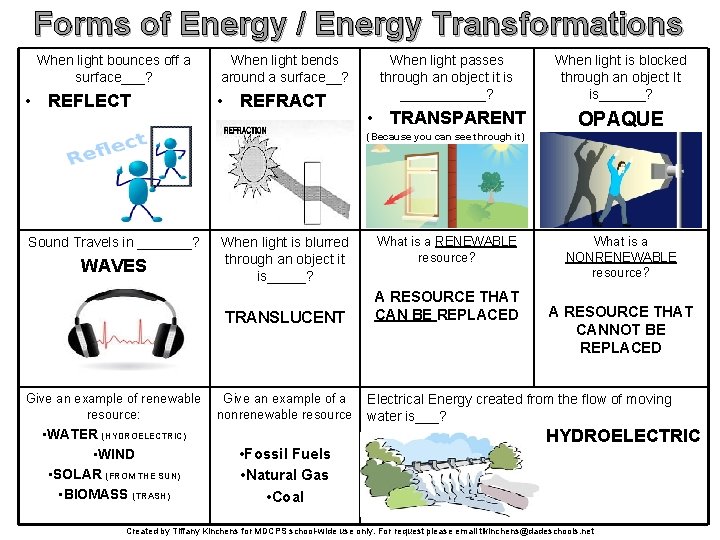
Forms of Energy / Energy Transformations When light bounces off a surface___? • REFLECT When light bends around a surface__? • REFRACT When light passes through an object it is ______? When light is blocked through an object It is______? • TRANSPARENT OPAQUE (Because you can see through it) Sound Travels in _______? WAVES When light is blurred through an object it is_____? TRANSLUCENT Give an example of renewable resource: • WATER (HYDROELECTRIC) • WIND • SOLAR (FROM THE SUN) • BIOMASS (TRASH) Give an example of a nonrenewable resource • Fossil Fuels • Natural Gas • Coal What is a RENEWABLE resource? A RESOURCE THAT CAN BE REPLACED What is a NONRENEWABLE resource? A RESOURCE THAT CANNOT BE REPLACED Electrical Energy created from the flow of moving water is___? HYDROELECTRIC Created by Tiffany Kinchens for MDCPS school-wide use only. For request please email tlkinchens@dadeschools. net
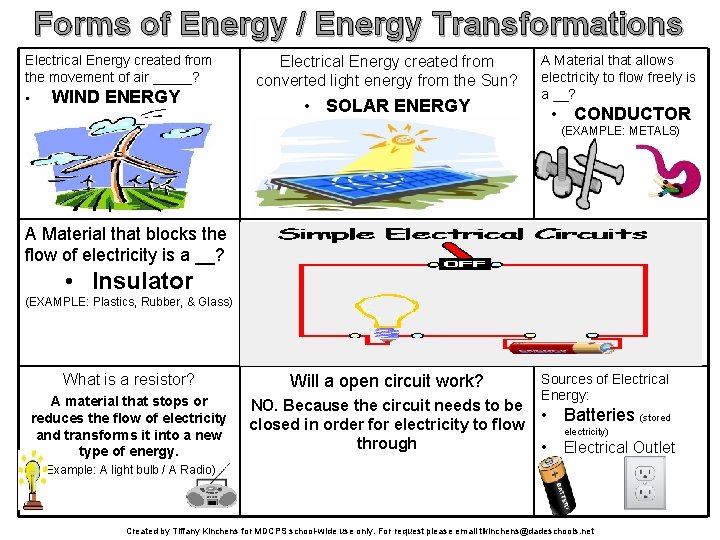
Forms of Energy / Energy Transformations Electrical Energy created from the movement of air _____? • WIND ENERGY Electrical Energy created from converted light energy from the Sun? • SOLAR ENERGY A Material that allows electricity to flow freely is a __? • CONDUCTOR (EXAMPLE: METALS) A Material that blocks the flow of electricity is a __? • Insulator (EXAMPLE: Plastics, Rubber, & Glass) What is a resistor? Will a open circuit work? A material that stops or reduces the flow of electricity and transforms it into a new type of energy. NO. Because the circuit needs to be closed in order for electricity to flow through Sources of Electrical Energy: • Batteries (stored electricity) • Electrical Outlet (Example: A light bulb / A Radio) Created by Tiffany Kinchens for MDCPS school-wide use only. For request please email tlkinchens@dadeschools. net
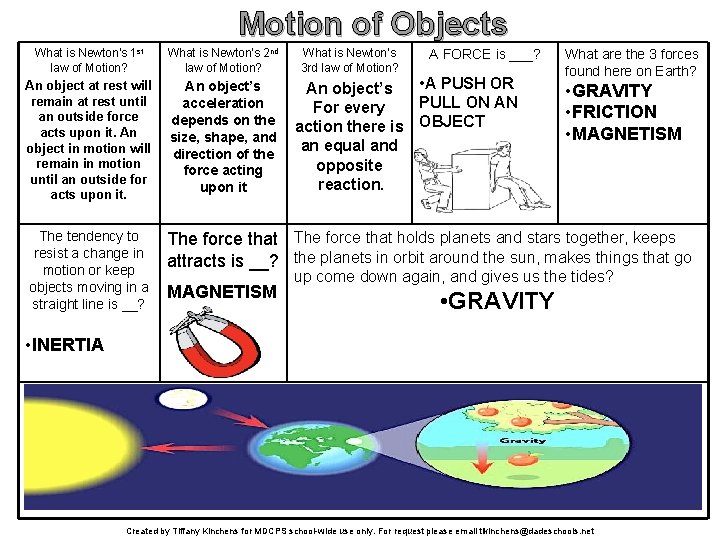
Motion of Objects What is Newton's 1 st law of Motion? What is Newton’s 2 nd law of Motion? An object at rest will remain at rest until an outside force acts upon it. An object in motion will remain in motion until an outside for acts upon it. An object’s acceleration depends on the size, shape, and direction of the force acting upon it The tendency to resist a change in motion or keep objects moving in a straight line is __? The force that holds planets and stars together, keeps attracts is __? the planets in orbit around the sun, makes things that go MAGNETISM What is Newton’s 3 rd law of Motion? A FORCE is ___? • A PUSH OR An object’s PULL ON AN For every action there is OBJECT an equal and opposite reaction. What are the 3 forces found here on Earth? • GRAVITY • FRICTION • MAGNETISM up come down again, and gives us the tides? • GRAVITY • INERTIA Created by Tiffany Kinchens for MDCPS school-wide use only. For request please email tlkinchens@dadeschools. net
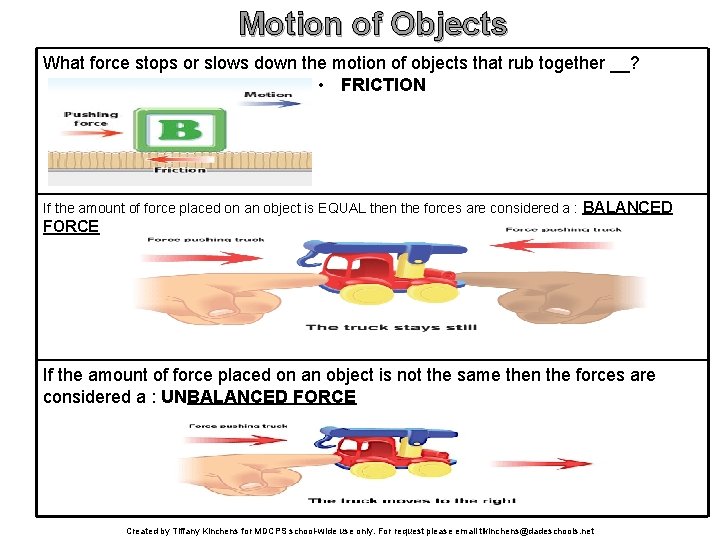
Motion of Objects What force stops or slows down the motion of objects that rub together __? • FRICTION If the amount of force placed on an object is EQUAL then the forces are considered a : BALANCED FORCE If the amount of force placed on an object is not the same then the forces are considered a : UNBALANCED FORCE Created by Tiffany Kinchens for MDCPS school-wide use only. For request please email tlkinchens@dadeschools. net
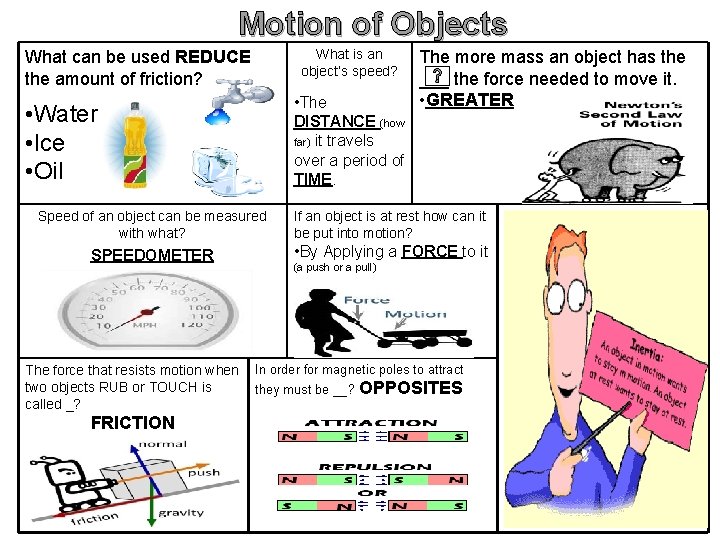
Motion of Objects What is an object’s speed? What can be used REDUCE the amount of friction? • The DISTANCE (how far) it travels over a period of TIME. • Water • Ice • Oil The more mass an object has the ___ the force needed to move it. • GREATER Speed of an object can be measured with what? If an object is at rest how can it be put into motion? SPEEDOMETER • By Applying a FORCE to it The force that resists motion when two objects RUB or TOUCH is called _? FRICTION (a push or a pull) In order for magnetic poles to attract they must be __? OPPOSITES
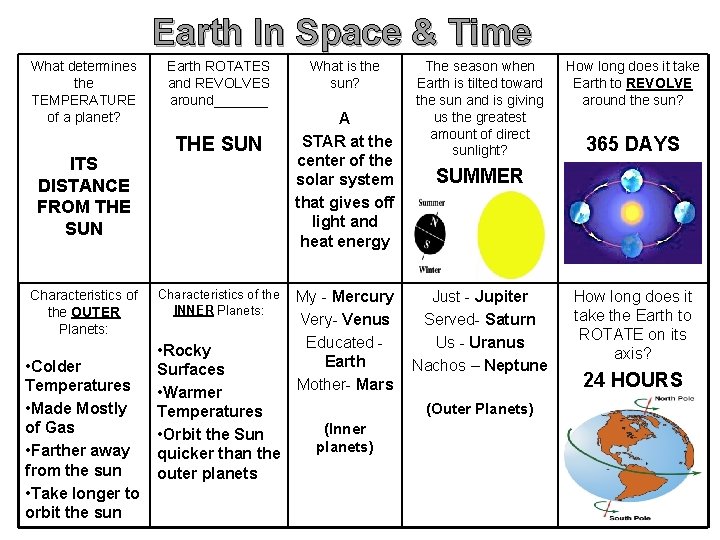
Earth In Space & Time What determines the TEMPERATURE of a planet? ITS DISTANCE FROM THE SUN Characteristics of the OUTER Planets: • Colder Temperatures • Made Mostly of Gas • Farther away from the sun • Take longer to orbit the sun Earth ROTATES and REVOLVES around_______ THE SUN Characteristics of the INNER Planets: • Rocky Surfaces • Warmer Temperatures • Orbit the Sun quicker than the outer planets What is the sun? A STAR at the center of the solar system that gives off light and heat energy My - Mercury Very- Venus Educated Earth Mother- Mars The season when Earth is tilted toward the sun and is giving us the greatest amount of direct sunlight? 365 DAYS SUMMER Just - Jupiter Served- Saturn Us - Uranus Nachos – Neptune (Outer Planets) (Inner planets) How long does it take Earth to REVOLVE around the sun? How long does it take the Earth to ROTATE on its axis? 24 HOURS
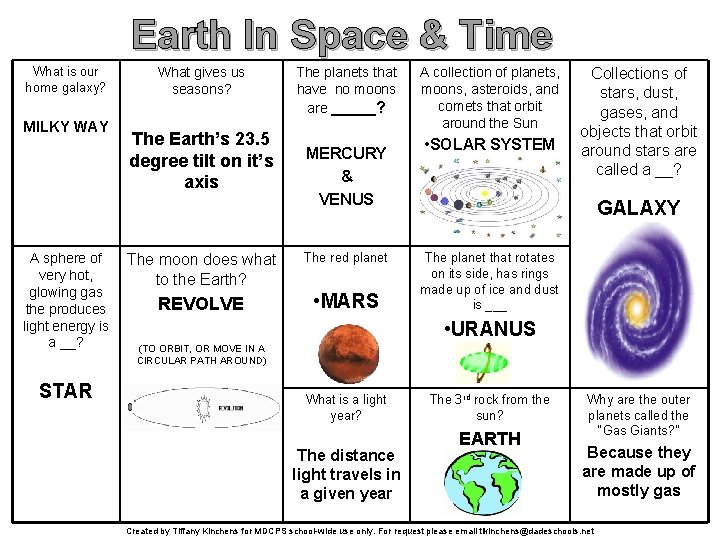
Earth In Space & Time What is our home galaxy? MILKY WAY A sphere of very hot, glowing gas the produces light energy is a __? STAR What gives us seasons? The Earth’s 23. 5 degree tilt on it’s axis The planets that have no moons are _____? MERCURY & VENUS The moon does what to the Earth? The red planet REVOLVE • MARS A collection of planets, moons, asteroids, and comets that orbit around the Sun • SOLAR SYSTEM Collections of stars, dust, gases, and objects that orbit around stars are called a __? GALAXY The planet that rotates on its side, has rings made up of ice and dust is ___ • URANUS (TO ORBIT, OR MOVE IN A CIRCULAR PATH AROUND) What is a light year? The distance light travels in a given year The 3 rd rock from the sun? EARTH Why are the outer planets called the “Gas Giants? ” Because they are made up of mostly gas Created by Tiffany Kinchens for MDCPS school-wide use only. For request please email tlkinchens@dadeschools. net
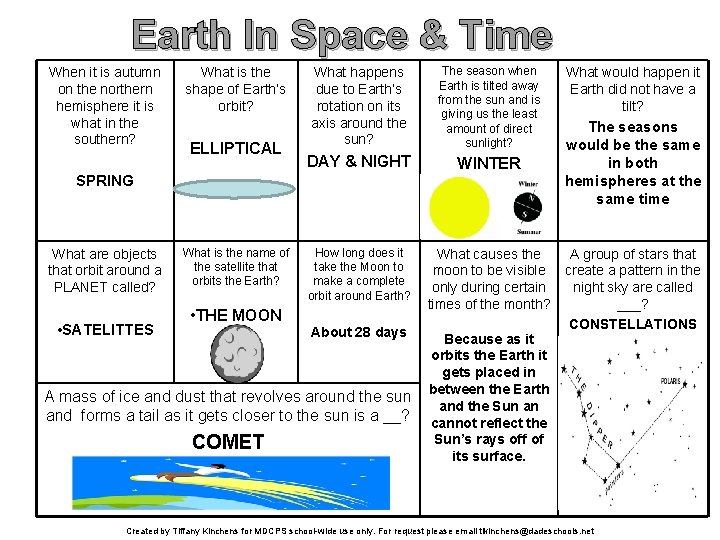
Earth In Space & Time When it is autumn on the northern hemisphere it is what in the southern? What is the shape of Earth’s orbit? ELLIPTICAL What happens due to Earth’s rotation on its axis around the sun? The season when Earth is tilted away from the sun and is giving us the least amount of direct sunlight? DAY & NIGHT WINTER How long does it take the Moon to make a complete orbit around Earth? What causes the moon to be visible only during certain times of the month? SPRING What are objects that orbit around a PLANET called? • SATELITTES What is the name of the satellite that orbits the Earth? • THE MOON About 28 days A mass of ice and dust that revolves around the sun and forms a tail as it gets closer to the sun is a __? COMET Because as it orbits the Earth it gets placed in between the Earth and the Sun an cannot reflect the Sun’s rays off of its surface. What would happen it Earth did not have a tilt? The seasons would be the same in both hemispheres at the same time A group of stars that create a pattern in the night sky are called ___? CONSTELLATIONS Created by Tiffany Kinchens for MDCPS school-wide use only. For request please email tlkinchens@dadeschools. net
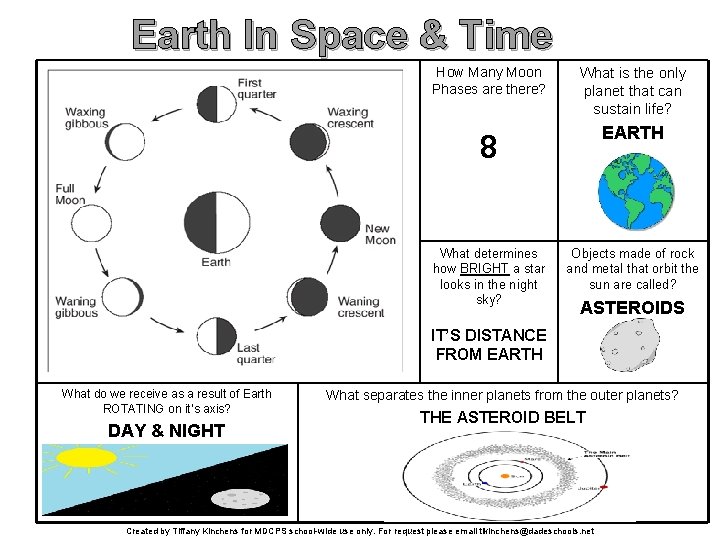
Earth In Space & Time How Many Moon Phases are there? What is the only planet that can sustain life? 8 EARTH What determines how BRIGHT a star looks in the night sky? Objects made of rock and metal that orbit the sun are called? ASTEROIDS IT’S DISTANCE FROM EARTH What do we receive as a result of Earth ROTATING on it’s axis? DAY & NIGHT What separates the inner planets from the outer planets? THE ASTEROID BELT Created by Tiffany Kinchens for MDCPS school-wide use only. For request please email tlkinchens@dadeschools. net
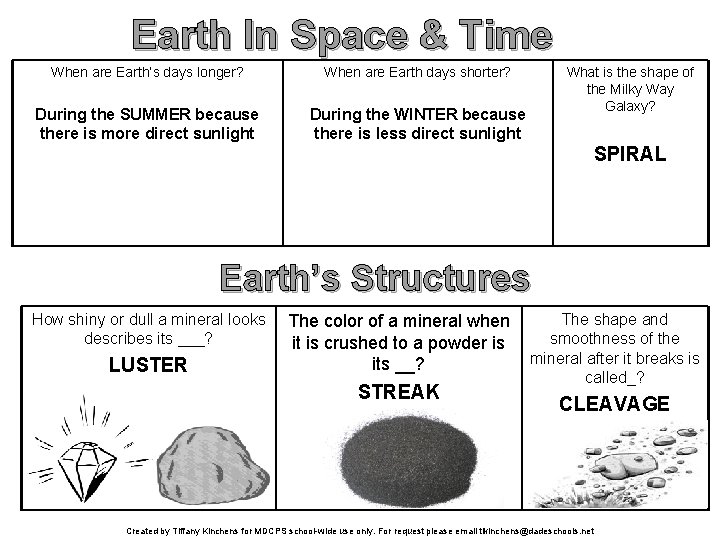
Earth In Space & Time When are Earth’s days longer? When are Earth days shorter? During the SUMMER because there is more direct sunlight During the WINTER because there is less direct sunlight What is the shape of the Milky Way Galaxy? SPIRAL Earth’s Structures How shiny or dull a mineral looks describes its ___? LUSTER The color of a mineral when it is crushed to a powder is its __? STREAK The shape and smoothness of the mineral after it breaks is called_? CLEAVAGE Created by Tiffany Kinchens for MDCPS school-wide use only. For request please email tlkinchens@dadeschools. net
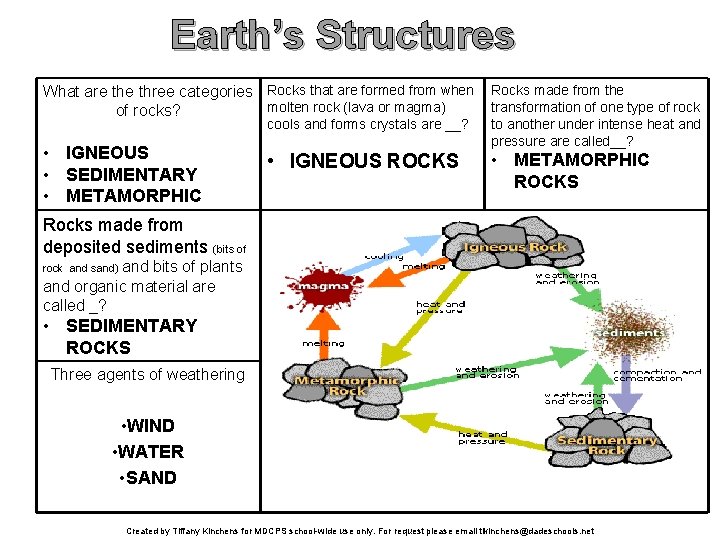
Earth’s Structures What are three categories Rocks that are formed from when molten rock (lava or magma) of rocks? cools and forms crystals are __? • IGNEOUS • SEDIMENTARY • METAMORPHIC • IGNEOUS ROCKS Rocks made from the transformation of one type of rock to another under intense heat and pressure are called__? • METAMORPHIC ROCKS Rocks made from deposited sediments (bits of rock and sand) and bits of plants and organic material are called _? • SEDIMENTARY ROCKS Three agents of weathering • WIND • WATER • SAND Created by Tiffany Kinchens for MDCPS school-wide use only. For request please email tlkinchens@dadeschools. net
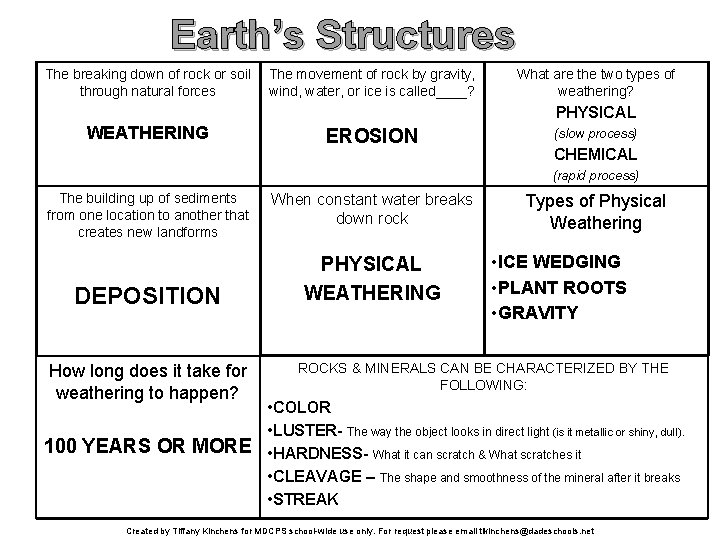
Earth’s Structures The breaking down of rock or soil through natural forces The movement of rock by gravity, wind, water, or ice is called____? What are the two types of weathering? PHYSICAL WEATHERING EROSION (slow process) CHEMICAL (rapid process) The building up of sediments from one location to another that creates new landforms DEPOSITION How long does it take for weathering to happen? 100 YEARS OR MORE When constant water breaks down rock PHYSICAL WEATHERING Types of Physical Weathering • ICE WEDGING • PLANT ROOTS • GRAVITY ROCKS & MINERALS CAN BE CHARACTERIZED BY THE FOLLOWING: • COLOR • LUSTER- The way the object looks in direct light (is it metallic or shiny, dull). • HARDNESS- What it can scratch & What scratches it • CLEAVAGE – The shape and smoothness of the mineral after it breaks • STREAK Created by Tiffany Kinchens for MDCPS school-wide use only. For request please email tlkinchens@dadeschools. net
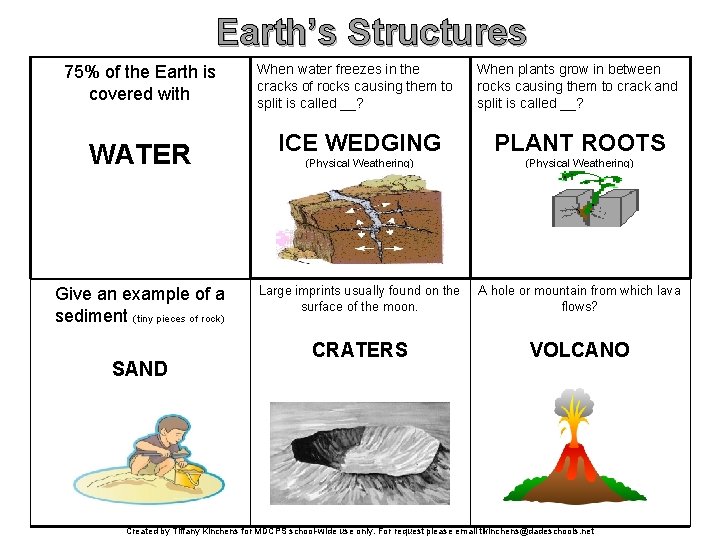
Earth’s Structures 75% of the Earth is covered with WATER Give an example of a sediment (tiny pieces of rock) SAND When water freezes in the cracks of rocks causing them to split is called __? When plants grow in between rocks causing them to crack and split is called __? ICE WEDGING PLANT ROOTS (Physical Weathering) Large imprints usually found on the surface of the moon. A hole or mountain from which lava flows? CRATERS VOLCANO Created by Tiffany Kinchens for MDCPS school-wide use only. For request please email tlkinchens@dadeschools. net
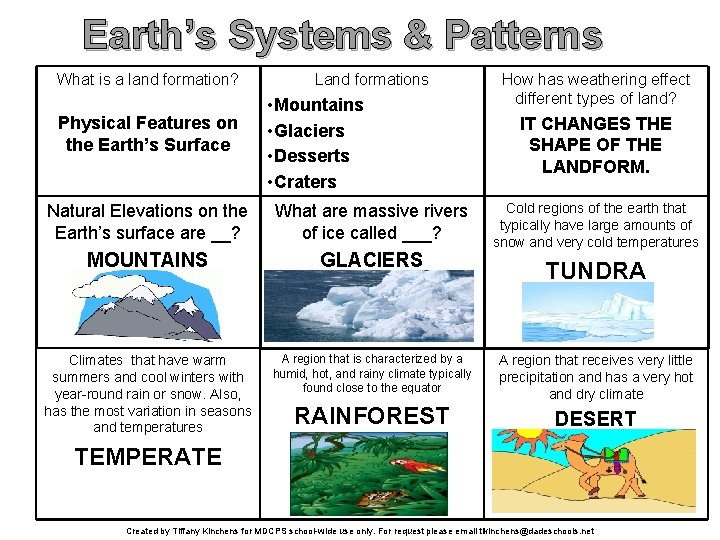
Earth’s Systems & Patterns What is a land formation? Physical Features on the Earth’s Surface Land formations • Mountains • Glaciers • Desserts • Craters How has weathering effect different types of land? IT CHANGES THE SHAPE OF THE LANDFORM. Cold regions of the earth that typically have large amounts of snow and very cold temperatures Natural Elevations on the Earth’s surface are __? What are massive rivers of ice called ___? MOUNTAINS GLACIERS Climates that have warm summers and cool winters with year-round rain or snow. Also, has the most variation in seasons and temperatures A region that is characterized by a humid, hot, and rainy climate typically found close to the equator A region that receives very little precipitation and has a very hot and dry climate RAINFOREST DESERT TUNDRA TEMPERATE Created by Tiffany Kinchens for MDCPS school-wide use only. For request please email tlkinchens@dadeschools. net
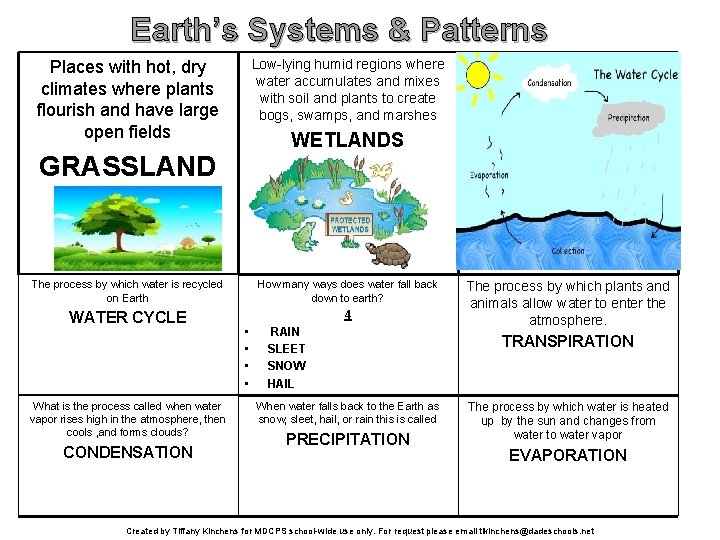
Earth’s Systems & Patterns Low-lying humid regions where water accumulates and mixes with soil and plants to create bogs, swamps, and marshes Places with hot, dry climates where plants flourish and have large open fields WETLANDS GRASSLAND The process by which water is recycled on Earth How many ways does water fall back down to earth? WATER CYCLE 4 What is the process called when water vapor rises high in the atmosphere, then cools , and forms clouds? CONDENSATION • • RAIN SLEET SNOW HAIL When water falls back to the Earth as snow, sleet, hail, or rain this is called PRECIPITATION The process by which plants and animals allow water to enter the atmosphere. TRANSPIRATION The process by which water is heated up by the sun and changes from water to water vapor EVAPORATION Created by Tiffany Kinchens for MDCPS school-wide use only. For request please email tlkinchens@dadeschools. net
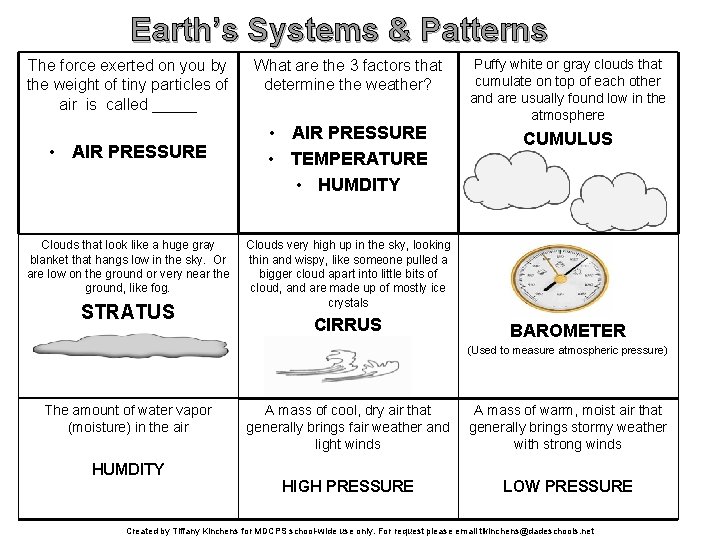
Earth’s Systems & Patterns The force exerted on you by the weight of tiny particles of air is called _____ • AIR PRESSURE Clouds that look like a huge gray blanket that hangs low in the sky. Or are low on the ground or very near the ground, like fog. STRATUS What are the 3 factors that determine the weather? • AIR PRESSURE • TEMPERATURE • HUMDITY Puffy white or gray clouds that cumulate on top of each other and are usually found low in the atmosphere CUMULUS Clouds very high up in the sky, looking thin and wispy, like someone pulled a bigger cloud apart into little bits of cloud, and are made up of mostly ice crystals CIRRUS BAROMETER (Used to measure atmospheric pressure) The amount of water vapor (moisture) in the air HUMDITY A mass of cool, dry air that generally brings fair weather and light winds A mass of warm, moist air that generally brings stormy weather with strong winds HIGH PRESSURE LOW PRESSURE Created by Tiffany Kinchens for MDCPS school-wide use only. For request please email tlkinchens@dadeschools. net
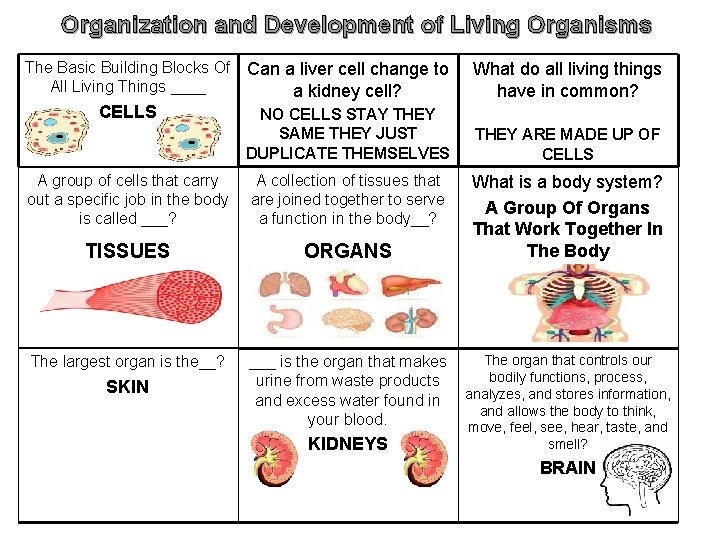
Organization and Development of Living Organisms The Basic Building Blocks Of All Living Things ____ Can a liver cell change to a kidney cell? What do all living things have in common? CELLS NO CELLS STAY THEY SAME THEY JUST DUPLICATE THEMSELVES THEY ARE MADE UP OF CELLS A group of cells that carry out a specific job in the body is called ___? A collection of tissues that are joined together to serve a function in the body__? TISSUES ORGANS The largest organ is the__? ___ is the organ that makes urine from waste products and excess water found in your blood. SKIN KIDNEYS What is a body system? A Group Of Organs That Work Together In The Body The organ that controls our bodily functions, process, analyzes, and stores information, and allows the body to think, move, feel, see, hear, taste, and smell? BRAIN
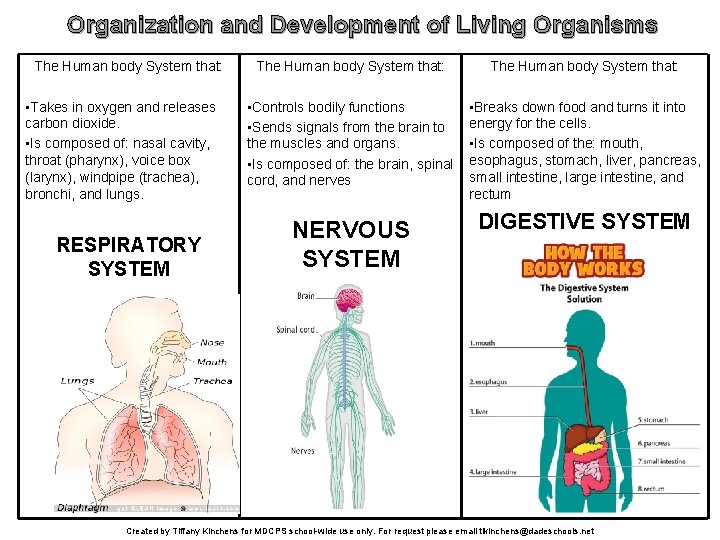
Organization and Development of Living Organisms The Human body System that: • Takes in oxygen and releases carbon dioxide. • Is composed of: nasal cavity, throat (pharynx), voice box (larynx), windpipe (trachea), bronchi, and lungs. RESPIRATORY SYSTEM The Human body System that: • Controls bodily functions • Sends signals from the brain to the muscles and organs. • Is composed of: the brain, spinal cord, and nerves • Breaks down food and turns it into energy for the cells. • Is composed of the: mouth, esophagus, stomach, liver, pancreas, small intestine, large intestine, and rectum NERVOUS SYSTEM DIGESTIVE SYSTEM Created by Tiffany Kinchens for MDCPS school-wide use only. For request please email tlkinchens@dadeschools. net
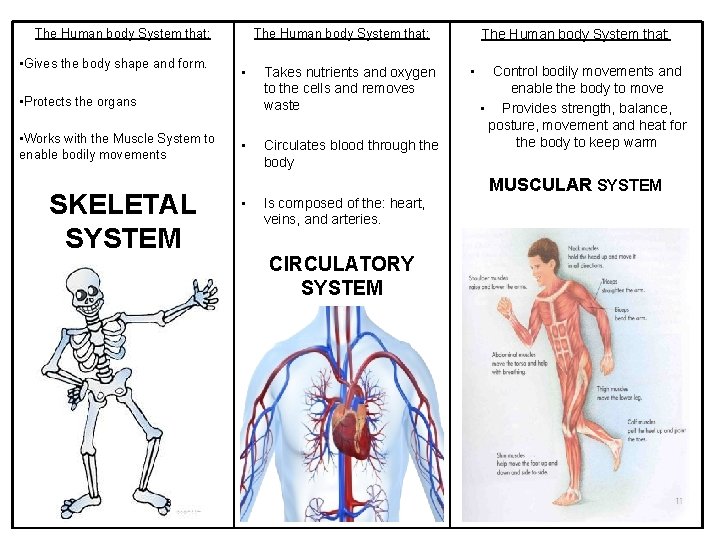
The Human body System that: • Gives the body shape and form. The Human body System that: • Takes nutrients and oxygen to the cells and removes waste • Circulates blood through the body • Protects the organs • Works with the Muscle System to enable bodily movements SKELETAL SYSTEM The Human body System that: • Control bodily movements and enable the body to move • Provides strength, balance, posture, movement and heat for the body to keep warm MUSCULAR SYSTEM • Is composed of the: heart, veins, and arteries. CIRCULATORY SYSTEM
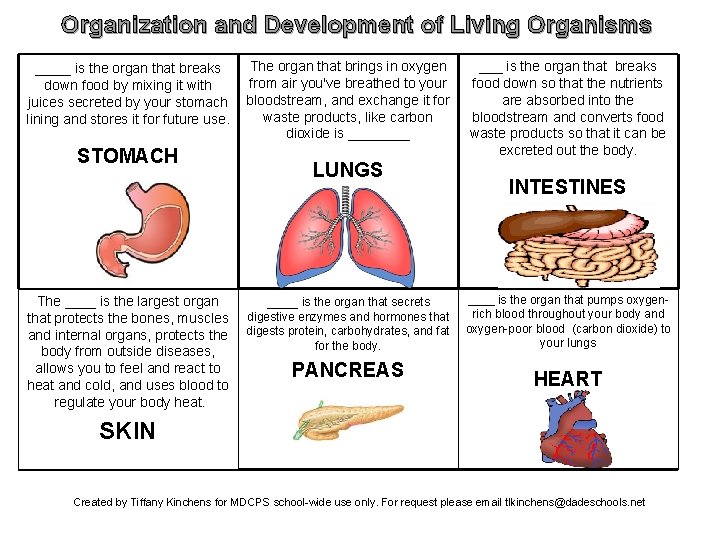
Organization and Development of Living Organisms ____ is the organ that breaks down food by mixing it with juices secreted by your stomach lining and stores it for future use. STOMACH The ____ is the largest organ that protects the bones, muscles and internal organs, protects the body from outside diseases, allows you to feel and react to heat and cold, and uses blood to regulate your body heat. The organ that brings in oxygen from air you've breathed to your bloodstream, and exchange it for waste products, like carbon dioxide is ____ LUNGS ____ is the organ that secrets digestive enzymes and hormones that digests protein, carbohydrates, and fat for the body. PANCREAS ___ is the organ that breaks food down so that the nutrients are absorbed into the bloodstream and converts food waste products so that it can be excreted out the body. INTESTINES ____ is the organ that pumps oxygenrich blood throughout your body and oxygen-poor blood (carbon dioxide) to your lungs HEART SKIN Created by Tiffany Kinchens for MDCPS school-wide use only. For request please email tlkinchens@dadeschools. net
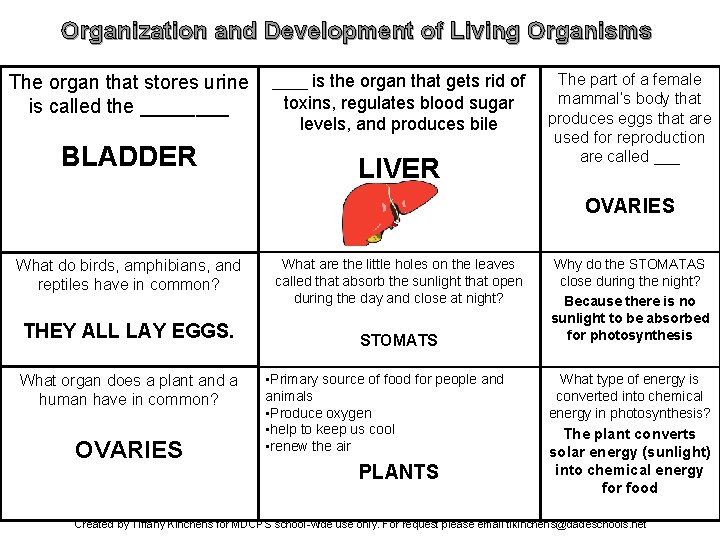
Organization and Development of Living Organisms The organ that stores urine is called the ____ BLADDER ____ is the organ that gets rid of toxins, regulates blood sugar levels, and produces bile LIVER The part of a female mammal’s body that produces eggs that are used for reproduction are called ___ OVARIES What do birds, amphibians, and reptiles have in common? THEY ALL LAY EGGS. What organ does a plant and a human have in common? OVARIES What are the little holes on the leaves called that absorb the sunlight that open during the day and close at night? STOMATS • Primary source of food for people and animals • Produce oxygen • help to keep us cool • renew the air PLANTS Why do the STOMATAS close during the night? Because there is no sunlight to be absorbed for photosynthesis What type of energy is converted into chemical energy in photosynthesis? The plant converts solar energy (sunlight) into chemical energy for food Created by Tiffany Kinchens for MDCPS school-wide use only. For request please email tlkinchens@dadeschools. net
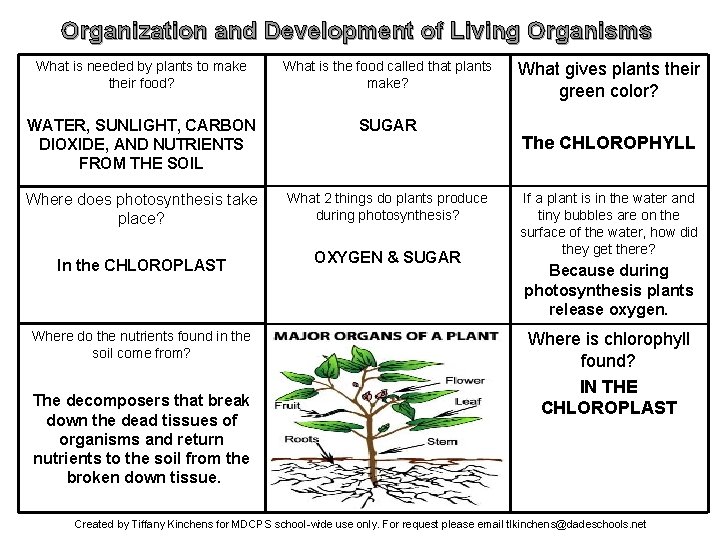
Organization and Development of Living Organisms What is needed by plants to make their food? What is the food called that plants make? WATER, SUNLIGHT, CARBON DIOXIDE, AND NUTRIENTS FROM THE SOIL SUGAR Where does photosynthesis take place? What 2 things do plants produce during photosynthesis? In the CHLOROPLAST Where do the nutrients found in the soil come from? The decomposers that break down the dead tissues of organisms and return nutrients to the soil from the broken down tissue. OXYGEN & SUGAR What gives plants their green color? The CHLOROPHYLL If a plant is in the water and tiny bubbles are on the surface of the water, how did they get there? Because during photosynthesis plants release oxygen. Where is chlorophyll found? IN THE CHLOROPLAST Created by Tiffany Kinchens for MDCPS school-wide use only. For request please email tlkinchens@dadeschools. net
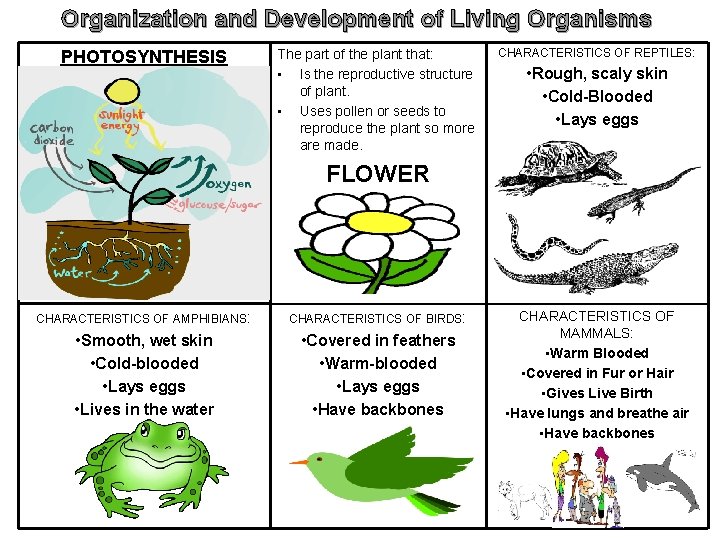
Organization and Development of Living Organisms PHOTOSYNTHESIS The part of the plant that: • Is the reproductive structure of plant. • Uses pollen or seeds to reproduce the plant so more are made. CHARACTERISTICS OF REPTILES: • Rough, scaly skin • Cold-Blooded • Lays eggs FLOWER CHARACTERISTICS OF AMPHIBIANS: CHARACTERISTICS OF BIRDS: • Smooth, wet skin • Cold-blooded • Lays eggs • Lives in the water • Covered in feathers • Warm-blooded • Lays eggs • Have backbones CHARACTERISTICS OF MAMMALS: • Warm Blooded • Covered in Fur or Hair • Gives Live Birth • Have lungs and breathe air • Have backbones
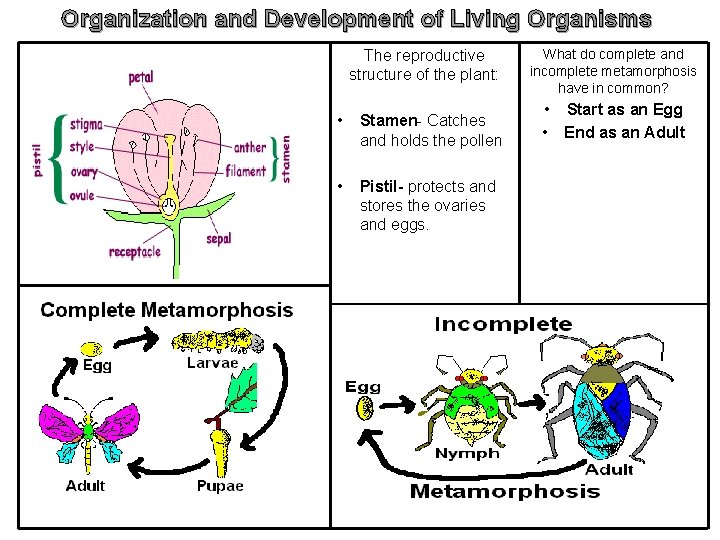
Organization and Development of Living Organisms The reproductive structure of the plant: • Stamen- Catches and holds the pollen • Pistil- protects and stores the ovaries and eggs. What do complete and incomplete metamorphosis have in common? • Start as an Egg • End as an Adult
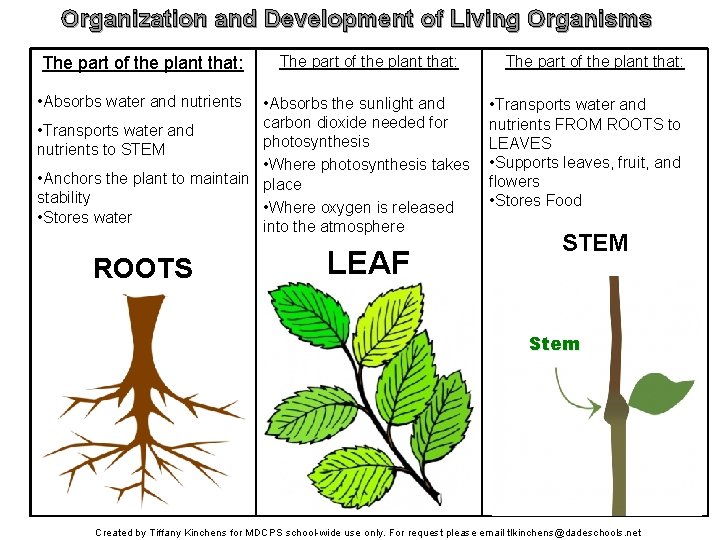
Organization and Development of Living Organisms The part of the plant that: • Absorbs water and nutrients • Absorbs the sunlight and carbon dioxide needed for • Transports water and photosynthesis nutrients to STEM • Where photosynthesis takes • Anchors the plant to maintain place stability • Where oxygen is released • Stores water into the atmosphere ROOTS LEAF The part of the plant that: • Transports water and nutrients FROM ROOTS to LEAVES • Supports leaves, fruit, and flowers • Stores Food STEM Stem Created by Tiffany Kinchens for MDCPS school-wide use only. For request please email tlkinchens@dadeschools. net
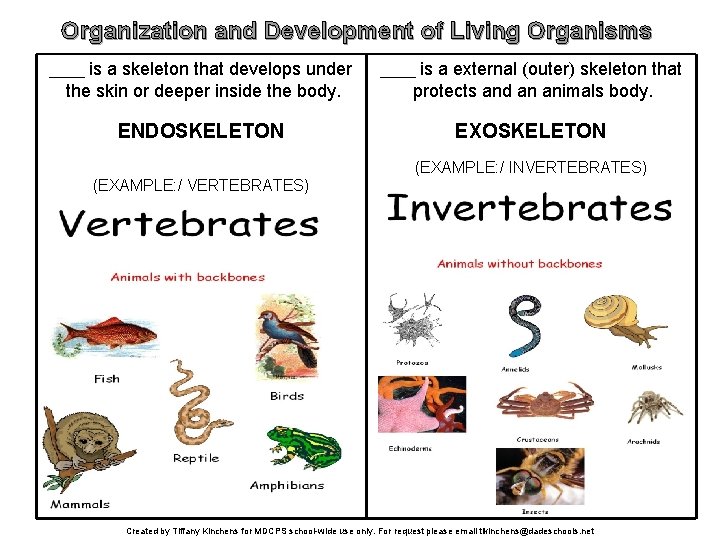
Organization and Development of Living Organisms ____ is a skeleton that develops under ____ is a external (outer) skeleton that the skin or deeper inside the body. protects and an animals body. ENDOSKELETON EXOSKELETON (EXAMPLE: / VERTEBRATES) (EXAMPLE: / INVERTEBRATES) Created by Tiffany Kinchens for MDCPS school-wide use only. For request please email tlkinchens@dadeschools. net
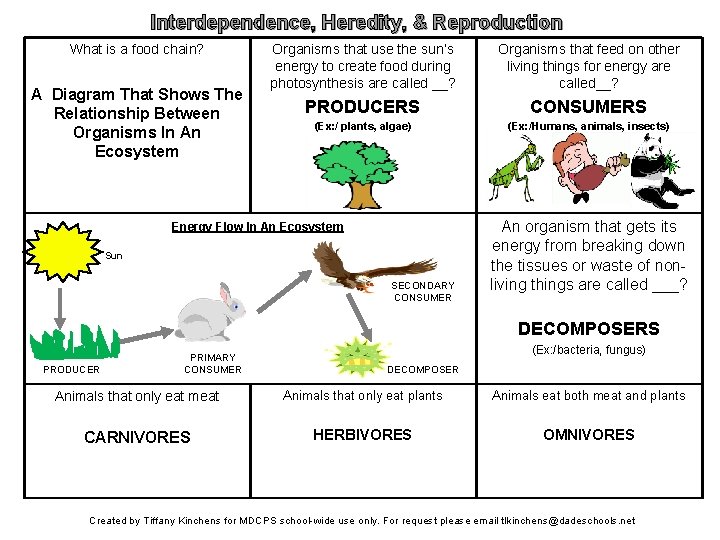
Interdependence, Heredity, & Reproduction What is a food chain? A Diagram That Shows The Relationship Between Organisms In An Ecosystem Organisms that use the sun’s energy to create food during photosynthesis are called __? Organisms that feed on other living things for energy are called__? PRODUCERS CONSUMERS (Ex: / plants, algae) (Ex: /Humans, animals, insects) Energy Flow In An Ecosystem Sun SECONDARY CONSUMER An organism that gets its energy from breaking down the tissues or waste of nonliving things are called ___? DECOMPOSERS PRODUCER PRIMARY CONSUMER (Ex: /bacteria, fungus) DECOMPOSER Animals that only eat meat Animals that only eat plants Animals eat both meat and plants CARNIVORES HERBIVORES OMNIVORES Created by Tiffany Kinchens for MDCPS school-wide use only. For request please email tlkinchens@dadeschools. net
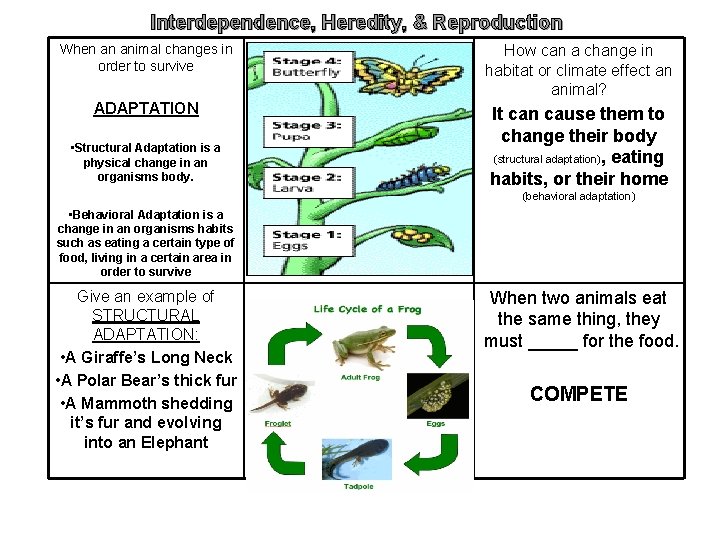
Interdependence, Heredity, & Reproduction When an animal changes in order to survive How can a change in habitat or climate effect an animal? ADAPTATION It can cause them to change their body (structural adaptation), eating habits, or their home • Structural Adaptation is a physical change in an organisms body. (behavioral adaptation) • Behavioral Adaptation is a change in an organisms habits such as eating a certain type of food, living in a certain area in order to survive Give an example of STRUCTURAL ADAPTATION: • A Giraffe’s Long Neck • A Polar Bear’s thick fur • A Mammoth shedding it’s fur and evolving into an Elephant When two animals eat the same thing, they must _____ for the food. COMPETE
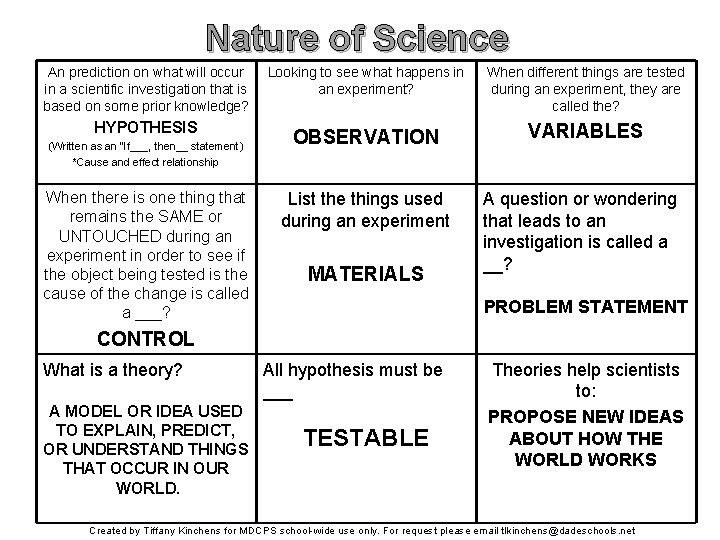
Nature of Science An prediction on what will occur in a scientific investigation that is based on some prior knowledge? HYPOTHESIS (Written as an “If___, then__ statement) *Cause and effect relationship When there is one thing that remains the SAME or UNTOUCHED during an experiment in order to see if the object being tested is the cause of the change is called a ___? Looking to see what happens in an experiment? When different things are tested during an experiment, they are called the? OBSERVATION VARIABLES List the things used during an experiment MATERIALS A question or wondering that leads to an investigation is called a __? PROBLEM STATEMENT CONTROL What is a theory? A MODEL OR IDEA USED TO EXPLAIN, PREDICT, OR UNDERSTAND THINGS THAT OCCUR IN OUR WORLD. All hypothesis must be ___ TESTABLE Theories help scientists to: PROPOSE NEW IDEAS ABOUT HOW THE WORLD WORKS Created by Tiffany Kinchens for MDCPS school-wide use only. For request please email tlkinchens@dadeschools. net
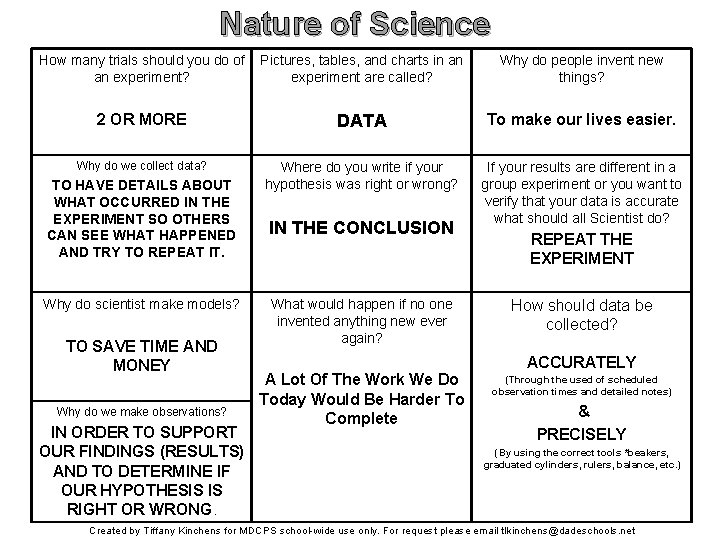
Nature of Science How many trials should you do of an experiment? Pictures, tables, and charts in an experiment are called? Why do people invent new things? 2 OR MORE DATA To make our lives easier. Why do we collect data? Where do you write if your hypothesis was right or wrong? If your results are different in a group experiment or you want to verify that your data is accurate what should all Scientist do? TO HAVE DETAILS ABOUT WHAT OCCURRED IN THE EXPERIMENT SO OTHERS CAN SEE WHAT HAPPENED AND TRY TO REPEAT IT. Why do scientist make models? TO SAVE TIME AND MONEY Why do we make observations? IN ORDER TO SUPPORT OUR FINDINGS (RESULTS) AND TO DETERMINE IF OUR HYPOTHESIS IS RIGHT OR WRONG. IN THE CONCLUSION What would happen if no one invented anything new ever again? A Lot Of The Work We Do Today Would Be Harder To Complete REPEAT THE EXPERIMENT How should data be collected? ACCURATELY (Through the used of scheduled observation times and detailed notes) & PRECISELY (By using the correct tools *beakers, graduated cylinders, rulers, balance, etc. ) Created by Tiffany Kinchens for MDCPS school-wide use only. For request please email tlkinchens@dadeschools. net