
Properties of Logarithms Section 3 3 Since logs
- Slides: 10
Properties of Logarithms Section 3. 3
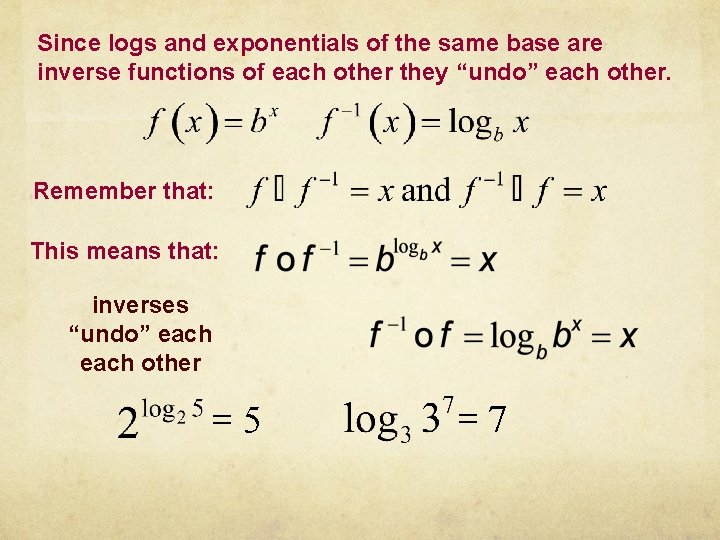
Since logs and exponentials of the same base are inverse functions of each other they “undo” each other. Remember that: This means that: inverses “undo” each other =5 =7
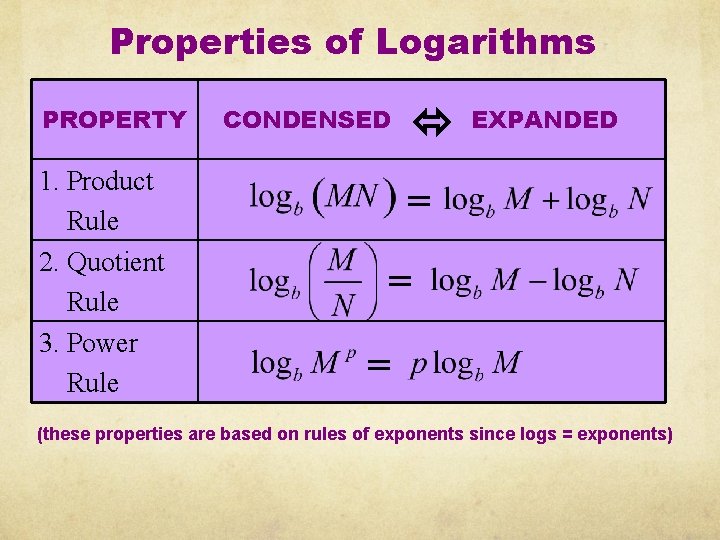
Properties of Logarithms PROPERTY 1. Product Rule 2. Quotient Rule 3. Power Rule CONDENSED EXPANDED = = = (these properties are based on rules of exponents since logs = exponents)
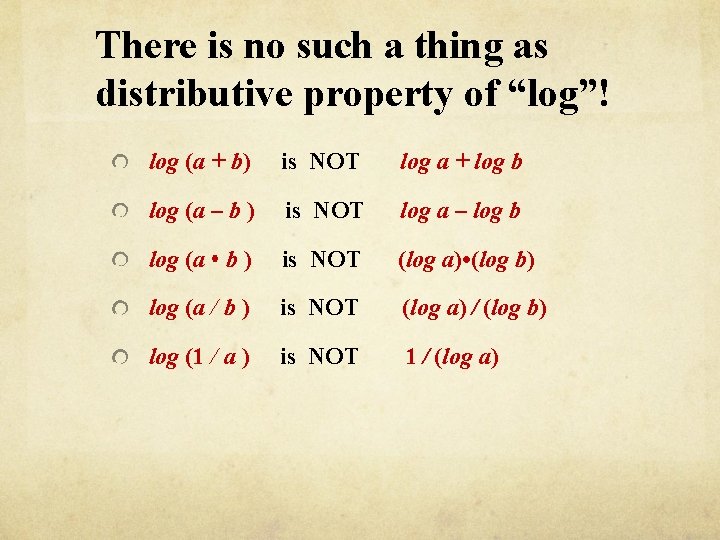
There is no such a thing as distributive property of “log”! log (a + b) is NOT log a + log b log (a – b ) is NOT log a – log b log (a • b ) is NOT (log a) • (log b) log (a / b ) is NOT (log a) ⁄ (log b) log (1 / a ) is NOT 1 ⁄ (log a)
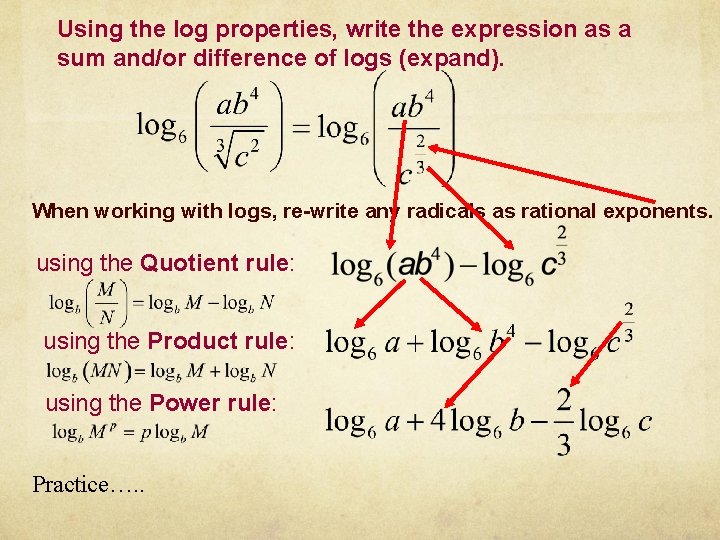
Using the log properties, write the expression as a sum and/or difference of logs (expand). When working with logs, re-write any radicals as rational exponents. using the Quotient rule: using the Product rule: using the Power rule: Practice…. .
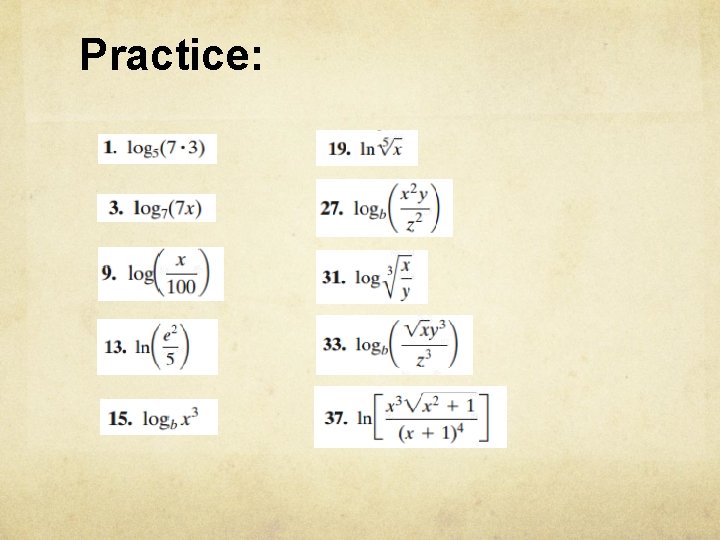
Practice:
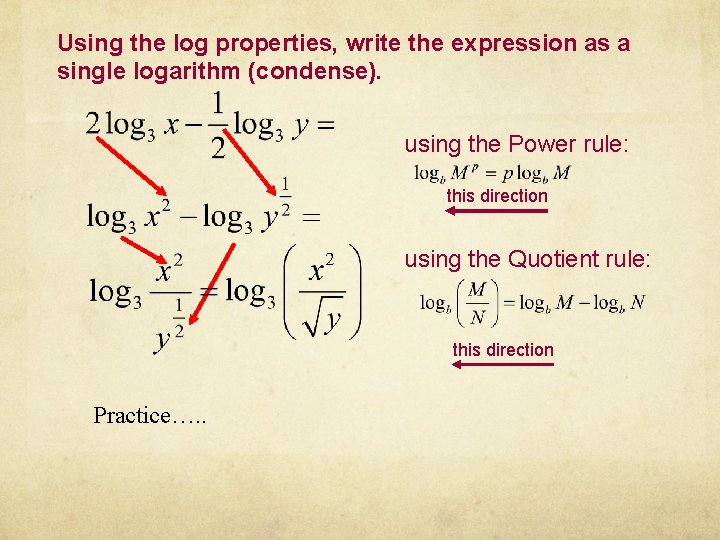
Using the log properties, write the expression as a single logarithm (condense). using the Power rule: this direction using the Quotient rule: this direction Practice…. .
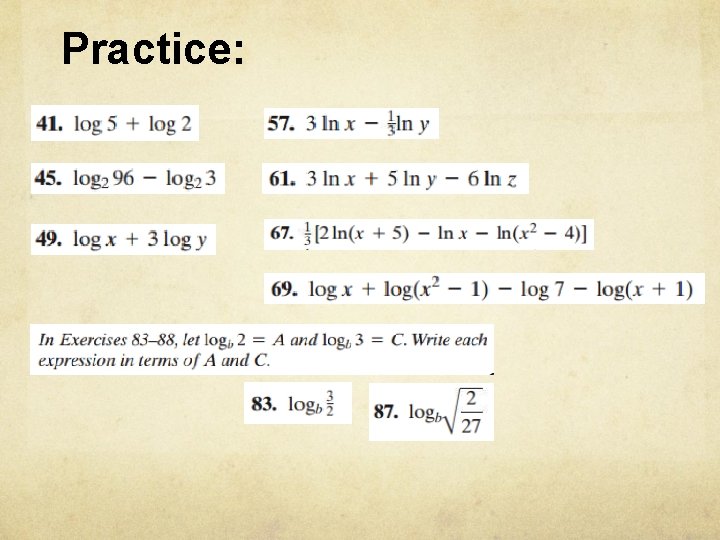
Practice:
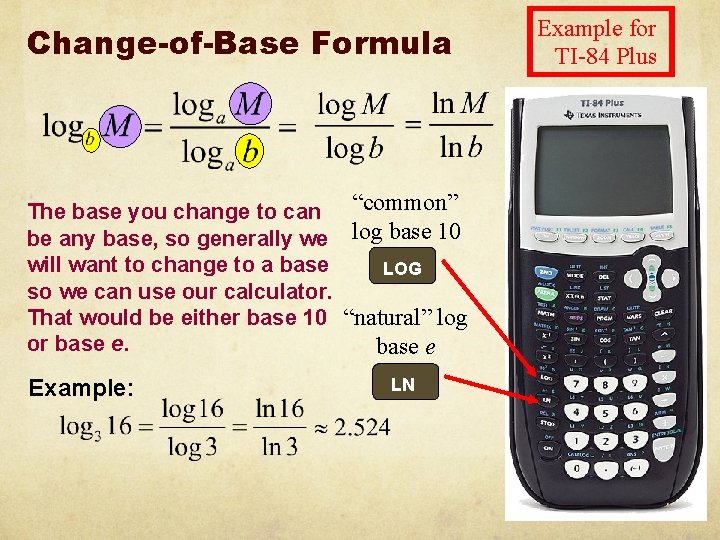
Change-of-Base Formula The base you change to can “common” be any base, so generally we log base 10 will want to change to a base LOG so we can use our calculator. That would be either base 10 “natural” log or base e Example: LN Example for TI-84 Plus
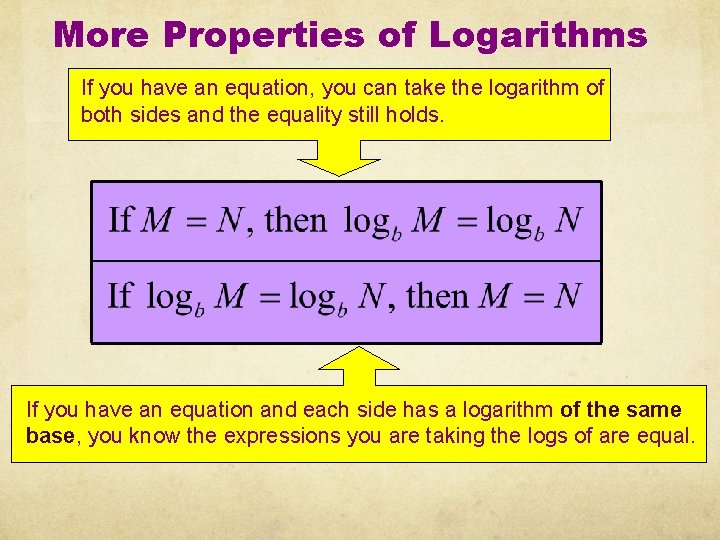
More Properties of Logarithms If you have an equation, you can take the logarithm of both sides and the equality still holds. If you have an equation and each side has a logarithm of the same base, you know the expressions you are taking the logs of are equal.