
Properties of Liquids and Solids Ch 11 Inter

- Slides: 34
Properties of Liquids and Solids (Ch. 11) Inter vs. Intramolecular Forces Intra ≈ strong forces within molecules (covalent or ionic bonds) (related to chemical reactivity of the substance) Inter ≈ weaker forces between molecules (determine the bulk physical properties of a substance) Coulomb’s Law—electrostatic repulsion of like charges is proportional to the amount of charge, and inversely proportional to the distance between them
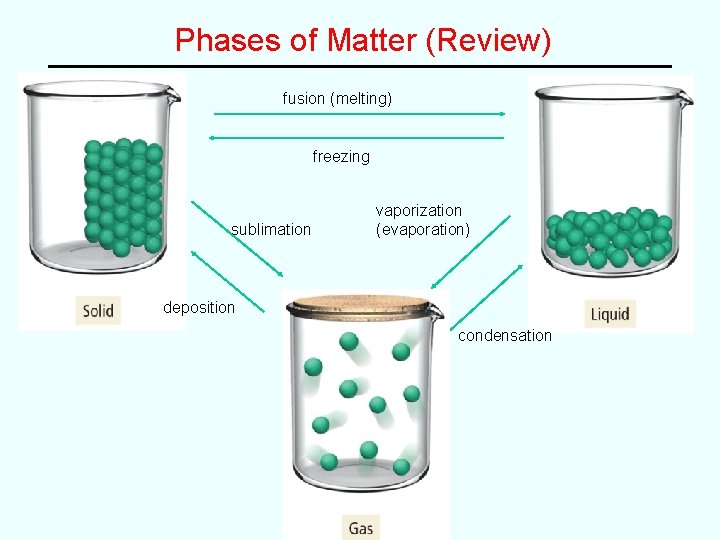
Phases of Matter (Review) fusion (melting) freezing sublimation vaporization (evaporation) deposition condensation
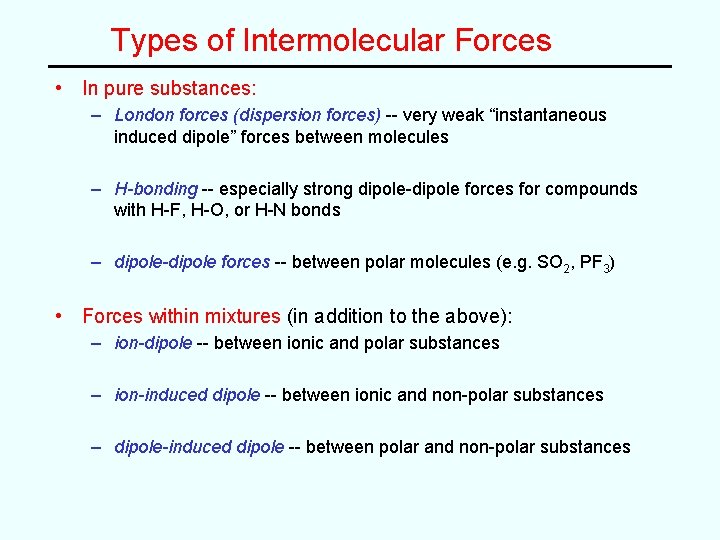
Types of Intermolecular Forces • In pure substances: – London forces (dispersion forces) -- very weak “instantaneous induced dipole” forces between molecules – H-bonding -- especially strong dipole-dipole forces for compounds with H-F, H-O, or H-N bonds – dipole-dipole forces -- between polar molecules (e. g. SO 2, PF 3) • Forces within mixtures (in addition to the above): – ion-dipole -- between ionic and polar substances – ion-induced dipole -- between ionic and non-polar substances – dipole-induced dipole -- between polar and non-polar substances
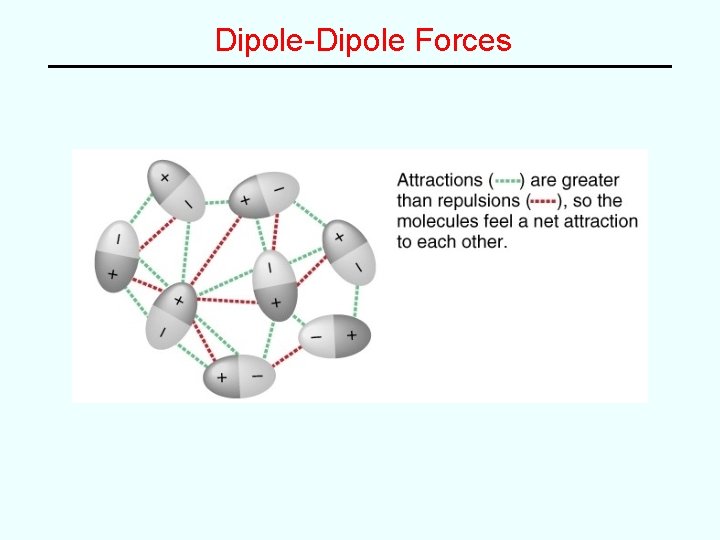
Dipole-Dipole Forces
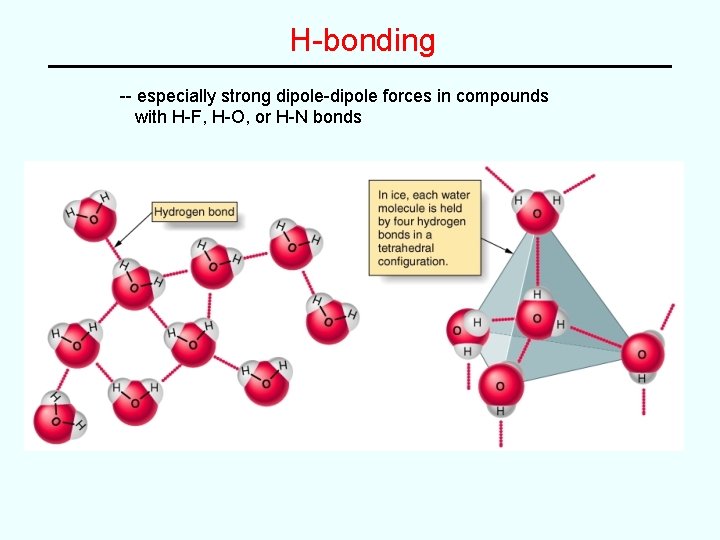
H-bonding -- especially strong dipole-dipole forces in compounds with H-F, H-O, or H-N bonds
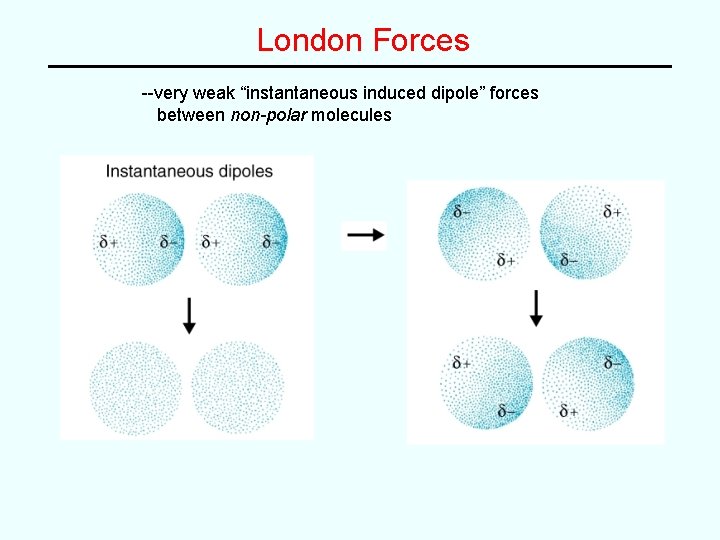
London Forces --very weak “instantaneous induced dipole” forces between non-polar molecules
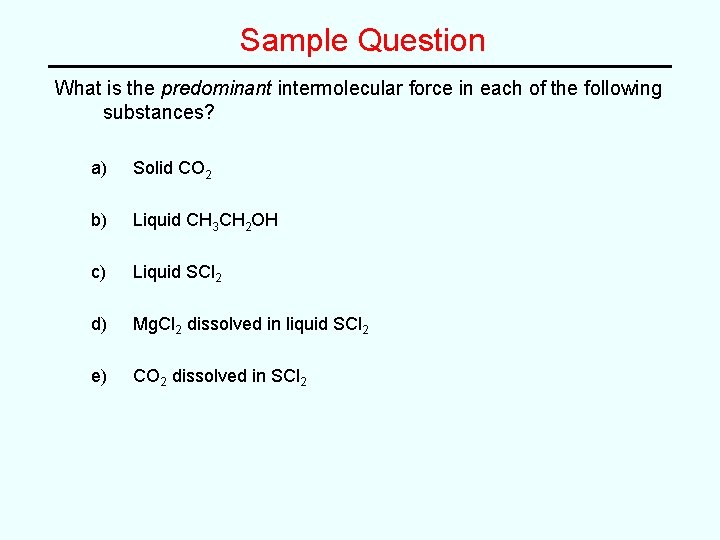
Sample Question What is the predominant intermolecular force in each of the following substances? a) Solid CO 2 b) Liquid CH 3 CH 2 OH c) Liquid SCl 2 d) Mg. Cl 2 dissolved in liquid SCl 2 e) CO 2 dissolved in SCl 2
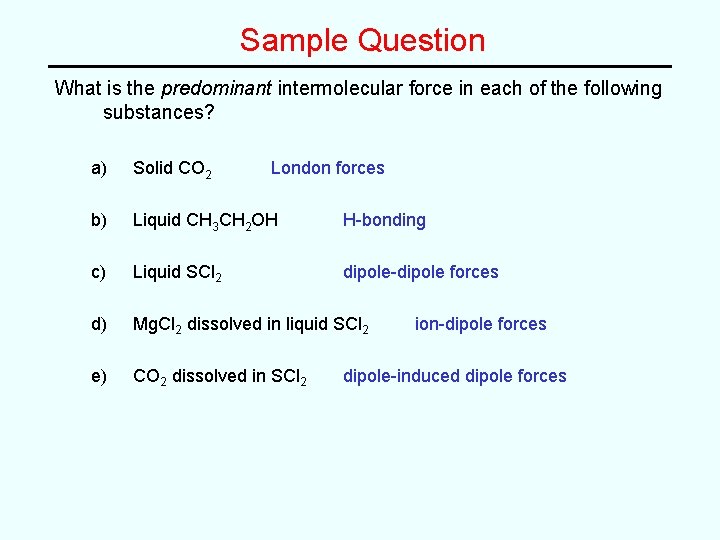
Sample Question What is the predominant intermolecular force in each of the following substances? a) Solid CO 2 b) Liquid CH 3 CH 2 OH H-bonding c) Liquid SCl 2 dipole-dipole forces d) Mg. Cl 2 dissolved in liquid SCl 2 e) CO 2 dissolved in SCl 2 London forces ion-dipole forces dipole-induced dipole forces
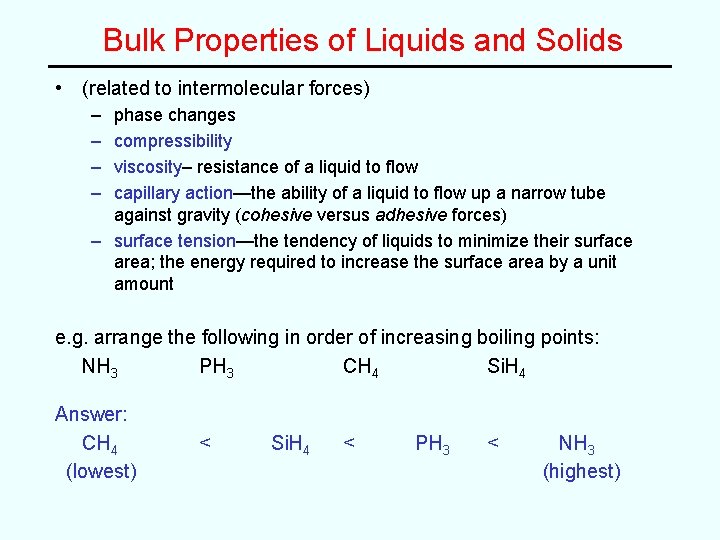
Bulk Properties of Liquids and Solids • (related to intermolecular forces) – – phase changes compressibility viscosity– resistance of a liquid to flow capillary action—the ability of a liquid to flow up a narrow tube against gravity (cohesive versus adhesive forces) – surface tension—the tendency of liquids to minimize their surface area; the energy required to increase the surface area by a unit amount e. g. arrange the following in order of increasing boiling points: NH 3 PH 3 CH 4 Si. H 4 Answer: CH 4 (lowest) < Si. H 4 < PH 3 < NH 3 (highest)
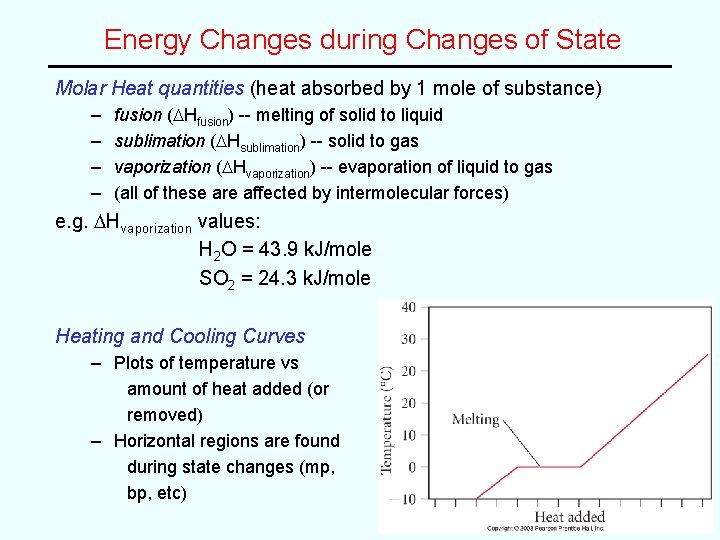
Energy Changes during Changes of State Molar Heat quantities (heat absorbed by 1 mole of substance) – – fusion (DHfusion) -- melting of solid to liquid sublimation (DHsublimation) -- solid to gas vaporization (DHvaporization) -- evaporation of liquid to gas (all of these are affected by intermolecular forces) e. g. DHvaporization values: H 2 O = 43. 9 k. J/mole SO 2 = 24. 3 k. J/mole Heating and Cooling Curves – Plots of temperature vs amount of heat added (or removed) – Horizontal regions are found during state changes (mp, bp, etc)
Vaporization/Vapor Pressure (pressure due to gas above surface of liquid) – Determined by strength of intermolecular forces – Related to surface tension – Volatile vs. nonvolatile boiling point -- temp at which vapor pressure = atmospheric pressure normal boiling point -- temp at which vapor pressure = 1 atm • Rate of Vaporization – Increases with temp – Increases with increased surface area – Increases with weaker intermolecular forces • Heat of Vaporization (DHvap) – Only slightly temperature-dependent – Decreases with weaker intermolecular forces – Not dependent on surface area
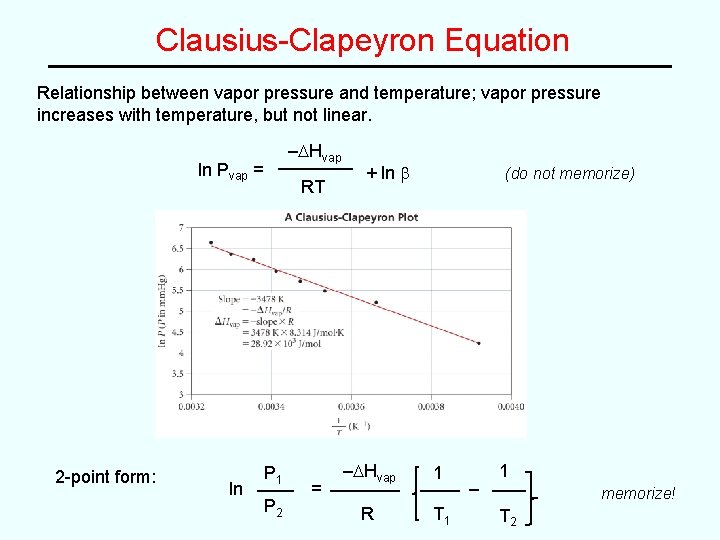
Clausius-Clapeyron Equation Relationship between vapor pressure and temperature; vapor pressure increases with temperature, but not linear. –DHvap ln Pvap = 2 -point form: ln RT P 1 P 2 = + ln b –DHvap R (do not memorize) 1 T 1 – 1 memorize! T 2
Changes of State Dynamic Equilibrium – Changes of state (e. g. evaporation/condensation) involve process of dynamic equilibrium: Liquid Gas at equilibrium: forward rate = reverse rate (no net change with time) (e. g. rate of evaporation = rate of condensation)
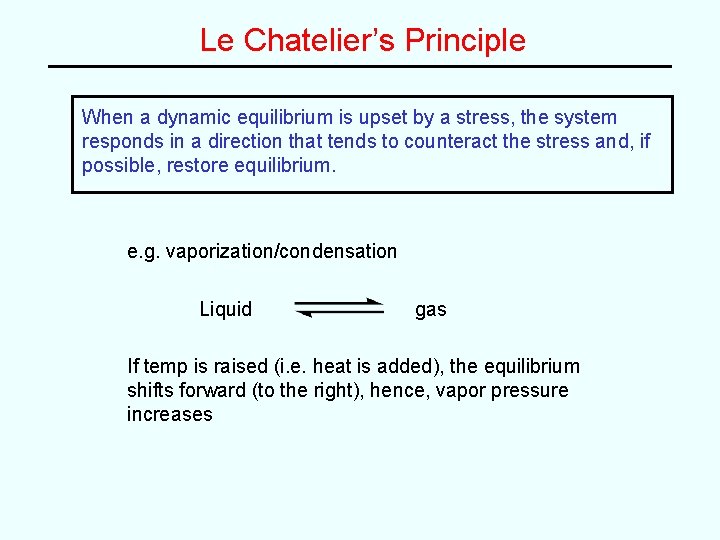
Le Chatelier’s Principle When a dynamic equilibrium is upset by a stress, the system responds in a direction that tends to counteract the stress and, if possible, restore equilibrium. e. g. vaporization/condensation Liquid gas If temp is raised (i. e. heat is added), the equilibrium shifts forward (to the right), hence, vapor pressure increases
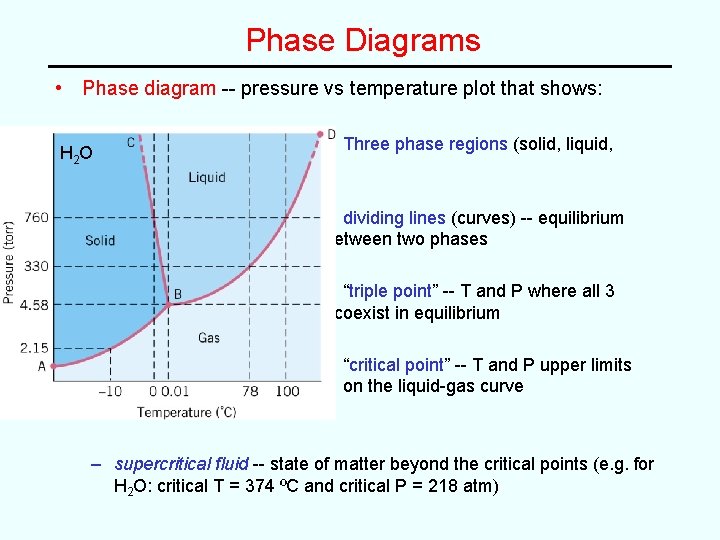
Phase Diagrams • Phase diagram -- pressure vs temperature plot that shows: H 2 O Three phase regions (solid, liquid, gas) dividing lines (curves) -- equilibrium points between two phases “triple point” -- T and P where all 3 phases coexist in equilibrium “critical point” -- T and P upper limits on the liquid-gas curve – supercritical fluid -- state of matter beyond the critical points (e. g. for H 2 O: critical T = 374 ºC and critical P = 218 atm)
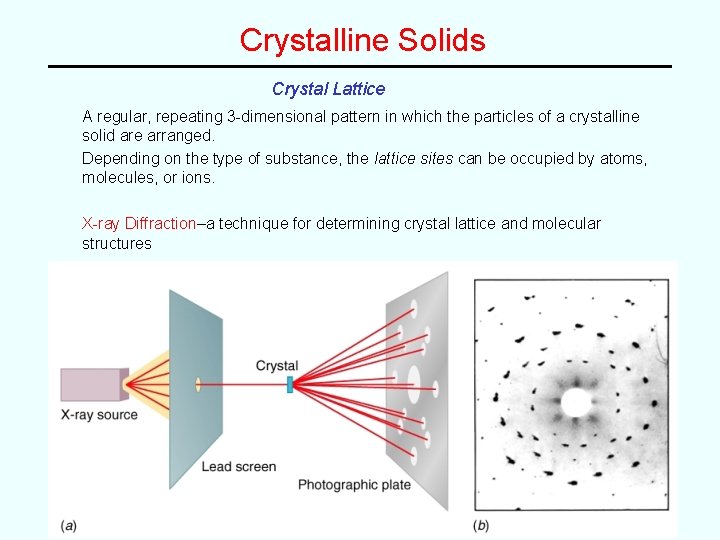
Crystalline Solids Crystal Lattice A regular, repeating 3 -dimensional pattern in which the particles of a crystalline solid are arranged. Depending on the type of substance, the lattice sites can be occupied by atoms, molecules, or ions. X-ray Diffraction–a technique for determining crystal lattice and molecular structures
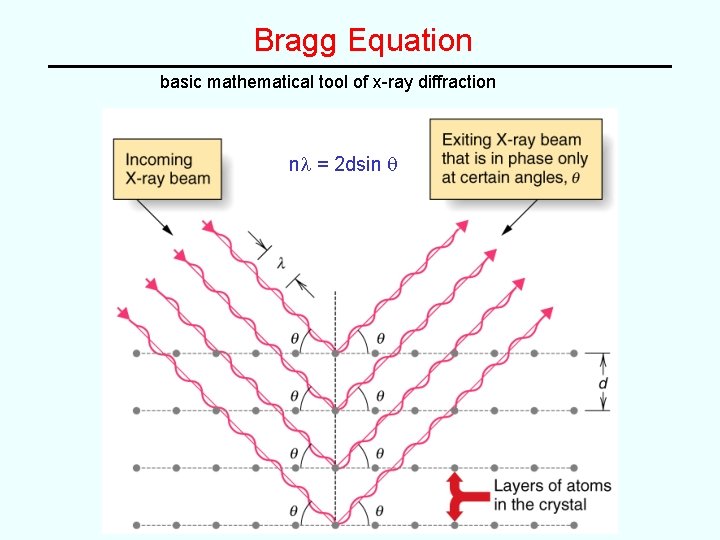
Bragg Equation basic mathematical tool of x-ray diffraction nl = 2 dsin q
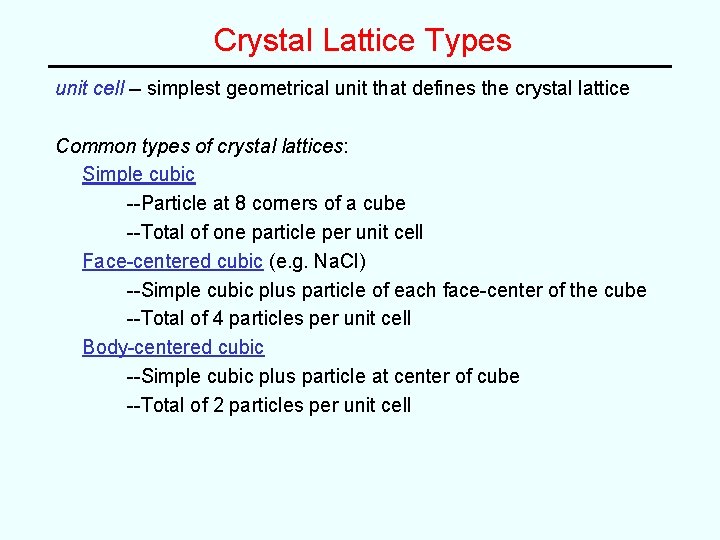
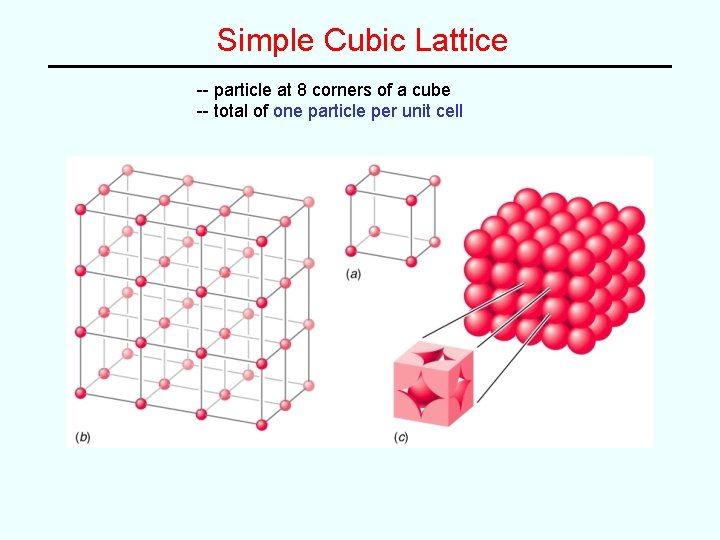
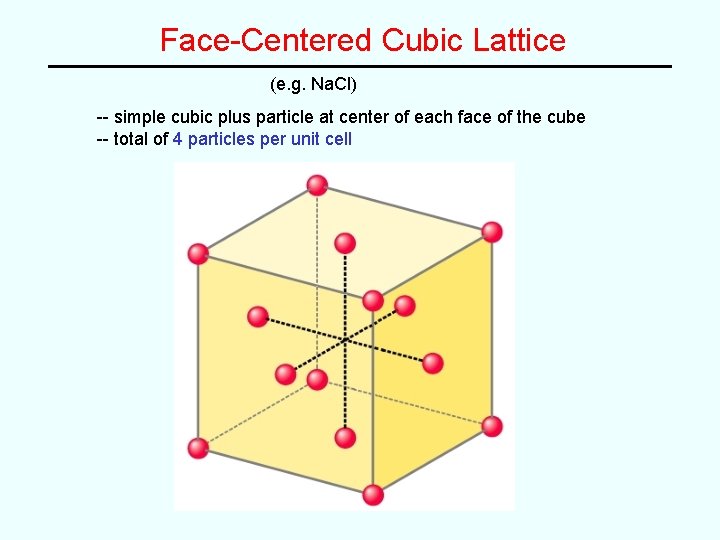
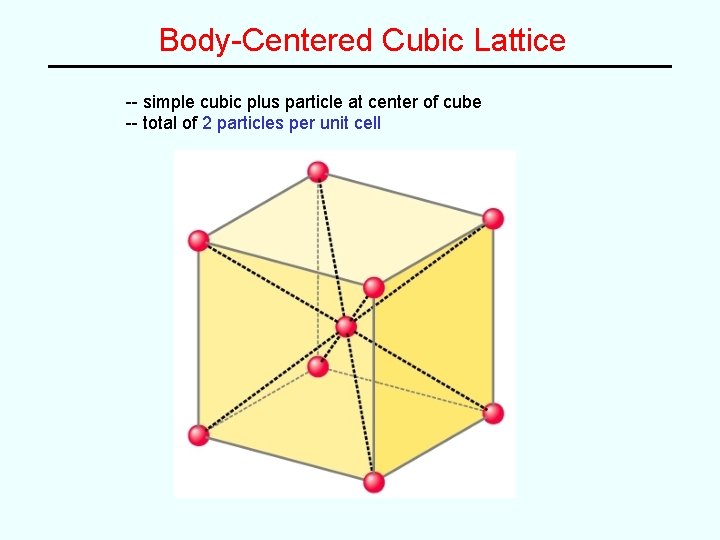
Crystal Lattice Types unit cell -- simplest geometrical unit that defines the crystal lattice Common types of crystal lattices: Simple cubic --Particle at 8 corners of a cube --Total of one particle per unit cell Face-centered cubic (e. g. Na. Cl) --Simple cubic plus particle of each face-center of the cube --Total of 4 particles per unit cell Body-centered cubic --Simple cubic plus particle at center of cube --Total of 2 particles per unit cell
Simple Cubic Lattice -- particle at 8 corners of a cube -- total of one particle per unit cell
Face-Centered Cubic Lattice (e. g. Na. Cl) -- simple cubic plus particle at center of each face of the cube -- total of 4 particles per unit cell
Body-Centered Cubic Lattice -- simple cubic plus particle at center of cube -- total of 2 particles per unit cell
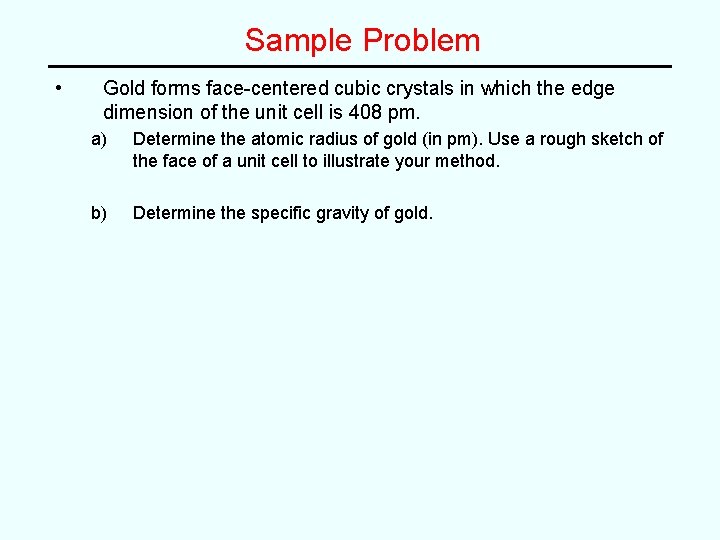
Sample Problem • Gold forms face-centered cubic crystals in which the edge dimension of the unit cell is 408 pm. a) Determine the atomic radius of gold (in pm). Use a rough sketch of the face of a unit cell to illustrate your method. b) Determine the specific gravity of gold.
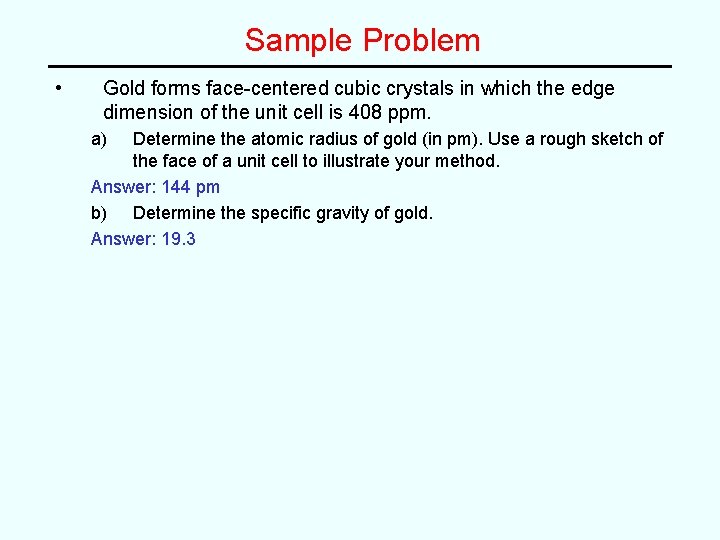
Sample Problem • Gold forms face-centered cubic crystals in which the edge dimension of the unit cell is 408 ppm. a) Determine the atomic radius of gold (in pm). Use a rough sketch of the face of a unit cell to illustrate your method. Answer: 144 pm b) Determine the specific gravity of gold. Answer: 19. 3
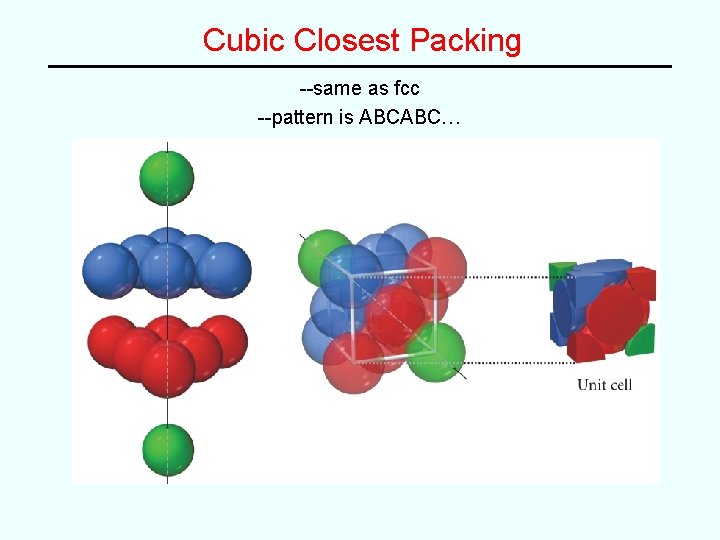
Closest-Packed Structures • Common for metals Common types of closest-packing: hexagonal closest packing (hcp) --hexagonal unit cell, not cubic --Layers have ABAB pattern Cubic closest packing (ccp) --same as face-centered cubic! (fcc) --Layers have ABCABC pattern
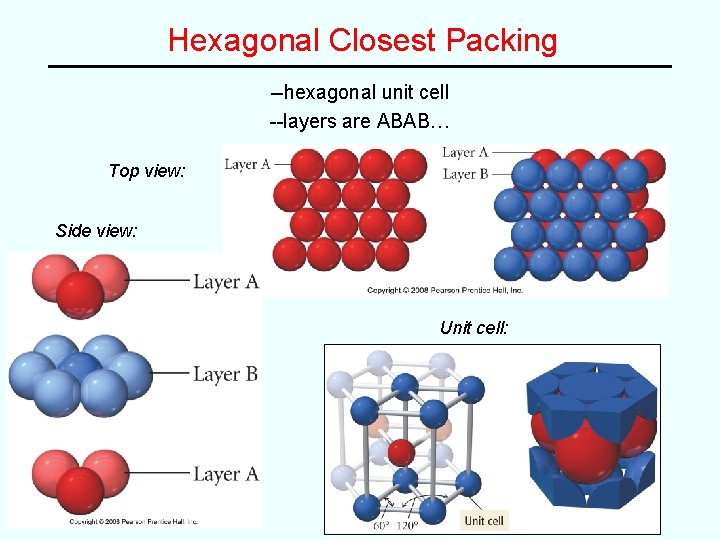
Hexagonal Closest Packing --hexagonal unit cell --layers are ABAB… Top view: Side view: Unit cell:
Cubic Closest Packing --same as fcc --pattern is ABCABC…
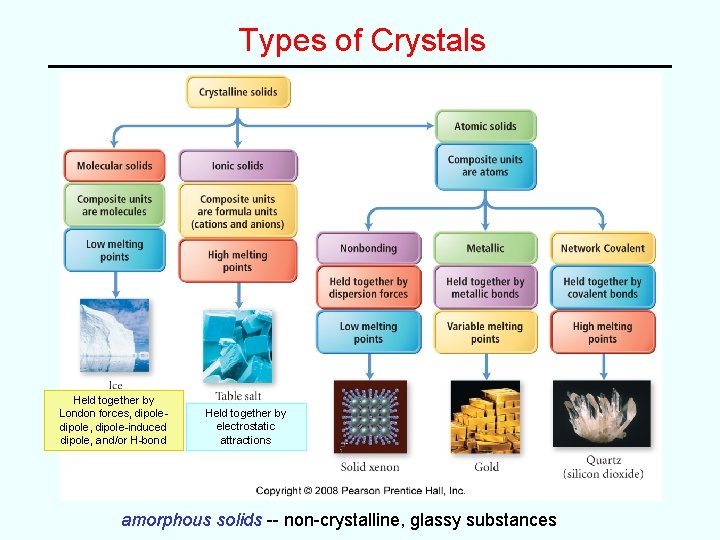
Types of Crystals Held together by London forces, dipole, dipole-induced dipole, and/or H-bond Held together by electrostatic attractions amorphous solids -- non-crystalline, glassy substances
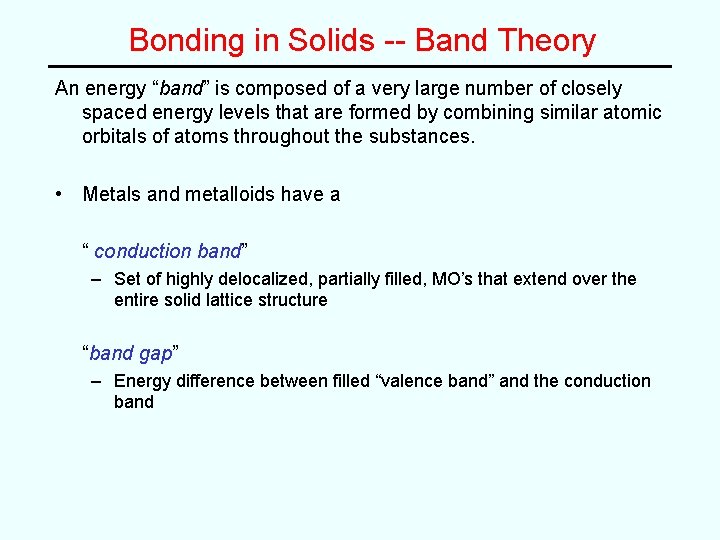
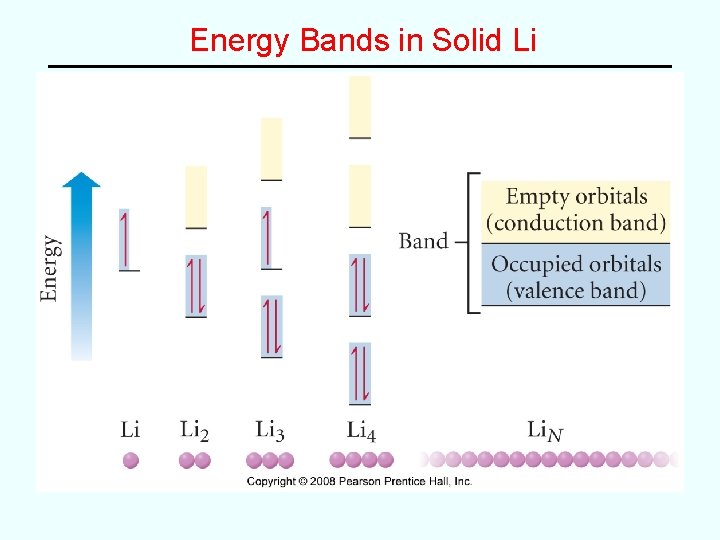
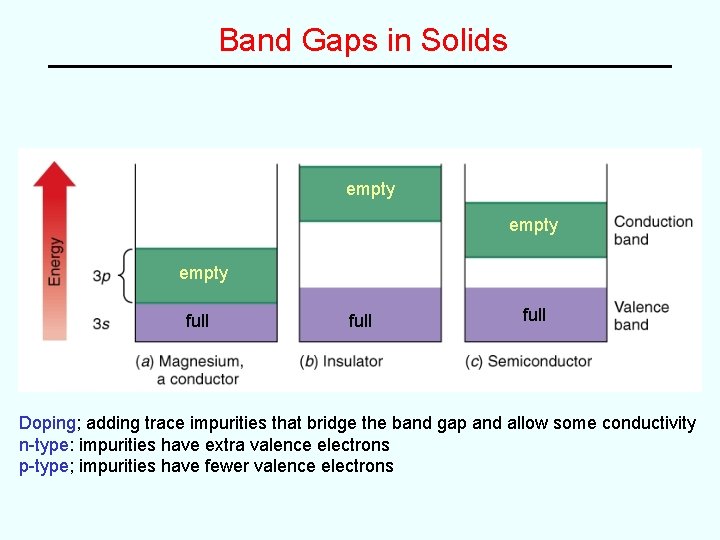
Bonding in Solids -- Band Theory An energy “band” is composed of a very large number of closely spaced energy levels that are formed by combining similar atomic orbitals of atoms throughout the substances. • Metals and metalloids have a “ conduction band” – Set of highly delocalized, partially filled, MO’s that extend over the entire solid lattice structure “band gap” – Energy difference between filled “valence band” and the conduction band
Energy Bands in Solid Li
Band Gaps in Solids empty full Doping; adding trace impurities that bridge the band gap and allow some conductivity n-type: impurities have extra valence electrons p-type; impurities have fewer valence electrons
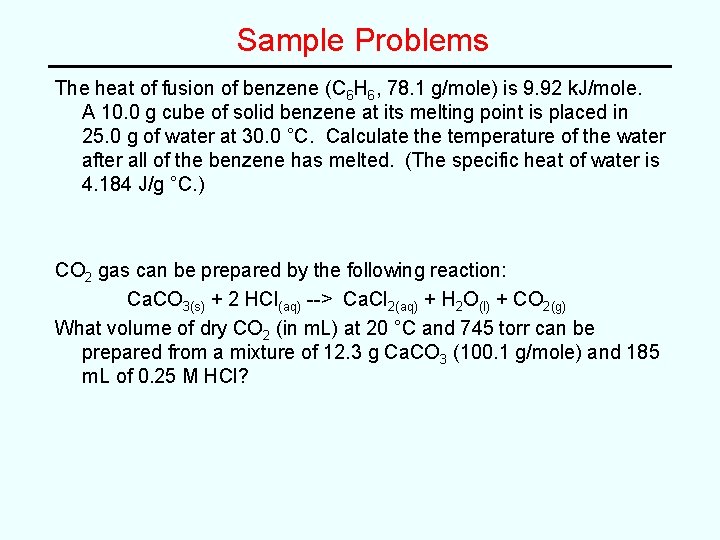
Sample Problems The heat of fusion of benzene (C 6 H 6, 78. 1 g/mole) is 9. 92 k. J/mole. A 10. 0 g cube of solid benzene at its melting point is placed in 25. 0 g of water at 30. 0 °C. Calculate the temperature of the water after all of the benzene has melted. (The specific heat of water is 4. 184 J/g °C. ) CO 2 gas can be prepared by the following reaction: Ca. CO 3(s) + 2 HCl(aq) --> Ca. Cl 2(aq) + H 2 O(l) + CO 2(g) What volume of dry CO 2 (in m. L) at 20 °C and 745 torr can be prepared from a mixture of 12. 3 g Ca. CO 3 (100. 1 g/mole) and 185 m. L of 0. 25 M HCl?
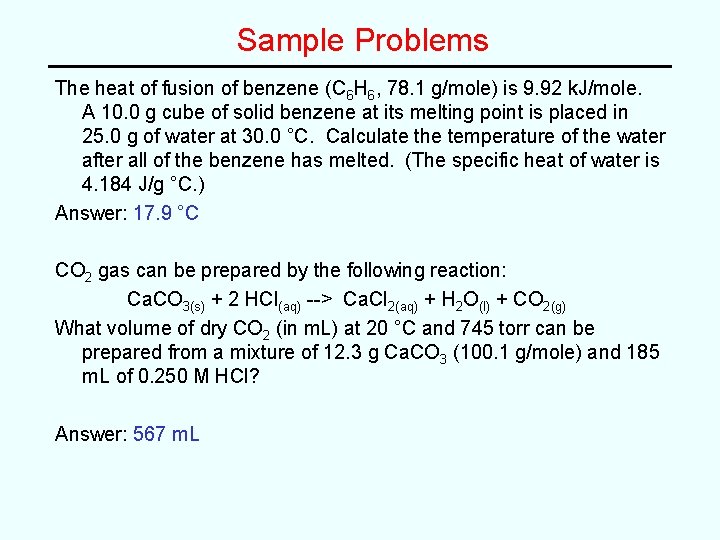
Sample Problems The heat of fusion of benzene (C 6 H 6, 78. 1 g/mole) is 9. 92 k. J/mole. A 10. 0 g cube of solid benzene at its melting point is placed in 25. 0 g of water at 30. 0 °C. Calculate the temperature of the water after all of the benzene has melted. (The specific heat of water is 4. 184 J/g °C. ) Answer: 17. 9 °C CO 2 gas can be prepared by the following reaction: Ca. CO 3(s) + 2 HCl(aq) --> Ca. Cl 2(aq) + H 2 O(l) + CO 2(g) What volume of dry CO 2 (in m. L) at 20 °C and 745 torr can be prepared from a mixture of 12. 3 g Ca. CO 3 (100. 1 g/mole) and 185 m. L of 0. 250 M HCl? Answer: 567 m. L
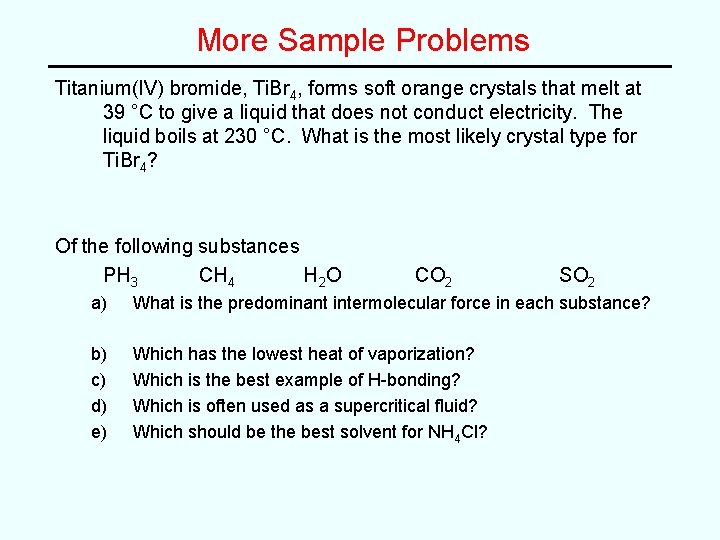
More Sample Problems Titanium(IV) bromide, Ti. Br 4, forms soft orange crystals that melt at 39 °C to give a liquid that does not conduct electricity. The liquid boils at 230 °C. What is the most likely crystal type for Ti. Br 4? Of the following substances PH 3 CH 4 H 2 O CO 2 SO 2 a) What is the predominant intermolecular force in each substance? b) c) d) e) Which has the lowest heat of vaporization? Which is the best example of H-bonding? Which is often used as a supercritical fluid? Which should be the best solvent for NH 4 Cl?
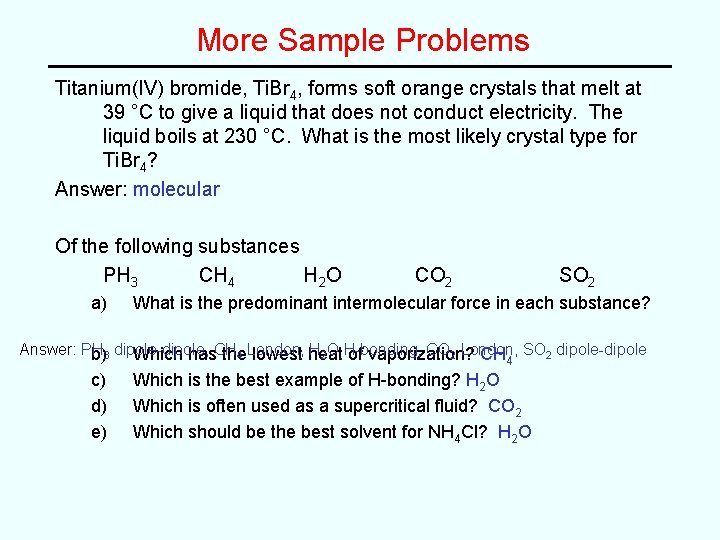
More Sample Problems Titanium(IV) bromide, Ti. Br 4, forms soft orange crystals that melt at 39 °C to give a liquid that does not conduct electricity. The liquid boils at 230 °C. What is the most likely crystal type for Ti. Br 4? Answer: molecular Of the following substances PH 3 CH 4 H 2 O a) CO 2 SO 2 What is the predominant intermolecular force in each substance? Answer: PH H 2 O H-bonding, CO 2 London, 4 London, b)3 dipole-dipole, Which has. CH the lowest heat of vaporization? CH SO 2 dipole-dipole 4 c) d) e) Which is the best example of H-bonding? H 2 O Which is often used as a supercritical fluid? CO 2 Which should be the best solvent for NH 4 Cl? H 2 O